
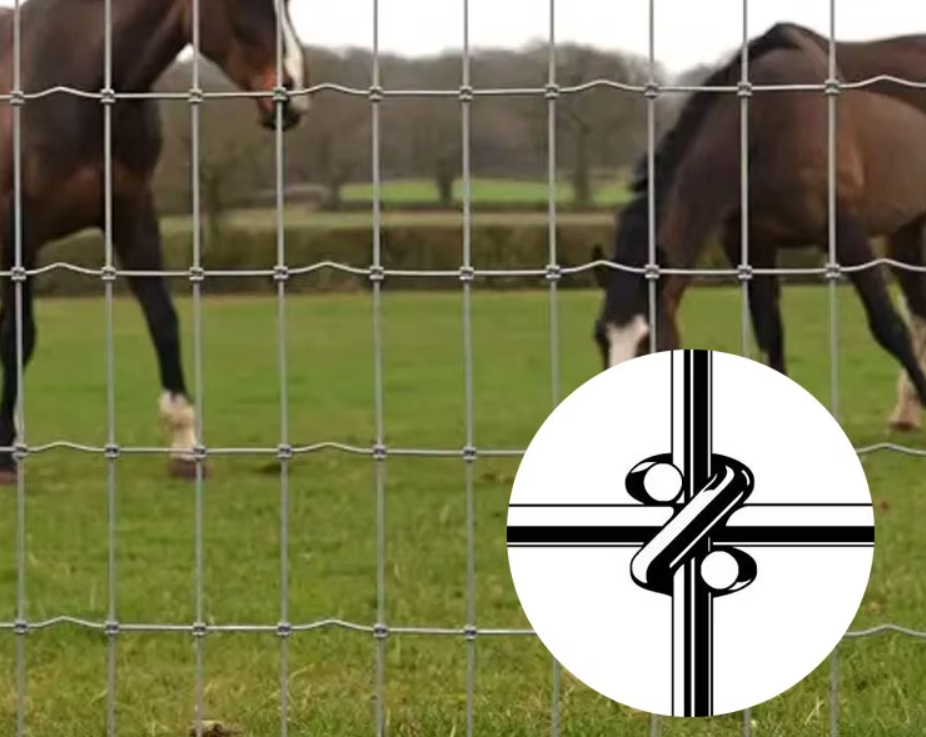
S knot fence wire is a woven wire fencing system that uses an S-shaped knot to securely connect horizontal line wires to solid vertical stay wires.
S knot fence wire, also known as square deal knot or square knot fencing, represents a proven solution for livestock containment that balances strength, flexibility, and animal safety. As one of the three primary woven cattle fence wire knot configurations, S knot construction uses a separate piece of wire to attach horizontal line wires to solid vertical stay wires, forming a distinctive S-shaped connection that delivers exceptional rigidity while maintaining terrain adaptability.
Unlike traditional welded mesh fencing where welding spots can break under pressure, S knot fence wire provides continuous structural integrity through its knotted design. The knot’s smooth, compact profile eliminates sharp edges that could scratch or injure livestock, making it particularly suitable for horses, sheep, goats, and cattle operations where animal welfare is paramount.
Product Specifications
| Item | Specification |
|---|---|
| Product Name | S Knot Cattle Fence Wire (Square Deal Knot Fence) |
| Knot Type | S Knot (Square Deal Knot) |
| Material | Low carbon steel wire / High tensile steel wire |
| Surface Treatment | Hot-dipped galvanized |
| Line Wire Diameter | 2.5 mm (10 ga) / 2.0 mm (12.5 ga) |
| Stay Wire Diameter | 2.0 mm (12.5 ga) / 1.8 mm (14 ga) |
| Stay Wire Type | Solid one-piece vertical stay wire |
| Fence Height | 800 – 2000 mm (32 – 78 inches) |
| Vertical Stay Spacing | 100 mm (4 inch) / 150 mm (6 inch) |
| Horizontal Line Spacing | 100 mm x 100 mm (4″ x 4″) for sheep/goat 50 mm x 100 mm (2″ x 4″) for horses |
| Roll Length | 50 m / 100 m / 200 m |
| Tensile Strength | Standard Tensile: 400 – 600 MPa High Tensile: 1000 – 1400 MPa |
| Zinc Coating | Class 1: 60 – 80 g/m² (8-12 years lifespan) Class 3: 230 – 275 g/m² (20-30 years lifespan) |
| Weight per Roll | 18 – 70 kg (depending on height and length) |
All specifications can be customized according to your requirements. For detailed technical parameters across different cattle fence wire specifications, consult our specification guide.
Zinc Coating Options
| Zinc Coating Type | Zinc Weight | Lifespan | Price Level | Best For |
|---|---|---|---|---|
| Class 1 (Standard) | 60 – 80 g/m² | 8 – 12 years | Economy | Temporary fencing, dry climates, budget projects |
| Class 3 (Premium) | 230 – 275 g/m² | 20 – 30 years | Recommended | Permanent installations, humid climates, coastal areas |
The hot-dipped galvanization process creates a metallurgical bond between zinc and steel, providing sacrificial corrosion protection. Class 3 galvanized S knot fence wire offers 2.5 to 3 times the service life of Class 1 coating, making it the industry standard for permanent livestock fencing. In humid climates, Class 3 galvanization can add 5 to 10 years of service life before rust appears.
S Knot Structure Advantage
Square Deal Knot Design
The S knot, also called the square deal knot, utilizes a small separate wire that wraps around both the horizontal line wire and the solid vertical stay wire at each intersection. This creates a compact, S-shaped connection that firmly grips both wires, preventing slippage and maintaining fence integrity under livestock pressure.
Solid Vertical Stay Wire
Unlike hinge joint knot fencing which uses wrapped individual stay wires, S knot construction features continuous solid vertical stay wires. This one-piece design provides superior vertical strength, allowing the fence to stand unsupported even before installation tensioning. The solid stay prevents the vertical wires from being forced apart by animals attempting to push through.
Key Benefits
- Rigid Yet Flexible Structure: The S knot creates a firm mesh that resists buckling and sagging while maintaining flexibility for uneven terrain installation
- Smooth, Animal-Safe Surface: The compact knot design has no protruding wire ends or sharp edges, protecting animal hides, wool, and coats from scratching or tearing
- Vertical Wire Stability: Solid stay wires prevent horizontal displacement, maintaining consistent mesh spacing even under pressure
- Fewer Posts Required: The rigid structure allows post spacing of 20-30 feet, reducing material and labor costs compared to traditional field fence
- Enhanced Terrain Conformity: Deep line wire crimps (tension curves) allow the fence to adjust to hills and valleys while maintaining structural integrity
- Superior to Welded Mesh: Knotted construction prevents catastrophic failure; if one wire breaks, the fence maintains functionality unlike welded mesh where broken welds create openings
Comparison with Other Knot Technologies
S knot fence wire occupies a middle position between hinge joint knot and fixed knot fencing in terms of strength and rigidity. The solid vertical stay provides more vertical strength than hinge joint designs, where vertical wires can be forced apart. However, S knot is less rigid than fixed knot construction, making it more suitable for applications where extreme impact resistance is not required but superior performance over traditional field fence is desired.
Application Scenarios
S knot cattle fence wire delivers optimal performance across diverse livestock and property protection applications:
Primary Applications
- Horse Fencing: The smooth knot surface and 2″ x 4″ mesh spacing prevents hoof entrapment and hide damage, making S knot the preferred choice for non-climb horse fence applications
- Sheep and Goat Enclosures: 4″ x 4″ mesh spacing prevents head entrapment and horn catching while deterring predators; the smooth knot protects valuable wool from snagging
- Cattle Containment: Provides adequate strength for cattle operations, particularly in low to medium pressure areas such as interior pasture divisions
- Mixed Livestock Operations: Versatile design accommodates multiple species including pigs, poultry, and various livestock combinations
- Uneven Terrain Fencing: Excellent performance on hilly land, rolling terrain, and sloped pastures where fence flexibility is essential
- Farm and Ranch Perimeter: Cost-effective boundary fencing that provides security without the expense of fixed knot systems
- Highway and Railway Protection: Prevents livestock from wandering onto roadways while maintaining visibility
- Property Line Demarcation: Durable, long-lasting solution for property boundaries in rural and agricultural settings
S knot fence wire is particularly recommended for horse operations, sheep and goat farms, and installations on uneven terrain where the combination of rigidity and flexibility delivers optimal performance.
Comparison with Other Knot Types
This comparison helps buyers quickly identify the most suitable knot type based on livestock pressure, terrain, and budget.
| Knot Type | Strength Level | Flexibility | Vertical Stay Type | Animal Safety | Best For | Cost Level |
|---|---|---|---|---|---|---|
| Hinge Joint | Medium | Very High | Wrapped individual wires | Good | Light livestock, economic fencing | Economy |
| S Knot (Square Deal) | High | High | Solid one-piece stay | Excellent – Smooth both sides | Horses, sheep, goats, hilly terrain | Mid-Range |
| Fixed Knot | Very High | Medium | Solid one-piece stay | Excellent | Bulls, large cattle, high-impact areas | Premium |
When to Choose S Knot Fence Wire
Select S knot fence wire when your operation requires:
- Superior Animal Safety: The smooth, compact knot design on both fence sides prevents hide scratching, wool snagging, and hoof entrapment—critical for horses and show animals
- Uneven Terrain Performance: Deep line wire crimps and solid stay construction allow the fence to conform to hills, valleys, and rolling land while maintaining tension and preventing sagging
- Balance of Strength and Economy: More rigid and durable than hinge joint fence wire, yet 25-30% less expensive than fixed knot systems
- Reduced Post Requirements: Solid vertical stays allow 20-30 foot post spacing, significantly reducing installation material and labor costs compared to hinge joint fencing
- Long Fence Runs: High tensile S knot wire maintains consistent tension over extended distances without the sagging common in traditional field fence
- Low to Medium Pressure Applications: Ideal for interior paddocks, pasture divisions, and perimeter fencing where extreme impact resistance is not required
Avoid S knot in high-impact situations with bulls, bison, or aggressive livestock where fixed knot fence wire provides superior strength. For budget-constrained temporary fencing or very light livestock, hinge joint options may be more economical.
Performance on Different Terrain Types
The tension curves (crimps) in S knot line wires create a spring action that allows expansion and contraction with temperature changes while absorbing animal impacts. This design excels on uneven ground, making S knot fence wire the recommended choice for rolling hills and sloped pastures. The fence automatically relieves high-pressure areas while remaining rigid in low-pressure zones, preventing the folding and sagging common with hinge joint construction. For optimal performance on challenging terrain, refer to our guide on wire spacing and tension design.
Manufacturing and Factory Information
- Factory Type: Professional woven wire fence manufacturer with dedicated S knot production lines
- Production Experience: 10+ years specializing in knotted fence wire manufacturing
- Production Lines: Automatic S knot weaving machines with precision knot forming technology
- Monthly Capacity: 50,000+ rolls across all knot types and specifications
- Quality Control: Wire diameter inspection per batch, zinc coating thickness testing (per ASTM A-641), tensile strength verification, knot pull-out testing
- Manufacturing Process: Wire drawing → galvanization → automatic knot weaving → tension curve crimping → quality inspection → packaging
Our factory maintains stable quality through ISO-certified production processes, ensuring on-time delivery and factory-direct pricing without distributor markups.
Quality Standards and Certification
- Standards Compliance: ASTM A-116 (Woven Wire Fence Fabric) / EN 10223-3 (European standard for hexagonal wire netting)
- Galvanization Standard: ASTM A-641 (Zinc-Coated Steel Wire) – Class 3 coating meets or exceeds 230 g/m² zinc weight
- Wire Quality: ASTM A-853 (Steel Wire for General Use) for tensile strength and ductility
- Inspection Protocol: Wire diameter measured with precision micrometers (±0.05mm tolerance), zinc coating thickness tested via weight-per-unit-area method, tensile strength verified through destructive testing on random samples
- Knot Strength Testing: S knot pull-out resistance tested to ensure secure attachment under livestock pressure
Each production batch undergoes rigorous testing before shipment, with test certificates available upon request.
Packaging and Container Loading
Packaging Method
- Each roll wrapped with waterproof kraft paper or PE film for moisture protection
- Exterior woven polypropylene bag with product label indicating specifications
- Steel banding or plastic strapping to secure roll shape during transport
- Pallet packing available on request for forklift handling
- Custom packaging available for large orders
Container Loading Capacity
| Fence Specification | Roll Length | Weight per Roll | 20GP Container | 40HQ Container |
|---|---|---|---|---|
| 0.8 m height (32″) | 50 m | 18 – 22 kg | 300 – 320 rolls | 600 – 650 rolls |
| 1.2 m height (48″) | 100 m | 32 – 42 kg | 220 – 260 rolls | 480 – 520 rolls |
| 1.5 m height (60″) | 100 m | 48 – 58 kg | 180 – 210 rolls | 400 – 440 rolls |
| 1.8 m height (72″) | 100 m | 58 – 70 kg | 160 – 190 rolls | 360 – 410 rolls |
Exact loading quantity depends on fence height, roll length, wire diameter, and mesh spacing. Mixed container loading available for diverse project requirements.
Installation Guidelines for S Knot Fence Wire
Post Spacing Requirements
S knot fence wire with solid vertical stays allows for extended post spacing compared to traditional hinge joint fencing:
- Line Post Spacing: 20-30 feet (6-9 meters) on level terrain; reduce to 15-20 feet on hills or with soft soil
- Corner and End Posts: Heavy-duty braced assemblies required to handle line wire tension
- Terrain-Based Adjustments: Install additional posts at peaks and valleys on uneven ground to maintain proper fence alignment
Tension and Installation Tips
The tension curves (crimps) in S knot line wires allow the fence to handle thermal expansion and contraction. Proper tensioning is critical—over-tensioning can straighten crimps and reduce flexibility, while under-tensioning causes sagging. High tensile S knot wire requires stretching equipment capable of applying 200-250 pounds of tension per line wire. Understanding proper wire spacing and tension design ensures optimal fence performance and longevity.
Installation on Uneven Terrain
S knot fence wire excels on rolling hills and sloped land. Install the fence to follow terrain contours rather than bridging low spots. Adjust the fence angle at corner posts to match slope direction, ensuring all line wires maintain proper tension. The flexible S knot construction automatically adjusts to pressure variations across uneven topography.
Wire Spacing and Tension Behavior
The performance of S knot fence wire depends significantly on proper line wire spacing and tension management. The graduated horizontal spacing design—typically 75-100mm at the bottom increasing to 150-200mm at the top—addresses different livestock behaviors and pressure points.
Smaller animals like sheep and goats exert pressure primarily at lower fence levels, necessitating tighter mesh spacing near the ground. Larger livestock such as cattle and horses create pressure at mid to upper levels. The S knot design with solid vertical stays maintains consistent spacing under this variable pressure, preventing the horizontal wire displacement common in hinge joint systems.
The tension curves crimped into line wires serve multiple functions. During installation, they allow controlled stretching to achieve proper fence tautness. After installation, these crimps act as tension buffers, absorbing thermal expansion in summer heat and contraction in winter cold without overstressing the wire. When animals impact the fence, the crimps compress slightly and then spring back, maintaining fence shape and preventing permanent deformation.
For detailed guidance on optimizing tension across different terrain types and livestock applications, consult our comprehensive resource on wire spacing and tension design principles.
Customization Options
We support OEM and customized S knot fence wire production to meet specific project requirements:
- Fence Height: Any height from 800mm to 2000mm (custom heights beyond standard range available)
- Wire Diameter: Line wire: 1.8-3.0mm; Stay wire: 1.6-2.5mm (specify gauge or metric measurement)
- Roll Length: 50m, 100m, 200m, or custom lengths for large projects
- Mesh Spacing: Custom horizontal and vertical spacing patterns to match livestock type and size
- Zinc Coating Level: Class 1, Class 3, or zinc-aluminum alloy coating for coastal/corrosive environments
- Tensile Strength: Standard tensile (low carbon) or high tensile steel wire
- Packaging Method: Waterproof paper, PE film wrap, pallet loading, or custom export packaging
- Private Labeling: Custom product labels and packaging with your brand information
Minimum order quantities apply for custom specifications. Contact us with your requirements for quotation and lead time.
Cost Considerations and Economic Benefits
Initial Investment Comparison
S knot fence wire typically costs 15-25% more than hinge joint fencing but 25-35% less than fixed knot systems on a per-roll basis. However, total installation costs present a more favorable picture due to reduced post requirements:
- Material Savings: Solid stay construction allows 20-30 foot post spacing versus 8-12 feet for traditional field fence, reducing post quantities by 40-60%
- Labor Reduction: Fewer posts mean less digging, setting, and alignment work, cutting installation labor by 30-40%
- Brace Requirements: Similar corner and end bracing needs as other high-quality woven wire fencing
Long-Term Ownership Costs
S knot fence wire delivers economic advantages over its service life:
- Durability: Class 3 galvanized S knot wire provides 20-30 years of service in typical agricultural environments, 2-3 times longer than Class 1 coated products
- Minimal Maintenance: Solid stay construction and secure S knots maintain fence integrity without annual re-tightening required for low-tensile hinge joint fencing
- Reduced Repairs: Smooth knot surface and rigid structure minimize damage from livestock, reducing repair frequency and costs
- No Rust Maintenance: Sacrificial zinc coating eliminates painting or rust treatment during the galvanization protection period
Total cost of ownership analysis typically shows S knot fence wire delivering 30-40% better value than economy hinge joint fencing when amortized over 20+ year service life, primarily through reduced maintenance and replacement frequency.
Frequently Asked Questions
What is the main difference between S knot and hinge joint fence wire?
S knot fence wire uses a separate piece of wire to form an S-shaped knot connecting solid vertical stay wires to horizontal line wires, creating a more rigid structure. Hinge joint fence uses individual vertical wires wrapped around line wires at each intersection, allowing more flexibility but less vertical strength. The solid stay in S knot construction prevents vertical wires from being pushed apart by livestock, a common issue with hinge joint designs. S knot also provides a smoother surface on both sides, making it safer for animals. For detailed comparison, see our woven cattle fence wire overview.
Why is S knot fence recommended for horses?
S knot fence wire, particularly in 2″ x 4″ mesh configuration, is ideal for horses because the smooth, compact knot design eliminates sharp edges that could scratch or cut horse hides. The 2-inch horizontal spacing prevents foal hooves from becoming trapped, while the 4-inch vertical spacing stops horses from pushing their heads through the fence. The rigid structure resists buckling when horses lean or rub against it, maintaining consistent barrier integrity. The solid vertical stays prevent the fence from developing gaps or openings over time, providing reliable long-term containment.
How does S knot fence perform on hilly or uneven terrain?
S knot fence wire excels on uneven terrain due to its combination of rigidity and flexibility. The deep tension curves (crimps) in horizontal line wires allow the fence to conform to hills and valleys while maintaining structural integrity. The solid vertical stays provide vertical strength that prevents sagging in low areas. The fence automatically adjusts to varying pressure across uneven topography—remaining rigid where needed but flexible enough to follow ground contours. For optimal installation results on challenging terrain, proper post placement at peaks and valleys is essential, combined with appropriate tensioning techniques detailed in our wire spacing and tension design guide.
Is S knot fence strong enough for cattle operations?
Yes, S knot fence wire is suitable for cattle operations, particularly in low to medium pressure applications such as interior pasture divisions and perimeter fencing. High tensile S knot wire provides adequate strength for most cattle containment needs. However, for high-impact areas with bulls, large aggressive cattle, or heavy animal pressure zones, fixed knot fence wire offers superior strength and impact resistance. S knot provides an excellent balance of performance and cost for general cattle fencing, delivering better rigidity and durability than traditional hinge joint field fence at a lower cost than fixed knot systems.
What wire gauge and tensile strength should I choose for S knot fence?
For most applications, 12.5 gauge (2.0mm) line wire with high tensile strength (1000-1400 MPa) provides optimal performance. High tensile wire maintains tension better over time, requires fewer posts, and resists stretching from livestock pressure. Standard tensile wire (400-600 MPa) in 10-12.5 gauge works well for sheep, goats, and light livestock in sheltered areas. Stay wires are typically 12.5-14 gauge. For large cattle or heavy-duty applications, specify 10 gauge (2.5mm) line wire. The choice between standard and high tensile significantly affects fence performance and longevity—consult our woven cattle fence wire grades guide for detailed recommendations.
How long does S knot fence wire last, and what affects lifespan?
S knot fence wire with Class 3 galvanization (230-275 g/m² zinc coating) typically lasts 20-30 years in most agricultural environments. Class 1 galvanization provides 8-12 years of service. Key factors affecting lifespan include: zinc coating class (most important factor), climate humidity (humid/coastal areas see faster zinc depletion), soil acidity (acidic soils accelerate corrosion at ground level), animal pressure (aggressive livestock causes mechanical wear), and maintenance quality (prompt repair of damage extends life). In dry climates with proper installation, Class 3 galvanized S knot wire can exceed 30 years of service. Coastal or highly humid environments may reduce lifespan by 20-30%.
What mesh spacing is best for sheep and goats?
For sheep and goats, 4″ x 4″ (100mm x 100mm) mesh spacing is the industry standard for S knot fence wire. This spacing prevents heads and horns from becoming trapped while keeping predators out. Never use 6-inch vertical spacing for sheep and goats, as this allows head entrapment—a serious safety hazard. The 4-inch spacing strikes the optimal balance: small enough to prevent head access but large enough to avoid entanglement. For young lambs or kids, some operators prefer 3-inch vertical spacing at bottom line wires with 4-inch spacing above. The smooth S knot surface prevents wool snagging, an important consideration for fiber production operations.
How does S knot fence wire pricing compare to other fencing types?
S knot fence wire occupies the mid-range price position among permanent livestock fencing options. Per linear foot of installed fence, S knot typically costs 15-25% more than hinge joint field fence but 25-30% less than fixed knot systems. However, total installed cost is more competitive because S knot requires 40-50% fewer posts than traditional field fence due to its solid stay construction. When comparing to non-woven alternatives: S knot costs 30-40% less than chain link fencing of similar height, more than barbed wire but provides superior livestock containment, and comparable to board fencing while offering greater durability and lower maintenance. Class 3 galvanization adds 20-30% to material cost but doubles service life, making it the best value for permanent installations.
Can S knot fence wire be installed by one person, or does it require professional installation?
S knot fence wire can be installed by capable individuals with proper tools and knowledge, though having 2-3 people significantly improves efficiency and safety. Key requirements include: stretching equipment capable of applying proper tension to high tensile wire (mechanical fence stretchers or come-alongs), post drivers or augers for setting line posts, solid corner/end bracing construction skills, and understanding of proper tensioning techniques. The solid vertical stays make S knot easier to handle during installation than traditional field fence—the fence stands upright before tensioning, simplifying alignment. First-time installers should thoroughly research techniques or consult professionals for corner brace construction, as improper bracing is the most common installation failure. For large projects or critical applications, professional installation ensures optimal performance and longevity.
How to Get Quotation for S Knot Fence Wire
For fast and accurate quotation on S knot (square deal knot) fence wire, please provide the following information:
- Fence Height: Specify in millimeters or inches (e.g., 1200mm / 48 inches)
- Mesh Spacing: Horizontal and vertical wire spacing (e.g., 4″ x 4″ for sheep/goat, 2″ x 4″ for horses)
- Wire Diameter/Gauge: Line wire and stay wire specifications (e.g., 12.5 gauge line wire, 14 gauge stay wire)
- Tensile Strength: Standard tensile or high tensile wire
- Zinc Coating: Class 1 (economy) or Class 3 (premium/recommended)
- Roll Length: 50m, 100m, 200m, or custom length
- Quantity: Number of rolls required
- Destination Port: For accurate freight calculation
- Delivery Timeline: Required delivery date or timeframe
Send your inquiry now – our factory team provides direct quotations within 12 hours. For technical assistance in selecting appropriate specifications for your livestock type and terrain, our fencing specialists are available to provide recommendations based on your specific application requirements.