
Weather & Seasonal Management for Electric Fencing
How weather conditions and seasonal changes affect electric fence performance—and how to manage them
Why Weather and Season Matter in Electric Fence Performance
Electric fencing systems operate outdoors year-round, making them directly affected by weather and seasonal changes. Temperature, moisture, snow, and sunlight all influence electrical performance, mechanical tension, and component lifespan.
Understanding how to adjust fence management through the seasons helps prevent failures, extend equipment life, and maintain consistent fence voltage. The two primary weather-related failure modes are grounding interruption and mechanical stress. Frozen or dry soil reduces grounding efficiency, while snow and ice create short circuits that drain voltage.
Most weather-related fence failures are preventable through proper system design and seasonal adjustments. Producers who understand these principles maintain reliable containment throughout the year without major system rebuilds.
Key Performance Factors:
- Grounding effectiveness varies dramatically with soil moisture and temperature
- Wire tension changes with temperature fluctuations
- Solar charging capacity drops significantly in winter months
- Vegetation growth patterns create seasonal shorting risks
Managing Rain and Wet Conditions
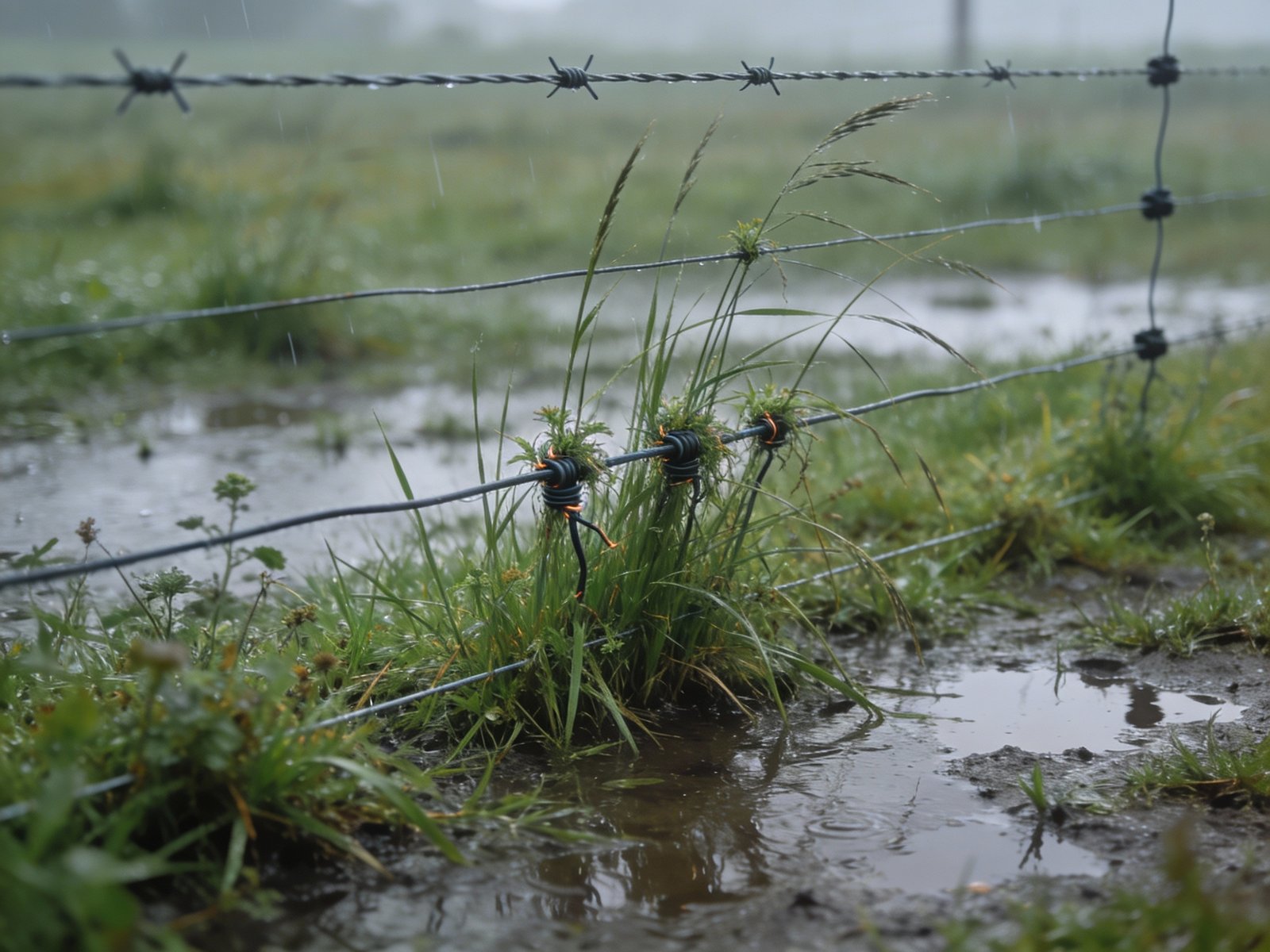
Electric Fences Continue Operating in Rain
Electric fences function normally during rainfall. Individual raindrops do not conduct electricity across insulators or air gaps because they fall as discrete droplets rather than continuous streams. The insulating properties of properly installed fence components prevent moisture from creating unintended electrical paths to ground.
Rain itself does not cause fence failure. When voltage drops after storms, the cause is almost always vegetation contact or insulator contamination, not rainwater on the wires.
Post-Rain Troubleshooting and Diagnosis
Voltage loss after rainfall typically results from one of three causes: vegetation shorting, insulator failure, or improved grounding revealing pre-existing faults. Distinguishing between these requires systematic testing.
To identify vegetation shorting, walk the fence line and look for grass, weeds, or branches touching conductors. These create direct paths to ground that drain voltage. Heavy rain can blow vegetation onto fence lines or cause wet grass to lean against wires, creating shorts that were not present in dry conditions.
To distinguish vegetation shorting from grounding failure, disconnect all fence wires at the energizer and test the energizer output directly. If voltage reads normal at the energizer terminals but low on the fence, the problem lies along the fence line. If voltage is low at the energizer itself, check the grounding system performance and energizer function.
Insulator inspection should focus on cracks, carbon tracking, and contamination. Wet conditions expose weaknesses in marginal insulators. Look for brown or black streaks on insulator surfaces, which indicate carbon buildup from arcing. Replace damaged insulators immediately to prevent ongoing voltage loss.
The Role of Insulators in Wet Weather
Properly installed insulators prevent moisture from creating electrical bridges between fence wires and posts or ground. Quality insulators maintain their insulating properties even when saturated with water. However, damaged or contaminated insulators can fail when wet, creating leakage paths that reduce fence voltage.
Wood insulators can retain moisture and gradually degrade. Plastic insulators are more weather-resistant but can carbonize if subjected to repeated arcing. Regular inspection and replacement of worn insulators prevents wet-weather voltage loss. For detailed guidance on selecting and installing weather-resistant insulators, see insulator selection and installation.
Improved Grounding Reveals Hidden Faults
Rain moistens soil and improves grounding efficiency. Paradoxically, this can reveal pre-existing faults that were not apparent in dry conditions. When grounding improves, more current flows through any short circuits on the fence, causing voltage to drop more noticeably. This effect helps identify problems that need correction but can be mistaken for rain-caused failure.
Post-Storm Maintenance Checklist
- Walk fence lines and remove vegetation blown onto wires
- Clear grass or branches contacting conductors
- Inspect insulators for cracks, tracking, or moisture-related damage
- Check wire connections for corrosion or loosening
- Test fence voltage at multiple points to locate faults
- Document recurring problem areas for permanent correction
Winter Challenges and Solutions
Winter introduces mechanical, electrical, and energy-storage challenges that require proactive management. The primary winter issue is frozen ground, which dramatically reduces grounding effectiveness and can render earth-return fence systems nearly ineffective.
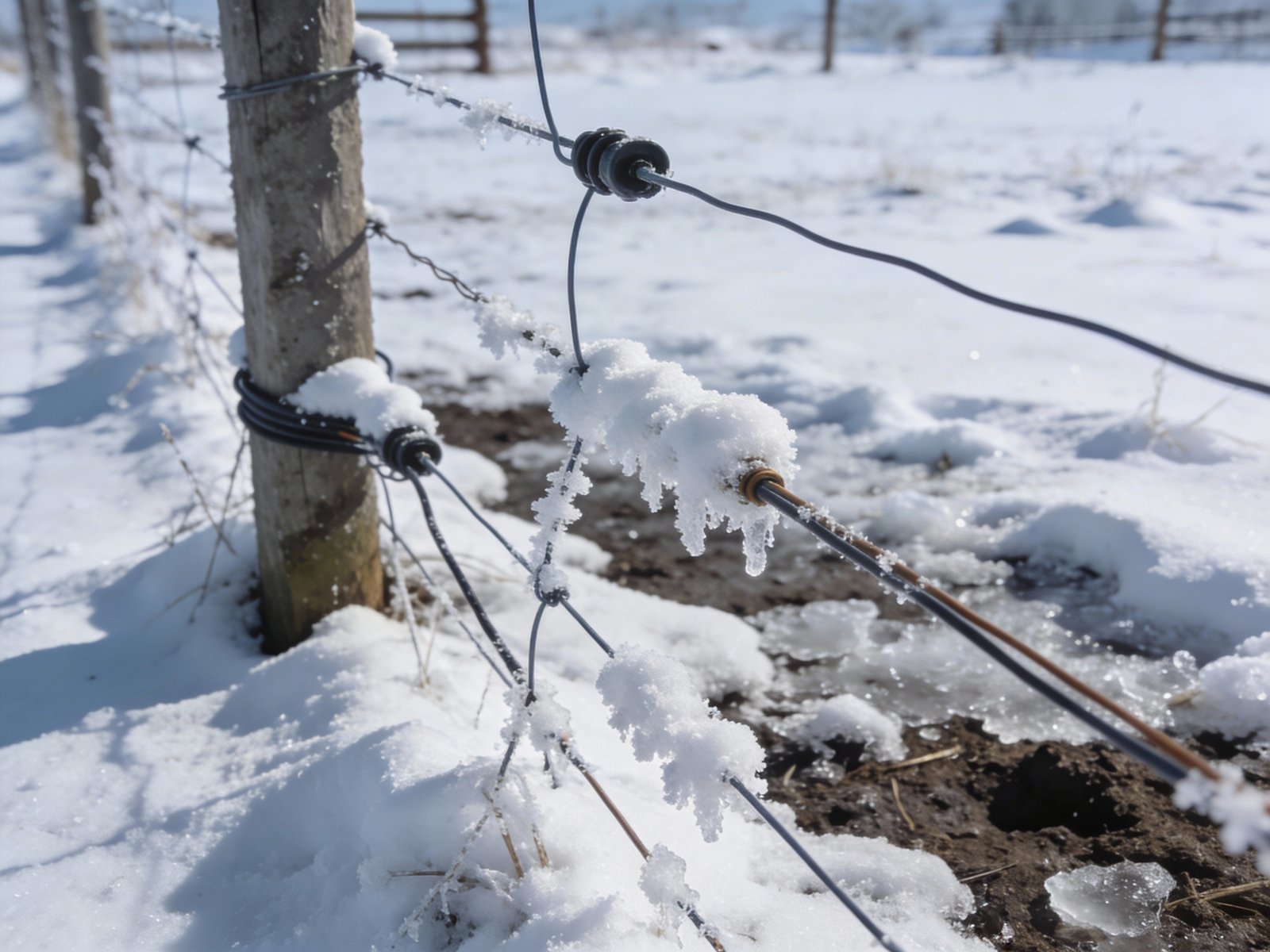
How Frozen Ground Interrupts Electric Fence Circuits
Electric fences rely on completing a circuit through the ground. The energizer sends a pulse through the hot wire. When an animal touches the fence, current flows through the animal into the soil, then through the soil to ground rods, and back to the energizer. This circuit requires conductive soil.
Frozen soil conducts electricity poorly because ice is an insulator. When the top several feet of soil freeze, ground rod effectiveness drops dramatically. Additionally, snow acts as insulation between animal hooves and the ground, preventing animals from making good electrical contact with the earth. Together, frozen soil and snow cover can reduce shock intensity to levels that no longer deter livestock.
This explains why fences show high voltage readings on a voltmeter but fail to contain animals in winter. The voltmeter indicates that the energizer is functioning and the fence wire is charged, but the incomplete ground circuit means animals do not receive effective shocks when they contact the fence.
Hot/Ground Wire Systems for Winter Performance
Hot/ground wire systems solve frozen ground problems by eliminating dependence on soil conductivity. In this configuration, alternating wires are connected to the hot terminal and ground terminal of the energizer. When an animal touches both a hot wire and a ground wire simultaneously, the circuit completes through the animal’s body rather than through the soil.
This system delivers consistent shocks regardless of soil conditions. It performs equally well in frozen ground, deep snow, rocky terrain, and arid climates where soil moisture is scarce. The ground wire transmits electricity back to the energizer, bypassing the soil entirely.
For effective hot/ground fence design, space wires so animals are likely to contact both types simultaneously. Placing a hot wire and ground wire close together forces animals to bridge both when attempting to push through the fence. This configuration works particularly well for cattle, horses, and other large livestock that contact multiple wire strands.
Existing single-wire fences can be retrofitted with ground-return wires without rebuilding the entire system. Adding one or more ground wires between existing hot wires and connecting them to the energizer’s ground terminal provides winter functionality while maintaining summer performance.
Winter Management Summary Table
| Winter Issue | Impact on Fence | Recommended Solution |
|---|---|---|
| Frozen ground reduces conductivity | Weak shocks despite normal voltage readings | Install hot/ground wire system or add ground-return wires |
| Low temperatures tighten wire | Increased tension, potential breakage | Use inline tensioners and adjust gradually through season |
| Snow and ice buildup | Short circuits, reduced voltage | Raise lower wires or use cutoff switches to disable snow-buried strands |
| Reduced solar input | Undercharged batteries, fence failure | Clear snow from panels, adjust angle, supplement with manual charging |
| Cold battery performance | Voltage drop and capacity loss | Store batteries indoors at 18°C, recharge every 1-2 weeks |
Grounding System Winterization
Even with earth-return systems, proper ground rod installation minimizes winter performance loss. Ground rods should be at least 6 to 8 feet long to extend below frost penetration depth. In regions with deep frost, longer rods or additional rods increase the probability of reaching unfrozen soil.
Install ground rods in locations that receive limited snow coverage, such as on the leeward side of buildings or under tree canopies. These protected locations experience less frost penetration. Thoroughly moisten soil around ground rods before winter sets in, as this moisture helps maintain some conductivity even as surface soil freezes.
Most fence systems should have at least three ground rods spaced 10 feet apart. Fence energizers with higher joule output require more extensive grounding. A general guideline is 3 feet of ground rod per joule of energizer output. A 6-joule energizer needs 18 feet of ground rod, typically achieved with three 6-foot rods.
Wire Tension Management in Cold Weather
Metal fence wire contracts as temperatures drop, increasing tension between posts. Excessive tension can break wires or pull posts out of alignment. Avoid over-tensioning wire during installation to allow for thermal contraction.
Inline tensioners absorb seasonal tension changes. Install tensioners at intervals along fence runs to prevent cumulative stress from building up. Adjust tension gradually through the fall and winter rather than making large adjustments all at once, which can shock the system and cause failures at weak points.
In extreme cold, some producers temporarily reduce fence tension to prevent breakage, then re-tension in spring. This approach requires careful monitoring to ensure adequate fence function during the adjustment period.
Snow and Ice Management
How Snow Creates Short Circuits
Heavy snow or ice contacting fence wires creates short circuits by providing a conductive path to ground. Wet snow conducts electricity better than dry snow. Ice accumulation can pull wires down into contact with posts or ground, creating direct shorts that drain voltage.
Snow depth varies across fence lines due to drifting. Lower wires are most vulnerable to snow contact. When snow buries the bottom one or two wires, those wires drain power from the entire fence system unless isolated.
Fence Design for Snow Shedding
Angled fence wires shed snow more effectively than horizontal wires. Slightly sloping fence lines allow snow and ice to slide off rather than accumulating. This design consideration is most relevant for permanent perimeter fences in high-snowfall regions.
Height adjustment provides a simpler solution for existing fences. Raise lower wires above typical snow depth where terrain and livestock containment needs permit. This prevents snow burial without requiring fence reconstruction.
Cutoff Switches for Snow-Buried Wires
Installing cutoff switches allows selective deactivation of lower wires during heavy snow while maintaining fence function on upper wires. After snowfall, disconnect buried wires to prevent voltage drain. When snow melts, reconnect all wires to restore full fence coverage.
This approach concentrates energizer power where it remains effective rather than wasting energy on buried wires. Mount switches in accessible locations and high enough to remain above snow cover. Label switches clearly to indicate which fence sections they control.
Post-Storm Snow Inspection
Inspect fence lines after heavy snowfall or ice events to identify damage and remove accumulated ice pulling wires down. Break off ice buildup from wires to restore normal wire position and prevent prolonged shorting. Check for broken insulators or damaged wires that may have resulted from ice weight or snow pressure.
Solar Energizers and Battery Management
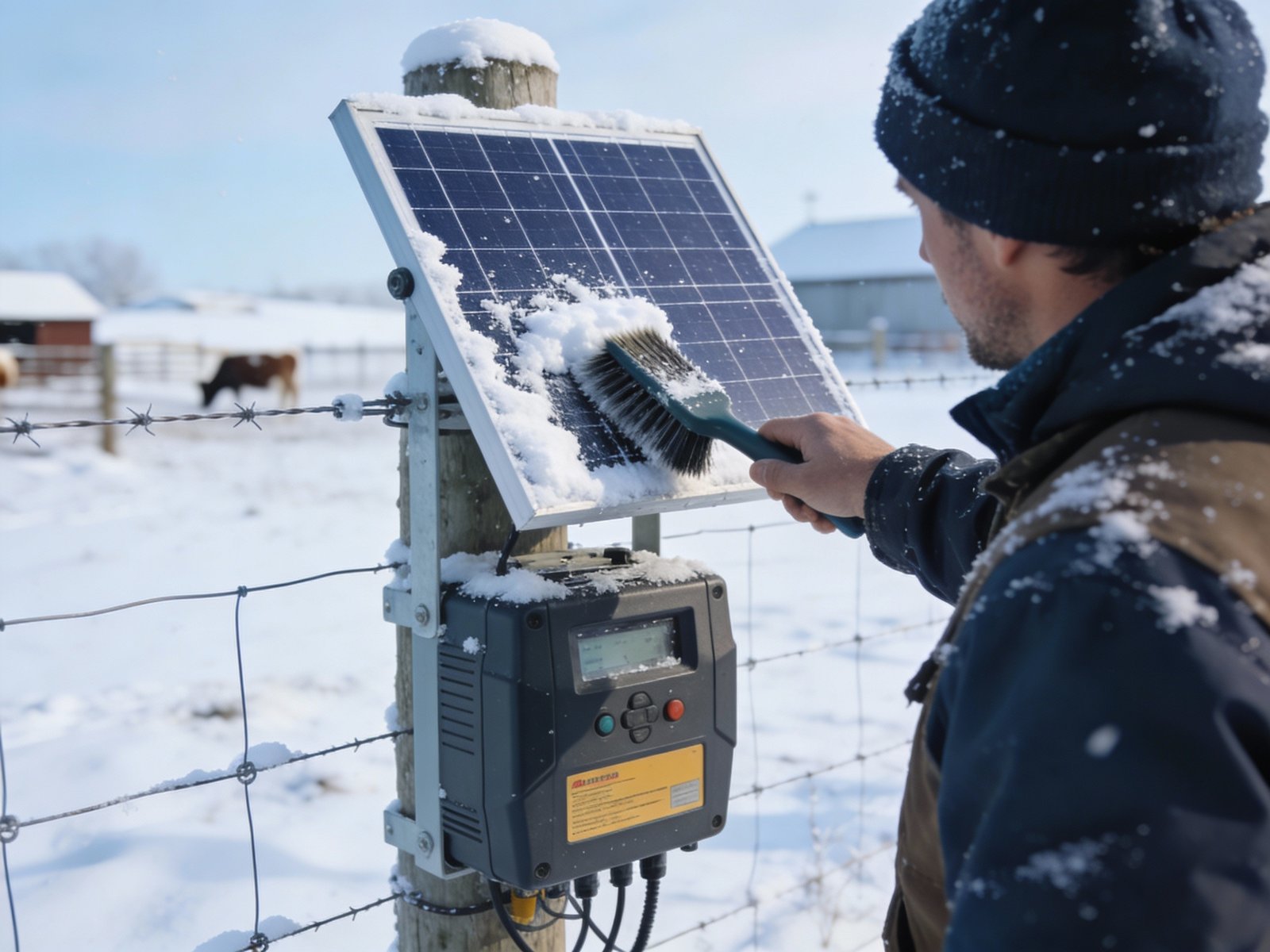
Solar Performance Limitations in Winter
Shorter daylight hours and lower sun angles reduce solar panel charging efficiency in winter months. Snow accumulation on panels blocks sunlight entirely until cleared. Shading from trees, buildings, or terrain features that may not affect summer performance can eliminate winter charging during critical low-sun hours.
Solar energizers experience their greatest power demand during seasons when charging capacity is lowest. Cold weather increases battery draw, while vegetation dieback in some climates reduces fence load. However, in regions with year-round grazing, fence systems must maintain full output while receiving reduced solar input.
When Solar Energizers Are Not Recommended
Solar energizers are poorly suited to several environments and applications. High-latitude locations receive insufficient winter sunlight to maintain battery charge, particularly above 45 degrees north or south latitude. Heavily shaded locations cannot generate adequate power year-round.
Regions with prolonged cloudy periods or frequent heavy snowfall require more frequent manual intervention to maintain solar fence systems. Producers should honestly assess whether the maintenance burden of winter solar management exceeds the benefit of avoiding AC power installation.
For critical containment applications where fence failure creates significant animal welfare or economic consequences, AC-powered energizers provide more reliable year-round performance than solar systems. Solar works well for temporary fencing, rotational grazing systems that can tolerate brief outages, and locations with strong year-round sun exposure.
Optimizing Solar Energizer Winter Performance
Position solar panels facing true south to receive maximum available winter sunlight. Adjust panel angle seasonally if the mounting system permits. Winter sun angles are lower than summer angles, so steeper panel tilt captures more winter sun.
Clear snow from panels regularly, ideally within hours of snowfall. Snow-covered panels generate no power, so prompt clearing maintains charging. Consider panel placement where snow is less likely to accumulate or where access for clearing is convenient.
Plan for manual battery charging every 1 to 2 months during winter in low-sun regions. Most quality solar energizers include AC adapter ports for supplemental charging. Establish a regular charging schedule before batteries discharge to levels that reduce fence effectiveness.
Battery Care Through Seasons
Cold temperatures reduce battery capacity and voltage output. Batteries stored outdoors in freezing conditions may lose 30 to 50 percent of their effective capacity. When possible, store batteries indoors at approximately 18°C to maintain performance and extend lifespan.
If indoor storage is not feasible, protect batteries from temperature extremes with insulated enclosures. Ensure enclosures allow ventilation to prevent hydrogen gas accumulation during charging.
Winter Battery Charging Schedule
Recharge batteries every 2 weeks in cold weather, even if the fence appears to be functioning. Cold reduces battery voltage, and voltage below 12.2 volts indicates the need for recharging. Do not exceed 12.6 volts during charging to avoid overcharging damage.
Deep discharge shortens battery life significantly. Prevent batteries from discharging below 50 percent of capacity. Monitoring voltage weekly helps catch discharge before it reaches damaging levels.
Long-Term Battery Storage
Store batteries fully charged when removing them from service for extended periods. Fully charged batteries resist freezing and sulfation better than discharged batteries. Recharge stored batteries every 30 to 60 days to prevent self-discharge from depleting them.
Never store batteries directly on concrete floors. Use wooden blocks, pallets, or insulated surfaces to prevent discharge through contact with cold concrete. This traditional practice remains valid for modern batteries.
Dry Weather and Drought Conditions
How Dry Soil Reduces Fence Effectiveness
Dry soil conducts electricity poorly, creating the same grounding problems as frozen soil. During drought, ground rod effectiveness decreases as soil moisture evaporates. The fence may show high voltage readings but deliver weak shocks because the circuit cannot complete through dry soil.
Dry conditions also affect animals. Hard, dry hooves and dry grass act as insulators, reducing shock intensity even when grounding is adequate. This combined effect can make fences ineffective during prolonged drought despite normal voltage readings.
Improving Grounding in Dry Conditions
Adding ground rods increases surface area for electrical conduction through soil. Install additional rods spaced 10 feet apart and driven to the full depth possible. Longer rods reach deeper soil layers that may retain more moisture than surface soil.
Locate ground rods where soil tends to remain moist. Areas under building drip lines, near water sources, or in low spots that collect runoff maintain better conductivity during dry periods. If possible, relocate grounding systems to these areas before drought conditions develop.
Watering Ground Rod Areas
Watering soil around ground rods maintains conductivity during drought. Deep, infrequent watering is more effective than frequent light watering. Water should penetrate to ground rod depth rather than moistening only surface soil.
An effective watering method uses a bucket with a small hole drilled in the bottom. Place the bucket next to the ground rod and fill it with water. Water gradually seeps into soil around and beneath the rod, maintaining moisture for several days. Refill the bucket as needed based on soil drying rate.
This technique works as well as installing very long ground rods and requires less labor. However, it demands regular attention during dry periods.
Hot/Ground Wire Systems for Drought Conditions
The same hot/ground wire configuration that solves frozen ground problems also works in drought conditions. By eliminating dependence on soil conductivity, alternating hot and ground wires maintain fence effectiveness in dry, sandy, or rocky soil.
This system is standard in arid regions and desert environments where soil moisture is perpetually scarce. Producers in regions with seasonal drought may choose hot/ground systems for year-round reliability rather than managing grounding challenges during dry months.
For more information on optimizing grounding systems for various soil conditions, see grounding system design and testing.
Recognizing Grounding Failure vs Fence Faults
Test grounding adequacy by creating an intentional short on the fence at least 300 feet from the energizer. Lay several steel rods against the fence or drive them into the ground touching the hot wire. This creates a heavy load that should pull fence voltage down to 2000 volts or less.
With the short in place, test voltage on the last ground rod. Voltage should read no more than 300 volts. If voltage on the ground rod exceeds 300 volts, the grounding system is insufficient. Add more ground rods or relocate the grounding system to more conductive soil.
If the fence shows low voltage but grounding tests adequately, the problem lies along the fence line. Use systematic section testing to locate shorts, broken insulators, or other faults. For comprehensive troubleshooting guidance, see troubleshooting electric fence problems.
Seasonal Electric Fence Management Checklist
Spring Management
- Inspect entire fence line for winter damage including broken wires, damaged insulators, and shifted posts
- Adjust wire tension to account for warming temperatures and wire expansion
- Clear accumulated debris from fence lines before vegetation growth accelerates
- Test and repair grounding systems that may have deteriorated during winter freeze-thaw cycles
- Re-train livestock to respect fences after winter confinement periods when they may have been away from electric fencing
- Service energizers and replace batteries that have degraded through winter
- Establish vegetation control program before weed growth becomes excessive
Summer Management
- Control vegetation growth through grazing management, mowing, or herbicide application to prevent shorts
- Monitor grounding system moisture, particularly during drought periods
- Water around ground rods if soil becomes excessively dry
- Inspect solar panels for dust or debris accumulation that reduces charging efficiency
- Check wire tension and adjust for thermal expansion in hot weather
- Test fence voltage regularly as vegetation load increases energizer demand
- Inspect insulators for UV degradation and replace as needed
- Prepare for lightning season by verifying lightning protection and surge prevention systems are functional
Fall Management
- Prepare for freezing temperatures by checking wire tension and adjusting for expected contraction
- Service batteries and replace weak batteries before winter increases demand
- Clear debris near fence lines that could be blown onto fences during fall storms
- Consider retrofitting hot/ground wire systems if winter grounding problems are anticipated
- Install cutoff switches for lower wires in snow-prone areas
- Adjust solar panel angles for lower winter sun if mounting hardware permits
- Test energizer output and repair or replace underperforming units before winter
- Document fence sections that required frequent attention during the past year for permanent improvements
Winter Management
- Monitor snow and ice buildup on fence wires and clear as needed
- Check battery voltage every 1 to 2 weeks and recharge when voltage drops below 12.2 volts
- Clear snow from solar panels promptly after snowfall
- Adjust wire tension gradually to prevent shock loading from sudden temperature changes
- Use cutoff switches to disable snow-buried lower wires while maintaining upper wire function
- Test fence voltage regularly as frozen ground may reduce shock effectiveness despite normal voltage readings
- Inspect fence after ice storms for damage from ice weight
- Plan permanent improvements for next season based on winter performance issues
Year-Round Maintenance Activities
- Test fence voltage at multiple points along fence lines monthly
- Walk fence perimeter quarterly to identify developing problems before they cause failures
- Maintain spare parts inventory including insulators, wire, connectors, and fuses
- Document recurring problem areas and schedule permanent corrections
- Keep routine fence maintenance records to track system performance and predict component replacement needs
Frequently Asked Questions
Do electric fences stop working in the rain?
No. Electric fences continue to function normally during rainfall. Rain droplets do not conduct electricity across insulators or air gaps. Voltage loss after rain storms is almost always caused by vegetation blown onto fence wires or pre-existing insulator damage that becomes apparent when improved soil moisture enhances grounding. Rain itself does not prevent fence operation.
Can snow short out an electric fence?
Yes. Heavy snow or ice accumulation contacting fence wires creates short circuits that drain voltage. Wet snow conducts electricity better than dry snow. Lower fence wires are most vulnerable to snow contact. Installing cutoff switches to disable snow-buried wires while maintaining upper wire function prevents voltage loss without requiring snow removal from the entire fence line.
How often should batteries be charged in winter?
Recharge batteries every 1 to 2 weeks during winter, depending on temperature and energizer load. Cold temperatures reduce battery capacity and voltage output. Test battery voltage weekly and recharge when voltage drops below 12.2 volts. Do not allow batteries to discharge below 50 percent of capacity, as deep discharge significantly shortens battery lifespan.
Why does my fence show high voltage but animals still escape in winter?
Frozen ground interrupts the electrical circuit even when fence voltage reads normal. The energizer charges the wire properly, but frozen soil cannot conduct current from the animal back to the ground rods, so animals receive weak or no shock. Installing a hot/ground wire system solves this by completing the circuit through wires rather than soil. This maintains shock effectiveness regardless of ground conditions.
Should I use a solar or AC-powered energizer?
The choice depends on several factors. Solar energizers work well in locations with strong year-round sunlight, temporary fencing applications, and situations where AC power is unavailable or expensive to install. AC-powered energizers provide more reliable year-round performance, particularly in high-latitude regions with limited winter sunlight or areas with frequent heavy snowfall. For critical containment where fence failure creates significant animal welfare or economic consequences, AC power is generally more reliable. Consider your latitude, local climate, fence criticality, and willingness to perform winter solar maintenance when choosing.
How do I know if my grounding system is adequate?
Test grounding by creating an intentional short on the fence at least 300 feet from the energizer. Lay several steel rods against the fence to create a heavy load. Fence voltage should drop to 2000 volts or less. Then test voltage on the last ground rod using a voltmeter with the ground probe inserted into soil. Voltage should read no more than 300 volts. If ground rod voltage exceeds 300 volts, add more ground rods or relocate the grounding system to more conductive soil. Most systems require at least three 6-foot ground rods spaced 10 feet apart.
What is a hot/ground wire system and when should I use one?
A hot/ground wire system uses alternating wires connected to the energizer’s hot and ground terminals. When an animal contacts both a hot wire and ground wire simultaneously, the circuit completes through the animal’s body rather than through soil. This system maintains shock effectiveness in frozen ground, deep snow, drought conditions, rocky terrain, and sandy soil where earth-return systems perform poorly. Hot/ground systems are standard in arid climates and are increasingly used in northern regions to ensure winter performance.
How much does temperature affect wire tension?
Wire contracts approximately 1 inch per 100 feet of length for every 10°F temperature drop. A fence tensioned at 70°F will experience significantly increased tension when temperature drops to 0°F. This contraction can break wires or pull posts out of alignment. Install inline tensioners to absorb seasonal tension changes and avoid over-tensioning wire during installation to allow for thermal contraction. Adjust tension gradually through fall and winter rather than making large adjustments suddenly.
Key Weather and Seasonal Takeaways
Weather conditions do not prevent electric fences from functioning, but poor seasonal management does. The two critical weather-related challenges are grounding interruption from frozen or dry soil and mechanical stress from temperature changes. Hot/ground wire systems solve most grounding problems by eliminating dependence on soil conductivity.
Proactive seasonal adjustments maintain reliable fence performance year-round. Spring and fall transition periods require attention to wire tension and system inspection. Summer demands vegetation control. Winter requires grounding system adaptation and battery management.
Most fence failures attributed to weather are actually failures of system design or maintenance. Properly designed fences with adequate grounding, appropriate energizer sizing, and regular seasonal maintenance provide consistent livestock containment regardless of weather conditions.
For producers experiencing recurring weather-related fence problems, the solution is rarely rebuilding the entire fence. Strategic improvements such as adding ground-return wires, installing additional ground rods, or implementing seasonal adjustment procedures address most issues without major capital investment.
Additional resources for fence system optimization include fence energizer sizing and selection and comprehensive voltage loss diagnosis.
For questions about specific products or custom fence applications, visit our products page or contact us for expert guidance.