
Power Source Selection: AC vs DC vs Solar Energizers
A practical guide to choosing the right power source for electric fence energizers based on location, reliability, and maintenance
Why Power Source Choice Matters in Electric Fencing
In an electric fencing system, the energizer’s power source determines reliability, long-term cost, and day-to-day management effort. This decision is a critical component within the broader framework of fence energizer selection and directly impacts whether your system delivers consistent voltage across all operating conditions.
While energizer output—measured in joules and voltage—defines fence strength, the power source defines whether that strength is available consistently across seasons and operating conditions. An undersized or poorly matched power source can reduce a high-output energizer to ineffective performance, particularly during winter months or periods of vegetation growth.
Power source selection is the second most important decision in electric fence system design, immediately following energizer sizing. AC, DC battery, and solar systems each impose distinct trade-offs in reliability, maintenance burden, capital cost, and operational flexibility. Understanding these trade-offs allows ranchers, farmers, and fence installers to match power infrastructure to site constraints and management capacity.
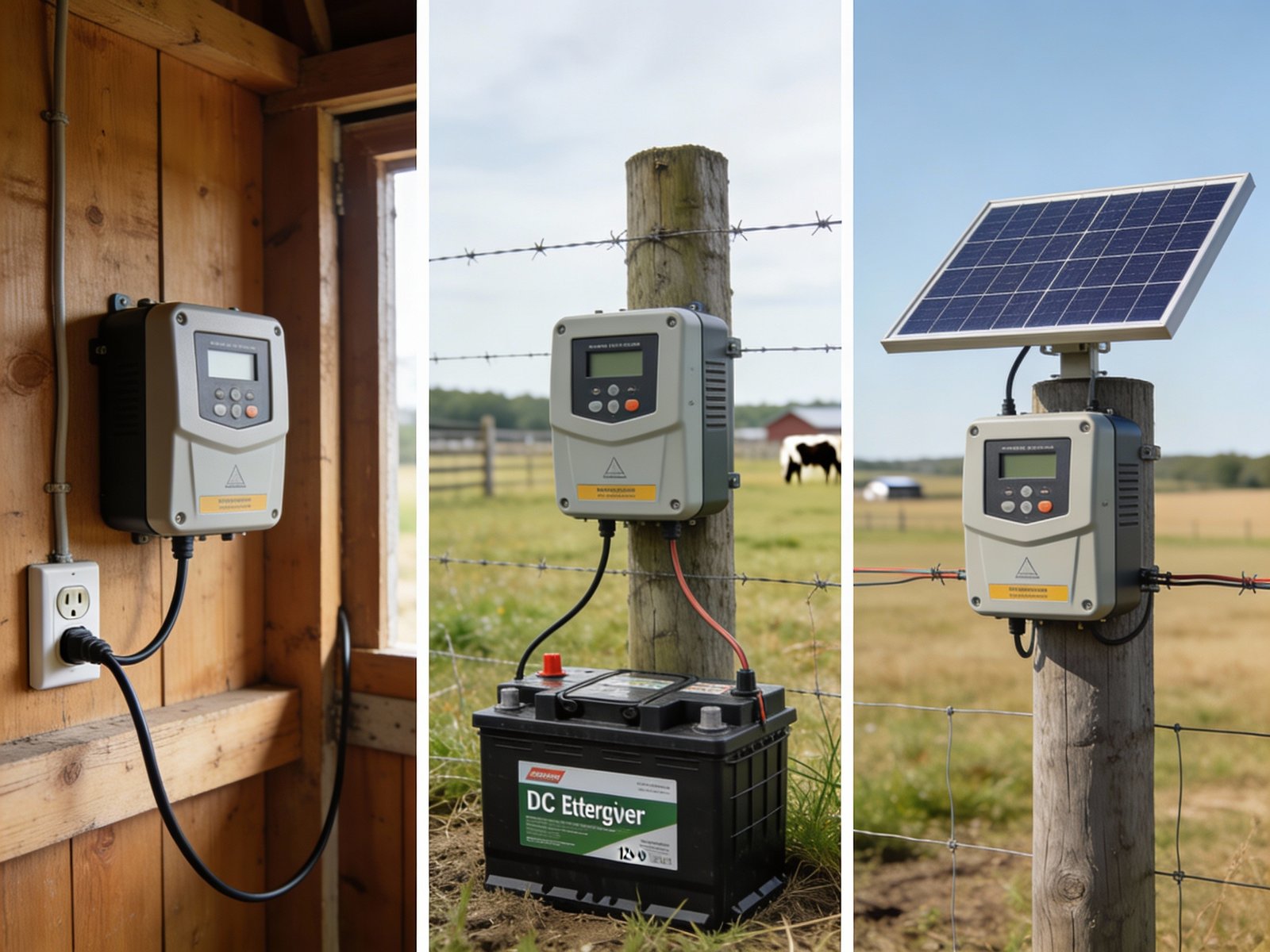
AC vs DC vs Solar: Power Source Comparison
Electric fence energizers are typically powered by alternating current (AC from utility grid), direct current (DC) batteries, or solar systems combining photovoltaic panels with battery storage. Each option has distinct advantages and limitations that constrain where and how it can be deployed effectively. The choice between these systems is driven primarily by access to grid power, fence permanence, site remoteness, and the operator’s willingness to perform regular maintenance.
AC-powered energizers offer the highest reliability and lowest per-joule cost when 120V utility power is available within economical reach of the fence line. DC battery systems provide portability and independence from fixed infrastructure, making them suitable for temporary or rotational grazing setups. Solar energizers eliminate the need for grid access or manual battery charging but introduce dependency on sunlight availability and require both panel and battery maintenance.
The table below summarizes key performance and operational characteristics across power source types. These comparisons assume properly sized components and standard agricultural operating conditions.
| Feature | AC Power (120V) | DC / Battery | Solar |
|---|---|---|---|
| Best Use Case | Permanent fence near utility power | Temporary or portable fencing | Remote areas with no grid access |
| Reliability | Very high (continuous) | Medium (depends on charging schedule) | Variable (sun and season dependent) |
| Output Cost per Joule | Lowest | Medium | Highest |
| Maintenance Frequency | Minimal | Battery management required | Panel cleaning + battery monitoring |
| Winter Performance | Unaffected | Reduced capacity in cold | Significantly reduced |
| Mobility | None (fixed installation) | High | Moderate |
| Typical Annual Operating Cost | ~$9 (4.5W energizer) | Battery replacement cost | Panel + battery upkeep |
| Infrastructure Requirement | Access to 120V outlet | Battery rotation or charging station | Adequate sunlight exposure year-round |
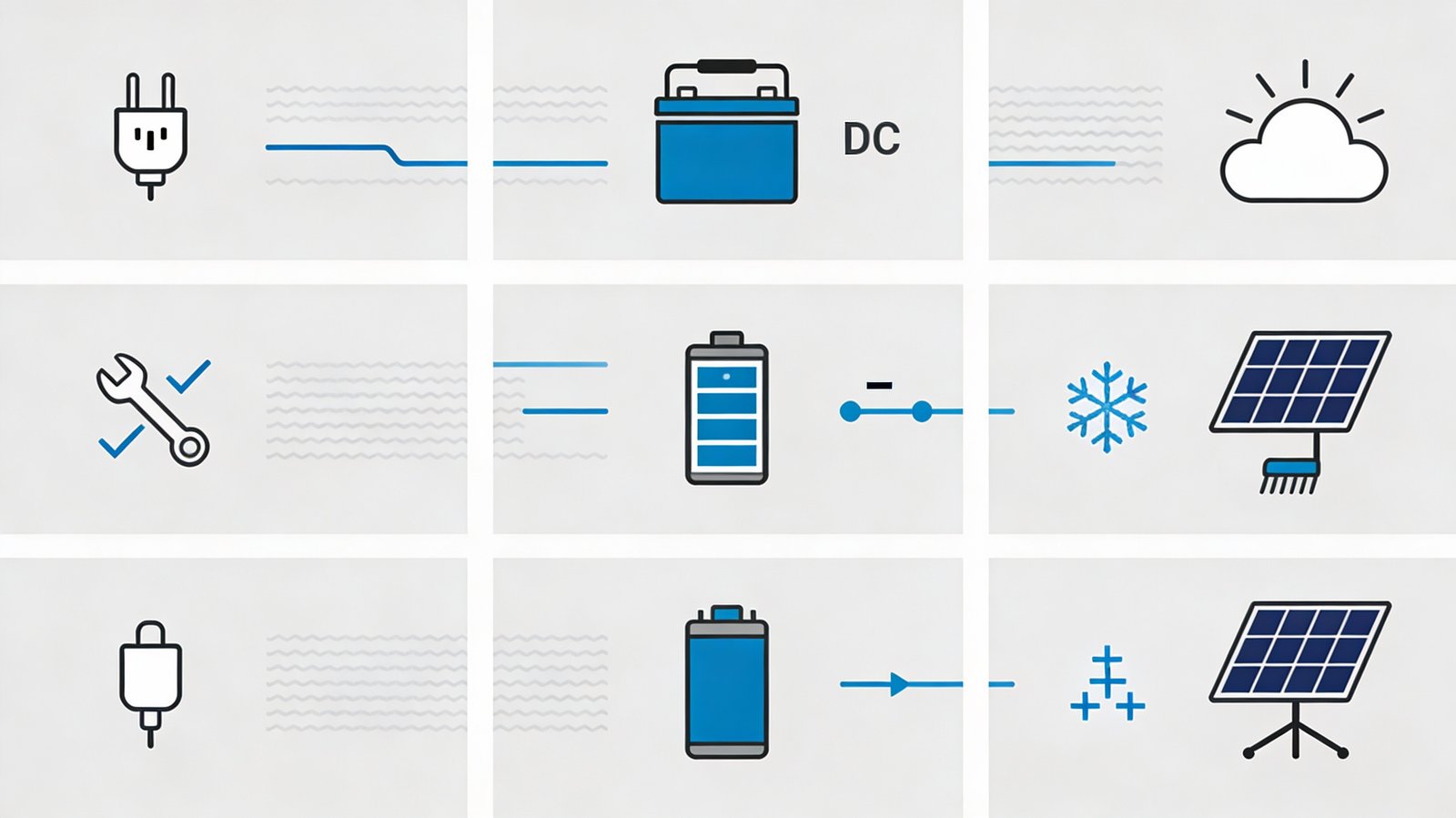
YouTube Video: Electric Fence Energizer Power Source Comparison
The following video provides a practical overview of how AC, DC battery, and solar energizers differ in reliability, maintenance requirements, and performance under varying environmental conditions. It explains why solar systems face challenges in winter and low-light conditions, when battery-powered systems outperform solar alternatives, and why AC energizers offer the lowest long-term operating cost when grid power is available within reasonable reach of the fence line.
This video is particularly useful for understanding the trade-offs between power sources before committing to a specific system configuration. It reinforces the importance of matching power source selection to site constraints and operational requirements rather than optimizing for upfront cost alone.
The video demonstrates that AC energizers receive continuous, stable power from utility sources, eliminating concerns about battery discharge or sunlight availability. DC battery systems offer portability and independence from fixed infrastructure but require regular charging cycles, particularly during cold weather when battery capacity decreases. Solar energizers combine convenience with remote capability but depend on adequate sunlight exposure, which is significantly reduced during winter months, especially at higher latitudes or in areas with frequent cloud cover.
AC-Powered Energizers
AC-powered energizers are the most reliable and cost-effective option when utility power is available within economical reach of the fence location. These units plug into standard 120V outlets (or 220V in some regions) and convert grid power into high-voltage pulses delivered to the fence line. AC energizers eliminate dependency on battery state-of-charge, sunlight availability, and the maintenance burden associated with battery management.
Because AC power is continuous and stable, these energizers can sustain maximum output indefinitely without performance degradation. This makes them the preferred choice for permanent perimeter fencing, high-security applications, and any scenario where fence reliability must be maintained year-round without operator intervention. AC energizers also deliver the highest joule output per dollar of capital investment, making them the most cost-efficient option when grid power access is feasible.
The primary constraint on AC energizer deployment is the cost and feasibility of extending utility power to the fence location. Running electrical wiring beyond approximately 300 feet from an existing outlet often becomes economically prohibitive, particularly if trenching, conduit, or overhead installation is required. In such cases, the total installed cost of AC infrastructure may exceed the cost of a solar or battery-powered system, even though the energizer unit itself is less expensive.
- Continuous, stable power supply unaffected by weather or temperature
- Lowest cost per joule delivered over the system’s operational life
- Minimal maintenance—no battery replacement or panel cleaning required
- Highest available output power for large or heavily vegetated fence lines
- Unaffected by seasonal changes in daylight hours or temperature
AC energizers are the foundation of permanent electric fence systems in commercial cattle operations, perimeter security fencing, and any application where fence downtime is unacceptable. For more information on selecting the appropriate energizer size and output capacity, see the Fence Energizer Guide.
DC / Battery-Powered Energizers
Battery-powered energizers offer flexibility and portability for temporary or semi-permanent fencing systems. These units operate on 12-volt deep-cycle batteries, which can be swapped or recharged as needed. DC energizers are widely used in rotational grazing systems, temporary paddock subdivisions, and remote fence sections where running electrical wiring would be impractical or cost-prohibitive.
The primary advantage of battery-powered systems is mobility. A DC energizer can be relocated easily as grazing patterns shift or as fence sections are added, removed, or reconfigured. This flexibility is critical in intensive grazing management systems where paddock boundaries change frequently. Battery systems also provide independence from fixed infrastructure, allowing fence installation in locations where neither grid power nor adequate sunlight is available.
However, battery-powered systems impose a significant maintenance burden. Batteries must be monitored regularly to ensure voltage remains above the minimum threshold required for effective energizer operation—typically 12.6V for a fully charged 12V deep-cycle battery. Cold temperatures reduce battery capacity substantially, often by 30-50% in freezing conditions. This means batteries that provide two weeks of operation in summer may require recharging every 5-7 days in winter.
Deep-cycle marine batteries are the recommended power source for DC energizers. Automotive starting batteries should not be used, as they are designed for short, high-current bursts rather than sustained low-current discharge. Deep-cycle batteries tolerate repeated discharge cycles without significant capacity loss, whereas automotive batteries degrade rapidly under these conditions.
- High portability—energizer and battery can be relocated as needed
- No need for grid power or solar panel infrastructure
- Requires regular charging or battery rotation
- Battery capacity decreases in cold weather, increasing charging frequency
- Suitable for temporary, rotational, or mobile fence configurations
For operations using rotational grazing or temporary paddock systems, DC battery-powered energizers provide the operational flexibility required for intensive pasture management. For guidance on temporary versus permanent fence configurations, see Permanent vs Temporary Electric Fencing.
Solar-Powered Energizers
Solar energizers combine a photovoltaic panel, charge controller, and battery to power the fence without requiring grid access or manual battery charging. They are ideal for remote locations where neither utility power nor regular battery service is practical. Solar systems eliminate the need for infrastructure extension or frequent site visits, making them attractive for distant pastures, rangeland fencing, and wildlife exclusion applications.
Despite their convenience, solar energizers impose several operational constraints. Panel wattage must be sized to match energizer power consumption plus battery charging requirements, accounting for geographic location, seasonal sunlight variation, and panel soiling. Inadequately sized panels will fail to maintain battery charge during periods of reduced sunlight, resulting in fence downtime. This is particularly problematic during winter, when daylight hours are shortest and sun angle is lowest.
Solar panels require regular cleaning to maintain charging efficiency. Dust, bird droppings, snow, and ice accumulation reduce panel output substantially—often by 30-60% when panels are heavily soiled. In winter conditions, snow coverage can eliminate charging entirely for days or weeks, forcing the system to operate solely on stored battery capacity. A deep-cycle 12V battery powering a typical 2-4 joule energizer may discharge completely within 5-7 days under winter conditions with no solar input.
Panel placement is critical. Panels must be installed with unobstructed southern exposure (in the Northern Hemisphere) and angled to maximize sunlight capture during the lowest-sun months. Shading from trees, buildings, or topography will reduce charging capacity and may render the system unreliable during winter. Operators should verify that the installation site receives at least 4-6 hours of direct sunlight daily during the shortest days of the year.
Special Considerations for Solar Systems
- Solar panel wattage must exceed energizer power draw by a margin sufficient to charge the battery and compensate for panel inefficiency
- Panels require regular cleaning, especially in winter when snow and ice reduce output
- Short daylight hours in winter reduce charging capacity significantly, often by 50-70% compared to summer
- Battery voltage must be monitored regularly to detect charging inadequacy before fence performance degrades
- Charge controllers prevent battery overcharging but cannot compensate for undersized panels or inadequate sunlight exposure
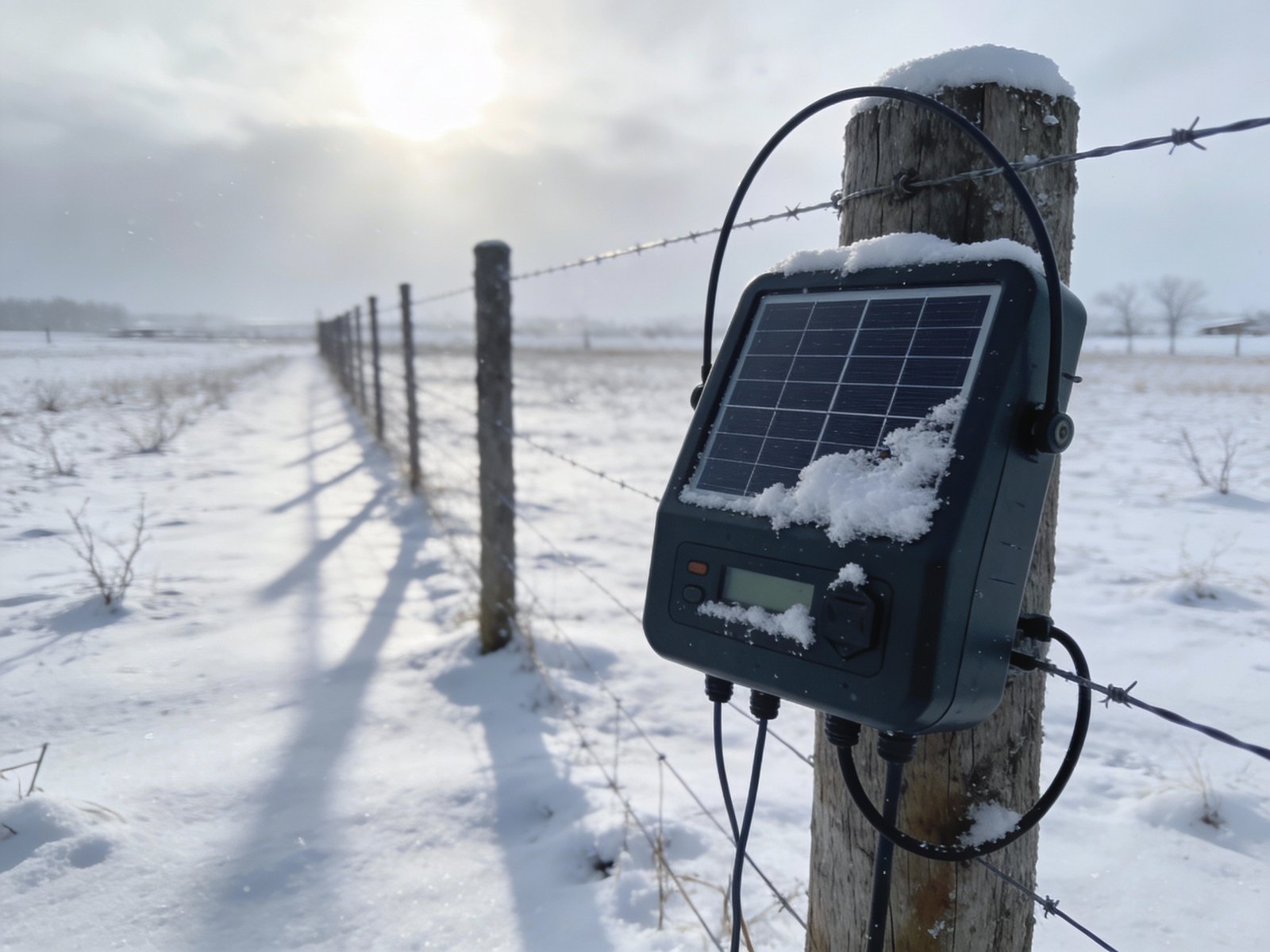
Solar energizers are most effective in regions with high solar insolation, minimal winter cloud cover, and relatively mild winters. Operators in these environments can achieve reliable year-round performance with properly sized systems. In contrast, operations at higher latitudes or in regions with extended cloudy periods may find solar systems require supplemental battery charging or seasonal power source switching to maintain fence reliability. For information on managing electric fences through seasonal challenges, see Weather and Seasonal Management.
Battery Voltage and Maintenance Requirements
Regardless of power source, battery health directly impacts energizer output. All DC and solar energizers rely on battery voltage to deliver effective fence pulses. When battery voltage drops below the energizer’s minimum operating threshold, output voltage and joule delivery decline rapidly, reducing fence effectiveness. Maintaining proper battery voltage is therefore a critical component of fence system reliability.
A fully charged 12V deep-cycle battery should read approximately 12.6-12.8V at rest. As the battery discharges, voltage decreases gradually until reaching approximately 12.0V, at which point the battery is considered 50% discharged. Discharging below 12.0V accelerates battery degradation and reduces overall cycle life. Most energizers will continue operating down to approximately 11.5V, but output power drops significantly below 12.0V.
Deep discharge—allowing battery voltage to fall below 11.0V—causes permanent capacity loss in lead-acid batteries and should be avoided. Operators should establish a minimum voltage threshold of 12.0V and recharge or replace batteries before voltage falls below this level. Regular voltage monitoring using a digital voltmeter is the most effective way to prevent unexpected fence failures due to battery discharge.
Battery maintenance extends beyond voltage monitoring. Terminals should be kept clean and free of corrosion, as poor electrical contact reduces charging efficiency and increases resistance. Battery cases should be inspected for cracks or leaks, and batteries should be stored off frozen ground to minimize cold-induced capacity loss. For solar systems, ensuring the charge controller is functioning properly prevents both overcharging and undercharging, both of which reduce battery lifespan.
- Maintain battery voltage above 12.6V for optimal performance
- Avoid deep discharge—recharge when voltage reaches 12.0V
- Use deep-cycle batteries designed for sustained discharge, not automotive starting batteries
- Clean battery terminals regularly to ensure low-resistance electrical contact
- Store batteries in insulated enclosures during winter to reduce cold-induced capacity loss
- Monitor voltage weekly during periods of high fence load or reduced charging (winter, cloudy weather)
Quick Power Source Decision Guide
The following decision tree provides a structured approach to power source selection based on site characteristics and operational requirements. This framework prioritizes reliability and long-term cost-effectiveness over convenience or upfront capital expenditure.
Yes → Choose AC-powered energizer. This is the most reliable and cost-effective option for permanent installations.
Yes → Choose DC battery-powered energizer. Battery systems provide the portability required for rotational grazing and temporary paddock management.
Yes → Choose solar-powered energizer, but plan for winter limitations. Ensure the site receives adequate sunlight year-round and establish a plan for manual battery charging during extended low-light periods.
Yes → Reconsider solar. Either oversize the panel and battery capacity significantly or plan for seasonal power source switching (e.g., manual battery charging during winter months).
Yes → DC battery systems are viable if you can maintain a charging schedule. No → Solar is the only practical option, but verify that sunlight availability supports year-round operation.
This decision framework applies to standard agricultural fencing applications. Specialized scenarios—such as wildlife exclusion, predator protection, or multi-species fencing—may impose additional constraints on power source selection. For guidance on these applications, see Predator Protection Electric Fencing and Multi-Species Mixed Herd Fencing.
Common Power Source Selection Mistakes
Several recurring errors in power source selection lead to poor fence reliability, increased maintenance burden, and premature system failure. The following issues represent the most common pitfalls observed in field installations.
Avoiding these errors requires careful site assessment, realistic evaluation of maintenance capacity, and understanding of seasonal performance variation. Operators should prioritize reliability and long-term cost-effectiveness over convenience or initial capital savings. For additional guidance on avoiding installation errors, see Common Installation Mistakes.
Frequently Asked Questions
Is solar power reliable for electric fencing?
Solar power is reliable during sunny seasons in regions with adequate sunlight, but reliability decreases significantly during winter or prolonged cloudy periods. Panel output drops due to shorter daylight hours, lower sun angle, and snow or ice coverage. Battery capacity also decreases in cold temperatures, compounding the problem. Operators in northern latitudes or areas with frequent winter cloud cover should plan for manual battery charging or reduced fence reliability during low-light months.
How much does an AC energizer cost to run?
A typical 4.5W AC energizer costs approximately $9 per year to operate, based on average residential electricity rates of $0.12-0.14 per kWh. Larger energizers with higher wattage ratings will increase annual operating cost proportionally. For example, a 15W energizer would cost approximately $30 per year. These costs are negligible compared to battery replacement or solar system maintenance expenses in DC and solar systems.
Can I combine solar and manual battery charging?
Yes. Many operators use solar as the primary power source during high-sunlight months and switch to manual battery charging or battery rotation during winter. This hybrid approach provides the convenience of solar power when conditions are favorable while ensuring fence reliability during periods when solar charging is inadequate. Establishing a battery rotation schedule—swapping discharged batteries with freshly charged units—is a practical strategy for maintaining fence uptime in winter.
How do I size a solar panel for my energizer?
Solar panel wattage should exceed energizer power consumption by a factor of 3-5 to account for panel inefficiency, battery charging losses, and reduced sunlight during winter. For example, a 3W energizer should be paired with a 10-15W panel minimum. Operators in northern latitudes or areas with frequent cloud cover should increase this margin further. Consult the energizer manufacturer’s specifications for recommended panel sizing based on geographic location.
What is the lifespan of a deep-cycle battery in fence applications?
Deep-cycle batteries typically provide 3-5 years of service in electric fence applications when properly maintained. Lifespan depends on depth of discharge, charging frequency, and exposure to extreme temperatures. Batteries subjected to frequent deep discharge or prolonged storage in discharged state will fail prematurely. Maintaining voltage above 12.0V and avoiding deep discharge maximizes battery cycle life.
Can I use a car battery for a DC energizer?
No. Automotive starting batteries are designed for short, high-current bursts and degrade rapidly when subjected to sustained low-current discharge. Deep-cycle marine or RV batteries are designed for this application and will provide significantly longer service life. Using automotive batteries results in frequent replacement and poor cost-effectiveness.