
Electric vs Woven Wire Cattle Fence: Which Is Better for Your Farm?
Choosing the right fencing system for cattle is one of the most important decisions a farmer or rancher will make. The debate between electric cattle fencing and woven wire fencing is not about which is universally “better,” but rather which system best aligns with your specific farm conditions, management style, and operational goals. Both fencing types have distinct strengths and limitations that make them suitable for different applications within a cattle operation.
Electric fencing operates as a psychological barrier, delivering a brief but memorable shock that trains cattle to respect the boundary. This system excels in flexibility, cost-effectiveness, and ease of installation, making it ideal for rotational grazing, temporary paddocks, and large pasture management. Woven wire fencing, by contrast, functions as a physical barrier with tightly woven horizontal and vertical wires that create a strong mesh. This design provides superior security, durability, and predator protection, making it the preferred choice for perimeter fencing and high-pressure containment areas.
Understanding the fundamental differences between these two systems will help you make an informed decision that balances initial investment, long-term maintenance, containment effectiveness, and your specific cattle management needs. Many successful operations use a hybrid approach, combining woven wire for permanent perimeters with electric fencing for interior paddock divisions.
Quick Comparison: Electric Fence vs Woven Wire Fence
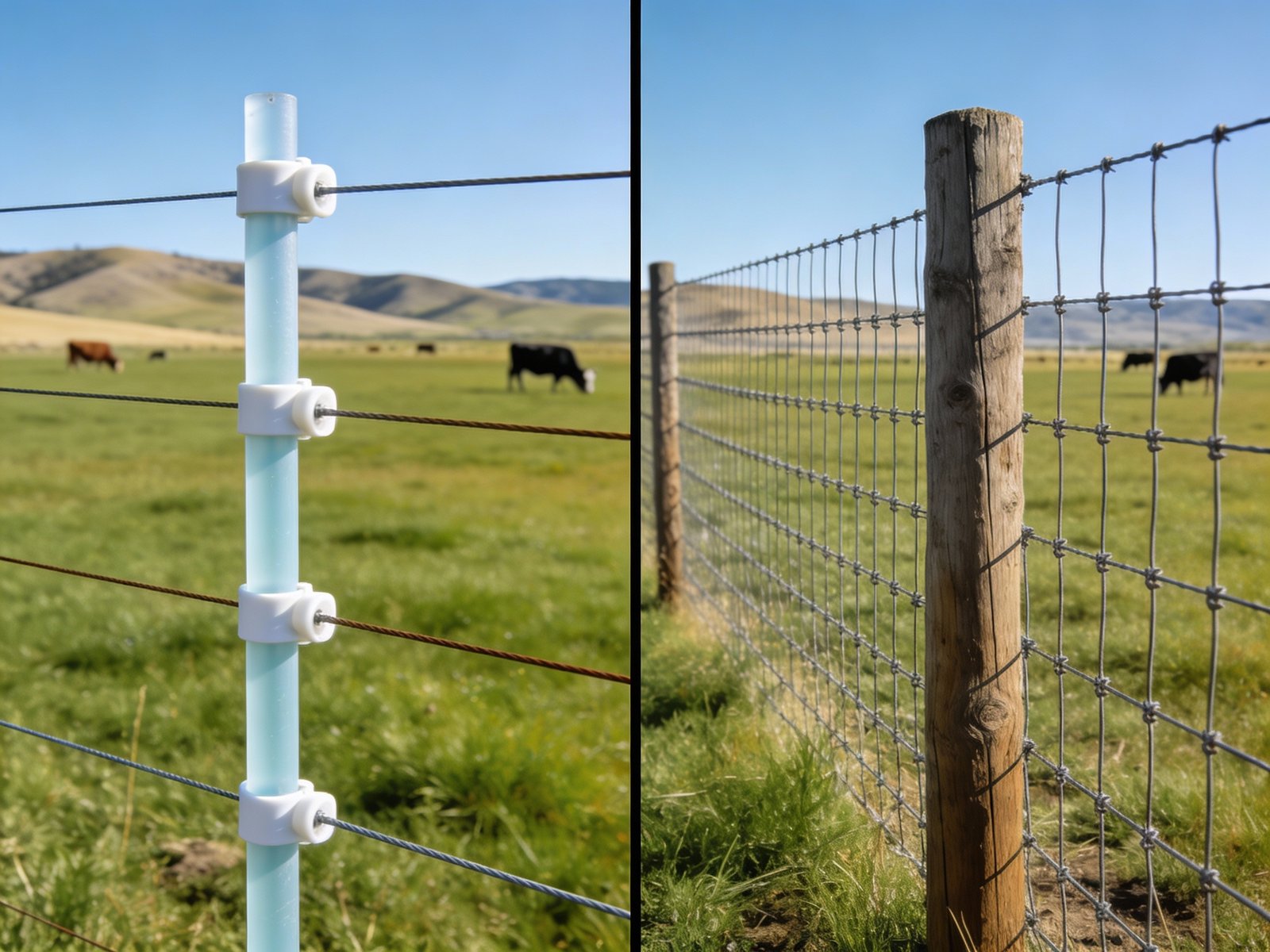
For cattle owners evaluating fencing options, the most critical differences between electric and woven wire systems fall into five key categories. Each system offers distinct advantages depending on your farm’s specific requirements, budget constraints, and management approach.
Cost (Initial & Long-Term)
Electric cattle fencing delivers substantial cost advantages in both installation and materials. A basic three-strand high-tensile electric fence costs approximately $0.30 to $1.00 per linear foot for materials, with total installation costs ranging from $1.00 to $6.00 per linear foot depending on terrain and post spacing. For a mile of fencing, electric systems typically run between $1,584 and $6,000, making them the most economical option for covering large areas. The lower cost stems from fewer required posts, lighter materials, and simpler installation procedures.
Woven wire fencing represents a more significant upfront investment, with material costs ranging from $1.50 to $6.00 per linear foot and total installed costs between $3.50 and $6.00 per linear foot. A mile of woven wire fence typically costs between $18,480 and $31,680 to install. This higher expense results from the heavy mesh material, closer post spacing requirements, specialized installation tools, and increased labor time needed for proper tensioning and corner bracing.
Long-term cost analysis shifts the equation considerably. Electric fencing requires ongoing maintenance including regular vegetation clearing to prevent grounding, energizer replacement or battery maintenance, periodic voltage testing, and potential insulator replacement. Woven wire fences, once properly installed, require minimal maintenance and can last 25-40 years with high-tensile, Class III galvanized wire, compared to 15-20 years for properly maintained electric systems. When calculating annual cost per mile over the fence’s lifespan, high-tensile woven wire can cost as little as $1,163 annually, making it competitive with electric fencing when evaluated over decades.
Durability & Lifespan
Woven wire fencing demonstrates superior durability and physical resilience. The interlocked grid structure of horizontal and vertical wires creates a fence that can withstand significant animal pressure, fallen trees, and harsh weather conditions without losing structural integrity. High-tensile woven wire with Class III galvanization offers exceptional corrosion resistance and can maintain tension for decades. Fixed-knot construction, where vertical and horizontal wires are mechanically locked together, provides even greater strength and prevents the fence from deforming when cattle push against it.
Electric fencing relies on psychological deterrence rather than physical strength, making it inherently less durable as a physical barrier. While the high-tensile wire itself is strong, the fence’s effectiveness depends entirely on consistent electrical current. Power outages, energizer failures, grounding caused by vegetation contact, or battery depletion can render the fence ineffective within hours. The wire strands can also be damaged more easily than woven wire mesh, and cattle that become accustomed to occasional power failures may learn to challenge or ignore the fence.
Weather resistance differs significantly between systems. Woven wire fences perform consistently in all conditions, from heavy snow to intense heat. Electric fences face challenges during wet conditions (which can cause grounding), dry periods (which reduce ground rod effectiveness), and winter weather (which drains solar panel and battery performance). However, properly installed high-tensile electric wire with quality insulators can still deliver reliable service for 15-20 years or more.
Containment Effectiveness
Both systems effectively contain cattle, but through fundamentally different mechanisms. Woven wire provides absolute physical containment—cattle simply cannot push through the tightly woven mesh even if they wanted to. This makes woven wire ideal for situations requiring guaranteed containment, such as property boundaries adjacent to roads, areas with high predator pressure, or when managing aggressive bulls. The visual presence of the fence is also clear to cattle, reducing accidental contact and associated stress.
Electric fencing relies on behavioral conditioning. Cattle quickly learn to respect a properly charged electric fence after one or two encounters with the 2,000-3,000 volt pulse. For most cattle operations, this psychological barrier proves highly effective, especially for mature, well-trained animals. Electric fencing’s effectiveness increases significantly when cattle are properly introduced to it, adequate voltage is maintained throughout the fence line, and the fence is clearly visible to prevent accidental contact.
However, electric fencing faces challenges that woven wire does not. Young calves may slip under or through widely spaced strands. Bulls in breeding condition may challenge electric fences more aggressively. If power fails or voltage drops below effective levels, cattle may quickly discover the fence is no longer a deterrent. Vegetation contact, poor grounding, or energizer malfunction can create weak spots that cattle learn to exploit. Woven wire eliminates these variables by providing consistent physical containment regardless of external conditions.
Installation Complexity
Electric fencing offers significantly easier and faster installation. A basic electric fence system requires lightweight fiberglass or steel posts spaced 30-50 feet apart, simple wire attachment using insulators, and an energizer connection. For temporary or semi-permanent installations, step-in posts can be placed and removed by hand in minutes. A competent crew can install a mile of three-strand electric fence in 1-2 days, even on moderately challenging terrain. The tools required are minimal—a post driver, wire cutters, and basic hand tools.
Woven wire installation demands considerably more labor, skill, and specialized equipment. Proper installation requires heavy-duty corner and end assemblies with substantial bracing, line posts spaced 8-12 feet apart, fence stretchers or come-alongs to achieve proper tension, and careful attention to maintaining consistent height and tension throughout the fence line. A professional crew typically needs 4-6 days to install a mile of woven wire fencing. Improper installation—inadequate corner bracing, insufficient tension, or uneven post spacing—can result in a fence that sags, loses effectiveness, or fails prematurely.
Terrain considerations also differ. Electric fencing adapts relatively easily to uneven ground, requiring only that posts maintain wire height and insulators prevent grounding. Woven wire installation on hilly or rocky terrain becomes significantly more challenging, often requiring additional posts, custom corner assemblies, and careful planning to maintain proper tension and ground clearance.
Maintenance Requirements
Electric fencing requires active, ongoing maintenance to remain effective. Vegetation management is critical—grass, weeds, or branches contacting the wire will drain voltage and may render the fence ineffective. This necessitates regular mowing, trimming, or herbicide application along the fence line, especially during peak growing seasons. Energizers require periodic testing, battery replacement for solar units, and occasional repair or replacement. Insulators can crack or fail over time, requiring inspection and replacement. Voltage testing should be performed monthly or more frequently to ensure the fence maintains adequate deterrent power.
Woven wire fencing, once properly installed, operates as a passive barrier requiring minimal maintenance. The fence does not depend on electrical components, vegetation contact does not compromise effectiveness, and the sturdy construction resists deformation from normal cattle pressure. Routine maintenance typically involves annual fence line inspection, occasional tightening of wire tension, and repair of any damage from falling trees or vehicular contact. Many woven wire fences operate for years with virtually no maintenance beyond basic inspection.
The maintenance burden of electric fencing can become a significant operational consideration, particularly for farmers managing large acreages or multiple properties. The time and labor required for vegetation control and system monitoring must be factored into the total cost of ownership. Woven wire’s passive operation eliminates these recurring maintenance tasks, freeing farmer time for other priorities.
| Factor | Electric Fence | Woven Wire Fence |
|---|---|---|
| Initial Cost (per linear foot) | $1.00 – $6.00 | $3.50 – $6.00 |
| Cost per Mile (materials + labor) | $1,584 – $6,000 | $18,480 – $31,680 |
| Lifespan | 15-20 years | 25-40 years |
| Barrier Type | Psychological | Physical |
| Installation Time (per mile) | 1-2 days | 4-6 days |
| Maintenance Level | High (regular vegetation control, voltage testing) | Low (annual inspection, occasional repairs) |
| Flexibility | High (easily moved or reconfigured) | Low (permanent installation) |
| Power Dependency | Required (failure compromises effectiveness) | None |
| Best Use Cases | Rotational grazing, temporary paddocks, interior divisions | Perimeter fencing, predator areas, permanent boundaries |
Electric Cattle Fencing — Strengths & Limitations
Electric cattle fencing has revolutionized pasture management by providing an economical, flexible, and psychologically effective containment system. Understanding both the capabilities and constraints of electric fencing helps farmers determine where this system will perform optimally and where alternative solutions may be more appropriate.
Why Electric Fencing Works Well for Cattle
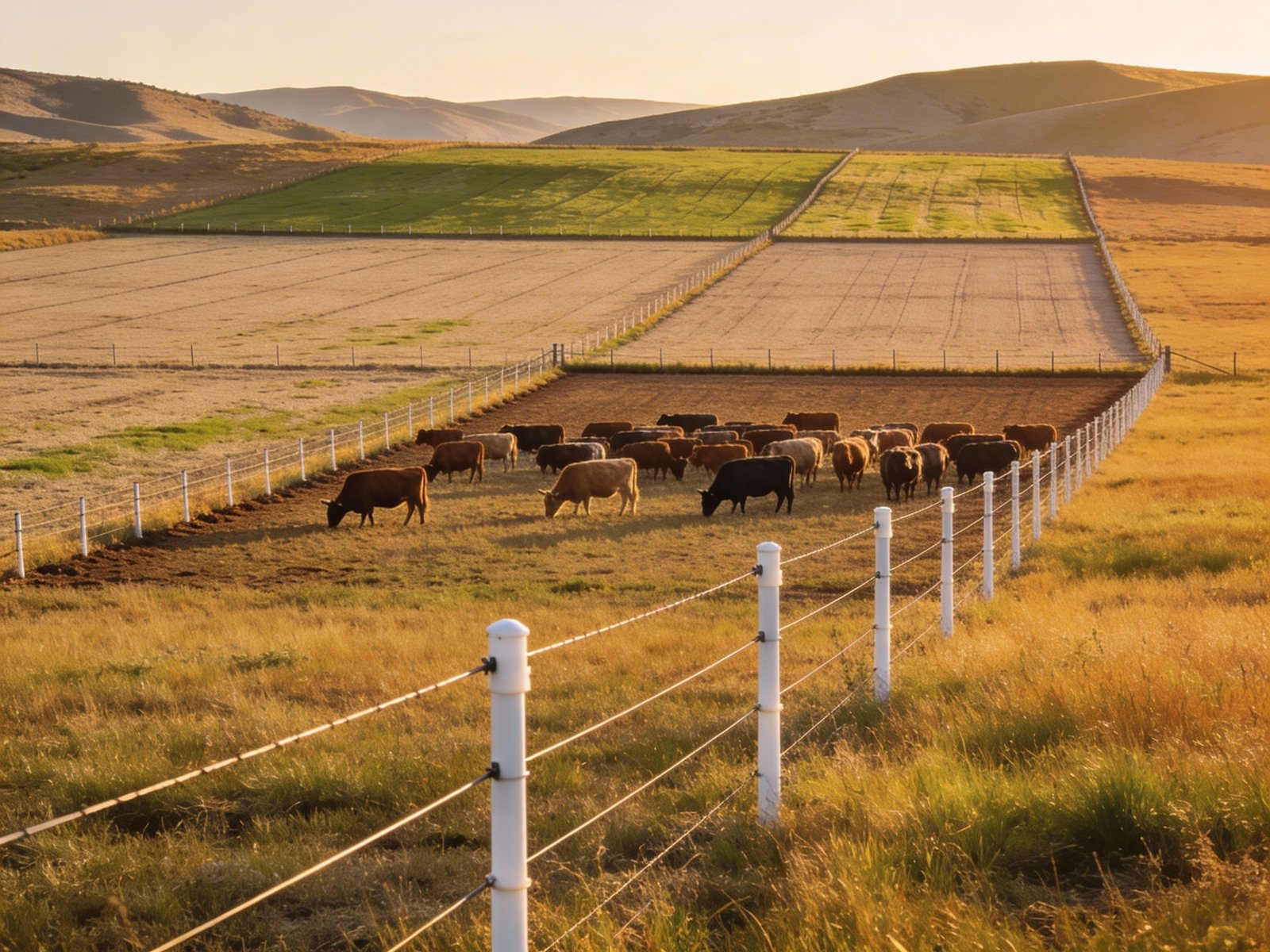
The fundamental advantage of electric fencing lies in its psychological training effect. Cattle possess tough hides that resist minor scratches or pressure, but they respond powerfully to the brief, high-voltage shock delivered by a properly charged electric fence. After one or two encounters with a 2,000-3,000 volt pulse, most cattle develop a lasting respect for the fence boundary. This learned behavior creates an effective invisible barrier that cattle will not challenge, even though the physical wire presents minimal actual obstacle.
Cost-effectiveness stands as electric fencing’s most compelling benefit, particularly for large-scale operations. The dramatic reduction in material costs—up to 80% less than woven wire for comparable length—allows farmers to fence significantly larger areas within budget constraints. The lower post count requirement (posts spaced 30-50 feet apart versus 8-12 feet for woven wire) further reduces both material and labor expenses. For operations managing hundreds or thousands of acres, these savings become transformational, enabling comprehensive pasture management that would be financially prohibitive with traditional fencing.
Flexibility represents another major strength. Electric fencing adapts seamlessly to rotational grazing systems, where cattle are moved between paddocks on regular schedules to optimize forage utilization and pasture recovery. Temporary electric fences using polywire and step-in posts can be installed in hours and moved just as quickly, allowing farmers to create custom paddock sizes based on cattle numbers, forage availability, and recovery time requirements. This adaptability supports intensive grazing management techniques like mob grazing or adaptive multi-paddock grazing, which can dramatically improve soil health, forage production, and stocking rates.
Installation speed and simplicity give electric fencing additional advantages. Basic electric fence systems require minimal specialized knowledge or equipment. A farmer working alone can install temporary electric fencing using step-in posts and polywire at rates exceeding 500 feet per hour. Even permanent high-tensile electric installations proceed much faster than woven wire equivalents. This speed advantage becomes particularly valuable when establishing grazing systems on rented land, creating temporary holding areas, or responding quickly to changing management needs.
Reduced animal injury represents an often-overlooked benefit. Unlike barbed wire, which can cut and gouge cattle, or even woven wire, which cattle may push against and damage themselves, electric fencing creates a hands-off boundary. Cattle learn to avoid contact entirely, eliminating the fence-rubbing behavior that causes hide damage, fence wear, and potential injury. This behavioral shift reduces veterinary costs and prevents the production losses associated with injured animals.
Where Electric Fencing Falls Short
The absolute dependency on consistent electrical power constitutes electric fencing’s primary vulnerability. Unlike physical barriers that function continuously regardless of external conditions, electric fences become immediately ineffective when power fails. Energizer malfunction, dead batteries in solar-powered systems, lightning damage, or simple power outages can eliminate the fence’s deterrent effect within minutes. Cattle that discover the fence is no longer “hot” may breach the boundary, and some individuals will remember this weakness and test the fence regularly thereafter.
Vegetation management creates an ongoing maintenance burden that many farmers underestimate. Any plant growth that contacts the hot wire creates a ground path that drains voltage from the system. During peak growing seasons, grass and weeds can require weekly trimming along fence lines. Failure to maintain adequate clearance results in progressive voltage drop, weakening the deterrent effect and potentially allowing cattle to breach the fence. This maintenance requirement becomes particularly challenging when managing multiple miles of fence line, especially in properties with abundant vegetation growth.
Grounding issues can severely compromise electric fence effectiveness, yet they often prove difficult to diagnose and resolve. Adequate grounding requires proper ground rod installation—typically three 6-8 foot ground rods driven at least 10 feet apart in consistently moist soil. In dry climates or during drought conditions, ground rod effectiveness decreases substantially, reducing the shock intensity cattle experience. Poor grounding creates “weak” fences that some cattle learn to tolerate or ignore, undermining the psychological barrier concept entirely.
Electric fencing provides limited physical security in certain situations. Young calves can slip under or between widely spaced wire strands. Bulls in breeding condition may challenge electric fences more aggressively, particularly if they can see or smell cows on the other side. Cattle unfamiliar with electric fencing require training and may challenge the fence repeatedly until they learn to respect it. In high-stress situations—during severe weather, when predators are present, or if panicked by unusual disturbances—some cattle may crash through electric fencing despite the shock.
Predator protection limitations affect operations in areas with significant predation pressure. While electric fencing can deter some predators, determined wolves, coyotes, or dogs may breach polywire or single-strand systems. The psychological barrier that effectively contains cattle does not provide the same security against predators that can slip under, jump over, or tolerate the shock to reach vulnerable calves. Operations facing serious predation challenges often find electric fencing alone insufficient for perimeter security.
Best Use Cases for Electric Cattle Fences
Rotational grazing systems represent the ideal application for electric cattle fencing. The ability to quickly create, modify, and relocate paddock boundaries allows farmers to implement sophisticated grazing strategies that optimize forage utilization and pasture recovery. Temporary electric fencing using polywire and step-in posts enables farmers to strip-graze pastures, giving cattle access to fresh forage daily or every few days while allowing previously grazed areas extended recovery periods. This management approach, which would be impractical with permanent fencing, can increase effective stocking rates by 30-50% while improving pasture health and productivity.
Large pasture management benefits enormously from electric fencing’s cost advantages. Operations managing 500, 1,000, or more acres can subdivide vast pastures into manageable paddocks at a fraction of the cost of woven wire or other permanent fencing. The reduced financial barrier allows comprehensive pasture division that supports better grazing management, easier cattle movement, and improved forage utilization across the entire property. For ranches in western states or other areas with extensive acreage, electric fencing often makes the difference between feasible and prohibitively expensive pasture management.
Temporary fencing needs play to electric fencing’s core strengths. Creating holding areas for sorting, establishing temporary lanes for cattle movement, subdividing pastures for specific management objectives, or creating bale grazing paddocks for winter feeding all benefit from electric fencing’s quick installation and easy removal. Farmers renting pasture land particularly value electric fencing’s portability—the entire system can be removed and relocated when the rental period ends, protecting the investment and allowing reuse on different properties.
Interior paddock divisions within larger permanent fences benefit from electric fencing’s flexibility and economy. Many successful operations use woven wire or other permanent fencing for perimeter security, then create flexible interior divisions using electric fencing. This hybrid approach combines the security and permanence of physical barriers with the adaptability and cost-effectiveness of electric systems, delivering optimal performance for the specific requirements of each fence line.
Woven Wire Cattle Fencing — Strengths & Limitations
Woven wire fencing represents traditional, time-tested technology that continues to serve as the gold standard for permanent cattle containment. Its physical barrier approach provides unmatched security and durability, though at higher initial cost and reduced flexibility compared to electric alternatives.
Why Woven Wire Fences Are Highly Reliable
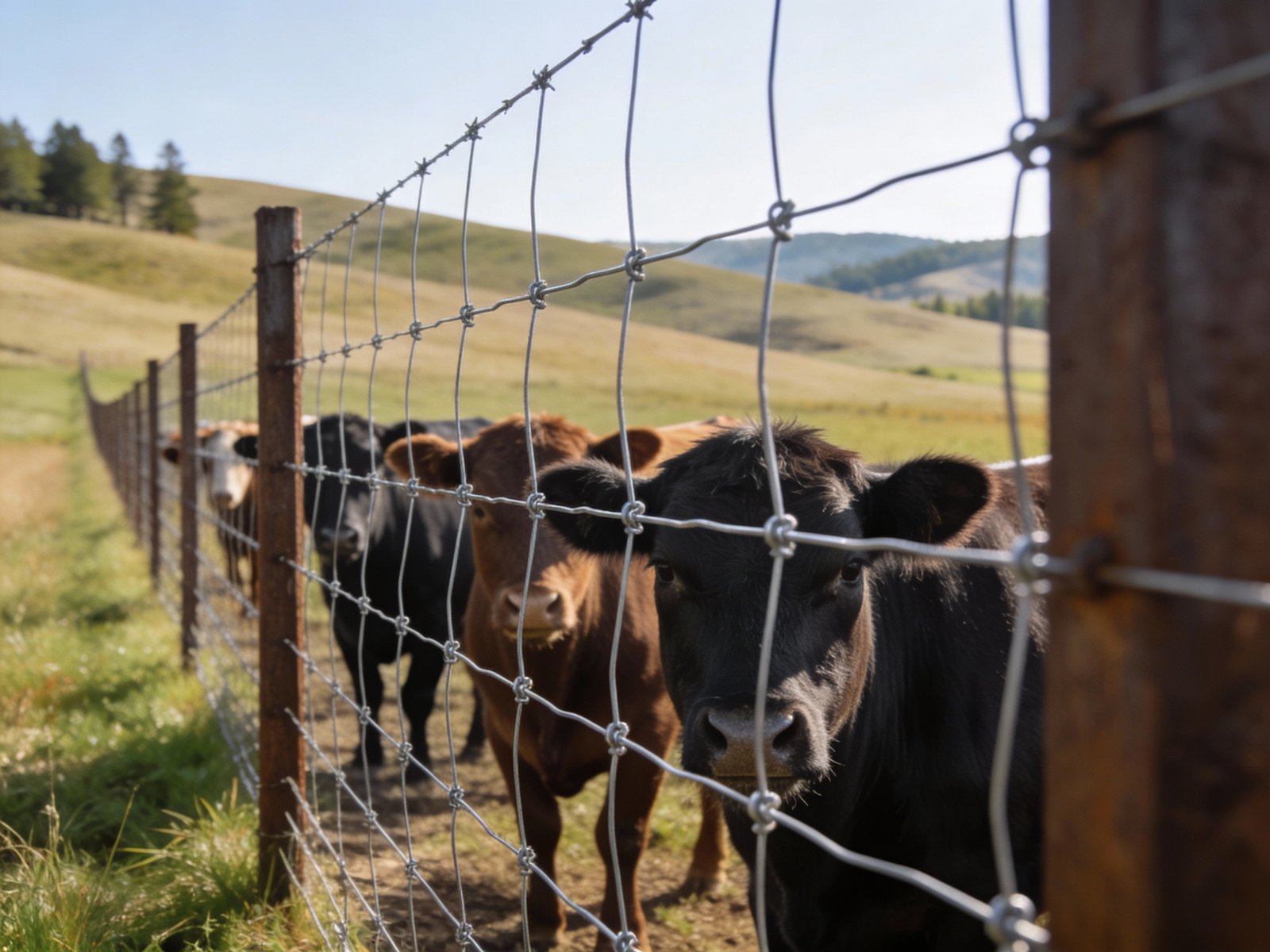
The fundamental strength of woven wire fencing lies in its role as an absolute physical barrier. The interlocked grid of horizontal and vertical wires creates a fence that cattle simply cannot push through, regardless of motivation or external circumstances. This guaranteed containment eliminates variables that can compromise electric fencing—power failures, voltage drops, untrained animals, or high-stress situations have no effect on woven wire’s effectiveness. Property owners with boundaries adjacent to roads, neighbors’ property, or other areas where fence breaches create serious liability concerns particularly value this reliability.
Structural durability distinguishes quality woven wire systems. High-tensile woven wire constructed with 12.5-gauge wire and Class III galvanization can withstand decades of exposure to weather, animal pressure, and environmental stress without significant degradation. Fixed-knot construction, where vertical stays are mechanically locked to horizontal wires, creates a fence that maintains tension and shape even when cattle push, rub, or lean against it. Some ranchers report high-tensile fixed-knot fences surviving fallen trees without breaking or losing significant structural integrity—a resilience no electric or standard field fence can match.
Predator protection capabilities make woven wire essential for operations in areas with significant predation pressure. The tight mesh construction prevents coyotes, wolves, and dogs from easily accessing pastures to attack calves or vulnerable cattle. When installed with bottom wire close to ground level or with an apron extending outward, woven wire deters digging predators effectively. Operations raising calves, particularly in remote areas or regions with active predator populations, often find woven wire’s security worth the additional investment.
Long-term cost-effectiveness emerges when evaluating woven wire fencing over its full lifespan. While initial installation costs run two to three times higher than electric fencing, the minimal maintenance requirements and 25-40 year lifespan create favorable economics over time. Quality woven wire fences can outlast multiple electric fence rebuilds while requiring only occasional inspection and minor repairs. When amortized over the fence’s life, annual costs can be competitive with electric systems that require regular maintenance, energizer replacement, and more frequent rebuilding.
Visual clarity benefits both cattle and farm management. Woven wire creates an obvious, visible boundary that cattle can clearly see and understand. This reduces stress from accidental fence contact, prevents cattle from repeatedly testing boundaries, and creates clear property lines for management and legal purposes. The fence’s permanent nature also increases property value, as prospective buyers recognize the long-term infrastructure investment represented by quality woven wire fencing.
Limitations of Woven Wire Fencing
High upfront costs represent woven wire fencing’s most significant limitation. Material costs alone run $1.50 to $3.00 per linear foot for quality woven wire, before considering posts, corner assemblies, gates, and other components. Professional installation adds $2.00 to $3.00 per linear foot in labor costs, bringing total installed costs to $3.50 to $6.00 per foot or more for challenging terrain. For a mile of fencing, total costs typically range from $18,480 to over $31,000—an investment many farming operations struggle to justify, particularly when covering extensive acreages.
Installation complexity demands significant skill, specialized equipment, and substantial labor time. Proper woven wire installation requires heavy-duty corner assemblies with H-brace or N-brace construction, precise tension adjustment using fence stretchers, consistent post spacing and alignment, and careful attention to maintaining uniform height and ground clearance. Improper installation results in fences that sag, lose tension, or fail prematurely, wasting the substantial investment. Many farmers lack the knowledge, equipment, or physical capability to install woven wire properly, necessitating professional contractors and further increasing costs.
Lack of flexibility creates limitations for certain management approaches. Once installed, woven wire fences become permanent infrastructure that cannot be easily moved or reconfigured. This permanence conflicts with rotational grazing systems that benefit from adjustable paddock sizes, temporary subdivisions for specific management objectives, or adaptive grazing strategies that respond to changing forage conditions. Farmers committed to intensive grazing management often find woven wire’s inflexibility constraining, limiting their ability to optimize pasture utilization.
Terrain challenges increase installation difficulty and cost on hilly, rocky, or uneven ground. Maintaining proper tension and ground clearance across varying elevations requires additional posts, custom corner assemblies, and significant additional labor. Rocky soil that prevents proper post setting or areas with frequent elevation changes can make woven wire installation prohibitively difficult or expensive. Electric fencing adapts far more easily to challenging terrain, requiring only that posts maintain adequate wire height.
Repair complexity presents ongoing challenges. Unlike electric fencing where broken wires can be quickly spliced or replaced, woven wire damage from fallen trees, vehicular contact, or wire breakage requires specialized tools and techniques to repair properly. Improper repairs create weak points that compromise the entire fence section. The heavy, rigid nature of woven wire also makes handling and repair physically demanding, particularly in remote locations or difficult terrain.
Best Use Cases for Woven Wire Cattle Fences
Perimeter fencing represents the primary justification for woven wire investment on most cattle operations. Property boundaries, especially those adjacent to roads, neighbors’ land, or public areas, require absolute reliability and permanent infrastructure. The liability concerns associated with cattle escaping onto roads or neighboring property, combined with the need for clear property demarcation, make woven wire’s guaranteed containment worth the additional cost. Perimeter fences also benefit most from woven wire’s longevity—these boundaries rarely need reconfiguration, allowing the fence to serve for decades without modification.
High-pressure containment areas justify woven wire investment. Bull pens, breeding areas, or paddocks housing aggressive or particularly valuable animals benefit from physical barriers that function regardless of electrical power or animal behavior. Bulls in breeding condition may challenge electric fencing aggressively, but properly installed woven wire provides absolute containment. Similarly, areas where cattle congregate regularly—around water sources, feeding areas, or shelter—experience sustained pressure that can wear down or damage lighter fencing systems, making woven wire’s structural strength valuable.
Predator protection requirements drive woven wire selection in certain regions. Operations in areas with active wolf, coyote, or feral dog populations, particularly those raising calves, often find electric fencing alone insufficient to prevent predation losses. Woven wire’s tight mesh construction and physical barrier capabilities provide security that protects vulnerable animals and reduces losses. Some ranchers implement “fortress” approaches using woven wire with buried aprons or electric offset wires for maximum predator deterrence.
Long-term infrastructure investment makes sense for permanent operations planning to maintain property for decades. Family farms, established ranches, or operations with stable land ownership can justify woven wire’s higher initial cost through its decades-long service life and minimal maintenance requirements. The fence becomes a generational asset that increases property value while requiring minimal ongoing investment. This contrasts with rental or short-term operations where woven wire’s cost and permanence create financial disadvantages.
Certain regulatory or insurance requirements may mandate physical barrier fencing. Properties adjacent to protected wildlife areas, organic certification boundaries, or locations with specific liability insurance requirements may need woven wire’s definitive containment capabilities. Similarly, operations in areas with strict fence-out laws or heightened legal liability for animal escapes benefit from woven wire’s reliability and clearly defined property boundaries.
Electric vs Woven Wire Fence — Which Should You Choose?
The decision between electric and woven wire cattle fencing should be driven by your specific operational requirements, management style, budget constraints, and long-term farm goals. Neither system is universally superior—each excels in different applications and farm contexts.
Choose Electric Fencing If…
Your operation emphasizes rotational grazing or adaptive pasture management. Electric fencing’s flexibility allows you to create, modify, and relocate paddock boundaries quickly, supporting intensive grazing strategies that optimize forage utilization and pasture recovery. If you plan to move cattle between paddocks weekly, implement strip grazing, or adjust paddock sizes based on seasonal forage availability, electric fencing provides the adaptability these systems require.
Budget constraints limit your fencing investment. When initial capital is limited but you need to fence extensive acreage, electric fencing’s 60-80% cost savings compared to woven wire may make the difference between implementing comprehensive pasture management or leaving large areas undivided. The dramatic reduction in both material and installation costs allows maximum pasture subdivision within realistic budget parameters.
You manage large pastures or extensive acreage. Operations with 500, 1,000, or more acres benefit enormously from electric fencing’s economy when subdividing vast areas. The cost of installing woven wire across such expanses would be prohibitive for most operations, while electric fencing makes comprehensive pasture division financially feasible.
Your property requires temporary or semi-permanent fencing. If you rent pasture land, need temporary holding areas, create seasonal paddocks, or anticipate future property changes, electric fencing’s portability and easy removal protect your investment. The entire system can be relocated when circumstances change, unlike permanent woven wire installations.
You have the capability to maintain consistent vegetation control and system monitoring. If your operation can commit to regular fence line maintenance, voltage testing, and energizer monitoring, electric fencing will perform reliably. Farmers with manageable fence line lengths, adequate labor availability, or willingness to implement systematic maintenance schedules can successfully operate electric systems.
Your cattle are calm, well-trained animals in low-stress situations. Mature cattle that have learned to respect electric fencing will generally not challenge properly maintained systems. Operations without aggressive bulls, minimal external stressors, and cattle familiar with electric boundaries experience high success rates with electric fencing.
Choose Woven Wire Fencing If…
Your primary need is permanent perimeter fencing. Property boundaries, especially those adjacent to roads, neighbors, or public areas, benefit from woven wire’s guaranteed containment and clear property demarcation. The absolute reliability of physical barriers eliminates concerns about power failures or system malfunctions creating liability situations.
Predator pressure poses significant risks to your herd. In regions with active wolf, coyote, or feral dog populations, particularly if you raise calves, woven wire’s physical barrier and tight mesh construction provide essential predator protection that electric fencing alone cannot match.
Your operation requires guaranteed containment in high-pressure areas. Bull pens, breeding areas, or paddocks housing aggressive or valuable animals benefit from woven wire’s absolute security. If cattle escape would create serious consequences—legal liability, injury risk, or substantial financial loss—woven wire’s reliability justifies the additional investment.
You prefer low-maintenance, passive infrastructure. If regular vegetation control, voltage testing, and energizer monitoring conflict with your management style or labor availability, woven wire’s minimal maintenance requirements may be preferable despite higher initial costs. Once properly installed, quality woven wire requires only occasional inspection and minor repairs.
Your farm represents a long-term investment with stable land ownership. Family operations, established ranches, or farms you plan to own for decades can justify woven wire’s higher initial cost through its 25-40 year lifespan and minimal ongoing expenses. The fence becomes a generational asset that increases property value.
Electrical power access is limited or unreliable. Remote properties without convenient electrical access, areas with frequent power outages, or locations where solar energizer performance would be compromised benefit from woven wire’s independence from electrical infrastructure.
When a Hybrid Fence System Makes Sense
Many successful cattle operations implement hybrid fencing strategies that combine woven wire’s security with electric fencing’s flexibility. This approach positions each system where it performs optimally, maximizing overall effectiveness while controlling costs.
The most common hybrid configuration uses woven wire for perimeter boundaries and electric fencing for interior divisions. This strategy provides guaranteed containment around property boundaries where security is paramount, while enabling flexible, cost-effective paddock creation within the secure perimeter. The combination delivers reliability where it matters most while maintaining the adaptability needed for sophisticated grazing management.
Another effective hybrid approach adds electric offset wires to existing woven wire fences. Installing one or two electric wires 8-12 inches outside the woven wire fence deters cattle from pushing, leaning, or rubbing against the mesh. This behavioral modification extends woven wire fence life by eliminating the animal pressure that causes gradual deformation and wear. The psychological barrier of the electric wire keeps cattle away from physical contact with the woven wire, combining the strengths of both systems.
Some operations use woven wire in high-risk areas—along roads, in predator zones, or for valuable breeding stock—while deploying electric fencing elsewhere. This targeted approach focuses expensive permanent infrastructure where security is non-negotiable while using economical electric systems where flexibility and cost-effectiveness provide greater value.
Hybrid systems can also phase infrastructure development within budget constraints. Starting with woven wire perimeter fencing establishes secure property boundaries, then adding electric interior divisions as budget allows creates comprehensive pasture management over time. This staged approach spreads investment across multiple years while building toward complete farm infrastructure.
Cost Comparison: Electric Fence vs Woven Wire Fence
Comprehensive cost analysis requires evaluating both initial installation expenses and long-term ownership costs, including maintenance, repairs, and expected lifespan. The apparent cost advantage of electric fencing diminishes when full lifecycle economics are considered, though electric systems still typically offer superior value for many applications.
Material Costs
Electric fencing materials cost substantially less than woven wire equivalents. A basic three-strand high-tensile electric fence requires 12.5-gauge high-tensile wire ($40-$60 per 4,000-foot roll), fiberglass or steel posts at 30-50 foot spacing ($2-$8 per post), insulators ($0.50-$1.50 each), and an energizer ($100-$500 depending on fence length and power source). For 1 mile of three-strand electric fence, material costs typically total $800-$1,500. Polywire systems for temporary fencing cost even less, with a 1,320-foot reel of polywire costing $30-$50 and step-in posts at $2-$5 each.
Woven wire material costs run significantly higher. Quality 48-inch high-tensile woven wire costs $180-$250 per 330-foot roll, or approximately $2,900-$4,000 per mile. Posts must be spaced 8-12 feet apart (requiring 440-660 posts per mile at $5-$15 each), adding $2,200-$9,900. Heavy-duty corner assemblies with proper bracing cost $75-$150 per corner. Total material costs for woven wire fence typically range from $5,000-$15,000 per mile before labor.
The material cost differential—electric fencing typically costs 60-85% less than woven wire—represents electric fencing’s most compelling economic advantage. For operations needing to fence extensive acreage, this cost reduction can mean the difference between comprehensive pasture subdivision and minimal fencing infrastructure.
Labor & Installation Costs
Electric fence installation labor costs remain modest due to simpler installation procedures and faster completion times. Professional installation typically costs $0.50-$2.00 per linear foot for permanent high-tensile systems, or about $2,640-$10,560 per mile. Temporary polywire systems install even faster, with competent individuals achieving installation rates of 500+ feet per hour. Many farmers successfully install their own electric fencing, eliminating labor costs entirely while gaining valuable experience with the system.
Woven wire installation demands significantly more labor and expertise. Professional installation costs typically run $2.00-$3.00 per linear foot, adding $10,560-$15,840 per mile to material costs. Total installed costs for woven wire frequently reach $18,000-$32,000 per mile. The specialized knowledge, equipment, and physical demands of proper woven wire installation make professional contractors necessary for most farmers, further increasing total project costs.
The labor cost differential reflects not just time requirements but also skill levels and equipment needs. Electric fence installation requires minimal specialized knowledge and basic hand tools. Woven wire installation demands understanding of proper corner bracing, tension adjustment, and fence mechanics, along with access to fence stretchers, post drivers, and other specialized equipment.
Maintenance Over Time
Electric fencing generates ongoing maintenance costs that must be factored into total ownership expenses. Vegetation control requires regular labor—estimates suggest 2-4 hours per mile per growing month for mowing, trimming, or herbicide application along fence lines. For properties in high-growth environments, annual vegetation control labor can reach 20-40 hours per mile. At typical farm labor rates of $15-$25 per hour, this represents $300-$1,000 per mile annually.
Energizer maintenance and replacement add to long-term costs. Solar energizers require battery replacement every 2-4 years ($50-$150 per replacement). Standard energizers last 7-12 years with proper care but eventually require replacement ($100-$500). Insulators gradually fail and need replacement ($50-$100 per mile every 5-10 years). Voltage testing equipment and repair supplies add modest ongoing expenses.
Woven wire maintenance costs remain minimal when quality fencing is properly installed. Annual inspection and minor repairs typically require 2-4 hours per mile, costing $30-$100 in labor. Barring major damage from fallen trees or vehicle impact, well-constructed woven wire fences can operate for decades with minimal intervention. The passive nature of physical barriers eliminates the ongoing vegetation control and electrical system maintenance that drives electric fence costs.
Lifespan differences significantly affect total cost of ownership. Quality high-tensile woven wire with Class III galvanization lasts 25-40 years. Electric fencing components—energizers, insulators, and even wire—typically require replacement or substantial refurbishment after 15-20 years. Over a 30-year period, electric fencing may require one complete rebuild, effectively doubling the initial installation cost. Woven wire installed once can serve the entire period.
Total lifecycle cost analysis often shows woven wire and electric fencing converging over time. While electric fencing offers 60-80% initial cost savings, the accumulated maintenance expenses, component replacements, and shorter lifespan narrow the economic gap. For a mile of fencing over 30 years, total costs might reach $12,000-$18,000 for electric systems versus $20,000-$35,000 for woven wire—a significant difference but not as dramatic as initial installation costs suggest.
Final Recommendation for Cattle Owners
The optimal fencing strategy for your cattle operation depends on your specific circumstances, management philosophy, and long-term goals. The following guidance helps match fencing systems to common farm scenarios and priorities.
Best Fence for Large Pastures
For operations managing extensive acreage—500 acres or more—electric fencing typically offers the most practical solution. The dramatic cost savings enable comprehensive pasture subdivision that would be financially impossible with woven wire. A hybrid approach works particularly well: install woven wire along external property boundaries for security and clear property demarcation, then create flexible interior paddocks using high-tensile electric fencing or temporary polywire systems. This strategy balances cost control with management flexibility, allowing sophisticated rotational grazing across large areas.
Consider permanent high-tensile electric fencing with 3-5 wire strands for semi-permanent paddock divisions, supplemented by temporary polywire systems for adaptive paddock sizing. This configuration supports rotational grazing, strip grazing, or mob grazing strategies while maintaining the economic feasibility needed for extensive land areas. The key is committing to consistent maintenance—vegetation control and voltage monitoring—which becomes critical across large fence line lengths.
Best Fence for Permanent Boundaries
Woven wire fencing represents the superior choice for permanent property perimeters, especially boundaries adjacent to roads, neighbors’ land, or public areas. The guaranteed containment, independence from electrical power, and clear property demarcation justify the additional investment for these critical fence lines. Property boundaries rarely require reconfiguration, allowing woven wire’s 25-40 year lifespan to deliver full value.
Select high-tensile fixed-knot woven wire with Class III galvanization for maximum durability and longevity. For high-pressure areas or properties with predator concerns, consider adding electric offset wires 8-12 inches outside the woven wire to deter cattle from fence contact and extend fence life. This combination provides absolute physical security while using psychological deterrence to minimize fence pressure and wear.
Proper corner assemblies and installation technique are critical—invest in professional installation if you lack experience with woven wire systems. Poor installation wastes the material investment and results in fences that sag, lose tension, or fail prematurely. Quality installation may cost more initially but delivers decades of reliable service.
Best Low-Budget or Flexible Option
Electric fencing clearly wins for budget-conscious operations or situations requiring maximum flexibility. Temporary polywire systems with step-in posts cost under $1,000 per mile and install in hours, making them ideal for rental properties, seasonal grazing, temporary subdivisions, or operations with limited capital. The system can be completely removed and relocated when circumstances change, protecting your investment.
For permanent installations on tight budgets, three-strand high-tensile electric fence offers reliable containment at $1,500-$4,000 per mile installed. While requiring regular maintenance, properly designed electric systems effectively contain cattle at a fraction of woven wire costs. Success requires commitment to consistent vegetation control, voltage monitoring, and energizer maintenance, but the cost savings often justify this operational attention.
Consider phased implementation to spread costs over time. Start with electric fencing for immediate needs, then upgrade critical sections to woven wire as budget allows. Many successful operations begin with all-electric systems, gradually replacing high-traffic or high-security fence sections with woven wire while maintaining electric fencing elsewhere.
Ultimately, the best fencing system for your cattle operation is the one that aligns with your management style, budget reality, and long-term vision. Many farmers find that hybrid approaches combining woven wire’s security with electric fencing’s flexibility deliver optimal performance across diverse farm needs. Carefully evaluate your specific requirements for each fence section, then select the system that best serves that particular application.
For personalized fencing recommendations tailored to your specific operation, visit our contact us page to connect with fencing experts who can help you design the optimal system for your cattle management needs.