
DIY vs Professional Cattle Fence Installation: Risks, Costs & Outcomes
Understanding the long-term implications of installation quality, maintenance burden, and total cost of ownership when choosing between self-installation and professional contractors
Quick Decision Summary: DIY fence installation can be cost-effective for small, low-risk interior fences with experienced labor and forgiving conditions. Professional installation is strongly recommended for perimeter fences, high-tensile systems, high-pressure livestock, or challenging environments where failure carries high cost.
Introduction: Understanding the Choice
Ranchers and farm managers face a fundamental decision when planning fence infrastructure: install the system yourself or hire professional contractors. This choice extends far beyond immediate labor costs. It directly impacts fence longevity, livestock containment reliability, long-term maintenance requirements, and total cost of ownership over the fence’s operational life. The decision also carries implications for liability, warranty coverage, and the operational disruption caused by installation quality issues.
Important Context: This page focuses specifically on the decision trade-offs between DIY and professional installation, not on fence design, material selection, or installation procedures themselves. For detailed installation guidance, see step-by-step fence installation procedures. For material specification frameworks, consult the overall cattle fence planning guide.
The core reality underlying this comparison is straightforward: fence installation quality is not uniformly achieved. Installation decisions—post depth, bracing specification, tensioning technique, material handling—directly determine whether a fence performs reliably for 25-30 years or requires major repairs or replacement within 10-15 years. Some decisions cannot be undone once posts are in ground. This irreversibility means initial installation quality carries disproportionate weight in long-term outcomes.
Understanding failure mechanisms provides essential context for evaluating DIY versus professional installation risk. Installation defects manifest as specific, predictable failure modes documented in typical cattle fence failure mechanisms. The question isn’t whether DIY can match professional quality in theory—it’s whether you can realistically achieve those standards in practice, given your experience, available time, and project complexity.
Decision Criteria Overview
Before evaluating DIY versus professional installation, clarify which characteristics of your project will determine the appropriate approach. These decision criteria establish the context within which you can realistically assess your ability to achieve required standards.
Fence System Complexity
Fence systems vary dramatically in specification and engineering requirements. A simple interior cross-fence using low-tensile hinge joint wire with basic post spacing represents minimal design complexity—posts can follow natural terrain, bracing can be minimal, and tensioning tolerances are wide. In contrast, perimeter fencing for high-value cattle operations using high-tensile fixed knot wire with engineered corner assemblies, storm bracing at specific intervals, and precise tensioning requires substantially more planning and execution precision.
System complexity also encompasses the interaction between fence specification and the environment. A coastal high-tensile fixed knot fence requires specification modifications (Galfan coating instead of Class 3 galvanized, potentially heavier gauge wire) and installation adjustments (drainage considerations, corrosion-resistant fasteners, supplemental protection) that increase technical demand beyond an identical fence in a semi-arid climate, as detailed in environment-specific fence selection guidance.
The knot design you specify carries significant complexity implications. Fixed knot systems require less frequent re-tensioning and lower maintenance burden, but their rigid geometry demands more precise initial installation—posts must be better aligned, tensioning must be more accurate, and bracing must be more substantial. Hinge joint systems tolerate installation imprecision better but demand more ongoing maintenance to manage progressive knot deformation.
Project Size & Accessibility
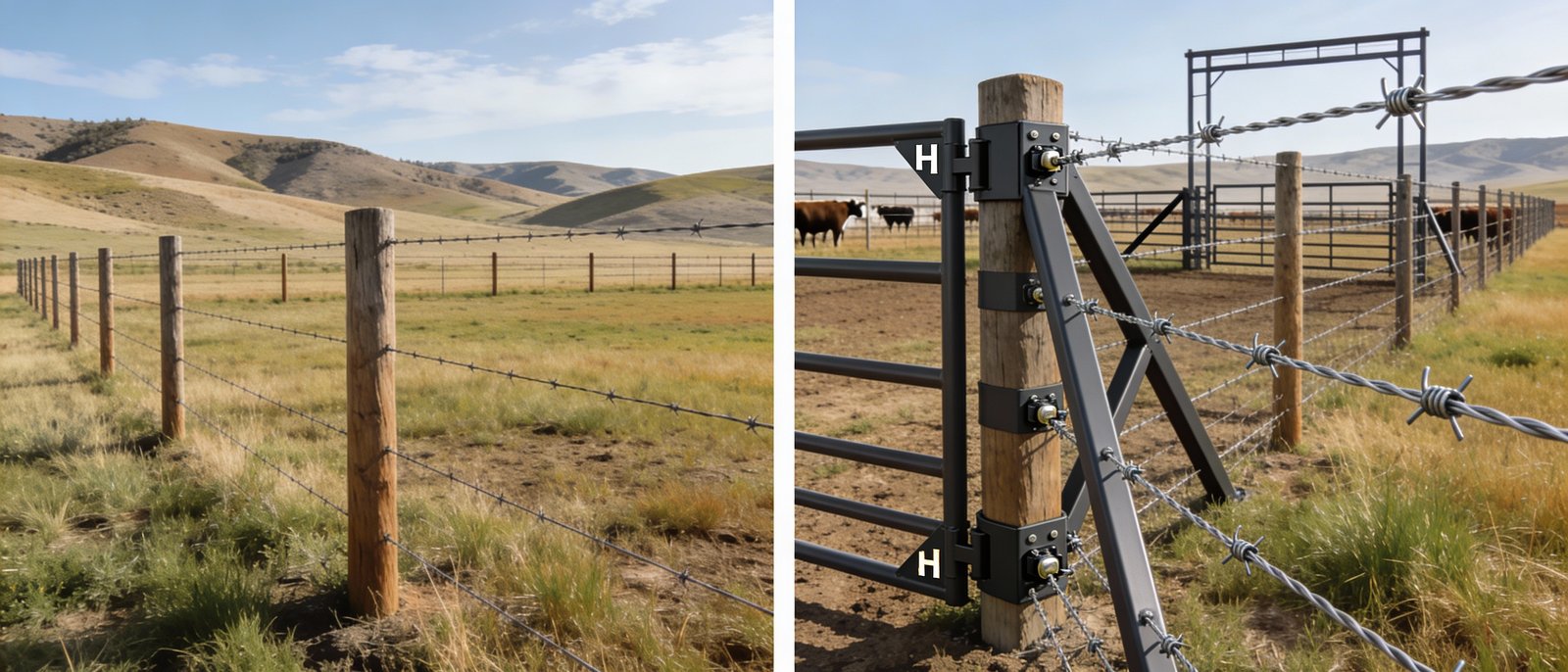
Project scale affects both feasibility and efficiency of DIY versus professional installation. A 2-3 mile interior subdivision fence on flat, accessible terrain is substantially different from a 5-mile perimeter fence crossing varied topography with multiple gates and difficult-access corners. As project size increases, sustained effort and coordination demands grow exponentially.
Accessibility directly impacts labor duration and efficiency. Terrain that is easily reached with equipment allows professional crews to work at rates that DIY labor cannot match, shifting the economic equation toward professional installation. Conversely, small projects on accessible land may be economically neutral between DIY and professional approaches—DIY saves labor cost but professional work completes faster, reducing operational disruption.
Livestock Pressure & Risk
The species and intensity of livestock you contain directly affects the margin for installation error. A cow-calf operation with mixed-age cattle creates moderate pressure; a bull containment operation or high-density rotational grazing system with high-impact cattle exerts extreme pressure on fence systems. Fences designed for extreme pressure tolerate installation imprecision poorly—undersized posts, inadequate bracing, or insufficient tensioning will fail prematurely under intensive pressure, while the same imprecisions might not manifest as early failure in moderate-pressure scenarios.
This risk gradient shifts the installation decision. DIY installation for bull fencing or high-density grazing represents greater risk than DIY installation for cow-calf operations. The cost difference between DIY and professional labor becomes less significant when DIY failure is more likely to cause escape, livestock commingling, injury risk, or rapid fence deterioration requiring expensive emergency replacement. Understanding fence requirements by livestock type helps assess this risk dimension.
Environment & Soil Conditions
Environmental conditions determine whether installation complexity is moderate or advanced. Semi-arid climates with stable soils and modest temperature variation permit installation with wide tolerance windows. Frost-susceptible regions with deep frost lines, coastal zones requiring specialized corrosion management, or areas with expansive clay soils impose stricter specification requirements and narrower installation tolerances, as documented in climate-specific fencing requirements.
Post depth decisions in frost-susceptible regions cannot be compromised—posts set above frost line will heave regardless of other quality factors, creating cascading failures that early mistakes cannot correct. Soil conditions that are difficult to work in (waterlogged soils requiring drainage management, highly compacted soils requiring special equipment, rocky soils with inadequate bearing capacity) increase both labor difficulty and technical knowledge required.
Budget & Time Constraints
Budget constraints obviously affect whether professional labor is economically feasible. However, budget operates in the context of time constraints and opportunity cost. A rancher with substantial time availability during off-season periods and no competing labor demands can absorb DIY labor cost more easily than a rancher with continuous operation requiring consistent staff presence. The opportunity cost of labor shifts based on operational phase—labor during busy season is more costly (requires hiring temporary replacement) than labor during slow season.
Time constraints also operate on the other axis: can you afford to have fence installation occurring over an extended period (weeks or months for DIY projects) versus compressed duration (days or weeks for professional crews)? Extended installation periods mean fence sections remain incomplete, potentially reducing operational flexibility and extending the operational disruption window.
Long-Term Maintenance Expectations
The fence system you specify and how well you install it determine maintenance burden for decades. High-tensile fixed knot fences with proper installation require re-tensioning every 3-4 years and routine annual inspections. Low-carbon or hinge joint fences require annual re-tensioning or more frequent maintenance. However, improperly installed fences of any type require maintenance more frequently and more intensively because installation defects compound—inadequate post depth enables progressive heave that must be managed repeatedly, improper tensioning accelerates knot deformation requiring premature re-tensioning, poor post alignment concentrates stress accelerating localized failures.
Maintenance burden depends partly on decisions you made during installation. Professional installation typically results in lower maintenance burden because systems are installed correctly from the outset, while DIY installation mistakes often create higher maintenance burden that persists for the fence’s remaining life, as detailed in long-term fence maintenance planning. This maintenance burden differential directly affects long-term cost of ownership.
DIY Installation: What It Is & What It Costs
What DIY Typically Entails
DIY installation means you (the ranch owner or manager) and potentially your crew, family, or hired farm labor manage the complete installation process. This includes design decisions—determining material specifications, post spacing, bracing strategy, tensioning targets; logistics—acquiring materials, planning work schedule, coordinating labor; execution—marking locations, digging holes, setting posts, installing wire, tensioning; and quality assurance—verifying depth, alignment, tension, and overall geometry meet standards.
DIY installations typically progress at rates determined by available labor and competing operational demands. A rancher might dedicate weekends or specific off-season periods, taking weeks or months to complete what a professional crew completes in days. Some ranchers hire temporary labor (neighbors, farm workers) to assist, creating a semi-professional hybrid approach with varying quality outcomes depending on worker skill and supervision.
Labor, Time & Hidden Costs
Labor hours required for DIY installation vary substantially based on fence type, terrain, and crew experience. A simple interior hinge joint fence on flat, easily accessible terrain might require 20-30 hours per mile of fence in good conditions. A high-tensile fixed knot perimeter fence with multiple gates, engineered corner bracing, and challenging terrain might require 60-100 hours per mile. Professional crews, working with specialized equipment and optimized procedures, typically complete similar projects in 40-50% of DIY time estimates due to experience, equipment efficiency, and sustained labor focus.
Hidden costs accumulate in DIY projects: material waste and ordering inefficiency, tool rental or acquisition (specialized equipment like post-hole diggers, wire tensioners, come-alongs that aren’t economical to purchase for single projects), equipment fuel and maintenance, rework costs (discovering installation errors and correcting them), and safety equipment costs. Rework costs deserve particular attention—professional contractors factor waste and rework into pricing because they’re experienced with typical error rates. DIY installers often underestimate rework probability.
Common DIY Risks
Field surveys and extension service documentation reveal consistent patterns in DIY installation failures. Understanding these risks enables realistic assessment of whether you can avoid them.
Improper Post Depth represents the most frequent DIY installation defect. Post depth standards—minimum 1/3 of total post length, or equal to top wire height, adjusted for soil type and climate—are documented in recognized fencing standards. However, DIY installers often compromise depth to reduce digging effort. Posts set to 24 inches (meeting minimum standard in a 6-foot post) are common, even in frost-susceptible regions requiring 42-48 inches. This compromise creates latent failure—the fence functions initially but fails within several years as frost heave or soil settlement undermines post stability.
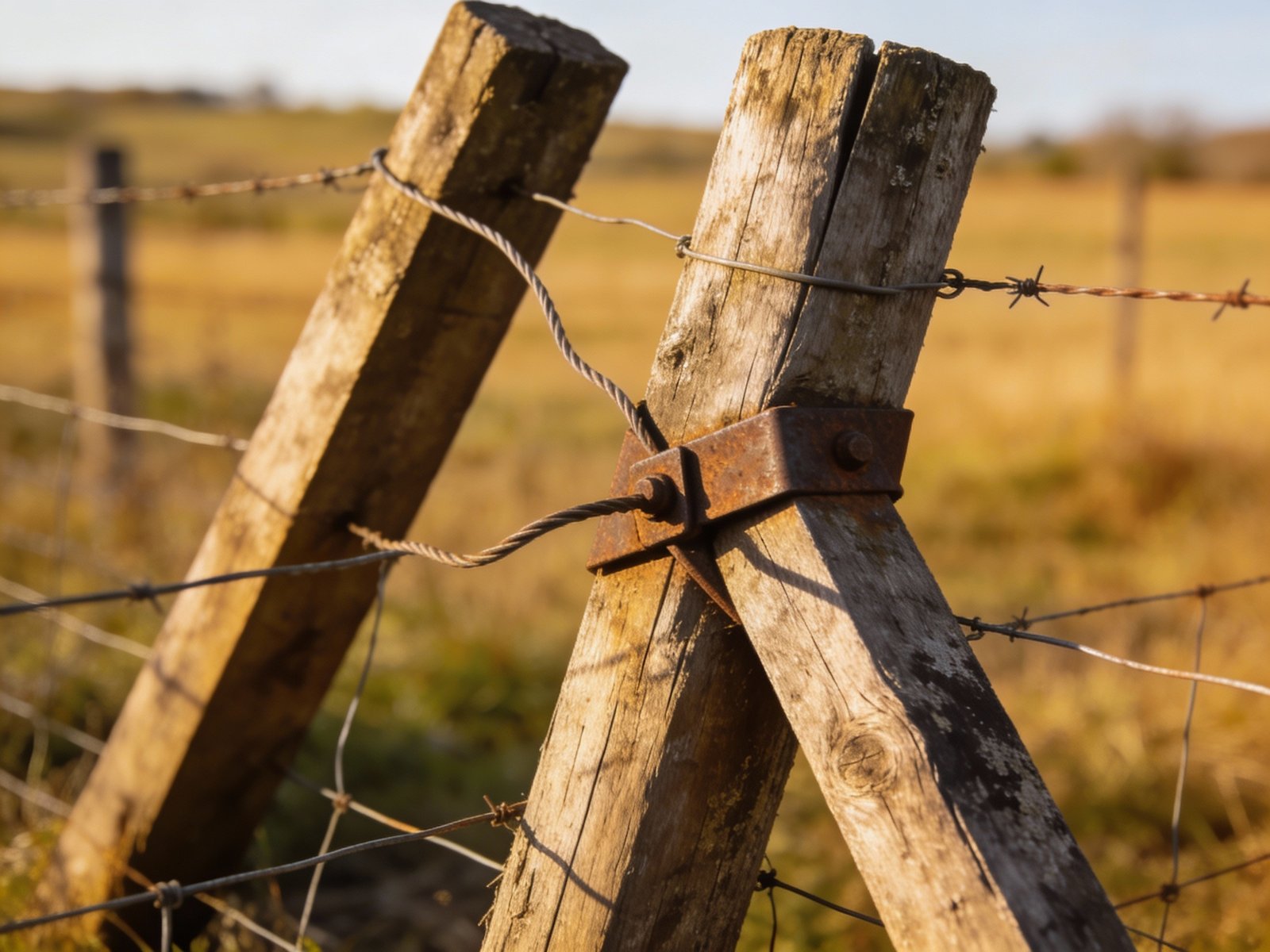
Inadequate Bracing at corners and direction changes represents the second major DIY defect category. Proper corner bracing requires engineering understanding—the brace must be deep enough, appropriately angled, and properly secured to resist horizontal tension loads. DIY installers frequently install minimal bracing (“enough to look right”) that meets visual standards but lacks structural adequacy. Consequent corner failure often doesn’t manifest immediately; it progresses slowly as tension loads gradually shift corner posts inward, eventually causing dramatic failure when posts reach critical tilt angle.
Tensioning Mistakes result from lack of proper equipment and experience. Professional installers use calibrated tension meters and come-alongs to achieve precise tension across all wires uniformly. DIY installers often tension by feel or visual assessment (“looks tight enough”), resulting in under-tensioned fence that sags prematurely, or over-tensioned fence that stresses staple connections and wire, causing accelerated failures.
Safety Risks in DIY installation include wire handling hazards (high-tensile wire under tension can recoil with significant force if connection fails), post-hole digging (risk of hitting utilities, striking rock causing tool rebound), equipment operation, and repetitive strain injuries from sustained physical labor.
Warranty and Insurance Implications vary by installation method. Some insurance policies distinguish between owner-installed systems and professionally installed systems in coverage terms. Some lenders or agricultural credit providers require fence systems to be professionally installed as collateral requirement. These policy differences must be verified with your insurance and financing providers before deciding on DIY installation.
Professional Installation: What You Pay For
Professional Skill Set & Tools
Professional installers bring multiple forms of expertise beyond basic fence construction knowledge. Site planning and design includes evaluating terrain, soil conditions, and environmental factors to optimize fence location and specification. This might involve recommending modified post spacing for difficult soils, suggesting additional bracing for challenging terrain, or specifying coating upgrades for high-corrosivity environments. Experienced professionals have observed how different specifications perform over years, enabling them to anticipate problems that DIY planners might miss.
Specialized tools and equipment constitute significant value. Tension meters, calibrated to within 5% accuracy, enable precise tensioning that visual assessment cannot achieve. Power post-drivers reduce installation time and improve post alignment. Come-alongs and specialized tensioning equipment allow operators to tension large sections uniformly across all wires. These tools represent capital investments that professional contractors amortize across multiple projects, making them economical for professionals but inefficient for single-project DIY installation.
Professional procedural knowledge encompasses the sequences, methods, and checkpoints that experienced installers use. This includes proper soil compaction technique, understanding how different soil types compact differently, recognizing when ground conditions aren’t right for installation, and knowing when to modify standard procedures for specific situations. This procedural knowledge is typically only acquired through extensive practice and observation of long-term outcomes.
Project Management & Efficiency
Professional crews can schedule installation in compressed timeframes—typically 1-3 days for a typical mile of fence depending on complexity. This efficiency results from sustained focus, coordinated labor, optimized procedures, and experience-based productivity. Professional scheduling reduces operational disruption—your fencing is installed and operational quickly, rather than existing in partially completed state for weeks or months.
Professional crew coordination ensures adequate labor is present when needed, work proceeds in logical sequence, and quality checkpoints occur at appropriate stages. A professional crew includes personnel with specific roles—some handle material staging and layout, others handle post installation, others handle wire installation and tensioning. This specialization creates efficiency that generalist DIY labor rarely matches.
Warranty & Accountability
Professional installation typically includes formal warranty—the contractor guarantees that work was performed to specification and materials are installed correctly. If defects appear within warranty period, the contractor is contractually obligated to remedy them at no additional cost. This warranty provides protection against latent defects discovered after installation is complete and paid.
Insurance and liability coverage differs between DIY and professional installation. Professional contractors carry liability insurance covering potential damage or injury resulting from their work. If professional installation causes property damage, injury to persons, or other covered incidents, insurance provides recourse. DIY installation creates potential gaps—if DIY fence installation causes an accident or injury, your personal liability insurance may apply, but coverage can be limited.
Third-party validation of professional installation provides documentation that fence was installed to standards. Some regulatory contexts, lender requirements, or insurance provisions require documentation of professional installation. Professional contractors typically provide documentation (photos of completed work, material invoices, workmanship warranty) that creates an audit trail.
Head-to-Head Comparison
| Comparison Dimension | DIY Installation | Professional Installation |
|---|---|---|
| Planning & Design | Owner determines specifications; risk of design optimization errors; may miss environment/soil adaptations | Professional designs based on site assessment; experience-based optimization; proactive risk identification |
| Labor Requirements | Owner and crew provide labor; variable productivity; sustained effort duration | Specialized crew; optimized procedures; sustained focus for compressed duration |
| Time to Completion | Weeks to months depending on available labor and competing operations | Days to 1-2 weeks depending on scope; compressed schedule minimizes disruption |
| Skill & Knowledge Requirements | Owner must acquire understanding; learning curve costs time and rework risk; variable quality | Professional expertise applied; established procedures; consistent quality application |
| Installation Quality | Variable; dependent on owner/crew experience; common defects (depth, bracing, tensioning) | Higher consistency; professional standards applied; peer review and QA processes |
| Longevity & Performance | Depends on execution quality; defects create accelerated failure timelines; maintenance burden higher if errors present | Installation defects less frequent; system performs to specification; lower maintenance burden |
| Warranty & Remediation | No warranty; owner responsible for any defects; rework costs borne by owner | Contractual warranty; contractor remedies defects within warranty period; insurance backing |
| Liability Coverage | Personal liability only; potential gaps in coverage; documentation lacking | Professional insurance; liability transfers to contractor; documentation provided |
| Equipment & Tools | Rental costs; access to specialized equipment limited; inefficient amortization | Contractor-supplied; optimized for professional use; efficient amortization across projects |
| Long-Term Maintenance Burden | Variable; installation defects create ongoing maintenance; rework cycles likely | Baseline maintenance only; fewer surprise failures; predictable maintenance schedule |
When DIY Makes Sense
Favorable Conditions for DIY Installation
DIY installation represents a rational choice under specific combinations of circumstances:
- Small, Simple Interior Cross-Fences: Subdivision fence within your own operation, using basic wire specifications (hinge joint, Class 1 or 2 galvanized), with straightforward terrain and no engineered bracing required. These fences serve internal management functions rather than perimeter containment, so failure consequences are limited.
- Short Life Expectancy (Temporary Fencing): Where you explicitly plan to remove and replace the fence within 5-10 years. If you’re fencing a short-term grazing area or temporary infrastructure that will be modified, installation quality standards can be appropriately relaxed.
- Good Prior Experience: If you’ve previously installed similar fence systems and had good results (verified through years of reliable operation), you have actual knowledge of proper procedures and can repeat them. This experience reduces learning curve risk and installation error probability dramatically.
- Low Livestock Pressure Scenarios: Where the fence contains light cattle (dairy cows, mature breeding females) rather than intense pressure (growing bulls, confined high-density grazing). With low pressure, installation imprecision is more forgiving—posts set slightly shallow might not heave dramatically, under-tensioned fence might not sag excessively.
- Accessible Terrain and Low-Risk Conditions: Flat, easily accessible land with stable soils, no frost heave risk, no corrosive environment, and no unusual site conditions reduces technical difficulty. Simple terrain means DIY labor can be efficient—digging time is predictable, post setting is straightforward, and bracing design is minimal.
- Labor Availability and Realistic Time Assessment: If you genuinely have adequate time and can sustain effort. If you have seasonal labor availability or family/neighbor help available for the installation period, and can realistically dedicate that time without other operational demands conflicting, DIY becomes more practical.
When Professional Installation Is Recommended
Conditions Strongly Favoring Professional Installation
Specific project characteristics strongly favor professional installation:
- Perimeter Fencing for Large Acreage: Where project scale is substantial (3+ miles) and represents major capital investment and long-term infrastructure. The scale means even modest quality differences affect many linear feet of fence, and the permanence means quality decisions made today affect operations for decades.
- High-Tensile and Fixed Knot Systems: Where installation specifications demand precision. These systems are designed to perform optimally only when installed correctly—improper tensioning or inadequate bracing undermines the design. Professional installation ensures these sophisticated systems are installed to specification.
- High-Pressure Livestock Applications: Bulls, rotational grazing at high stocking density, or aggressive breeds where containment reliability is critical. Fence failure creates immediate operational problems—escaped livestock, commingling, potential injury. Professional installation reduces failure probability substantially.
- Challenging Terrain or Difficult Soil Conditions: Expansive clays, waterlogged soils, rock-filled ground, steep slopes where installation technique must adapt to site-specific challenges. Professional experience with regional soil conditions and terrain variations enables appropriate technical decisions that DIY knowledge might miss.
- Harsh Environmental Exposure: Coastal zones, extreme cold regions, high-altitude windswept areas, industrially polluted zones where specification modifications are required and installation technique must account for environmental factors. These environment-specific requirements are best managed by professionals experienced with the specific conditions.
- Regulatory or Compliance Requirements: Where fence must meet specific standards or documentation must be provided. Some jurisdictions, lender requirements, or conservation programs require fences to be installed by licensed contractors or have third-party certification.
- Insurance or Financing Requirements: Where your insurance or agricultural financing requires professional installation. Some policies or credit arrangements specify that infrastructure must be professionally installed to maintain coverage or financing eligibility.
Lifecycle Costs & Risk Outcomes
Cost Pattern Over Time
The total cost of fence ownership extends far beyond initial installation labor. Initial labor cost represents perhaps 30-40% of true fence cost; material costs (wire, posts, fasteners) represent 50-60%; and long-term maintenance and eventual replacement represent an additional cost stream over the fence’s operational life.
DIY Installation Cost Pattern:
- Initial: Lower labor cost (owner labor valued at reduced rate or opportunity cost)
- Years 1-5: Moderate maintenance if installation quality is good, or accelerated maintenance if defects are present
- Years 5-15: Variable costs depending on whether installation defects have manifested as requiring rework
- Years 15-30: Eventually requires replacement, full cost of new installation plus removal
Professional Installation Cost Pattern:
- Initial: Higher labor cost (professional rates) but often partially offset by material efficiency
- Years 1-5: Baseline maintenance only; installation is correct so no emergency rework
- Years 5-15: Consistent baseline maintenance; no surprise major failures or rework events
- Years 15-30: Planned replacement at end-of-life; no premature failure forcing emergency spending
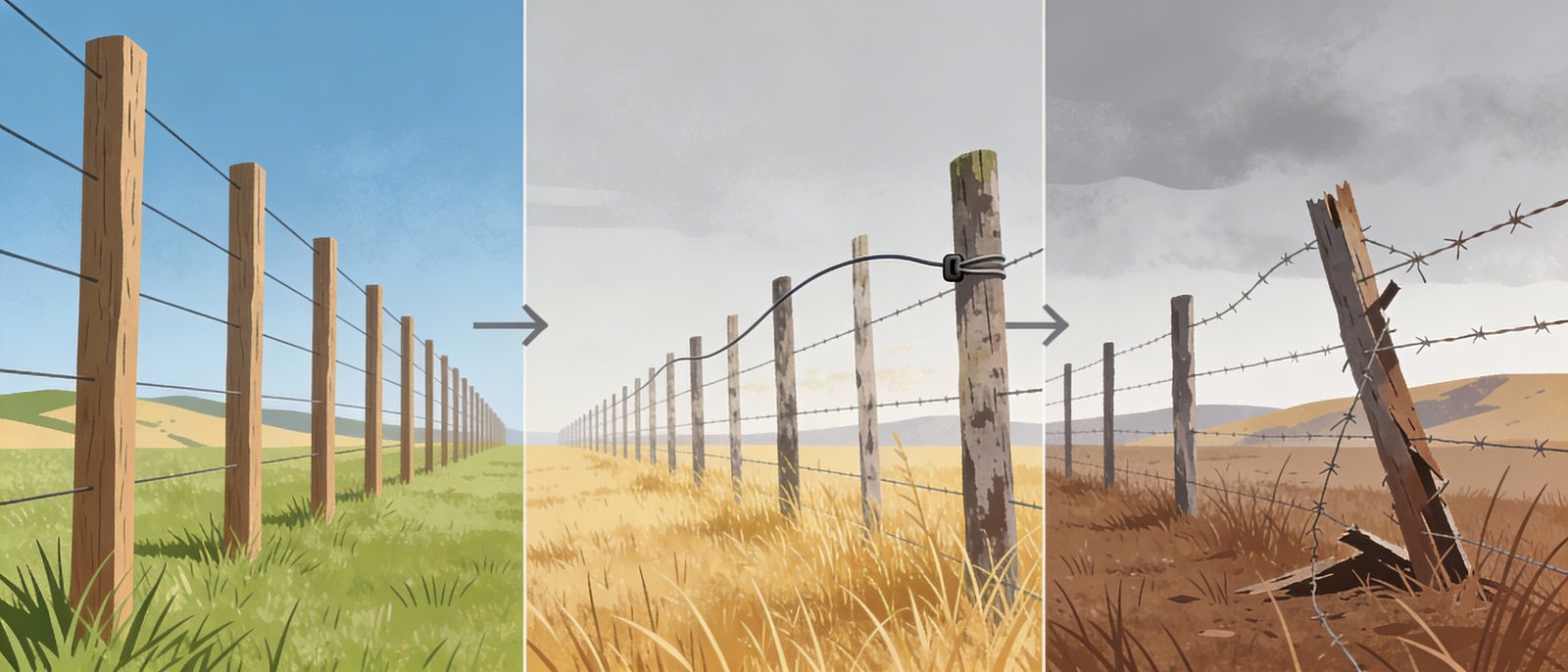
The key cost pattern difference: Professional installation frontloads cost but creates stable, predictable maintenance thereafter. DIY installation minimizes initial cost but creates variable, sometimes high, maintenance costs if installation defects manifest. Understanding these patterns connects directly to why cattle fences fail over time and how installation quality determines failure probability.
Risk & Reliability Patterns
Common DIY Failure Patterns documented through extension service surveys and practitioner experience include:
- Post Depth Failures: Posts set insufficiently deep heave within 3-7 years in frost-susceptible regions, requiring emergency partial replacement
- Bracing Inadequacy Failures: Corner or brace failures manifest gradually over 5-10 years, eventually requiring section replacement
- Tensioning and Knot Deformation: Under-tensioned fence or hinge joint fence experiences accelerated sagging requiring frequent re-tensioning
- Material Defect Issues: Mistakes in wire attachment, fastener corrosion due to improper material selection, or handling damage to materials
- Safety Issues: DIY installation accidents occur at higher rate than professional installations due to safety protocols and experience
Professional Installation Reliability Patterns show substantially lower failure rates. Contractors occasionally make errors, but experience and systematic quality checks reduce defect rate substantially. Professional installations don’t typically fail early due to design or execution defects; failures that occur are generally material failures (unexpected corrosion, material manufacturing defects) rather than installation quality issues. Professionally installed fence requires maintenance on predictable schedule determined by fence type and environment, with few surprise failures.
Decision Framework: Checklist
Working through this checklist systematically enables rational installation method selection:
1. Define Design Scope
- What fence type (high-tensile fixed knot, low-carbon hinge joint, barbed wire)?
- What specifications (Class 1/3 galvanized, gauge, post spacing)?
- What complexity (simple perimeter, multiple gates, engineered bracing)?
- Understand that this scope should be determined by livestock type, environment, and target lifespan—not by budget convenience
2. Assess Livestock Type and Pressure
- What livestock will be contained (cattle, sheep, horses)?
- What intensity of pressure (growth cattle, breeding bulls, dairy cows)?
- Assess behavioral factors (known escape artists, high-fence-testing animals)?
- Understand that high-pressure applications tolerate less installation imprecision
3. Evaluate Environmental Conditions
- What is your climate classification (coastal, frost-susceptible, arid, humid)?
- What are soil conditions (expansive clay, waterlogged, rocky, stable loam)?
- Is there frost heave risk? Corrosion risk? Extreme wind/weather risk?
- Understand that harsh environments require more precise installation and better materials
4. Assess Your Skill and Experience
- Have you successfully installed fence before?
- Do you understand proper post depth, bracing, and tensioning requirements?
- Can you recognize what proper fence geometry looks like?
- Are you willing to learn from mistakes or do you need reliable outcomes?
- Understand that honest self-assessment is crucial—overestimating your skill creates risk
5. Evaluate Available Labor and Time
- Do you have adequate labor available (self, crew, hired help)?
- Can you dedicate time without operational disruptions?
- Is your available time during a season that permits good work?
- Can you sustain effort long enough to complete project at required pace?
- Understand that extended timelines create operational disruption—compressed schedule has value
6. Determine Comfort with Maintenance Burden
- Can you budget for and manage regular re-tensioning?
- Can you handle potential rework if defects appear?
- Are you comfortable with some level of unpredictability in maintenance needs?
- Would you prefer predictable baseline maintenance schedule?
- Understand that professional installation typically creates lower ongoing maintenance burden
7. Decide Installation Pathway
- For simple, low-risk projects: DIY can be appropriate with good experience
- For complex, high-risk projects: Professional installation is strongly recommended
- For mid-range projects: Evaluate time, labor availability, and personal skill honestly
- Consider hybrid approach (DIY for simple sections, professional for complex sections)
- Understand that delaying decision until work must start creates worse outcomes—make decision in planning phase
Frequently Asked Questions
Is DIY Fence Installation Cheaper in the Long Run?
The answer depends on execution quality and honest accounting of all costs. If DIY installation is executed at professional-equivalent quality (proper depth, adequate bracing, precise tensioning) and you truly have available labor at low opportunity cost, DIY can be cost-competitive over 30-year ownership period. However, this requires realistic assessment of whether your installation quality truly matches professional standards—most DIY installations involve some compromises that create higher maintenance costs later.
More commonly, total cost analysis shows professional installation becomes cost-equivalent or even cost-advantageous when you include rework, maintenance, and eventual replacement cycles. A professional installation that costs 30% more upfront but creates 20% lower maintenance burden and reaches full design lifespan without emergency replacement often has lower total cost over 30 years than a cheaper DIY installation that requires mid-life replacement due to quality issues.
The key factor is honest assessment of whether your DIY installation will truly achieve the quality standards required. If not, the cost savings are illusory—you’re deferring costs to the maintenance and replacement phases.
What Risks Do DIY Projects Commonly Underestimate?
Several systematic underestimations appear frequently in DIY planning:
Post Depth Underestimation: DIY installers often underestimate the frost line depth required in their region, or underestimate how much effort frost heave can exert on posts. The result is posts set at minimum specification rather than adequate specification with safety margin, creating failure risk in unusual years or soil conditions that are more severe than average.
Tensioning Precision Required: DIY installers often underestimate how important precise, uniform tensioning is to long-term performance. “Close enough” tensioning creates variable stress distribution that accelerates knot deformation or localized wire failure. Professional tension meters cost hundreds to thousands of dollars—not economical for DIY single projects—but the precision they provide matters.
Bracing Adequacy: DIY installers frequently install bracing that “looks adequate” but lacks structural capacity to resist actual forces. The problem doesn’t manifest immediately—braces gradually shift under load over several years before failures become obvious.
Maintenance Commitment: DIY installers sometimes underestimate the ongoing maintenance commitment required. Even well-installed fence requires re-tensioning and inspection on regular schedule. If you’re not genuinely willing to maintain the fence on required schedule, installation quality becomes irrelevant.
Are There Fences Too Complex for DIY?
Yes. High-tensile fixed knot systems designed for high-pressure livestock in challenging environments represent the complexity threshold where DIY becomes genuinely difficult. These fences require precise specification, careful engineering of corner assemblies and bracing, and exact tensioning technique. Installation mistakes create failures that are expensive to remediate.
Similarly, perimeter fences for large acreage (5+ miles) represent complexity due to scale. The project duration extends into weeks or months, sustained labor commitment becomes difficult, and integration of multiple gates, multiple terrain variations, and environmental adaptations requires coordination that DIY projects struggle with.
Any fence system in harsh environments (coastal, extreme cold, extreme wind) where corrosion management, frost heave prevention, or structural enhancement are critical also represents complexity threshold where professional guidance is valuable.
The decision rule: if your fence must be right because failure is costly, professional installation is justified. If your fence can tolerate some imprecision because failure consequences are limited, DIY is more appropriate.
How Does Professional Warranty Affect Total Cost?
Professional warranty typically covers defects in workmanship and materials for 30-90 days post-installation. Within this window, if defects appear, contractor is obligated to remedy them at no additional cost. This warranty has value because it shifts risk: if problems appear that are contractor’s responsibility, you don’t pay for rework.
However, warranty doesn’t cover long-term material degradation (corrosion, rust, normal wear) or maintenance that becomes necessary after warranty expires. Warranty protects against installation defects, not against fence aging and eventual replacement.
The value calculation: does warranty cost (absorbed into professional labor rate) exceed your risk of DIY installation defects requiring rework? For most ranchers, the answer is yes—avoiding one major rework event (emergency post replacement, complete corner rebuild) more than justifies professional labor costs.
Does Professional Installation Improve Fence Lifespan?
Professional installation doesn’t fundamentally extend material lifespan—Class 3 galvanized coating has the same corrosion resistance whether installed professionally or DIY. However, professional installation enables the fence system to achieve its design lifespan consistently, while DIY installation sometimes falls short.
A properly specified Class 3 high-tensile fixed knot system installed professionally should reach 25-30 year lifespan. The same system installed poorly (posts too shallow, inadequate bracing, improper tensioning) might reach only 15-20 years due to installation defects requiring rework. This 25% reduction in useful lifespan represents real value loss.
Additionally, professional installation often enables fence to perform optimally for its design life with baseline maintenance only. DIY installation sometimes requires mid-life upgrades or emergency rework that well-installed professional fences avoid. This reduces lifecycle cost and operational disruption.
The distinction: professional installation doesn’t make fence last forever, but it ensures fence reaches its intended design lifespan reliably without premature failures from installation defects.