
Cattle Fence Wire Selection by Livestock Type: Complete Decision Guide
Fence selection is not one-size-fits-all. Different livestock species possess distinctly different behavioral patterns, strength levels, and safety requirements that directly determine the most appropriate fencing system. This guide is built on standards from the USDA Natural Resources Conservation Service (NRCS), Oklahoma State University Extension, and industry practitioners to provide farm owners, ranch operators, and fence planners with actionable specifications.
Proper fence selection not only ensures animal safety and effective control but also minimizes injury risk and reduces maintenance costs. Whether you’re containing beef cattle, protecting sheep from predators, preventing goat escapes, or ensuring horse safety, understanding species-specific behaviors and physical requirements is the foundation of successful livestock fencing.
This guide serves as a critical decision-support resource within your broader fence planning process. For a comprehensive decision framework that includes budget analysis, material selection, and installation planning, refer to our complete cattle fence wire buying guide.
Quick Livestock Fencing Reference
| Animal Type | Min Height | Best Fence Type | Key Safety Concern |
|---|---|---|---|
| Cattle | 48-52″ | High-tensile woven + barbed top | Leaning pressure / wire sag |
| Bulls | 54-60″ | Heavy-duty high-tensile + double bracing | Aggressive behavior / strength |
| Sheep | 48″ | Dense mesh (2×4″ or smaller) | Hoof entrapment / predators |
| Goats | 48-54″+ | Dense mesh (4×4″ max) + electric | Climbing / head breakthrough |
| Horses | 54-60″ | V-mesh or board (NO BARBED WIRE) | High-speed impact injuries |
| Mixed Herd | 48-54″ | Layered: dense bottom + reinforced top | Species requirement conflicts |
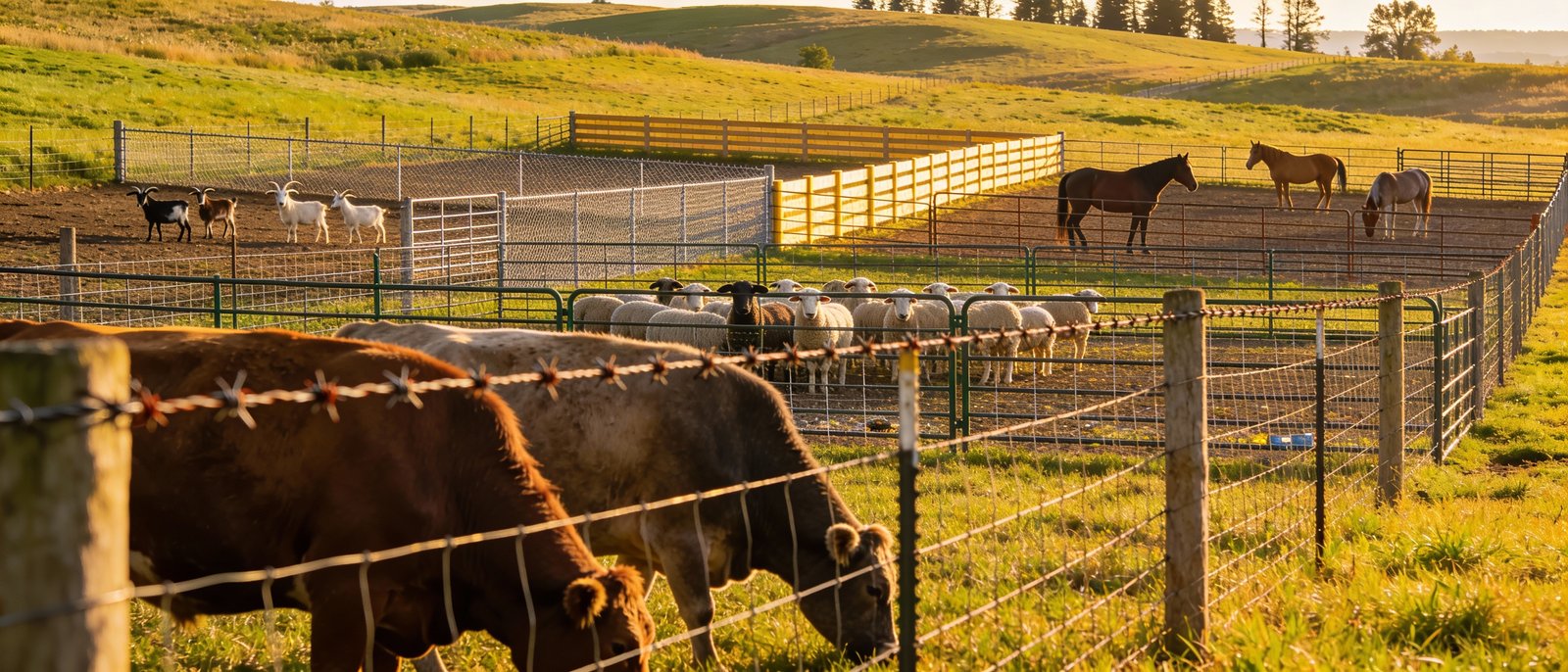
Understanding Livestock Fencing Differences
Before diving into species-specific requirements, this educational video provides essential context on why different animals need different fencing approaches. Understanding these foundational principles will help you make informed decisions as you review the detailed specifications below.
📺 Video Insight Summary
Video Overview:
This video features expert fencing recommendations from Kencove Farm Fence, explaining how behavioral differences between livestock species determine fencing requirements. The discussion covers cattle, goats, sheep, horses, and mixed-species situations with specific focus on fixed-knot vs. hinge-joint construction and high-tensile wire applications.
Key Takeaways from the Video:
- Cattle apply sustained pressure through leaning and body weight, requiring strong tensioned fencing systems—particularly high-tensile wire that offers strength and flexibility for confinement and open pasture situations.
- Goats and sheep need fixed-knot woven wire because the non-sliding vertical stays prevent animals from pushing through or enlarging openings. Graduated spacing (tighter at bottom, wider at top) prevents escape and entrapment.
- Horses require specialized safety considerations with 2×4 inch spacing to prevent leg injuries. The video emphasizes visibility and smooth surfaces to minimize injury risk during high-speed contact.
- Wire spacing must match animal behavior: Graduated spacing works for most livestock (closer at ground level where animals test fences), but consistent small spacing throughout is critical for small ruminants and goats.
How This Supports Fence Planning:
These principles align with industry best practices across North American livestock operations. The video demonstrates why fence height, wire spacing, and knot construction must be matched to livestock behavior patterns rather than using generic one-size-fits-all approaches. This behavioral-first methodology forms the foundation of the detailed specifications provided throughout this guide.
Cattle Fencing Requirements
Cattle Behavior Characteristics and Risks
Cattle are large, powerful animals whose fence selection is primarily driven by their pressure behavior patterns. Adult cattle weighing 600-1,200 pounds routinely test fences through sustained sitting, leaning, and pushing actions. This pressure creates both instantaneous loading and long-term stress on fence systems, leading to wire sag and post loosening when systems are inadequately designed.
Weight and Force Application: Adult beef cattle averaging 900-1,200 pounds can exert several thousand pounds of lateral force through sitting or leaning pressure. This requires fencing with high tension and robust support infrastructure. Based on Canadian agricultural research and North American ranching practices, proper tension management is critical to system longevity.
Pressure-Related Wire Sag: The signature cattle behavior is “laying on fence,” which causes woven wire bottom sections to sag downward, potentially creating escapable gaps. This is precisely why many successful cattle fence designs incorporate barbed wire at the top—it prevents formation of gaps when wire is pressed downward.
Temperature and Tension Dynamics: High-tensile wire exhibits unusual sensitivity to temperature changes. A mere 5°C temperature shift produces approximately 5kg tension change per mile of wire. During winter-to-spring transitions, northern operations may need tension adjustment to prevent excessive contraction or slackening.
Recommended Cattle Fence Types
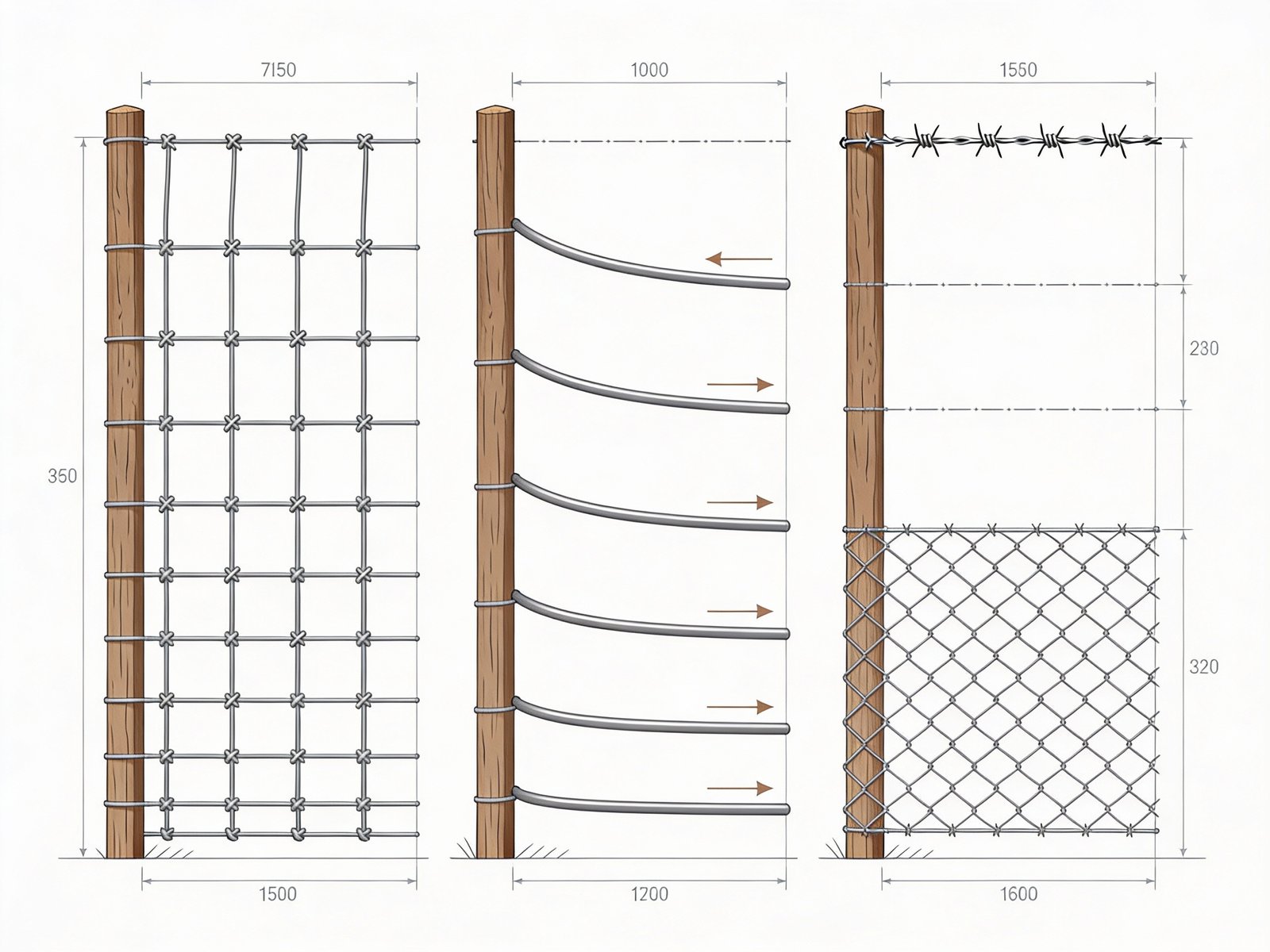
High-Tensile Smooth Wire + Barbed Wire Combination
Consists of multiple high-tensile smooth wire strands (typically 5-7 strands) plus 1-2 barbed wire strands at the top.
- Top barbed wire prevents cattle from pressing down woven sections
- Relatively lower cost compared to board or rail fencing
- Service life 3× longer than traditional low-carbon barbed wire
- Suitable for both beef and dairy operations
Fixed-Knot High-Tensile Woven Wire
Professional-grade woven wire with non-slip knot construction offering superior strength and durability.
- Strength 175% greater than traditional field fence
- Single 12.5-gauge wire breaking strength: 1,380 lbs (vs 500 lbs traditional low-carbon)
- Post spacing extends to 20 feet, reducing overall costs
- Nearly maintenance-free with high pressure resistance
To understand the differences between fixed knot vs hinge joint vs S-knot fencing, review construction methods that impact durability and containment effectiveness.
Electric Fencing (Supplementary)
Functions as psychological deterrent rather than primary physical barrier.
- Requires minimum 1,600 volts for effective cattle containment
- High-quality charger essential (low-cost chargers have high failure rates)
- Best used in combination with physical wire barriers
- Particularly effective for rotational grazing systems
Evaluate when woven wire vs electric fencing systems work best for your specific cattle management needs.
Cattle Fence Specifications
| Parameter | Beef Cattle | Dairy Cattle | Bulls |
|---|---|---|---|
| Minimum Height | 48-52 inches | 42-48 inches | 54-60 inches |
| Tension (@ 20°C) | 116 kg per wire | 116 kg per wire | High-tensile double bracing |
| Post Spacing | 12-20 feet | 12-20 feet | 8-12 feet (reinforced) |
| Bottom Clearance | 0-6 inches | 0-6 inches | 0-6 inches |
| Wire Spacing | Bottom: 1.5″, Top: 6-9″ | Bottom: 1.5″, Top: 6-9″ | Tighter spacing throughout |
| Staple Specification | 1.75-2″, 8-9 gauge with barbs | 1.75-2″, 8-9 gauge with barbs | Reinforced fastening system |
Height Considerations by Cattle Type
Standard Cattle: 48-52 inches is adequate for most beef and dairy cattle in typical grazing operations.
Bulls: Require 54-60 inches height due to larger body size, greater strength, and increased aggression. Bulls are significantly more likely to test fence boundaries and attempt extreme escape behaviors.
Wire Spacing: Graduated spacing from bottom to top: 1.5 inches at bottom (prevents calf escape), 3-6 inches in middle sections, and 6-9 inches at top.
Common Problems and Solutions
Problem 1: Wire Sag and Sustained Downward Pressure
Causes: Long-term cattle sitting pressure or excessively loose staples
Solutions:
- Install barbed wire at top to prevent downward pressing movement
- Use tension-indicating springs for regular tension adjustment monitoring
- Ensure staples have slight clearance (never driven too tight) to allow wire elastic movement
- Install droppers every 3-6 meters based on pressure intensity in specific zones
Problem 2: Staple Failure and Wire Slippage
Causes: Soft wood posts combined with low-quality staples
Solutions:
- Soft wood posts: Use 1.75-2″ length, 8-9 gauge staples with barbs
- Hard wood posts: Use 1.5″ smooth staples
- Verify proper staple alignment and driving depth
- Never over-tighten staples—allow 2-3mm wire movement for impact absorption
Problem 3: Seasonal Tension Variation
Causes: 5°C temperature change produces approximately 5kg tension variation
Solutions:
- Set standard tension at 20°C (116kg for cattle fence)
- Increase to 136kg at 0°C, reduce to 100kg at 30°C
- Install tension adjustment devices or conduct regular inspections
- Consider spring-loaded tension systems in regions with extreme seasonal temperature swings
Understanding why cattle fences fail—from improper tensioning to inadequate corner bracing—is critical for designing systems that last beyond the first few seasons. Many failures occur not from material deficiencies but from installation and maintenance errors that are completely preventable.
Sheep Fencing Requirements
Sheep Behavior Characteristics and Risks
Compared to cattle, sheep are more agile animals with stronger escape tendencies. Their primary risks stem from three factors: opening escapes, hoof entrapment, and collective breakthrough behaviors.
Escape Behavior: Sheep possess strong flocking instincts. When one sheep breaches a fence, others rapidly follow, potentially causing mass escape events. This herd mentality requires fence systems that provide consistent containment across the entire perimeter.
Hoof Entrapment and Injury: Sheep hooves easily become trapped in openings 6 inches or larger. This not only immobilizes sheep but can cause leg fractures or tissue damage. Mesh spacing must be carefully controlled to prevent this hazard.
Critical Safety Note: Barbed Wire Risks for Sheep
Unlike cattle, barbed wire is extremely dangerous for sheep. Barbed wire cuts wool and skin, leading to infections and permanent injury. This is why sheep fencing should exclusively use smooth wire. The fleece provides less protection than cattle hide, and entanglement injuries are significantly more severe.
Predator Threats: Compared to cattle, sheep are far more vulnerable to attacks from coyotes, wild dogs, and other predators. Fencing must not only prevent escape but also exclude predator intrusion—a dual requirement that significantly impacts design choices.
Recommended Sheep Fence Types
Small-Opening Dense Woven Mesh (Primary Choice)
- Opening Size: 2×4 inches or smaller
- Features: Tight woven design prevents head penetration and hoof entrapment
- Material: High-tensile fixed-knot woven wire prevents slippage
- Advantages: Provides complete predator barrier while preventing escape
- Height: Minimum 48 inches
Electric Fencing (Supplementary or Temporary)
- Voltage Requirement: 2,000 volts minimum (higher than cattle)
- Configuration: 7-8 wire strands at 48 inches total height
- Bottom Wire: 6 inches from ground
- Purpose: Temporary cross-fencing for rotational grazing or supplement to permanent fence for psychological deterrent
- Training Time: 12-48 hours for sheep to fully respect electric fence
Sheep Fence Specifications
| Parameter | Recommended Value | Rationale |
|---|---|---|
| Minimum Height | 48 inches | Prevents jumping; matches cattle height standards |
| Opening Size (Line Wires) | Bottom: 1.5″, Top: 3-6″ | Prevents hoof entrapment and head penetration |
| Opening Size (Stay Spacing) | 6″ (no predator pressure); tighter if predators present | Prevents head and body passage through fence |
| Bottom Clearance | 0-6 inches; 0-2″ in predator zones | Prevents digging; coyotes struggle to excavate at 0-2″ |
| Material | Smooth high-tensile woven (NO barbed wire) | Protects wool and skin from cuts and entanglement |
| Post Spacing | 12-16 feet | Standard spacing for woven wire systems |
Predator-Proof Configuration
For Areas with Coyote or Wild Dog Pressure:
- Bottom barbed wire 0-2 inches from ground (coyotes cannot easily dig beneath)
- Small-opening woven mesh covering entire height
- Top smooth or barbed wire at 48 inches
- Consider electric wire offset 11 inches from fence line as additional psychological barrier
Electric Fence Training for Sheep
Sheep respond more slowly to electric fencing than cattle. Initial contact should occur in a low-stress environment allowing gradual adaptation. Training typically requires 12 hours of passive contact with full training achieved within 48 hours. The critical success factor is ensuring solid grounding—this is the primary cause of electric fence failure across all livestock species.
Proper grounding requires copper ground rods driven into moist soil. Without robust grounding infrastructure, electric fencing systems are largely ineffective regardless of voltage or wire configuration.
Goat Fencing Requirements
Goat Behavior Characteristics and Risks
If sheep are escape artists, goats are escape masters. They represent the most challenging livestock for fence containment, combining multiple escape skills: climbing, jumping, squeezing, and head breakthrough tactics.
Climbing and Jumping Ability: Goats possess exceptional climbing ability evolved for wild predator evasion in mountainous terrain. This behavior manifests in domestic settings as an obsession with climbing any scalable surface. The universally recognized rule is: “If a goat’s head can fit through, its body can squeeze out.”
The 6-Inch Opening Lethal Risk
This is the single most critical data point in goat fence design: 6-inch opening spacing is lethal for horned goats. Horns become trapped, and goats die from suffocation or predator capture. Any goat fence with horned animals must use maximum 4-inch spacing, with 2-inch or smaller preferred for maximum safety.
Curiosity and Persistence: Goats repeatedly test fence weak points, remember escape routes, and optimize breakthrough strategies through learning. A single goat escape typically leads to the entire herd following suit. This requires fence designs that address not just physical strength but also psychological deterrents.
Recommended Goat Fence Types
Small-Opening Woven Mesh + Electric Wire Supplement (Best Practice)
Woven Mesh: 4×4 inch opening maximum (prefer ≤2×2 inches for horned goats)
Additional Protection:
- Top electric wire prevents climbing
- Middle electric wire approximately 18 inches high prevents head penetration
- Optional bottom electric wire deters digging
- Voltage: 2,500-3,000V for effective goat deterrent
Fixed-Knot High-Tensile Woven (Solidlock)
- Features: Non-slip vertical wires resist sustained goat pushing pressure
- Advantages: More rigid than S-knot construction, though slightly harder on goat skin
- Durability: Superior long-term performance under continuous testing
- Spacing: Available in tight configurations suitable for goat containment
Panel Fencing (Small Areas)
- Advantages: Quick installation, easy maintenance
- Disadvantages: Higher cost, best suited for small enclosures or pen applications
- Typical Use: Kidding areas, medical isolation, temporary containment
- Specifications: Must use livestock panels with 4×4 inch or smaller openings
Goat Fence Specifications
| Parameter | Recommended Value | Considerations |
|---|---|---|
| Minimum Height | 48-54 inches; high agility breeds 54+ inches | Nigerian Dwarf and other jumping breeds may require taller fencing |
| Opening Size (Line Wires) | 4×4 inches maximum; horned goats ≤2×2 inches | Head entrapment risk: openings <6″ strongly recommended |
| Opening Size (Stay Spacing) | 4-6 inches near ground | Prevents body squeezing through large openings |
| Bottom Clearance | 0-6 inches; can bury or use ground stakes for reinforcement | Prevents digging; goats push and dig at fence bottoms |
| Electric Wire Supplement | Top + 18″ height placement | 3-4 wire strands at each position, 2,500-3,000V |
| Post Spacing | 8-12 feet | Closer than cattle/sheep due to concentrated goat pressure |
Escape Prevention Design Details
Corner Reinforcement
Goats naturally target fence corners and gates as weak points. Use H-posts and proper corner bracing systems for cattle fencing to ensure these areas resist collapse. Corners should be treated as the highest-stress zones in any goat containment system.
Intermediate Droppers
Install droppers every 3-4 meters to maintain wire spacing. Sagging wire creates climbing opportunities or pass-through gaps for goats. Consistent tension and spacing are non-negotiable in goat fencing.
Bottom Reinforcement
Goats continuously push and dig at fence bottoms. Options include:
- Bury mesh bottom 6-12 inches underground
- Install L-shaped metal strips along the bottom to anchor mesh
- Place interior electric wire providing mild contact during training
Gates and Latches
Gates are primary goat targets. Use heavy-duty hinges and latches with goat-proof closures. Many standard gate latches can be opened by persistent goats. Consider adding electric wire around gate frames as additional deterrent.
Horse Fencing Requirements
Horse Behavior Characteristics and Risks
Horse fencing design differs most dramatically from other livestock fencing due to horses’ unique biological and psychological characteristics: flight response, low injury tolerance, and high visibility requirements.
Flight Response and Full-Speed Impact: When frightened, horses flee at full gallop, potentially reaching speeds of 40 mph or higher. This means any fence contact occurs with tremendous force. Unlike cattle’s sustained leaning pressure, horses create high-velocity collisions with catastrophic injury potential.
Barbed Wire: Absolutely Prohibited for Horses
Barbed wire injuries to horses can be catastrophic:
- Lacerations requiring hundreds of stitches and months of recovery
- Tendon damage causing permanent lameness or death
- Even low-speed contact creates infectious wounds
- Conclusion: Under no circumstances should barbed wire be used for horse fencing
This prohibition is absolute and applies to all horse fence configurations regardless of other design elements.
Visibility is Critical: Horses collide with low-visibility fences. Smooth wire without coloring or electrical supplementation is an invisible hazard to horses. This is fundamentally different from cattle, which test fences through touch and pressure rather than high-speed movement.
Hoof Entanglement Risk: Any opening >3 inches square can trap hooves, causing leg fractures. This requires careful attention to mesh sizing and panel opening dimensions in horse fence design.
Prohibited Materials for Horse Fencing
Never Use for Horses:
- Barbed Wire (any configuration) — Zero tolerance
- Large Square Openings (>3″) — Hoof entrapment risk
- Low-Tension Smooth Wire — Sag after impact creates hazard
- Hidden High-Tensile Wire (without electrical current) — Invisible to horses, high collision probability
Recommended Horse Fence Types
High-Visibility Board or Rail Fencing (Safest)
Construction: Minimum 4 rails of 1″×6″ boards or 2″×4″ rails
Advantages:
- Completely visible (horses see and learn to respect)
- No injury risk (smooth surfaces)
- Fully enclosed (no penetration or entrapment risk)
Disadvantages: High initial cost, significant maintenance (rot, cracking)
V-Mesh (No-Climb) Wire
Features: Diamond-shaped opening design prevents hoof or head penetration
Effectiveness: Simultaneous escape prevention and external intrusion protection
Cost: Most expensive wire option
Advantages: Durable, low-maintenance, high safety
PVC-Coated High-Tensile Wire + Electric Wire Supplement
Configuration:
- 2-3 high-tensile wire strands coated in white PVC for visibility
- Top or middle 1-2 uncoated electric wires
Advantages: Lower cost than board fencing, good visibility
Critical Requirement: Must maintain constant tension (no sag) and regular maintenance
Tubular or Rail Fencing
Features: Heavy steel pipes or aluminum rails
Advantages: Very safe, low injury risk
Disadvantages: Extremely high cost, rust/corrosion concerns with steel
Horse Fence Specifications
| Parameter | Recommended Value | Rationale |
|---|---|---|
| Minimum Height | 54-60 inches | Prevents jumping; taller than most livestock requirements |
| Vertical Opening Spacing | ≤9 inches | Prevents hoof entrapment |
| Mesh Opening Size | ≤3 inches square | Prevents head and hoof entrapment |
| Bottom Clearance | 6-8 inches | Prevents horses from stepping on fence bottom |
| Material | No barbed wire; visible or electrified | Absolutely no barbed wire under any circumstances |
| Post Spacing | 8-10 feet | High safety requirements demand closer spacing |
| Electric Wire Configuration | Top + nose height placement | Prevents leaning behavior without creating injury hazard |
Key Safety Features for Horse Fencing
Low Puncture Risk
Horse skin is highly susceptible to infection from any puncture. All materials must be smooth with no sharp edges. Even minor punctures can lead to serious complications requiring veterinary intervention.
Impact Absorption
Boards possess natural flex and elasticity that absorbs impact energy. Steel and rigid options should consider impact absorption capability. Any horse fence design should pass the mental “full-speed impact test”—if a horse gallops into it at full speed, what happens? If the answer includes “cutting” or “trapping,” the design is unsafe.
Visibility and Recognition
Horses must be able to see fences from a distance. This is why white or colored materials work better than natural tones that blend into landscape. Electric wire can be made visible through colored tape or reflective markers at regular intervals.
Mixed Herd Fencing Strategies
Primary Challenges
When different livestock species share the same space, fence design faces fundamental contradictions:
- Cattle require robust physical barriers capable of withstanding sustained pressure
- Sheep require escape-proof dense mesh spacing
- Goats require both height and dense mesh combinations
- Horses require visibility and injury-free surfaces
No single fence design can perfectly satisfy all these requirements simultaneously. Successful mixed-herd fencing requires strategic compromise or zone-based approaches.
Comprehensive Solutions
Strategy 1: Multi-Zone Isolation
Use permanent fencing to separate zones for different species throughout the farm. This approach provides optimal containment for each animal type:
- Cattle in large grazing areas with high-tensile or woven wire + barbed top
- Sheep/goats in subdivided areas with dense mesh configurations
- Horses in separate paddocks with board or V-mesh systems
- Temporary electric fencing for rotational grazing within species-specific zones
Strategy 2: Design to Most Stringent Species Requirements
For shared areas, implement fencing that satisfies the most stringent requirement among all species present. For instance, if cattle and horses share a zone, use horse fencing standards (54-60″ height, no barbed wire). Cattle will respect fencing designed for horses; the reverse is not necessarily true.
Strategy 3: Layered Fence Configuration
Create graduated fence systems that address multiple species needs in a single structure:
- Bottom section: Dense mesh woven wire (for sheep/goats)
- Middle section: Standard spacing wire (for all species)
- Top section: Barbed wire or smooth high-tensile wire (for large animals like cattle)
- Electric wires: Two offset wire strands—one at small animal height, one at large animal height
Example Mixed Configuration: Cattle-Sheep-Goat Herd
- Bottom 30 inches: 2×4 inch opening woven mesh (sheep/goat dense net)
- Middle 18 inches: 6 inch opening spacing (standard)
- Top 6 inches: Barbed wire or high-tensile smooth wire (prevents cattle pressure)
- Total Height: 48-54 inches
- Electric Wire Supplement: One 3,000V wire at nose height for goats, one 1,600V wire for cattle
Critical Principles for Mixed Herds
Graduated Opening Principle
Progressively increase opening size from bottom to top. This allows larger animals to have larger openings farther from ground level while preventing small animal escapes through tight bottom spacing.
Inter-Species Behavioral Matching
Research demonstrates that when small ruminants (sheep/goats) “bond” with cattle, they tend to cluster with the herd. This enhances predator protection and reduces escape tendencies. A unified mixed herd appears safer than multiple small separated groups.
Separate During Critical Periods
Even in multi-zone configurations, temporarily separate species during certain situations:
- Feeding/finishing areas (prevents competition)
- Breeding seasons (prevents cross-species breeding)
- Medical treatment periods (facilitates targeted care)
Understanding how to optimize cattle fence wire selection by environment becomes even more critical in mixed-herd scenarios where soil conditions, climate exposure, and terrain variations affect multiple species simultaneously.
Electric Fencing Specifications and Best Practices
Electric fencing functions as a psychological deterrent rather than a physical barrier. Its effectiveness depends on four critical factors: voltage, pulse characteristics, grounding infrastructure, and animal training.
Species-Specific Voltage Requirements
| Species | Minimum Voltage | Optimal Configuration |
|---|---|---|
| Cattle | 1,000V | 1,600V standard; often combined with physical wire barriers |
| Horses | 1,000V | 1,600V standard; focus on visibility and supplementation |
| Sheep | 2,000V | 2,000V+ minimum due to thick wool insulation |
| Goats | 2,500V | 2,500-3,000V for horned goats with high pain threshold |
| Deer (reference) | 7,000-8,000V | 8,000V+ for effective wildlife deterrent |
Sheep’s High Voltage Requirement reflects their elevated pain threshold—thick wool provides insulation and skin tolerance requires stronger shocks for effective deterrence. This is a critical consideration often overlooked in electric fence planning.
Permanent Electric Fence Configuration
Recommended System: 7-8 Wire Strands at 48 Inches Height for Cattle and Sheep
| Wire Position | Height from Ground | Function |
|---|---|---|
| Bottom | 6 inches | Prevents digging/bottom passage |
| 2nd | 12 inches | Continuous low-level deterrent |
| 3rd | 18 inches | Middle-height barrier |
| 4th | 24 inches | Continues vertical coverage |
| 5th-7th | 30″, 36″, 42″ | Height coverage zones |
| Top | 48 inches | Top-level protection |
Critical Elements for Electric Fence Success
High-Quality Charger is Essential
Low-cost chargers represent the primary cause of electric fence failure. Professional-grade energizers deliver consistent pulse patterns and maintain voltage under vegetation load. This is not an area for cost-cutting—charger quality directly determines system effectiveness.
Pulse Characteristics
The most effective pulse duration is 0.003 seconds (3 milliseconds). This short burst limits total energy while producing noticeable shock sensation. Longer pulses can be dangerous to animals, while shorter pulses may not provide adequate deterrent effect.
Grounding System: The Most Critical Component
Without robust grounding, electric fencing is essentially non-functional regardless of voltage or wire configuration. Grounding requirements:
- Copper ground rods driven into moist soil
- Multiple ground rods spaced appropriately for soil conductivity
- Heavy-gauge copper wire connecting ground rods to charger
- Regular testing to verify ground system integrity
Vegetation Management
Weeds and plants contacting electric wires dramatically reduce effectiveness. Maintain clear zone 3-4 feet around fence line. High-power chargers can overcome moderate vegetation contact, but consistent clearing is always preferred for optimal performance.
Universal Engineering Requirements and Maintenance
Staples, Tension, and Elasticity
A common fence failure cause stems from misunderstanding proper stapling technique. The widespread error is driving staples too tightly, which actually reduces fence impact resistance.
Correct Stapling Method
Staples should allow slight lateral wire movement (approximately 2-3mm clearance).
Why Loose Staples Work Better: Loose staples distribute impact force across longer wire lengths, resulting in only small tension increases per meter of wire. Tight staples create massive tension spikes from small deflections, potentially exceeding wire elastic limits and causing breakage.
Specifications:
- Soft wood posts: 1.75-2″ length, 8 or 9-gauge staples with barbs
- Hard wood posts: 1.5″ smooth staples
Dropper Spacing and Pressure Management
Droppers (vertical support wires) maintain wire spacing and tension across entire spans. Required spacing depends on anticipated pressure intensity:
- Light Pressure (grazing areas, no concentrated activity): One dropper every 6 meters
- Medium Pressure (high-traffic areas, regular use): One dropper every 3 meters
- Heavy Pressure (feeding areas, high-traffic lanes): One dropper every 1.5 meters
Temperature Impact and Tension Management
Fundamental Principle
5°C temperature change produces approximately 5kg tension variation per wire strand (independent of length).
Practical Implications
Across a 40°C range from winter depths (-10°C) to summer peaks (+30°C), tension can vary by 80kg. This is sufficient to exceed wire elastic limits when wire is already near maximum tension capacity.
Solutions
- Tension Adjustment Devices (Preferred): Install spring-loaded tension indicators allowing regular adjustment monitoring
- Seasonal Adjustments:
- Winter (0°C): 136kg tension
- Spring/Fall (10-15°C): 126kg tension
- Summer (20-25°C): 116kg tension
- Loose Staple Method: Rather than rigidly fixing wire, leave moderate clearance to allow thermal expansion
Seasonal Maintenance Schedule
Spring (Post-Winter Recovery)
- Inspect all post verticality (freeze-thaw cycles cause post heaving)
- Evaluate high-tensile system tension
- Check woven wire for sag or separation
- Clear brush and weeds 3-4 feet around fence line
Summer (Heat and Growth Management)
- Monitor high temperatures’ effects on materials (PVC expansion, steel expansion)
- Manage vegetation near fence line (prevents grass contact with electric wires)
- Inspect fencing near automatic waterers for damage
Fall (Winter Preparation)
- Comprehensive inspection identifying pre-winter repair needs
- Check post bracing and corner supports
- Ensure proper drainage around posts preventing water accumulation
Winter (Harsh Weather Resilience)
- Regularly remove ice and snow accumulation (can exceed design loads)
- Maintain backup power for electric systems
- Conduct emergency repairs as needed (maintain access), delay major work until spring
Monthly Inspection Protocol
- Visual patrol of entire fence line
- Observe animal behavior for anomalies (unusual clustering may indicate weak points)
- Evaluate gate function and latch operation
- Assess hardware (hinges, buckles) for wear
Implementing a systematic cattle fence maintenance and repair guide prevents minor issues from escalating into major failures requiring complete section replacement.
High-Tensile Systems: Tension Spring Indicators
Permanent tension-indicating springs (installed on each wire or each span) represent a wise investment. They allow operators to quickly assess tension through tactile “plucking” with surprising accuracy. Through practice, operators can match tension to indicator springs, ensuring consistent tension across the entire system.
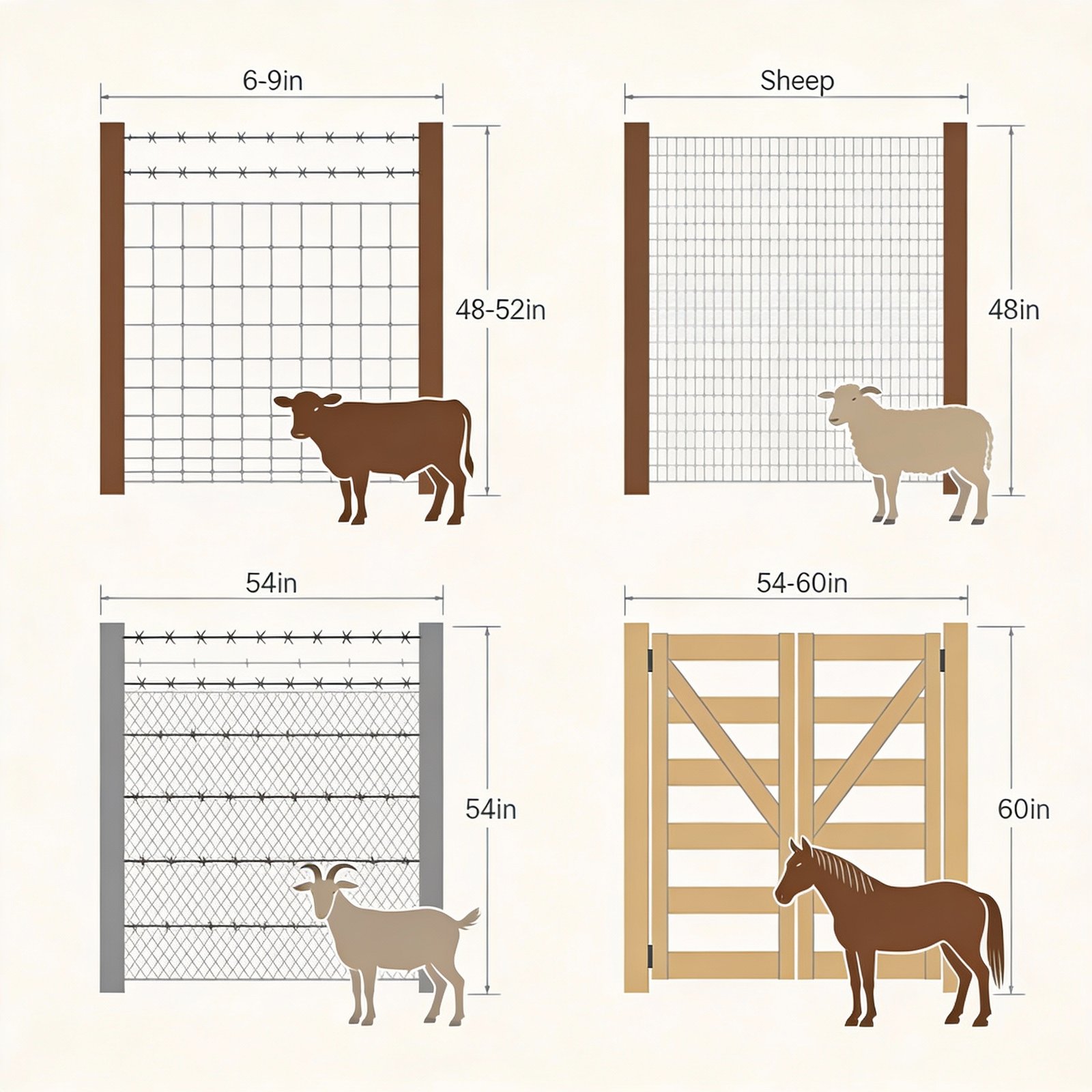
Decision Matrix and Action Checklist
Livestock Fence Selection Reference Table
| Animal | Best Fence Type(s) | Min Height | Key Safety Risk | Electric Voltage |
|---|---|---|---|---|
| Beef/Dairy Cattle | Fixed-knot high-tensile woven + barbed top wire | 48-52 inches | Leaning pressure causing wire sag | 1,600V (optional) |
| Bulls | Double-braced high-tensile + barbed wire | 54-60 inches | Aggressive escape attempts | 1,600V (optional) |
| Sheep | Small-opening woven (2×4″) + smooth top wire | 48 inches | Hoof entrapment / escape / predators | 2,000V+ |
| Goats | Small-opening woven (4×4″) + electric supplement | 48-54+ inches | Climbing / head breakthrough | 2,500-3,000V |
| Horses | Board/V-mesh + electric supplement | 54-60 inches | Barbed wire injury / high-speed impact | 1,600V |
| Mixed Herd | Layered: dense bottom + reinforced top | 48-54 inches | Species requirement conflicts | 2-3 layer electric wires |
Fence Installation and Specification Checklist
✓ Material Specifications
- All wire is galvanized (corrosion prevention)
- Correct specification/gauge based on species and pressure
- Posts sufficiently thick (wood 3-4 inches, steel 1.33 lbs/foot+)
- Hardware is galvanized or stainless steel
✓ Dimensions and Spacing
- Total height meets species requirements
- Wire spacing conforms to specifications (not excessively wide)
- Post spacing proportionate to anticipated pressure
- Dropper spacing adjusted for pressure (every 1.5-6 meters)
- Bottom clearance does not exceed species requirements
✓ Installation Quality
- Staples have slight clearance (not over-tightened)
- All corners and ends have double bracing
- Posts vertical and sufficient depth (24-36 inches)
- Grounding system (electric fence) complete with copper rods buried
✓ Maintenance Planning
- Monthly visual inspection scheduled
- Seasonal inspection dates established
- Tension adjustment process documented
- Repair parts inventory established
Before finalizing your fence project, use our fence installation cost and labor calculator to estimate total project expenses and compare DIY vs professional installation options.
Ensuring you have the right essential cattle fence installation tools before beginning work prevents project delays and ensures professional-quality results.
Conclusion
Selecting the appropriate fencing system represents one of the most foundational decisions in any farm or ranch operation. As this guide demonstrates, correct selection depends not merely on fence type but on deep understanding of each livestock species’ unique behaviors, strength characteristics, and safety requirements.
Core Principles Summary:
- Not One-Size-Fits-All — Each species requires customized solutions matched to behavioral patterns
- Safety First — Particularly for horses, injury minimization is non-negotiable
- Tension Management — Proper stapling and seasonal adjustments extend lifespan and improve performance
- Regular Maintenance — Monthly inspections and seasonal preparation prevent expensive failures
- Mixed Herds Need Layered Design — Satisfy most stringent species specifications
High-quality fencing requires upfront investment and sustained maintenance attention, but returns are clear: animal safety, minimized escapes, reduced injury risk, and maximized operational efficiency. Using specifications and best practices from this guide, farm owners and consultants can design confident, robust fencing systems for their specific needs.
This specialized guide addresses one critical dimension of fence selection—matching wire systems to livestock behavior. For comprehensive decision-making that incorporates budget analysis, environmental factors, and long-term planning, consult our systematic cattle fence wire selection framework.
Additional Decision-Support Resources
Successful fencing projects require consideration of multiple variables beyond livestock type:
- Environmental Factors: How soil conditions, moisture, and climate affect fence wire performance in your specific region
- Regulatory Compliance: Understanding livestock fencing regulations and guidelines for commercial operations and cost-share programs
- Proven Applications: Review field-proven cattle fencing examples where designs were tested across multiple seasons
- Common Pitfalls: Avoid planning errors and incorrect assumptions that cause fence project failures
- Installation Decisions: Evaluate when to hire a professional fence installer based on scale and complexity
When comparing permanent fence systems with supplementary options, understanding woven wire vs barbed wire for cattle helps determine optimal combinations for your specific containment and safety requirements.
Reference Resources and Data Sources
This guide is based on authoritative resources from government agencies, university extension services, and industry research:
- USDA Natural Resources Conservation Service (NRCS) Fence Specifications and Conservation Practice Standards
- Oklahoma State University Extension Agricultural Guides on Electric Fencing for Sheep and Livestock Infrastructure
- Canadian Agriculture Wire Fences for Livestock Management Standards (Beef Cattle Research Council)
- Utah State University Extension Service Wildlife-Friendly Fencing Guidelines
- Kencove Farm Fence Expert Fencing Recommendations (Video Resource)
- Industry professionals and field practitioners from North American livestock operations
All specifications are based on real industry practices, testing data, and published agricultural standards rather than hypothetical values. These resources represent the current consensus from North American livestock fencing experts as of 2024-2026.