
How Electric Fencing Works for Cattle: Voltage, Grounding & Animal Behavior Explained
Electric fencing works for cattle by delivering short, high-voltage pulses through a complete electrical circuit that trains animals to avoid the fence as a psychological barrier rather than a physical one.
Understanding voltage, current, grounding systems, animal behavior, and the physics of livestock containment
Why Understanding Electric Fence Physics Matters
Electric fencing is one of agriculture’s most elegant solutions: simple in concept, remarkably complex in execution. It’s not a physical barrier but rather a psychological one that relies on learned behavior. Understanding how it works is crucial for successful implementation.
Why Master the Physics?
- Better System Design: Know why specifications matter, not just memorize them
- Efficient Troubleshooting: Diagnose failures in minutes instead of guessing for days
- Performance Optimization: Maximize effectiveness in varying weather and soil conditions
- Cost Efficiency: Avoid over-specification while ensuring reliability
- System Longevity: Make informed maintenance decisions
Quick Overview: The Five Key Elements
- Energizer: Generates pulsed electrical energy (5,000-10,000V)
- Fence Wire: Conducts electricity at decreasing voltage along distance
- Animal Contact: Completes circuit through animal body (200-1,000Ω resistance)
- Soil Return: Conducts current back through earth
- Ground Rods: Re-establish circuit connection to energizer
The Complete Electric Circuit
Current must flow in a complete loop. Without understanding this path, you can’t diagnose failures.
The Basic Circuit Path
The complete circuit follows a precise path. Understanding each stage reveals why failures occur at specific points.
Energizer → Fence Wire → Animal Contact → Animal Body → Ground/Soil → Ground Rods → Back to Energizer
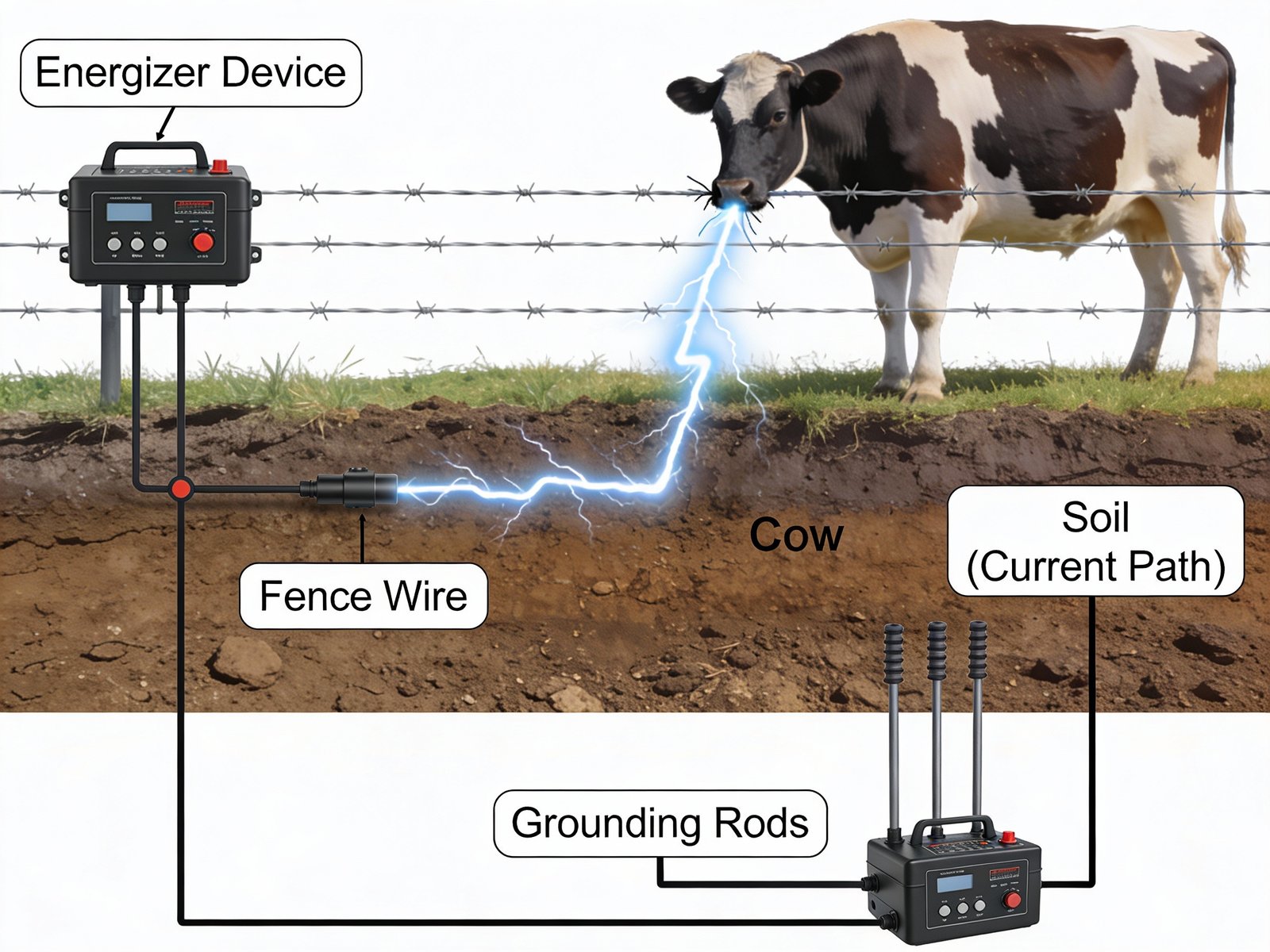
Why This Path Matters
If any section has poor conductivity or is broken, the entire circuit fails. This is why 80% of electric fence failures are grounding-related—the soil return path is often overlooked.
Energizer Operation: Pulsed, Not Continuous
The energizer is the heart. It doesn’t produce continuous current like household electricity—it creates short, repeated pulses. This fundamental difference ensures safety while maintaining effectiveness.
Why Pulsed is Superior
- Safety: Brief contact time prevents dangerous cumulative effects
- Durability: Energizer doesn’t overheat from continuous operation
- Battery Efficiency: Pulsed systems drain batteries far slower than continuous
- Learning Clarity: Animals perceive distinct stimulus-response cycle
Fence Wire: The Electrical Highway
Wire carries voltage from the energizer to the animal. The farther the distance, the more voltage is lost through resistance. Wire material directly impacts this loss.
Animal Body: The Variable Resistor
An animal’s body resistance varies dramatically based on moisture conditions. This single variable determines whether the fence will deliver enough current for a memorable shock.
Dry Conditions: Animal skin resistance 5,000-50,000Ω. Requires higher voltage (4,500-5,500V) to achieve effective current. Most failures occur here.
Moist/Wet Conditions: Animal skin resistance 200-1,000Ω. Lower voltage (2,000-3,000V) is sufficient for trained cattle. Optimal conditions.
Grounding Return Path: The Invisible Hero
Current must return to the energizer to complete the circuit. This happens through soil and ground rods. If this return path has poor conductivity, the entire fence fails—even if everything else is perfect.
This Is Why 80% of Fences Fail
Ranchers invest in powerful energizers and quality wire, then connect just 2-3 shallow ground rods. The fence appears to work initially but fails when soil dries. The return path was never adequate.
Video Explanation: Electric Fence Circuit and Grounding in Real Conditions
This video visually demonstrates how an electric fence circuit is completed when cattle touch the wire, emphasizing the role of grounding systems. It shows why high voltage alone is insufficient without proper soil return, and explains common failure scenarios in dry or rocky soil. The demonstration reinforces the concept of electric fencing as a psychological, learned barrier rather than a physical one.
Voltage, Current, Resistance and Power: The Physics
Four electrical parameters control whether your fence works. Understand these and you understand electric fencing.
Voltage: The Pressure
Voltage is the electrical pressure pushing current. Higher voltage overcomes resistance like water pressure overcoming a narrow pipe. Electric fences use high voltage precisely because animal skin resistance is so variable.
Voltage Requirements for Cattle
- Untrained cattle: 4,500-5,500V (need stronger shock to establish learning)
- Trained cattle: 2,000-3,500V (psychological barrier plus lower voltage)
- Wet conditions: Lower voltage needed (2,000V sufficient)
- Dry conditions: Higher voltage critical (4,500V minimum)
- Long distances: Start with 5,000V plus to account for wire losses
Key Insight: Voltage naturally decreases along the fence wire. A 1-mile fence with 5,000V at the energizer may only have 2,000-3,000V at the far end. This is why fence length matters when selecting an energizer output specification.
Current: The Flow
Current is the actual flow of electrons through the animal. It’s measured in milliamps. Despite the fence’s high voltage, the actual current delivered is quite low—which is why it’s safe.
Why High Voltage, Low Current?
High voltage overcomes the animal’s variable skin resistance. Low current due to pulsed, brief nature ensures no serious harm. The combination is brilliant: effective training without danger.
Resistance: The Opposition
Resistance opposes current flow. Total circuit resistance is the sum of all resistances: wire resistance plus animal body resistance plus ground return resistance plus connection resistances.
Total Circuit Resistance equals Wire plus Animal Body plus Soil plus Connections
Typical Resistance Values
- Fence wire (100m): 1-5Ω (negligible)
- Animal body (dry): 5,000-50,000Ω (DOMINANT factor)
- Animal body (wet): 200-1,000Ω (major change)
- Soil return (good grounding): 100-500Ω
- Poor ground connections: 1,000-10,000Ω (major failure point)
Critical Insight: The animal’s body is typically the highest resistance element. When soil is dry, this resistance skyrockets. This is why dry conditions require higher voltage.
Ohm’s Law in Electric Fencing
The fundamental electrical relationship V equals I times R explains everything about electric fence performance.
Example: At the fence point, 5,000V across 10,000Ω resistance. Current equals 5,000V divided by 10,000Ω equals 0.5 Amps (500 mA). This is the shock the animal experiences.
Why the Grounding System Determines Everything
This section reveals why 80% of electric fence failures have nothing to do with voltage or wire.
Critical Statement
Poor grounding is responsible for 80% of electric fence failures. Many ranchers invest in 20-joule energizers and quality wire, then install 2-3 short ground rods and wonder why the fence fails after 3 months.
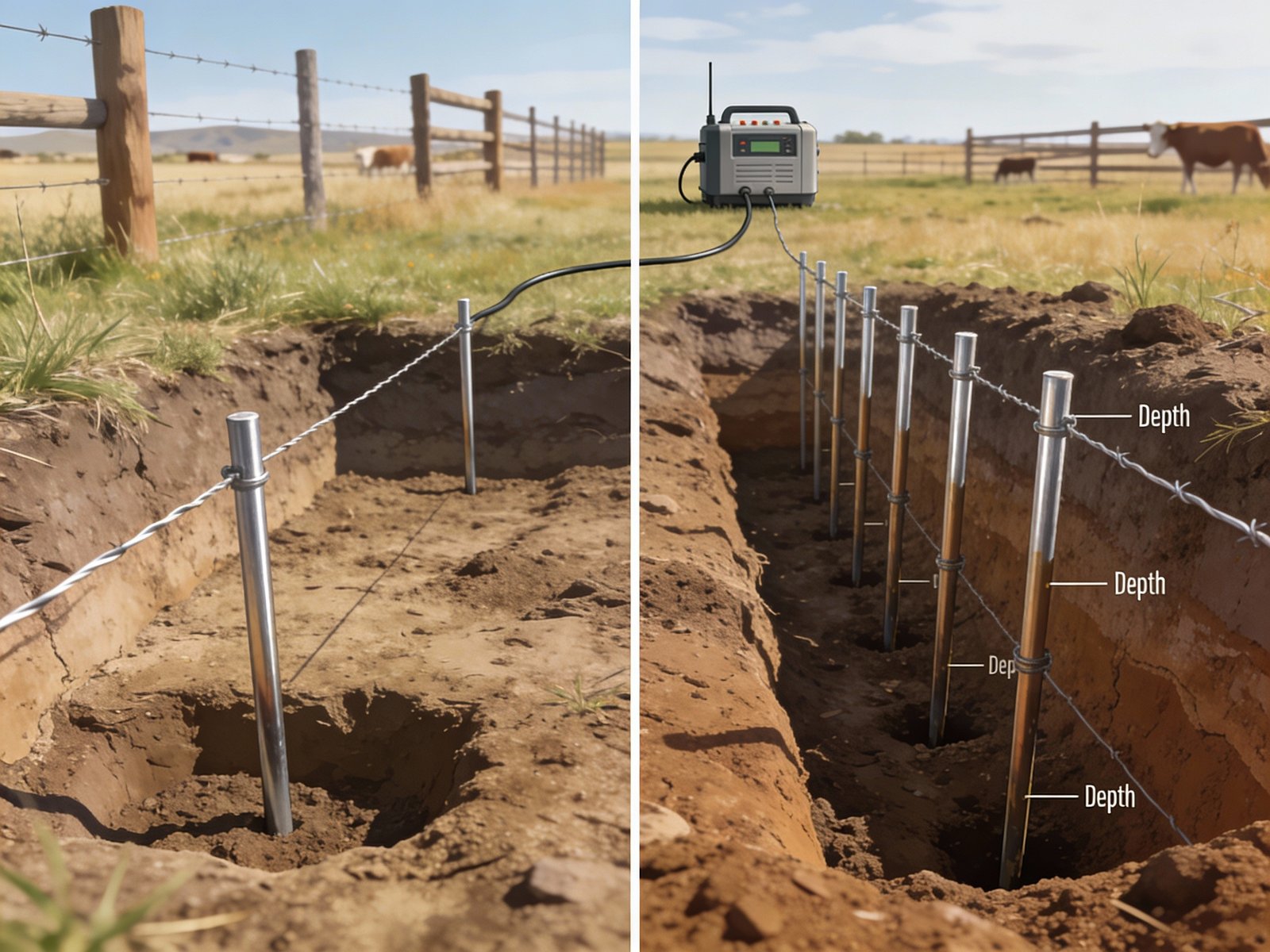
The Ground Return Loop
Current must complete a full circuit: Energizer to Wire to Animal to Soil to Ground Rods back to Energizer. Break any link, and the entire system fails.
GROUND RETURN PATH: Energizer negative terminal connects to Ground Rod Cable, then to Ground Conductor Cable buried in soil, then to Multiple Ground Rods 6-8 feet deep, through Earth/Soil (should be less than 200 ohms resistance), back to Energizer Positive Terminal via animal contact.
Ground Rod Formula
Total Ground Rod Length equals Energizer Joules times 3 feet
Real-World Examples
Scenario 1: 15-Joule Energizer
- Calculation: 15 times 3 equals 45 feet total
- Installation: 3 ground rods, 8 feet long each equals 24 feet (NOT ENOUGH)
- Better: 4-5 rods, 6-8 feet long, spaced 10 feet apart equals 32-40 feet total
- Ideal: 6 rods, 8 feet long equals 48 feet (exceeds minimum)
Scenario 2: 28-Joule Energizer (High-Power)
- Calculation: 28 times 3 equals 84 feet total
- Installation: 6 rods, 8 feet equals 48 feet (INSUFFICIENT)
- Correct: 8-10 rods, 8 feet long, spaced 10 feet apart equals 64-80 feet
Critical Grounding Design Principles
- Minimum 6-8 feet deep: Reaches moist soil layer. Dry soil equals poor conductivity.
- 10 feet spacing minimum: Prevents interference between rods. Rods compete and reduce effectiveness.
- Multiple rods (6-8): Distributes current, reduces resistance. Insufficient current return otherwise.
- Copper clamps (not steel): Prevent electrolytic corrosion. Connection corrodes, resistance increases.
- Annual testing (less than 200Ω): Catches corrosion/deterioration early. Prevents seasonal failures.
Learn more about proper grounding system design and comprehensive troubleshooting methods.
How Soil Moisture Affects Grounding
Seasonal Performance Variation
Spring/Summer (Wet): Soil conductivity is excellent. Ground resistance drops to 50-150Ω. Fence works great with lower voltage.
Late Summer/Fall (Drying): Soil conductivity decreases. Ground resistance climbs to 300-1,000Ω. Fence becomes unreliable unless voltage is increased.
Winter (Frozen): Frozen soil is extremely resistive (1,000-5,000Ω). Unless ground rods reach below frost line, fence may fail completely.
After Heavy Rain: Ground resistance drops dramatically. This is why fences work best just after storms.
Animal Behavior: Training, Learning and Psychological Barriers
The science of why cattle respect electric fences even when the power is off.
Electric fencing works not through physical force but through learned behavior. This is why an untrained cow treats a single wire like wet pasta while a trained cow respects it like a steel barrier.
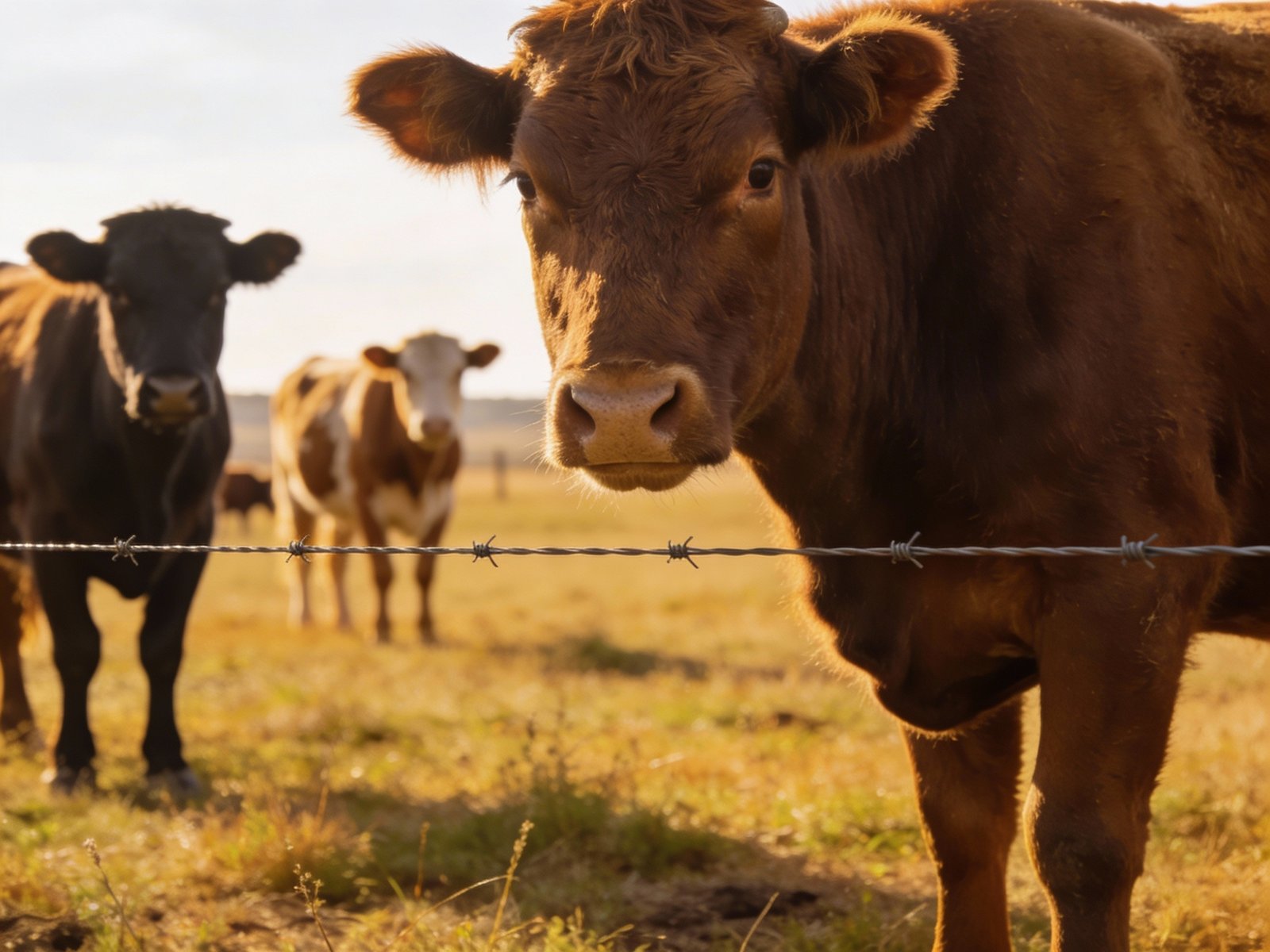
The Learning Mechanism
- First contact: Unpleasant stimulus (shock)
- Association formation: Cattle link the visual fence with the discomfort
- Behavioral learning: Avoidance becomes automatic within 24 hours
- Long-term memory: Training persists for years
- Psychological barrier: Even with power off, trained cattle maintain distance
Why Trained Cattle Avoid Even De-Energized Fences
After training, cattle associate the visual markers (wire, posts, color) with discomfort. The energizer itself is irrelevant—they’ve learned to recognize the fence itself as something to avoid. Research on virtual fencing (audio warnings without shock) shows cattle respond well to consistent sensory cues.
Group Dynamics in Training
Cattle learn from each other. When one animal receives a shock and retreats, others observe. Older, trained animals demonstrate the appropriate response to new animals. This social learning accelerates training for entire herds beyond what individual training would suggest.
For detailed guidance on training cattle to respect electric fences, explore proven techniques and timelines.
How Weather, Soil and Environment Affect Performance
Electric fences operate in variable conditions. Understanding these effects reveals why seasonal failures occur.
Moisture and Rainfall Effects
Why Rain Improves Performance
- Lower animal skin resistance: Wet coat equals 200-1,000Ω instead of 5,000-50,000Ω
- Lower soil resistance: Moist soil conducts current 10-100x better
- Better ground return: Water in soil increases conductivity dramatically
- Result: Fence may work with 2,000V in rain vs 5,500V in drought
Why Heavy Rain Can Degrade Performance
Counterintuitively, extreme downpours can temporarily reduce fence effectiveness. Heavy rain pushes wet vegetation into contact with hot wires, creating shorts that drain the circuit. After storms, always clear vegetation touching wires.
Temperature Effects: Season by Season
Spring (Wet, Warming): Soil conductivity excellent. Fence performance at peak efficiency. Maintenance requires clearing growing vegetation weekly. Vegetation growth accelerates; shorts become likely.
Summer (Dry, Hot): Soil conductivity declining. Fence performance degrading. Maintenance requires increasing voltage and testing grounding weekly. Heat loosens connections; dry soil reduces return current.
Fall (Cooling, Drying): Soil conductivity poor. Fence performance unreliable. Critical season for testing. This is when most failures occur; must test grounding.
Winter (Frozen, Very Poor): Soil conductivity extremely poor. Fence performance often fails. Sheltered energizers essential. Frozen soil blocks return path; battery performance drops.
Understand weather and seasonal management strategies to maintain year-round effectiveness.
Soil Type: The Determining Factor
Clay/Loam: Excellent conductivity. Dry resistance 300-1,000Ω. Wet resistance 50-200Ω. Standard installation with 6 rods.
Sandy Loam: Good conductivity. Dry resistance 1,000-5,000Ω. Wet resistance 200-500Ω. Add 2 additional rods.
Sandy Soil: Poor conductivity. Dry resistance 5,000-20,000Ω. Wet resistance 500-1,500Ω. Add 4 additional rods with bentonite treatment.
Rocky/Shallow: Very poor conductivity. Dry resistance greater than 20,000Ω. Wet resistance 2,000-5,000Ω. Specialized drilling required; may be impractical.
Key Physics Principles of Electric Fencing
- Electric fencing creates a psychological barrier through learned behavior, not physical force
- The complete circuit requires: Energizer to Wire to Animal to Soil to Ground Rods back to Energizer
- Grounding system quality determines 80% of fence reliability (not voltage or wire quality)
- Soil moisture is the single biggest variable affecting performance; dry soil is the primary failure condition
- Ohm’s Law explains why different animals and soil conditions require different voltage
- Cattle training establishes behavioral avoidance within 24 hours and persists for years
Related Guides for Deeper Understanding
- How Electric Fence Energizers Work: Power and Joules Explained
- Grounding System Design and Testing: Why Most Fences Fail
- Permanent vs Temporary Electric Fencing: Electrical Differences
- Troubleshooting Low Voltage Electric Fence Problems
- Training Cattle to Respect Electric Fences
- Wire and Conductor Material Comparison
- Weather and Seasonal Management
- Electric Fence Safety Guidelines
- Maintenance Best Practices
- Return to Electric Cattle Fencing Guide
Ready to Master Your Electric Fence?
Return to the complete guide for installation, grounding design, and troubleshooting