
Multi-Species Electric Fencing for Cattle, Sheep & Goats
How to design electric fencing systems for cattle, sheep, goats, and mixed-species grazing operations
Why Multi-Species Fencing Requires Special Design
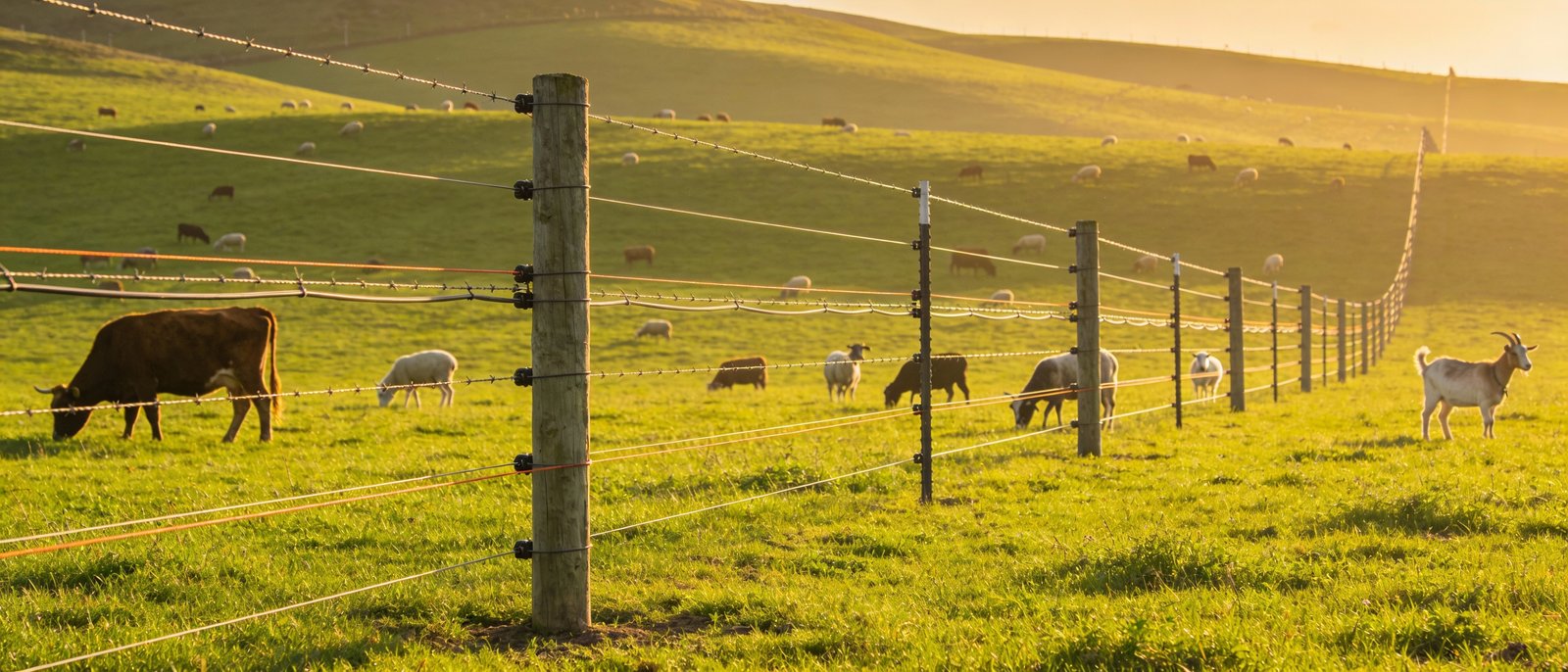
Multi-species grazing and mixed herds offer powerful advantages in pasture utilization, parasite control, and forage efficiency. However, fencing systems designed for cattle alone are often inadequate for sheep or goats.
Different species vary dramatically in size, behavior, wool or hair insulation, and escape tendencies. Electric fencing must be configured to control the most challenging animal in the system.
Recommended Wire Configuration by Species
The table below summarizes typical electric fence configurations for different livestock types. Values reflect common industry practices used by mixed-grazing operations.
| Animal Type | Recommended Wires | Wire Heights (inches) | Voltage Requirement |
|---|---|---|---|
| Cattle (Only) | 2 strands | Bottom 20″, Top 34″ | 3,000–3,500 V |
| Cattle + Calves | 3 strands | 6″, 12″, 18″ | 3,000–4,500 V |
| Sheep | 4–5 strands | Every 15 cm up to ~90 cm | 4,000–5,000 V |
| Goats | 5–6 strands | 6″–42″ (tight spacing) | 7,000–9,000 V |
| Mixed Cattle & Sheep | 3 strands | 10″, 20″, 30″ | 3,500–4,500 V |
Behavioral Differences That Affect Fence Design
Understanding species-specific behavior is critical to designing effective multi-species electric fencing. Each animal interacts with fences differently based on physical characteristics, intelligence, and grazing patterns.
🐄 Cattle
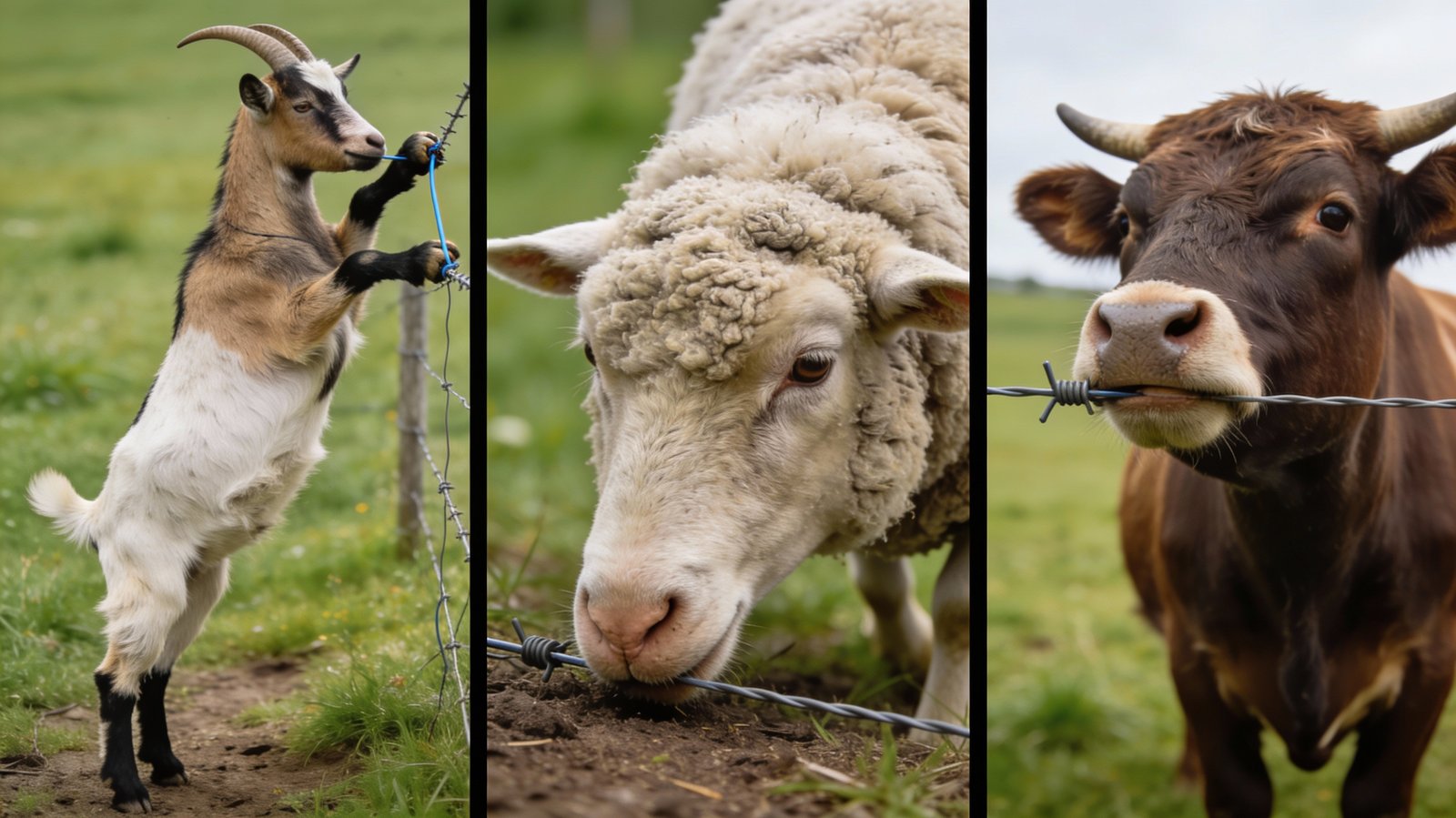
Cattle are relatively easy to contain once trained. They respect visual and psychological barriers and typically avoid testing fences repeatedly. Cattle have minimal hair insulation and make consistent nose or muzzle contact with wires, allowing effective shock delivery at 2,000-3,000 volts. Bulls require higher voltage (3,000-4,000 volts) due to aggressive behavior and testing tendencies.
🐑 Sheep
Wool reduces shock effectiveness, requiring higher voltage and closer wire spacing to ensure nose or face contact. Sheep wool can block electrical current from reaching skin, necessitating 4,000-5,000 volts minimum. Wire spacing must account for lambs, with the bottom wire starting at 4-6 inches and subsequent wires spaced every 4-6 inches. Sheep are generally docile but will push through inadequate fences when motivated by fresh forage.
🐐 Goats
Goats are widely regarded as escape artists. They climb, crawl, and push through weak points, demanding dense wire spacing and high voltage. Goat behavior includes standing on hind legs to reach over fences, squeezing between wires, and persistent testing of fence integrity. Many goat breeds have thick hair coats that insulate against shock, requiring 7,000-9,000 volts for effective control. Wire spacing must be tight (6 inches maximum) from ground level to prevent crawling under or through the fence.
Shock Tolerance and Hair Insulation Comparison
The effectiveness of electric shock varies dramatically across species due to differences in coat density, skin moisture, and contact behavior:
- Cattle: Short hair, high skin moisture, consistent nose contact. Minimal insulation allows reliable shock delivery at lower voltages.
- Sheep: Dense wool creates air pockets that block electrical current. Shock primarily delivered through face, ears, and legs where wool is thinner. Wet conditions improve conductivity.
- Goats: Variable coat thickness by breed. Angora and Cashmere goats have extreme insulation requiring maximum voltage. Goats often test fences with their bodies rather than noses, reducing shock effectiveness.
- Mixed herds: Design for the highest insulation level present. If goats are included, entire system must operate at 7,000-9,000 volts regardless of other species.
Behavioral Testing Patterns
Each species exhibits distinct fence-testing behavior that influences design requirements:
- Cattle: Initial curiosity followed by avoidance. Rarely test the same fence location repeatedly after receiving shock. Training period is 3-7 days.
- Sheep: Follow-the-leader mentality. If one sheep breaches, others follow. Flock behavior means fence failure has cascading consequences. Training period is 5-10 days.
- Goats: Persistent, intelligent testing. Goats remember fence weak points and exploit them systematically. They test fences daily, especially when forage quality declines. Training period is 7-14 days and requires consistent voltage maintenance.
Wire Conductor Material Selection for Multi-Species Systems
Conductor material significantly impacts fence performance in multi-species applications. The increased wire count and higher voltage requirements demand low-resistance conductors to maintain adequate voltage across long fence runs.
Conductor Resistance Comparison
Resistance is measured in ohms per kilometer. Lower resistance values ensure voltage is maintained at distant fence sections:
- High-tensile steel wire (12.5 gauge): 5-8 ohms/km. Most common for permanent perimeter fences. Economical and durable. Requires galvanization to prevent rust.
- Aluminum wire (12.5 gauge): 1-2 ohms/km. Four times more conductive than steel. Higher initial cost but superior performance on long fence runs. Does not rust but can corrode in thin filaments.
- Polywire (6 strand stainless steel): 6,000 ohms/km. Suitable only for temporary paddocks under 200 meters. Highly visible but significant voltage drop over distance.
- Polywire (9 strand copper): 130 ohms/km. Turbo wire with copper conductors. Suitable for semi-permanent and rotational grazing systems up to 500 meters.
- Polytape: 300-400 ohms/km. Wide visibility for horses and cattle. Not recommended for goat fencing due to higher resistance.
Material Selection for Mixed-Species Perimeter Fencing
For perimeter fences containing goats and sheep, low-resistance conductors are essential:
- Use 12.5-gauge high-tensile galvanized steel or aluminum wire for all hot strands
- Connect all hot wires at beginning and end of fence runs to reduce overall resistance
- Avoid polywire for permanent perimeter fences exceeding 500 meters
- For interior subdivision, polywire strand count and resistance must match energizer output and fence length
Wire Material Performance Under Vegetation Load
Multi-strand fences experience greater vegetation load, causing voltage loss. High-conductivity materials minimize this effect:
- Steel wire: Maintains 60-70% voltage under moderate vegetation load
- Aluminum wire: Maintains 75-85% voltage under same conditions
- Standard polywire: Voltage drops below effective threshold within 200-300 meters under heavy vegetation
- Turbo wire (copper conductor): Maintains 50-60% voltage under moderate load, acceptable for temporary paddocks
Mixed Grazing Strategies with Electric Fencing
Zoned Fence Design
One effective approach is to divide the pasture into zones, allowing different species to graze separately when needed.
- Outer perimeter designed for all species (goat-standard: 5-6 wires, 7,000-9,000 volts)
- Internal fences adjusted by species (cattle subdivisions: 2-3 wires, sheep subdivisions: 4-5 wires)
- Temporary fencing for seasonal separation using polywire or netting
- Perimeter fence must meet the highest containment standard; interior fences can be species-specific
Perimeter Fence vs. Internal Subdivision Fence Design Logic
The design requirements differ significantly between perimeter fences and internal subdivision fences in mixed-species operations:
Perimeter Fence Requirements
- Design standard: Must contain the most difficult species (typically goats) at all times
- Wire configuration: 5-6 strands with tight spacing (6″, 12″, 18″, 24″, 30″, 36″-42″)
- Voltage requirement: 7,000-9,000 volts maintained continuously
- Conductor material: High-tensile steel or aluminum for maximum durability and conductivity
- Post spacing: 12-15 feet maximum to prevent wire sagging
- Grounding system: Sized for maximum energizer output (see Grounding section below)
Internal Subdivision Fence Requirements
- Design standard: Can be species-specific based on current paddock occupants
- Wire configuration: Flexible – 2-3 strands for cattle-only paddocks, 4-5 for sheep, 5-6 for goats
- Voltage requirement: Must still meet minimum for species present (cattle: 3,000V, sheep: 4,000V, goats: 7,000V)
- Conductor material: Polywire acceptable for temporary rotational paddocks under 500 meters
- Post spacing: 30-50 feet using step-in posts for portable systems
- Energizer sharing: Internal subdivisions typically powered by same energizer as perimeter
This dual-standard approach allows cost-effective rotational grazing electric fencing systems while maintaining maximum security at the property boundary.
Sequential Grazing
Sequential grazing uses species differences to maximize pasture use:
- Cattle graze tall grasses first, consuming mature vegetation and opening the canopy
- Sheep or goats follow to graze shorter regrowth and target broadleaf weeds
- Improves utilization and pasture uniformity by matching animal diet preferences to forage stages
- Reduces parasite transmission – grazing different species breaks parasite life cycles
- Timing matters: Move follow-up species within 3-7 days for optimal forage quality and weed control
Simultaneous Mixed Grazing
Running multiple species together in the same paddock offers distinct advantages but requires careful fence design:
- Improved pasture utilization: Cattle prefer grasses, goats prefer browse and forbs, sheep consume both. This reduces selective grazing and promotes even utilization.
- Fence design requirement: Must meet goat containment standards (5-6 wires, 7,000-9,000 volts) regardless of other species present.
- Carrying capacity increase: Multi-species grazing can increase carrying capacity by 10-30% compared to single-species systems due to improved forage utilization.
- Natural predator deterrence: Presence of cattle provides protection for smaller ruminants against coyotes and dogs.
Voltage and Power Considerations
Mixed-species systems require higher energizer output due to increased wire count, voltage requirements, and fence loading. Proper energizer sizing and grounding design are critical to system success.
Energizer Sizing for Multi-Species Fencing
Energizer selection must account for total wire miles, not fence length. A 1-mile perimeter fence with 6 hot wires equals 6 miles of conductor:
- Industry standard: 1 output joule per mile of fence under ideal conditions
- Multi-strand fencing: 0.16-0.33 miles per joule (3-6 joules per mile) to accommodate increased wire count
- Sheep with wool insulation: 0.16-0.25 miles per joule (4-6 joules per mile)
- Goats with thick coats: 0.16-0.20 miles per joule (5-6 joules per mile)
- Vegetation load factor: Under heavy weed contact, multiply required joules by 1.5-2x
Calculating Required Energizer Output
Use this formula for accurate energizer sizing for mixed-species systems:
Required Output Joules = (Total Wire Miles × Species Factor × Vegetation Factor)
Example: 1 mile perimeter with 6 hot wires for goats, moderate vegetation
- Total wire miles: 1 mile × 6 wires = 6 miles
- Species factor for goats: 5 joules per mile
- Vegetation factor (moderate): 1.5
- Required output: 6 × 5 × 1.5 = 45 output joules minimum
Stored Joules vs. Output Joules
Critical distinction when selecting energizers:
- Stored joules: Energy stored in energizer capacitor before transformation
- Output joules: Actual energy delivered to fence (60-75% of stored joules due to transformer efficiency)
- Marketing trap: Some manufacturers advertise stored joules to inflate performance claims
- Always specify: Energizer output requirements based on output joules, not stored joules
Grounding System Design for High-Load Systems
Multi-species fencing places extreme demands on grounding systems. Inadequate grounding is the most common cause of fence failure.
Ground Rod Requirements by Energizer Output
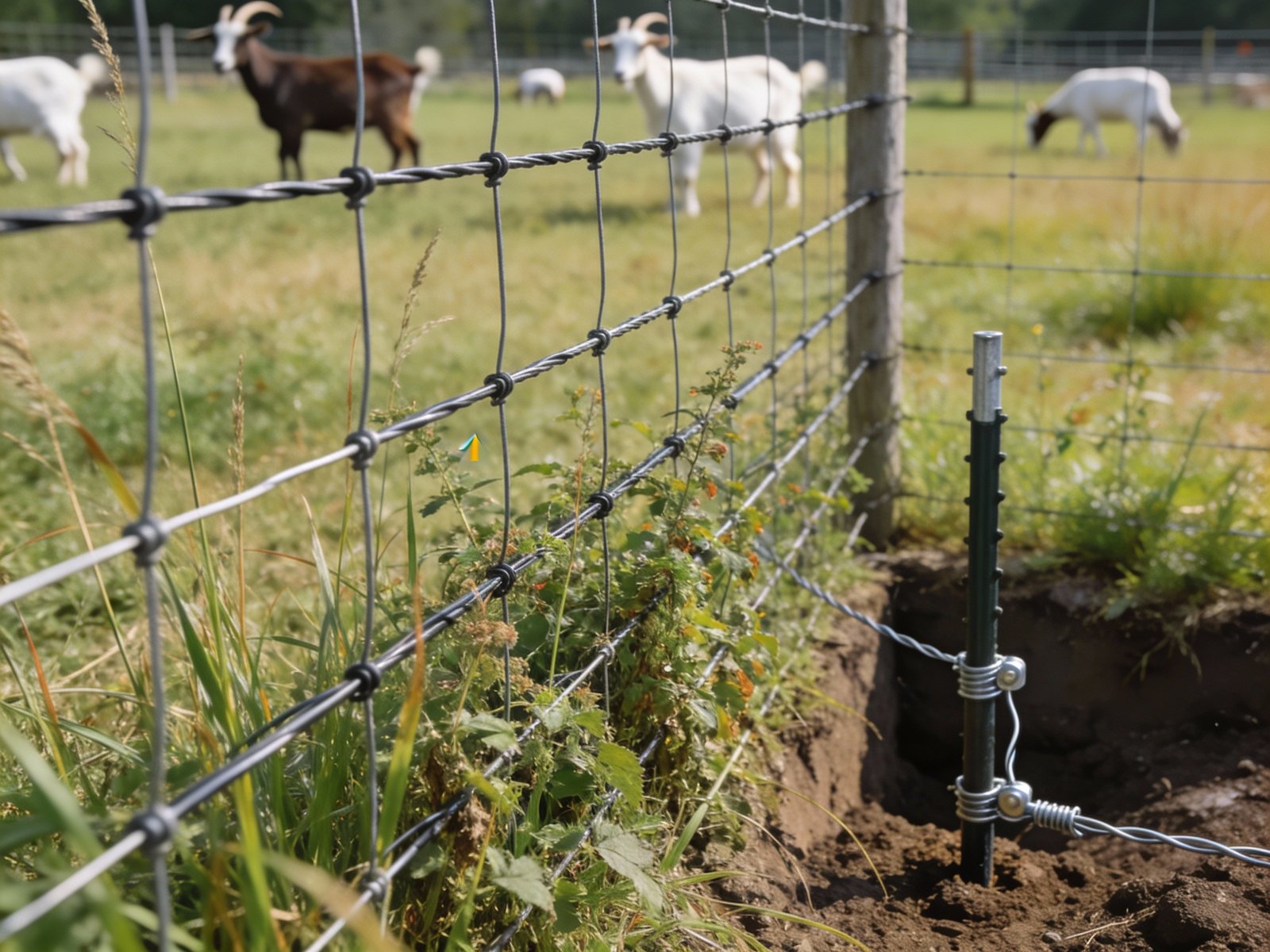
Standard formula: 3 feet (90 cm) of ground rod per output joule. For complete guidance, see our grounding system design and testing page.
- 10 output joule energizer: Minimum 30 feet of ground rod (three 10-foot rods or five 6-foot rods)
- 20 output joule energizer: Minimum 60 feet of ground rod (six 10-foot rods or ten 6-foot rods)
- 50+ output joule energizer: Minimum 150 feet of ground rod (fifteen 10-foot rods or twenty-five 6-foot rods)
- Rod spacing: Minimum 10 feet apart, connected with 10-12 gauge galvanized wire
- Soil conditions: Dry, sandy, or rocky soil requires 50-100% additional ground rod length
Ground Rod Installation Best Practices
- Use 5/8″ or 3/4″ diameter galvanized steel or copper-clad rods
- Drive rods in moist soil locations (north sides of buildings, low spots, near water sources)
- Install within 75 feet of energizer for optimal performance
- Keep ground system at least 75 feet from building grounds, utility grounds, and water lines
- Use galvanized ground rod clamps rated for outdoor use
- Connect all ground rods in series using continuous 10-12 gauge galvanized wire
Testing Ground System Adequacy
Regular testing prevents fence failure:
- Create a temporary short by laying metal rod across multiple hot wires 300+ feet from energizer
- Measure voltage between ground terminal on energizer and ground rod furthest from energizer
- Passing test: Less than 200 volts indicates adequate grounding
- Failing test: More than 300 volts indicates insufficient ground rod capacity – add more rods
- Test in dry summer conditions when soil conductivity is poorest
Video Guide: Multi-Species Electric Fencing Setup
This comprehensive webinar from university extension covers electric fencing for multiple livestock species, including practical setup guidance for goats, sheep, and cattle. The presentation includes real-world examples of multi-species grazing systems, energizer sizing, grounding requirements, and common mistakes to avoid.
Key Insights from Extension Specialists
Based on university extension research and practical farm experience:
- Why goat standards are mandatory: Goats combine climbing ability, intelligence, and thick coat insulation. Any weakness in voltage or wire spacing will be systematically exploited. Even if goats represent only 10% of your herd, the entire system must meet goat containment standards.
- Wire spacing impact on sheep and goats: Bottom wire placement is critical. Goats will crawl under any wire higher than 6 inches. Sheep with lambs require the same spacing. Maximum spacing between subsequent wires should never exceed 6 inches for goats or 8 inches for sheep.
- Energizer and grounding requirements: Multi-species systems demand 3-5 times more energizer output than single-species cattle fencing. A 20-acre perimeter fence for goats requires 40-60 output joules, compared to 10-15 joules for cattle only. Grounding system failure is the number one cause of fence breakouts in mixed herds.
- Cattle-only design failure: The most common mistake is designing a two-strand cattle fence and attempting to add goats or sheep later. This always fails. The psychological barrier effective for cattle is physically inadequate for goats. Rebuilding the entire fence is typically required.
Common Mistakes in Multi-Species Fencing
Learning from common installation and design errors prevents costly fence failures. For comprehensive troubleshooting guidance, see our pages on common installation mistakes and troubleshooting electric fence problems.
Critical Failure Points in Mixed-Species Systems
These design oversights cause immediate or eventual system failure:
- Bottom wire too high: Goats crawl under anything above 6 inches. Lambs follow. Once one animal succeeds, entire herd learns the technique.
- Inadequate training period: Goats require 7-14 days of consistent high voltage in a confined training area before release to pasture. Rushing training guarantees fence testing and breakouts.
- Voltage drop over distance: Long perimeter fences with high-resistance polywire experience catastrophic voltage drop. Fence may read 8,000 volts at energizer but only 2,000 volts at far end – inadequate for goats.
- Seasonal grounding failure: Ground systems adequate in spring may fail in summer drought. Test grounding in driest soil conditions, not when initially installed in spring.
- Vegetation load underestimation: Energizer sized for clean fence fails when pasture vegetation grows against wires. Size energizer for worst-case vegetation contact, not ideal conditions.
Frequently Asked Questions
Can one fence work for cattle, sheep, and goats?
Yes, but it must be designed to control goats, which typically require the most demanding configuration. A properly designed goat fence (5-6 wires, 7,000-9,000 volts, tight spacing) will effectively contain all three species. However, a cattle fence (2-3 wires, 3,000 volts, wide spacing) will not contain sheep or goats reliably.
Why do goats escape electric fences more often?
Goats combine climbing behavior, intelligence, and physical agility, making them the most challenging species to contain. Additionally, many goat breeds (Angora, Cashmere, Spanish) have thick hair coats that insulate against electric shock. Goats also test fences persistently and remember weak points, returning to exploit them repeatedly. Their ability to stand on hind legs, squeeze through narrow gaps, and push against wires requires maximum voltage and minimum wire spacing.
Does multi-species grazing require more maintenance?
Yes. Higher wire counts and voltage requirements demand more frequent inspection and vegetation control. Key maintenance requirements include: weekly voltage testing at multiple fence locations, vegetation trimming to prevent voltage loss, monthly ground system testing during dry seasons, post-storm inspection for wire damage or shorts, and quarterly energizer performance verification. Budget 2-3 times more maintenance labor compared to simple cattle fencing.
What voltage should I actually see on my multi-species fence?
Measure voltage at the fence line, not at the energizer. For effective multi-species containment: minimum 7,000 volts for goats, 4,000 volts for sheep, 3,000 volts for cattle. Voltage should not drop below these minimums even at the furthest point from the energizer or under moderate vegetation load. If voltage drops below minimum thresholds, increase energizer output, improve grounding, reduce fence length, or use lower-resistance conductor materials.
Can I use polytape or polywire for goat fencing?
Polywire and polytape are acceptable for temporary rotational paddocks under 200-300 meters, but not for permanent perimeter fences. Standard 6-strand polywire has 6,000 ohms/km resistance, causing significant voltage drop. Goat-containing permanent fences require high-tensile steel (5-8 ohms/km) or aluminum wire (1-2 ohms/km). For rotational grazing with polywire, use 9-strand turbo wire with copper conductors (130 ohms/km) and keep paddock perimeter under 500 meters.
How do I train multiple species to respect electric fence?
Train each species separately in a small confined area before mixing herds: Cattle require 3-7 days training with 2-3 hot wires at nose height; sheep require 5-10 days with 4 wires starting low; goats require 7-14 days with 5-6 wires and maximum voltage. Set up temporary training pen using same wire type and spacing as permanent fence. Ensure voltage is at species maximum during training. Do not release to pasture until animals consistently avoid fence for 48 hours. Once trained separately, species can be mixed, but new animals must always be trained before introduction.
What’s the minimum energizer size for 10 acres with goats?
Calculate based on perimeter wire miles. A 10-acre square parcel has approximately 0.79-mile perimeter (2,640 feet). With 6 hot wires for goats, total wire miles = 0.79 × 6 = 4.74 miles. At 5 joules per mile for goats with moderate vegetation, required output = 4.74 × 5 × 1.5 = 35-40 output joules minimum. Select energizer rated for 40-50 output joules to provide safety margin. Grounding system requires 120-150 feet of ground rod (twelve to fifteen 10-foot rods spaced 10 feet apart).
Key Takeaways for Multi-Species Fencing
System Design Priority Checklist
- Design all fencing to goat standards if goats are present or may be added in the future
- Calculate energizer requirements using output joules and total wire miles, not fence miles
- Install 3 feet of ground rod per output joule minimum, more in dry or rocky soil
- Use high-tensile steel or aluminum wire for permanent perimeter fences
- Test voltage at multiple fence locations, not just at energizer
- Train each species properly before releasing to pasture
- Plan for worst-case vegetation load, not ideal conditions
- Budget for increased maintenance time and regular system testing
Professional Fence Materials for Multi-Species Operations
Implementing a successful multi-species electric fencing system requires high-quality materials designed for demanding livestock containment. Our cattle fence wire products include options suitable for mixed-herd operations:
- Fixed Knot Fence: High-tensile woven wire with vertical stay wires. Ideal for perimeter fencing in multi-species operations where physical barrier supplements electric wires. Fixed knot construction prevents wire slippage and maintains consistent spacing.
- Hinge Joint Fence: Flexible woven wire design that adapts to terrain variations. Suitable for challenging topography where rigid fence materials would fail. Works well when electrified with offset electric wires for goat containment.
- Knot Fence Systems: Durable woven wire foundation that provides physical containment while electric wires add psychological deterrent. Combines strength of woven wire with efficiency of electric systems.
When combining woven wire physical barriers with electric offset wires, ensure electric strands are positioned at critical heights: 6″ from ground for goats, nose height for cattle, and face height for sheep. This combination provides maximum security for high-value livestock.
For technical specifications, installation guidance, and pricing information, visit our products page or contact our fencing specialists for personalized system design assistance.