
Permanent vs Temporary Electric Fencing for Cattle
Complete Comparison Guide: Cost Analysis, Installation Time, Maintenance, Flexibility & ROI for Modern Cattle Operations
Cost Range: $2K–$10K per mile
Lifespan Variance: 15–30 years (permanent) vs 2–4 years (temporary)
Payback Period: 3–5 years for most operations
Read Time: 13–17 minutes
Making the Right Choice: Permanent or Temporary?
The biggest mistake ranchers make isn’t choosing the wrong fence type—it’s choosing only one. Modern successful farms combine both systems for maximum efficiency and flexibility.
Your fencing choice today will impact your farm’s operations for the next 5–30 years. Initial investment, annual maintenance, operational flexibility, and long-term asset value all hinge on this critical decision.
Why This Decision Matters
- Initial Investment Impact: $1,860–$10,000 per mile determines your cash flow pressure
- Operational Flexibility: Directly affects your ability to rotate cattle daily, weekly, or seasonally
- Long-Term Costs: Year-over-year maintenance ranges from $100–$600 annually
- Asset Value: Permanent fencing adds 5–15% to property value at resale
- Labor Requirements: Annual maintenance ranges from 10–60 hours depending on system type
Quick Comparison: At a Glance
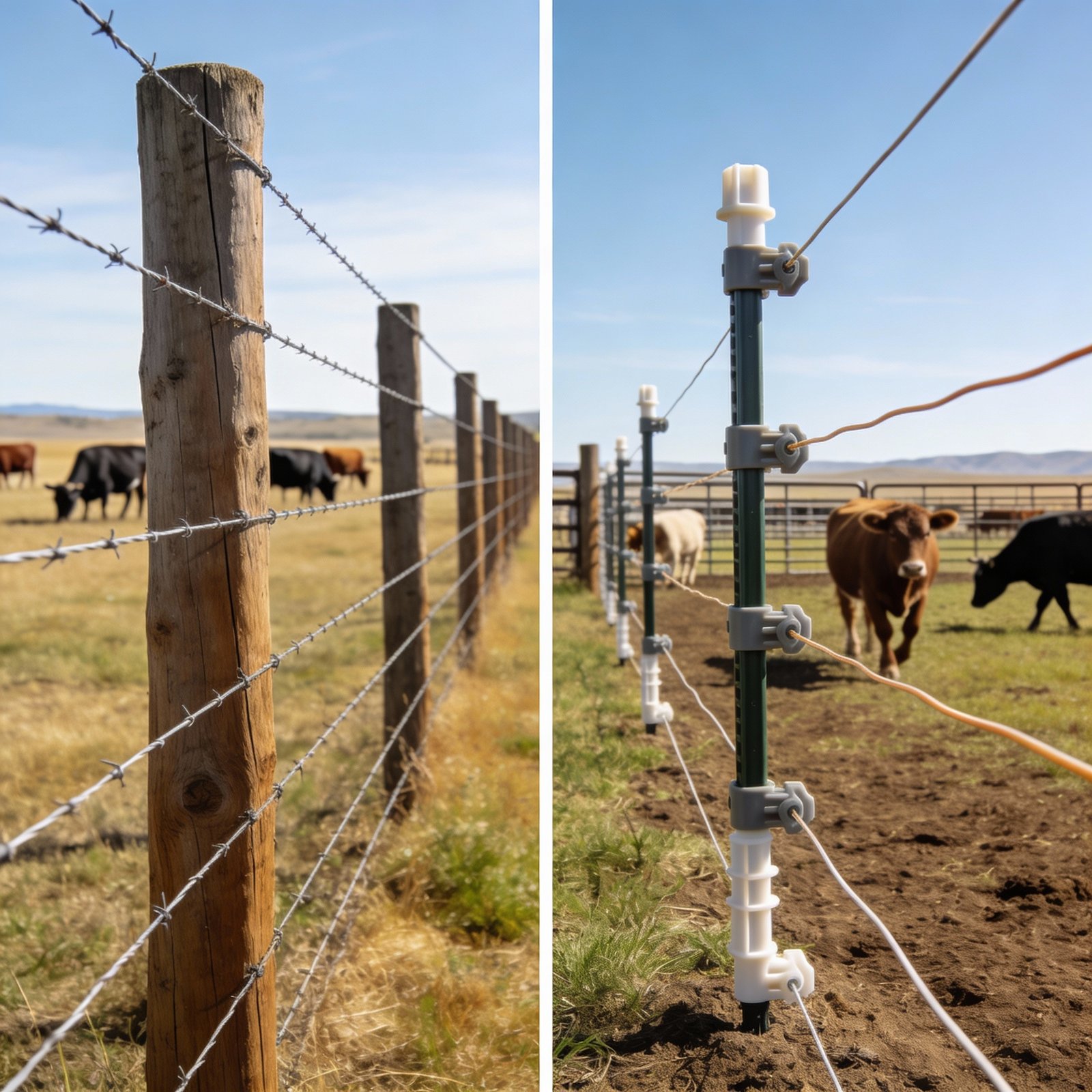
Permanent Electric Fencing
Lifespan: 15–30 years
Initial Cost/mile: $5,530–$9,750
Annual Cost: $150–$500
Installation: 3–5 days
Flexibility: Low
Best For: Long-term perimeter, fixed boundaries
Temporary Electric Fencing
Lifespan: 2–4 years
Initial Cost/mile: $1,860–$3,410
Annual Cost: $300–$600
Installation: 1–2 hours/acre
Flexibility: Excellent
Best For: Rotational grazing, daily adjustments
Hybrid System (Best Practice)
Approach: Permanent perimeter + Temporary internal
Initial Cost/mile: $3,500–$5,500
Annual Cost: $200–$400
Flexibility: Excellent
ROI Period: 8–10 years
Best For: Most operations (optimal balance)
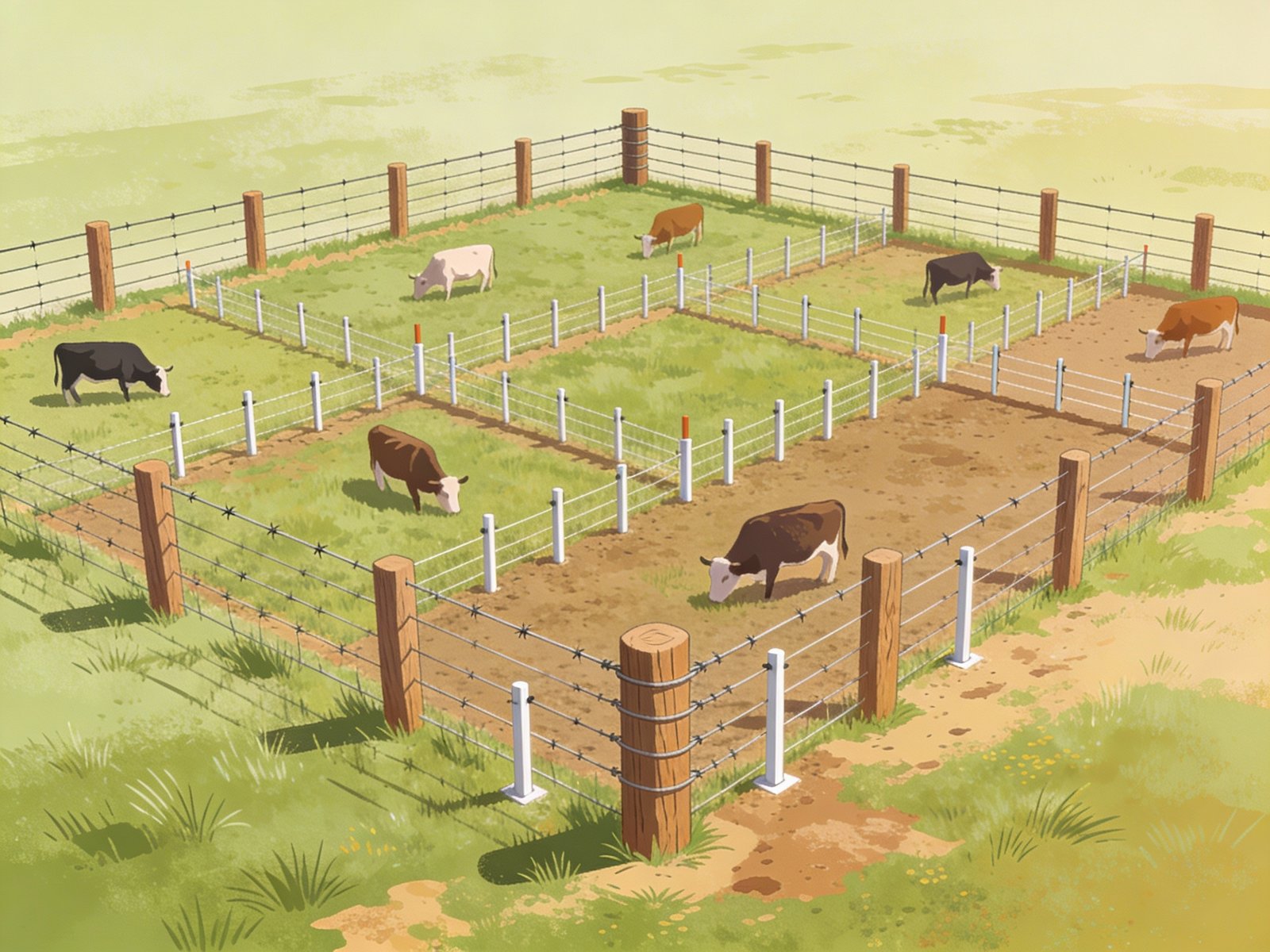
Key Insight: The Modern Standard
Top-performing ranches use a hybrid approach: permanent high-tensile wire fencing around the perimeter (15–30 year investment) plus temporary portable fencing for internal paddocks (2–4 year rotational use). This balances long-term stability with operational flexibility.
Permanent Electric Fencing: Long-Term Stability & Investment
Designed for 15–30 years of reliable service with minimal maintenance. The gold standard for property perimeters and main boundaries.
System Overview & Configuration
Permanent electric fencing uses fixed, high-quality materials installed in specific locations. It’s a set-it-and-forget-it solution for long-term boundary definition.
Key Specifications:
- Design Lifespan: 15–30 years
- Post Material: Wood (15–20 yrs), cement (30–40 yrs), metal (25–35 yrs)
- Post Spacing: 20–30 feet apart
- Wire Gauge: 12.5 gauge high-tensile (superior conductivity)
- Grounding: Permanent installation (6–8 rods, 6–8 feet deep)
- Energizer: AC mains or fixed solar system
Typical Material Bill of Materials (1 mile)
Posts (wood): $2,100–$3,200
12.5 gauge high-tensile wire: $630–$950
Brackets & hardware: $400–$600
AC mains energizer: One-time $400–$800
Grounding system: $300–$600
Professional installation labor: $2,000–$4,000
Total: $5,530–$9,750 per mile
For detailed installation guidance, see our Installing Electric Cattle Fences Guide, Grounding System Design and Testing, and High-Tensile Wire Selection Guide.
Complete Cost Analysis: Permanent Systems
Initial Investment by Farm Size:
| Farm Size | Linear Distance | Initial Cost Range | Cost per Acre |
|---|---|---|---|
| 10 acres | 0.5 miles | $2,765–$4,875 | $276–$487 |
| 25 acres | 1 mile | $5,530–$9,750 | $221–$390 |
| 50 acres | 2 miles | $11,060–$19,500 | $221–$390 |
| 100 acres | 4 miles | $22,120–$39,000 | $221–$390 |
| 200+ acres | 6+ miles | $33,180–$58,500+ | $221–$390 |
Annual Operating Costs:
- Vegetation management: $50–$150/year (1–2 cleanings annually)
- Occasional post replacement: $0–$200/year average
- Energizer electricity: $50–$100/year
- Annual maintenance labor: 10–15 hours (DIY or minimal professional help)
- Total Annual Cost: $150–$500
Long-Term Cost Comparison (15-Year Outlook):
| Timeline | Permanent Fencing | Temporary Fencing | Hybrid System |
|---|---|---|---|
| Year 1 | $6,000 | $2,160 | $3,700 |
| Year 3 | $6,800 | $3,360 | $4,500 |
| Year 5 | $7,530 | $4,560 | $5,500 |
| Year 10 | $9,530 | $8,160 | $8,000 |
| Year 15 | $11,280 | $11,760 | $10,500 |
| Year 20 | $13,030 | $15,360 | $12,500 |
Financial Insight: Break-Even Point
Permanent fencing breaks even with temporary fencing at approximately 12–15 years. After this point, the permanent system becomes significantly cheaper. For farms planning long-term operation (20+ years), permanent fencing is the most economical choice.
For detailed financial planning, see our Cost Comparison and ROI Analysis.
Permanent Fencing: Advantages & Disadvantages
Major Advantages
- Extreme Longevity: 15–30 years service life = true long-term investment
- Low Maintenance: Annual upkeep only 10–15 hours
- Professional Appearance: Neat, organized, attractive to property buyers
- Property Value: Adds 5–15% to real estate value ($25K–$75K for $500K property)
- Zero Flexibility Required: Can set and forget for years
- Superior Reliability: Less than 5% annual failure rate with proper installation
- Supports Hybrid Systems: Perfect perimeter for flexible temporary paddocks
Major Disadvantages
- High Initial Cost: $5,500–$10,000/mile is substantial upfront cash
- Inflexible Boundaries: Can’t adjust daily, weekly, or seasonally
- Planning Risk: Incorrect placement is expensive to correct
- Long Installation: 3–5 days per mile requires professional crew
- Material Degradation: Wood posts rot (15–20 yr lifespan), metal rusts
- Difficult Expansion: Adding more fencing requires new design and installation
- Not Suitable for Experimentation: Testing new grazing patterns is impractical
Best Use Cases for Permanent Fencing
- Property perimeter boundaries (exterior borders)
- Fixed grazing areas where cattle rotation is minimal
- Properties being prepared for sale (boost curb appeal & value)
- Established farms with 20+ year operation plans
- Base layer for hybrid systems (permanent perimeter)
Temporary Electric Fencing: Flexibility & Rapid Deployment
Deploy in hours, adjust daily, replace every 2–4 years. The operational workhorse for modern rotational grazing systems.
System Overview & Configuration
Temporary fencing prioritizes flexibility and speed over permanence. Designed for frequent repositioning, it enables sophisticated rotational grazing patterns and rapid experimentation.
Key Specifications:
- Usable Lifespan: 2–4 years (reusable until degradation)
- Post Type: Plastic T-posts or fiberglass stakes
- Post Spacing: 10–15 feet apart (rapid deployment)
- Wire Gauge: Poly-wire (3–6 strand) or 14-gauge high-tensile
- Grounding: Portable rods, quickly installed & removed
- Energizer: Battery or portable solar unit
Typical Material Bill of Materials (1 mile)
T-posts (plastic): $420–$630
Poly-wire or tape: $530–$790
Clips & fasteners: $260
Battery energizer: One-time $250–$500
Portable grounding rods: $150–$250
Installation labor (DIY or helper): $500–$750
Total: $1,860–$3,410 per mile
Learn more in our Rotational Grazing Electric Fencing Guide, Poly Wire and Tape Guide, and Portable Energizer Selection.
Complete Cost Analysis: Temporary Systems
Initial Investment by Farm Size:
| Farm Size | Linear Distance | Initial Cost Range | Cost per Acre |
|---|---|---|---|
| 10 acres | 0.5 miles | $930–$1,705 | $93–$170 |
| 25 acres | 1 mile | $1,860–$3,410 | $74–$136 |
| 50 acres | 2 miles | $3,720–$6,820 | $74–$136 |
| 100 acres | 4 miles | $7,440–$13,640 | $74–$136 |
| 200+ acres | 6+ miles | $11,160–$20,460+ | $74–$136 |
Annual Operating Costs:
- Wire/tape replacement: $150–$300/year (UV degradation)
- Battery charging/replacement: $100–$200/year
- Post maintenance: $50–$100/year
- Seasonal setup/takedown labor: 40–60 hours/year
- Winter storage space: Approximately $50–$100/year
- Total Annual Cost: $350–$700
Lifespan Cost Comparison:
| Timeline | Temporary (1 mile) | Annual Average | Note |
|---|---|---|---|
| Year 1 | $2,160–$4,110 | $2,160–$4,110 | Initial + first year ops |
| Year 4 (Lifecycle) | $3,260–$6,310 | $815–$1,578 | Replace all materials |
| Year 10 | $6,860–$13,710 | $686–$1,371 | 2.5 complete cycles |
| Year 15 | $10,460–$21,110 | $697–$1,407 | 3.75 complete cycles |
| Year 20 | $14,060–$28,510 | $703–$1,426 | 5 complete cycles |
Key Understanding: Cost Curve
Temporary fencing starts 40–60% cheaper but has higher annual costs. The 4-year lifespan means complete system replacement. Over 15+ years, total costs can exceed permanent fencing, but the operational flexibility justifies the expense for most modern rotational grazing farms.
Temporary Fencing: Advantages & Disadvantages
Major Advantages
- Low Initial Cost: $1,860–$3,410/mile = easy startup
- Maximum Flexibility: Adjust daily, hourly if needed
- Rapid Deployment: 1–2 hours per acre (DIY feasible)
- Minimal Skill Required: No tools needed, simple clips
- Experimentation-Friendly: Test new grazing patterns risk-free
- Scalability: Expand incrementally without major planning
- Rotational Excellence: Enables daily/weekly paddock rotation
- Labor Efficiency: One person can manage large areas
Major Disadvantages
- Short Lifespan: Complete replacement every 2–4 years
- Higher Annual Costs: $350–$700/year vs $150–$500 for permanent
- Poor Aesthetics: Looks temporary, doesn’t enhance property value
- Weather Vulnerability: High winds, snow damage posts easily
- Animal Pressure: Cattle can push over T-posts if determined
- Labor-Intensive Maintenance: Weekly checks, frequent adjustments
- Winter Storage Required: Takes shed/barn space, extra cleaning
- Poly-Wire Degradation: UV damage, requires regular replacement
Best Use Cases for Temporary Fencing
- Rotational/mob grazing systems (daily to weekly moves)
- Testing new grazing strategies or areas
- Seasonal grazing operations (spring–fall intensive use)
- Starting farms with limited capital
- Internal paddock subdivision (with permanent perimeter)
- Short-term intensive grazing projects
Detailed Comparison: Permanent vs Temporary Head-to-Head
Side-by-side analysis of cost, flexibility, installation, maintenance, durability, and aesthetics across 20-year operational scenarios.
Total Cost of Ownership: The Complete Picture
Comprehensive Cost Comparison (per mile):
| Cost Category | Permanent | Temporary | Hybrid |
|---|---|---|---|
| Initial Investment | $5,530–$9,750 | $1,860–$3,410 | $3,500–$5,500 |
| Year 1 Total | $6,000–$10,250 | $2,160–$4,110 | $4,000–$6,100 |
| Year 5 Total | $7,280–$12,250 | $3,660–$6,410 | $5,100–$7,500 |
| Year 10 Total | $9,030–$14,750 | $6,860–$13,710 | $7,100–$10,500 |
| Year 15 Total | $11,280–$17,000 | $10,460–$21,110 | $9,100–$13,500 |
| Year 20 Total | $13,030–$19,250 | $14,060–$28,510 | $11,100–$16,500 |
| Annual Average | $651–$963 | $703–$1,426 | $555–$825 |
Break-Even Analysis
Temporary breaks even with Permanent at 12–15 years. For farms expecting 20+ year operations, Permanent becomes the lowest-cost solution. However, for 5–7 year operations, Temporary wins. The Hybrid approach offers the best long-term balance.
Expert Video Explanation: Real Ranch Conditions
This expert-led video explains how permanent and temporary electric fencing systems perform under real ranch conditions.
It demonstrates:
- Why permanent fencing excels for long-term perimeter security
- How temporary fencing enables high-frequency rotational grazing
- The labor and flexibility trade-offs between both systems
- Why most modern cattle operations adopt a hybrid approach
The video reinforces key decision factors such as lifespan, labor input, grazing intensity, and long-term ROI, supporting the recommendations outlined in this guide.
Watch: The Best Electric Fence Setup for Rotational Grazing (Gallagher demonstration)
Also recommended: NEW Fencing Technology for Daily Cattle Moves (advanced rotational systems)
Flexibility & Operational Agility
Grazing Management Flexibility Comparison:
| Grazing Scenario | Permanent | Temporary | Winner |
|---|---|---|---|
| Daily paddock rotation | Difficult | Perfect | Temporary |
| Weekly rotational grazing | Possible (with temporary) | Standard | Temporary |
| Seasonal adjustments | Requires planning | Immediate | Temporary |
| Fixed perimeter | Excellent | Workable | Permanent |
| Rapid farm expansion | Expensive/difficult | Easy | Temporary |
| Testing new strategies | High cost/risk | Low cost/risk | Temporary |
| Long-term stable boundaries | Ideal | Requires maintenance | Permanent |
Grazing Pattern Recommendations
- Fixed Grazing: Permanent system (low change required)
- Mob Grazing (daily moves): Temporary system (flexibility essential)
- Rotational Grazing (weekly/monthly): Hybrid system (best balance)
- Seasonal Grazing: Hybrid system (winter fixed, summer flexible)
- High-Intensity Grazing: Temporary system (multiple daily adjustments)
Installation, Maintenance & Labor Requirements
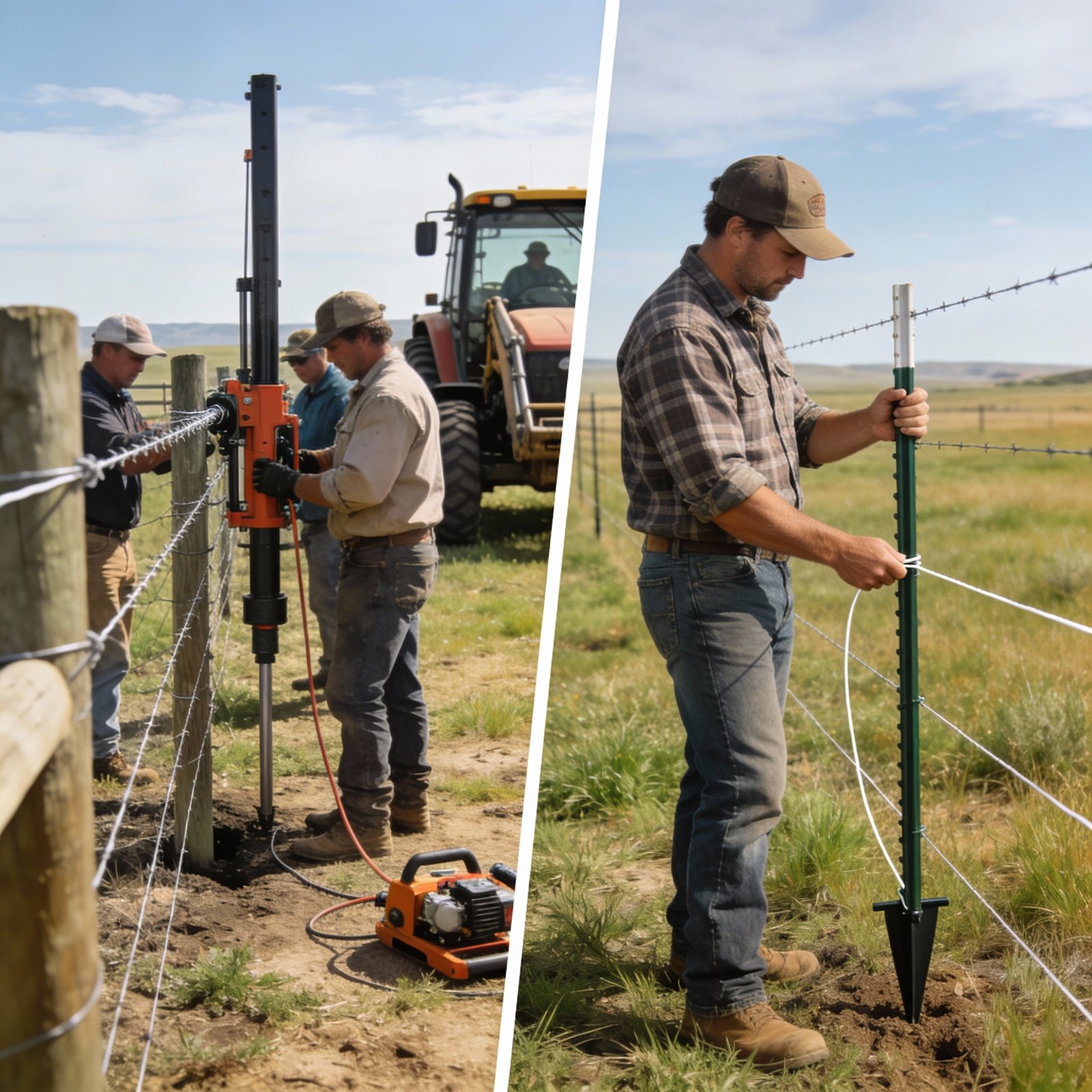
Installation Time & Complexity:
| Factor | Permanent | Temporary |
|---|---|---|
| Installation Time (per acre) | 6–10 hours | 1–2 hours |
| Professional Skill Required | High (recommended) | Low (DIY feasible) |
| Tools Required | Post driver, wire tensioner, digger | None (just hands) |
| Single-Person Installation | Difficult | Easy |
| Weather Dependency | High (must have good conditions) | Low (flexible scheduling) |
| Can Be Paused Mid-Project | No (must finish) | Yes (stop anytime) |
Maintenance Demands:
| Maintenance Task | Permanent | Temporary |
|---|---|---|
| Visual Inspections | 2–3 per year | Weekly during grazing season |
| Vegetation Clearing | 1–2 times/year | 2–3 times/week |
| Repair Frequency | Rare (less than 5% annually) | Moderate (10–20% annually) |
| Component Replacement | Every 5–10 years | Every 2–4 years |
| Annual Labor Hours | 10–15 hours | 40–60 hours |
| Professional Help Needed | Rarely | Usually can be DIY |
Labor Cost Analysis
If you value your labor at $20/hour: Permanent saves approximately $600–$1,000/year vs Temporary in maintenance labor. Over 10 years, that’s $6,000–$10,000 in saved labor costs, favoring Permanent for larger operations.
For avoiding common pitfalls, review our Common Installation Mistakes Guide and Troubleshooting Electric Fence Problems.
Decision Guide: Which System is Right for Your Operation?
Use these decision trees and scenario-based recommendations to identify your optimal fencing strategy.
Scenario-Based Recommendations by Farm Type
New Small Farm (10–25 acres)
Recommended: Temporary Electric
Investment: $2,000–$5,000
Why: Low startup cost, learn management, easy to expand later
Timeline: Upgrade to hybrid in 3–5 years as operation matures
Established Farm (50–100 acres)
Recommended: Hybrid System
Investment: $8,000–$15,000
Why: Permanent perimeter for stability + temporary internal for flexibility
Payback: 4–6 years through improved pasture management
Large Commercial (200+ acres)
Recommended: Hybrid with Permanent Emphasis
Investment: $25,000–$50,000
Why: Scale economies favor permanent; temporary supports intensive rotation
ROI: 2–3 years through operational efficiency gains
Organic and Grass-Fed Operation
Recommended: Temporary + Hybrid
Investment: $5,000–$12,000
Why: Frequent rotation essential for soil health and forage quality
Premium ROI: Supports price premium from better management
Hobby and Small Hobby Farm
Recommended: Temporary Electric
Investment: $800–$2,000
Why: Low cost, minimal maintenance, aesthetic not critical
Scaling: Easy to add more as experience grows
Property with Near-Future Sale
Recommended: Permanent Perimeter
Investment: $5,500–$10,000
Why: Adds 5–15% property value; looks professional to buyers
Payback: Immediate through enhanced sale price
Quick Decision Tree
Step 1: How long do you plan to keep this farm?
- Less than 7 years? Temporary
- 7–15 years? Hybrid
- 15+ years? Permanent or Hybrid
Step 2: How frequently do you rotate cattle?
- Daily/Weekly? Temporary
- Monthly/Seasonal? Hybrid
- Fixed location? Permanent
Step 3: What’s your capital available?
- Limited? Temporary
- Moderate? Hybrid
- Substantial? Hybrid (best ROI)
For specialized applications, see our guides on Multi-Species and Mixed Herd Fencing, Predator Protection Electric Fencing, and Weather and Seasonal Management.
ROI Analysis by Farm Size & Scenario
Understanding potential return on investment across different operation scales and grazing strategies.
ROI Metrics: How Fencing Pays for Itself
Typical Benefits (Annual Value):
- Improved Pasture Utilization: 20–40% increase in forage consumption efficiency = reduced supplemental feed costs ($500–$2,000/year)
- Reduced Labor: 10–20 hours saved annually in manual movement ($200–$400/year at $20/hr)
- Improved Animal Health: Better grazing rotation = 10–15% reduction in veterinary costs ($300–$1,000/year)
- Enhanced Milk Quality (Dairy): Diverse forage = 3–5% production increase ($500–$2,000/year)
- Breeding Efficiency: Better pasture = shorter calving intervals, 2–3% improvement ($200–$500/year)
Real-World ROI Examples:
Case 1: 50-Acre Dairy Farm (Hybrid System)
Investment: $8,000 (permanent perimeter $6,000 + temporary internal $2,000)
Annual Benefits:
- Pasture utilization improvement: +$1,200
- Labor savings: $300
- Vet cost reduction: $600
- Milk quality premium: $800
Total Annual Benefit: $2,900
Payback Period: 2.8 years
Year 10 Value: $29,000 (plus permanent asset)
Case 2: 200-Acre Beef Operation (Hybrid System)
Investment: $30,000 (permanent perimeter $20,000 + temporary internal $10,000)
Annual Benefits:
- Feed cost savings (better grazing): $3,000
- Labor reduction: $800
- Weight gain improvement (15%): $2,500
- Veterinary costs: $1,200
Total Annual Benefit: $7,500
Payback Period: 4.0 years
Year 10 Value: $75,000+ (plus land value increase)
Property Value Enhancement (Permanent Fencing)
Professional, well-maintained permanent fencing adds 5–15% to property value:
- $300,000 property: +$15,000–$45,000
- $500,000 property: +$25,000–$75,000
- $1,000,000 property: +$50,000–$150,000
For comprehensive planning resources, explore our Electric Fence Energizer Selection Guide, Training Cattle to Electric Fences, and Gate Systems for Electric Fences.
Frequently Asked Questions
Can I combine permanent and temporary fencing on the same property?
Absolutely—this is recommended! The hybrid approach uses permanent high-tensile wire around the property perimeter (20-30 year investment) and temporary portable fencing for internal paddock divisions (2-4 year replacement). This combines the best of both worlds: long-term stability plus operational flexibility. Most modern high-performing farms use this exact approach.
How long do permanent posts actually last?
It depends on material:
- Wood posts: 15–20 years (requires wood preservative treatment)
- Concrete posts: 30–40 years (longest lifespan)
- Metal posts: 25–35 years (requires rust prevention coating)
Most permanent installations will need post replacement after 15–20 years, which costs $500–$1,500 per mile. This is factored into the long-term cost calculations above.
What’s the real difference in installation difficulty?
Dramatic difference:
- Permanent: Requires heavy equipment (post driver, wire tensioner), professional crew, 3–5 days per mile. DIY possible for experienced ranchers but not recommended.
- Temporary: Literally push T-posts into ground by hand, clip wire on, done. One person can set up 1 acre in 1–2 hours. Completely DIY-friendly.
This is why temporary systems are popular with new and small-scale operations.
Will temporary fencing work with large, aggressive bulls?
Depends on training and cattle behavior: Well-trained bulls generally respect temporary fencing once they learn the boundaries (through brief contact during training). However, aggressive or untrained bulls may test T-posts and potentially push through, especially at feeding time. Recommendation: Use permanent or very sturdy temporary system (heavier posts, higher voltage) for bulls. For small herds, permanent is safer.
How much voltage do I actually need?
Cattle require:
- Trained cattle: 2,000–3,500 volts
- Untrained cattle: 4,500–5,500 volts (stronger stimulus)
- Wet conditions: Add 500–1,000V (moisture reduces skin resistance)
Use a fence tester to verify your system is delivering 3,000V+ at the fence line. If voltage is below 2,000V, the fence won’t work reliably.
What’s the best way to start if I’m new to electric fencing?
Recommended approach:
- Start with temporary portable fencing on a small area (5–10 acres)
- Learn cattle behavior and management
- Test different grazing patterns
- After 2–3 years, upgrade to hybrid system as you expand
- Add permanent perimeter once operation is established and stable
This gradual approach lets you learn with minimal risk and cost before major investment.
Does electric fencing work in winter or wet conditions?
Winter: Yes, but battery-powered energizers need winter care (move to warm shelter, charge monthly). AC-powered systems work fine year-round. Frozen ground makes installation harder but doesn’t affect function.
Wet conditions: Actually improves performance! Wet soil improves grounding, making the system more effective. Snow on wires can cause minor efficiency loss but generally works fine.
Can I expand permanent fencing later if I need more?
Technically yes, but it’s expensive and disruptive. Expanding permanent fencing requires additional grounding system installation, new energizer capacity, and 2–4 week installation time. Each expansion is a new $5,000–$10,000 project.
Better approach: Start with temporary/hybrid system that scales easily, then install permanent perimeter once final size is determined.
For safety and compliance guidance, review our Electric Fence Safety Guide, Regulations Safety and Compliance, and Lightning Protection and Surge Prevention.
Related Resources by Decision Stage
Stage 1: Planning & System Design
- Electric Cattle Fencing Hub
- How Electric Fences Work
- Permanent vs Temporary Electric Fencing (this page)
- Best Electric Fence for Cattle
- Electric vs Woven Wire Cattle Fence
Stage 2: Component Selection
- Energizer Selection Guide
- Energizer Power Source Selection
- Wire Conductor Material Comparison
- Poly Wire and Tape Guide
- Insulator Selection and Installation
Stage 3: Installation & Setup
- Installing Electric Cattle Fences
- Grounding System Design and Testing
- Common Installation Mistakes
- Gate Systems for Electric Fences
- Training Cattle to Electric Fences
Stage 4: Optimization & Scaling
Permanent vs Temporary Electric Fencing: Summary for Decision-Makers
Permanent electric fencing is best for long-term perimeter boundaries with low annual maintenance and strong property value impact. Temporary electric fencing excels in rotational grazing systems requiring frequent adjustments and low upfront cost. For most cattle operations, a hybrid system combining permanent perimeter fencing with temporary internal paddocks delivers the best balance of cost, flexibility, and ROI.
Key Takeaways: Permanent vs Temporary Decision
- Permanent = Long lifespan (15–30 yrs), high initial cost ($5,500–$10K/mi), low annual cost ($150–$500)
- Temporary = Short lifespan (2–4 yrs), low initial cost ($1,860–$3,400/mi), higher annual cost ($350–$700)
- Hybrid = Best of both (permanent perimeter + temporary internal) = optimal for most farms
- Break-even point = 12–15 years (permanent becomes cheapest beyond this)
- Permanent adds 5–15% to property value; excellent for pre-sale improvements
- Temporary enables daily rotation and experimentation; essential for intensive grazing
- Installation time: Permanent 3–5 days (professional), Temporary 1–2 hours (DIY)
- Labor requirements: Permanent 10–15 hours/year, Temporary 40–60 hours/year
Need personalized guidance? Contact our fencing specialists for custom recommendations based on your specific operation.