
Wire & Conductor Material Comparison for Electric Fencing
In electric fencing systems, the conductor is the pathway that delivers voltage from the energizer to the animal. While fence layout and energizer size are critical, conductor material often determines how much voltage actually reaches the far end of the fence. Poor conductor choice leads to excessive voltage drop, unreliable shocks, and frequent fence failures—especially in long fences or high-load conditions.
Understanding conductor materials is essential for designing effective electric fencing systems. The electrical resistance of the wire directly impacts how efficiently energy travels from the energizer to distant sections of the fence. Low-resistance conductors maintain strong voltage levels across long distances, while high-resistance materials cause significant energy loss, reducing shock effectiveness and compromising livestock control.
Conductor selection must account for the complete electric fence system: the energizer’s output power, the grounding system’s effectiveness, and the fence’s total length. A low-resistance conductor cannot compensate for inadequate grounding or an undersized energizer. These three components—conductor resistance, grounding quality, and energizer output—work together to deliver effective shock to livestock. Upgrading only one element without addressing system-wide limitations will not resolve voltage delivery problems.
Why Conductor Material Matters in Electric Fencing
The conductor’s electrical properties determine the fence’s ability to maintain voltage over distance. When an energizer sends a high-voltage pulse through the fence wire, electrical resistance causes voltage to drop as energy travels along the conductor. This voltage drop becomes more pronounced as fence length increases, and the rate of drop depends entirely on the conductor’s resistance per unit length.
In practical terms, a fence using high-resistance conductor may show 8,000 volts at the energizer but only 2,000 volts at the far end of a long run—insufficient to deter livestock effectively. The same fence using low-resistance conductor might maintain 6,500 volts at the same distance. This difference directly impacts animal containment and fence reliability.
Material selection involves balancing three factors: electrical conductivity, mechanical strength, and cost. Stainless steel provides excellent strength and corrosion resistance but conducts electricity poorly compared to copper. Copper offers superior conductivity but costs more and has lower tensile strength. Aluminum provides the highest conductivity but stretches easily and lacks durability. Hybrid conductors attempt to combine the advantages of multiple materials.
Electrical Conductivity Comparison (Relative)
Electrical conductivity determines how efficiently electricity travels through a fence conductor. The following comparison uses stainless steel as the baseline, with other materials rated relative to this standard. Higher conductivity means lower resistance and less voltage drop over distance.
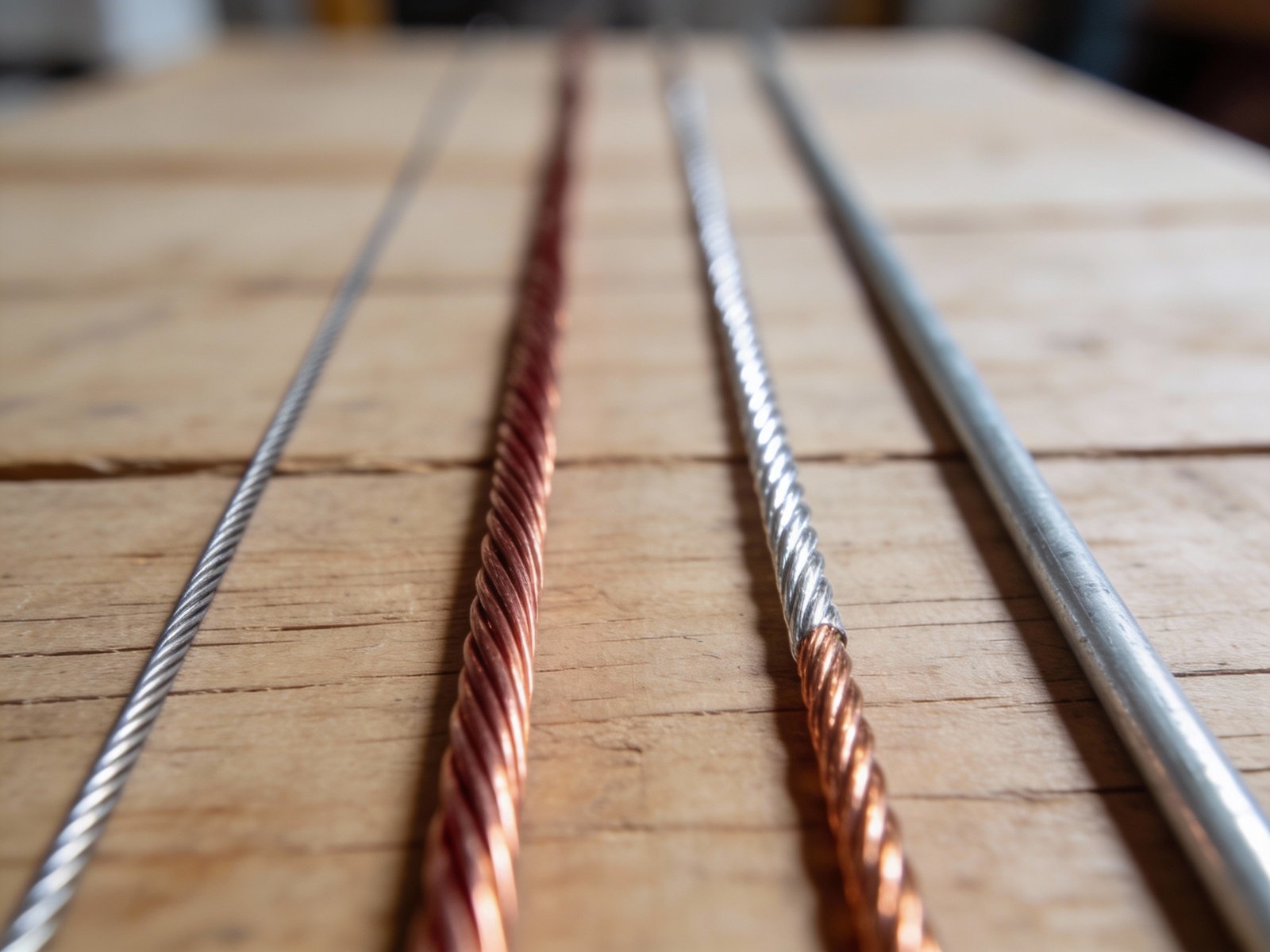
| Conductor Material | Relative Conductivity | Key Characteristics | Typical Use Case |
|---|---|---|---|
| Stainless Steel | 1× (Baseline) | Very strong, corrosion-resistant, lowest cost, highest resistance | Short fences, durability-first designs, small paddocks |
| TriCOND Alloy | 5–7× | Balanced conductivity and strength, rust-proof, moderate cost | Medium-length farm fencing (0.5–2 km) |
| Copper / Tinned Copper | ≈ 40× | Excellent conductivity, prone to corrosion (unless tinned), higher cost, lower tensile strength | Long-distance perimeter fences (2–5+ km) |
| Aluminum | ≈ 70× | Very high conductivity, very low strength, stretches easily | Lead-out wire, lightweight temporary applications |
These conductivity ratings reflect the material’s ability to carry electrical current with minimal resistance. Stainless steel, while mechanically robust, forces the energizer to work harder to maintain voltage over distance. Copper conductivity is approximately 40 times greater than stainless steel of the same diameter, meaning copper can carry the same current with far less voltage drop. Aluminum exceeds copper in conductivity but sacrifices structural integrity.
Higher conductivity reduces voltage drop but does not compensate for poor grounding or undersized energizers. The grounding system must be adequate to receive the returning current from the soil, and the energizer must generate sufficient pulse energy to overcome all resistance in the circuit. A fence with excellent conductor but insufficient ground rods will still fail to deliver effective shock.
Understanding Poly Wire and Poly Tape Conductors
Poly wire and poly tape are popular portable fencing options that incorporate metal conductor strands woven into synthetic polymer material. The electrical performance of these products depends entirely on the type, quantity, and diameter of the metal strands—not the overall thickness or appearance of the wire.
A 6-strand stainless steel poly wire typically has higher resistance than a 6-strand mixed-metal poly wire containing both stainless steel and copper filaments. The number of strands matters: a 9-strand poly wire generally outperforms a 6-strand version of the same material composition. However, strand count alone does not determine performance—a 9-strand stainless steel poly wire will still have far higher resistance than a 6-strand copper-blend wire.
Economy poly wire often uses only stainless steel conductors and may have resistance values exceeding 2,000 Ω per 1,000 feet. Premium poly wire incorporating tinned copper strands can achieve resistance as low as 50 Ω per 1,000 feet—a 40-fold improvement. This difference becomes critical on fences longer than 500 meters, where high-resistance poly wire may fail to deliver sufficient voltage to the far end.
The metal proportion in poly wire also affects performance. Some manufacturers use thicker conductor strands or increase the ratio of metal to polymer, improving conductivity. When evaluating poly wire, always check the resistance specification (measured in ohms per unit length) rather than relying on visual thickness or strand count alone. A thicker-looking poly wire with stainless steel conductors will underperform compared to thinner poly wire with copper-blend conductors on long fence runs.
Electrical Resistance Comparison (Ω/m)
Resistance, measured in ohms per meter (Ω/m), is the most practical indicator of conductor performance. Lower resistance means less energy loss over distance. The following table shows typical resistance values for common electric fence conductors, converted to ohms per meter for direct comparison.
| Conductor Type | Typical Resistance | Performance Level | Recommended Maximum Distance |
|---|---|---|---|
| Economy stainless poly wire | 6–10 Ω/m | Low (short distances only) | 100–300 m |
| 6-strand stainless poly wire | 4–6 Ω/m | Moderate | 300–500 m |
| 9-strand stainless poly wire | 2–4 Ω/m | Good | 500–800 m |
| Hybrid stainless + tinned copper poly wire | 0.15–0.2 Ω/m | High | 1,500–3,000 m |
| High copper-content conductors | 0.1–0.3 Ω/m | Very high | 3,000–5,000+ m |
| Aluminum insulated lead-out cable | 0.01–0.02 Ω/m | Excellent (lead-out wire only) | Not for fence use |
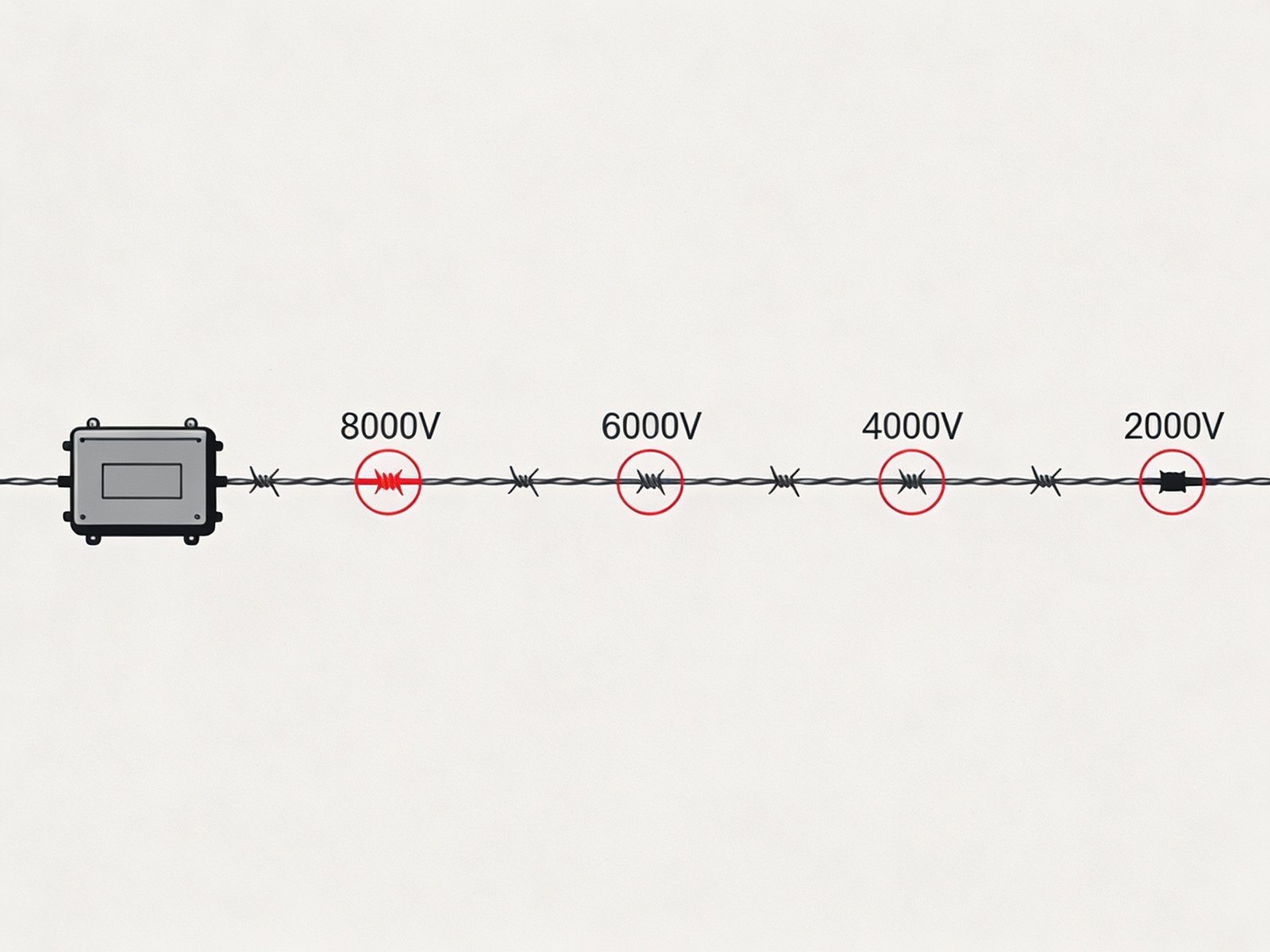
Resistance becomes exponentially more important as fence length increases. On a 200-meter fence, a conductor with 6 Ω/m resistance causes a total line resistance of 1,200 ohms, which may be acceptable with a powerful energizer. On a 2,000-meter fence, the same conductor creates 12,000 ohms of resistance—enough to reduce voltage to ineffective levels even with high-joule energizers.
Voltage drop calculations demonstrate this effect. A fence energizer outputting 8,000 volts with 1 amp of current faces significant voltage loss when pushing energy through high-resistance wire. If the conductor has 4 Ω/m resistance and the fence runs 1,000 meters, total line resistance is 4,000 ohms. Using Ohm’s Law (V = I × R), the voltage drop along the wire is substantial, potentially reducing far-end voltage below the 3,500-volt minimum needed for effective livestock deterrence.
Why energizer voltage readings can be misleading: Many electric fence troubleshooting errors occur because operators test voltage at the energizer and assume the entire fence carries the same voltage. In reality, high conductor resistance causes voltage to decrease progressively along the fence length. An energizer may show 7,000 volts at the terminal, but if high-resistance wire connects to a long fence, the far end might read only 2,000 volts—below the effective shock threshold. This explains why livestock sometimes ignore distant sections of fence that appear functional based on energizer readings.
Pulse energy, not just voltage, determines shock effectiveness. High-resistance conductors dissipate pulse energy as heat along the wire, reducing the available energy for shocking livestock. Even if some voltage reaches the far end, the current available for shock may be insufficient. This energy loss becomes severe with economy poly wire on fences exceeding 500 meters, where the conductor itself consumes most of the energizer’s output.
The System Relationship: Conductor, Grounding, and Energizer
Electric fence performance depends on the interaction between three system components: conductor resistance, grounding system capacity, and energizer output power. Optimizing only one component without addressing the others yields minimal improvement. Understanding how these elements work together prevents common troubleshooting mistakes and design errors.
The conductor provides the path for electrical energy from the energizer to the point where an animal touches the fence. The grounding system provides the return path from the soil back to the energizer, completing the circuit. The energizer provides the pulse energy that must overcome all resistance in both paths. If any of these three elements is inadequate, the system fails to deliver effective shock regardless of how well the other components perform.
A low-resistance conductor cannot compensate for inadequate grounding. If the grounding system has insufficient ground rods or is installed in dry, poorly conductive soil, high resistance in the ground return path limits current flow back to the energizer. This bottleneck reduces shock intensity even if the conductor efficiently delivers voltage to the animal contact point. Industry guidelines recommend a minimum of three 6-foot ground rods for energizers up to 15 joules, with additional rods required for higher-output systems. Testing ground system voltage under load (with the fence shorted to ground) should show less than 500 volts on the ground rod; higher readings indicate insufficient grounding.
Similarly, an excellent conductor and grounding system cannot overcome an undersized energizer. If the energizer lacks sufficient joule output to push current through the total circuit resistance, voltage at the animal contact point will be too low for effective deterrence. Energizer sizing depends on total fence length and conductor type: high-resistance conductors require more powerful energizers to maintain adequate voltage, while low-resistance conductors allow smaller energizers to power longer fences.
Multi-paddock and multi-gate systems introduce additional complexity. Each gate, connection point, and insulator adds resistance to the circuit. Poor connections at split bolts, corroded gate handles, or damaged insulators create high-resistance points that cause voltage loss. In rotational grazing systems with multiple gates, these connection points can accumulate substantial resistance, negating the advantages of low-resistance conductor. Using high-quality stainless steel or aluminum connectors and maintaining clean, tight connections is essential for preserving voltage throughout the system.
Single long perimeter fences and multi-zone fences require different conductor strategies. A single continuous perimeter fence benefits most from low-resistance conductor throughout, as voltage must travel the entire distance from energizer to the farthest point. Multi-zone systems with separate powered sections can use lower-cost, higher-resistance conductor for individual zones while employing high-conductivity lead-out wire from the energizer to distribution points. This hybrid approach balances performance and cost.
Material Trade-Offs: Strength vs Conductivity
Stainless Steel Conductors
Stainless steel offers exceptional mechanical strength, excellent corrosion resistance, and the lowest cost per unit length. Its high tensile strength allows for tight wire tensioning in permanent installations, and it resists rust in humid or coastal environments. However, stainless steel provides the lowest electrical conductivity of common fence conductor materials, limiting its effectiveness on fences longer than 500 meters.
Stainless steel wire is appropriate for short rotational paddocks, strip grazing applications, and small enclosures where fence length remains under 300 meters. In these applications, the total line resistance stays low enough that even stainless steel’s poor conductivity delivers adequate voltage. The material’s durability makes it suitable for permanent installations in challenging weather conditions where copper-based conductors would corrode.
On long fences, stainless steel conductor causes excessive voltage drop. A 2,000-meter fence using 6-strand stainless poly wire (approximately 5 Ω/m resistance) has 10,000 ohms of total line resistance—enough to reduce far-end voltage below effective levels even with powerful energizers. Attempting to compensate by using larger energizers is inefficient; upgrading to lower-resistance conductor provides better results at lower cost.
Copper-Based Conductors
Copper and tinned copper deliver superior electrical performance, carrying current with approximately 40 times less resistance than stainless steel of equivalent diameter. This allows copper-based conductors to maintain strong voltage over long distances, making them ideal for perimeter fences spanning 2 to 5 kilometers or more.
Pure copper wire corrodes when exposed to weather, developing a green patina that increases surface resistance and reduces conductivity over time. The oxidized surface makes poor electrical contact at connection points, further degrading performance. Tinned copper—copper wire coated with tin—resists corrosion and maintains consistent conductivity throughout its service life. Most high-performance poly wire uses tinned copper strands for this reason.
Copper has lower tensile strength than stainless steel, requiring careful installation to prevent stretching and sagging. Hybrid designs combining copper and stainless steel conductors in the same poly wire or rope balance electrical performance with mechanical strength. These mixed-metal conductors typically use stainless steel strands for structural support and copper strands for conductivity, achieving 10 to 20 times better performance than pure stainless steel while maintaining adequate strength.
The higher cost of copper-based conductors is justified on long fences where stainless steel would fail to deliver adequate voltage. Attempting to save money by using cheap stainless steel poly wire on a 3-kilometer fence often results in ineffective livestock control and the need for expensive upgrades. Investing in appropriate conductor material initially prevents these problems.
Aluminum Conductors
Aluminum provides the highest electrical conductivity of practical fence conductor materials—approximately 70 times more conductive than stainless steel. This makes aluminum ideal for lead-out wire connecting the energizer to the fence and for underground connections between ground rods. Insulated aluminum cable with resistance as low as 0.01 Ω/m can carry pulse energy hundreds of meters with negligible voltage loss.
However, aluminum lacks the tensile strength needed for fence wire applications. It stretches easily under tension and cannot withstand the mechanical stress of livestock contact or environmental loads. For this reason, aluminum is rarely used as the primary fence conductor except in specialized temporary fencing where low mechanical loads are expected.
High-conductivity insulated aluminum cable is valuable for system upgrades. Replacing small-gauge steel lead-out wire with aluminum cable can improve fence performance by 20–30% without changing the fence conductor itself. Similarly, connecting ground rods with aluminum cable instead of steel wire reduces ground system resistance and improves shock effectiveness.
Hybrid & Alloy Conductors
Hybrid conductors combine multiple metal types to balance conductivity and strength. The most common designs use stainless steel strands for structural integrity and copper or tinned copper strands for electrical performance. A typical configuration might include 6 stainless steel strands and 3 tinned copper strands in a single poly wire.
These hybrid conductors achieve resistance values of 0.15 to 0.3 Ω/m—roughly 10 to 20 times better than pure stainless poly wire while maintaining sufficient tensile strength for most applications. This performance range is appropriate for medium to long fences (1 to 3 kilometers) in permanent or semi-permanent installations.
Proprietary alloys like TriCOND offer intermediate performance between stainless steel and copper. With conductivity 5 to 7 times higher than stainless steel, these alloys provide noticeable improvement on medium-length fences while costing less than copper-based options. Alloy conductors resist corrosion better than pure copper and offer better conductivity than stainless steel, making them suitable for fences in the 500 to 1,500-meter range.
Recommended Conductor by Application and Fence Length
Fence length is the primary factor when selecting conductor material. The following recommendations balance electrical performance, mechanical requirements, and cost-effectiveness for typical electric fencing applications.
| Fence Length | Recommended Conductor | Target Max Resistance | Typical Applications |
|---|---|---|---|
| 100–500 m (short rotational paddocks) | 3–6 strand stainless steel poly wire | ≤ 8–10 Ω/m | Strip grazing, temporary paddocks, small enclosures |
| 0.5–1.5 km (standard pasture fencing) | 9-strand stainless or hybrid stainless + copper poly wire | ≤ 1–2 Ω/m | Rotational grazing, permanent pasture divisions |
| 1.5–3 km (large pasture) | Mixed metal poly wire (stainless + tinned copper) | ≤ 0.3–0.5 Ω/m | Large pasture systems, multi-paddock operations |
| 3–5+ km (long perimeter fences) | Tinned copper poly wire or high-copper hybrid conductor | 0.1–0.3 Ω/m | Ranch perimeters, large-scale cattle operations |
| Lead-out wire (any application) | Insulated aluminum cable | ≤ 0.02 Ω/m | Energizer to fence connection, ground rod connections |
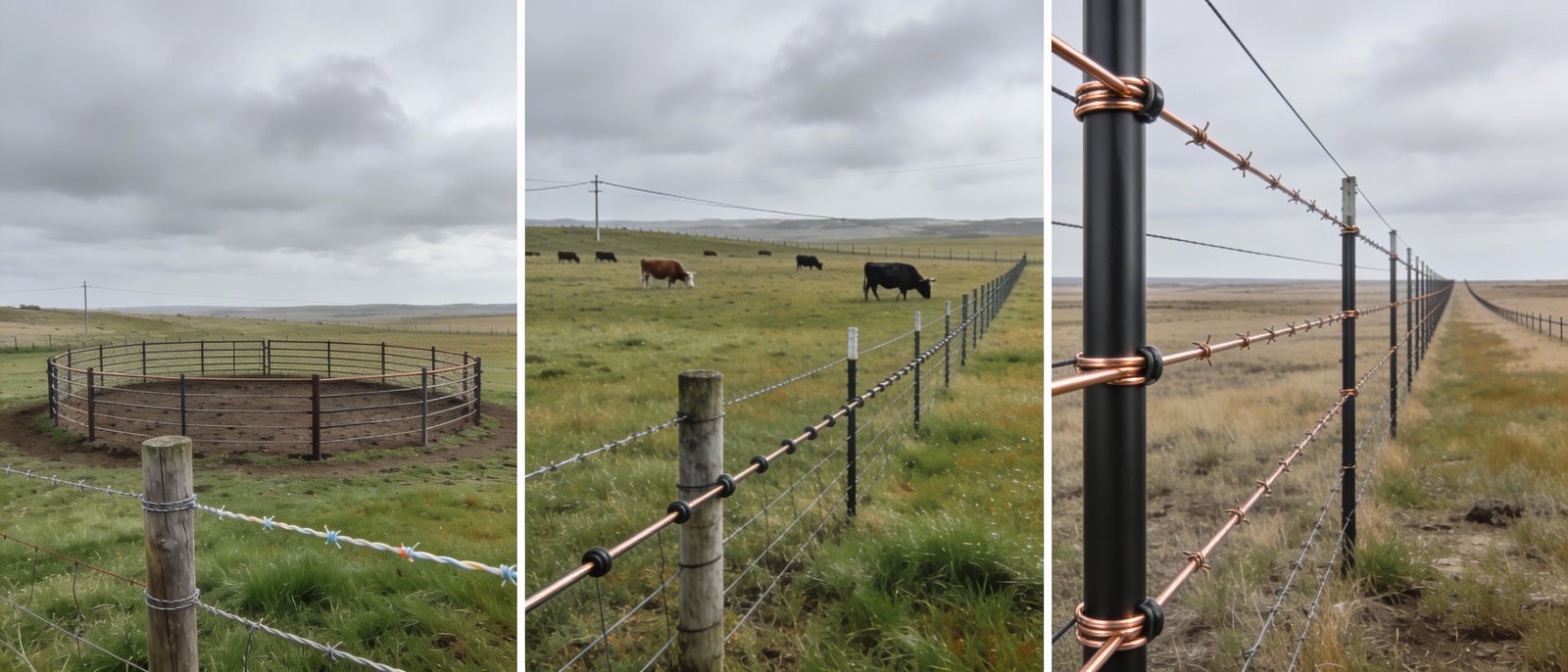
These recommendations assume adequate energizer sizing and proper grounding for each application. A 3-kilometer fence using tinned copper conductor still requires an appropriately sized energizer (typically 1 joule per kilometer) and a grounding system scaled to the energizer’s output (generally 3 ground rods per 5 joules).
Environmental conditions may require adjustments to these guidelines. In very dry climates where soil conductivity is poor, reducing fence length per energizer or upgrading to lower-resistance conductor helps compensate for ground system limitations. In areas with heavy vegetation that causes frequent shorts, higher-output energizers and lower-resistance conductors maintain adequate voltage despite parasitic loads.
Multi-wire fences carrying voltage on multiple strands benefit from lower total resistance. If a fence has four hot wires running in parallel, the effective resistance is one-quarter that of a single wire. This configuration allows slightly higher-resistance conductor to achieve acceptable performance, though low-resistance conductor still outperforms high-resistance options in all scenarios.
Common Mistakes in Conductor Selection
Testing and Troubleshooting Conductor Performance
Systematic voltage testing identifies conductor-related problems. Using a high-voltage fence tester, measure voltage at multiple points along the fence: at the energizer terminal, at 25% of fence length, at 50% of fence length, and at the far end. Progressive voltage drop indicates excessive conductor resistance.
Acceptable voltage drop depends on fence length and conductor quality. On a properly designed fence with appropriate conductor, voltage at the far end should be at least 60–70% of the voltage measured at the energizer under normal load conditions. If far-end voltage falls below 50% of energizer voltage, conductor resistance is likely excessive for the fence length.
Testing under load conditions is critical. An unloaded fence (no vegetation touching wires, no animals making contact) may show acceptable voltage throughout because minimal current flows. Loading the fence by deliberately creating shorts 300 meters from the energizer reveals whether the conductor can carry sufficient current without excessive voltage drop. If voltage collapses under load, conductor resistance is too high for the application.
Amperage testing with a fault finder helps identify high-resistance sections. Walking the fence while monitoring amperage shows where current drops, indicating poor connections, damaged conductor, or sections of inadequate wire. Current should remain relatively constant along the fence length until reaching the point where shorts or loads draw current into the ground.
Frequently Asked Questions
Is copper always better than stainless steel for electric fence conductor?
Electrically yes, mechanically no. Copper provides approximately 40 times better conductivity than stainless steel, significantly reducing voltage drop on long fences. However, copper has lower tensile strength and is prone to corrosion unless tin-plated. The best choice depends on fence length, mechanical load requirements, and environmental conditions. For fences under 500 meters, stainless steel may be adequate and more cost-effective. For fences exceeding 1 kilometer, copper-based conductor is usually necessary to maintain adequate voltage.
What resistance value should I target when selecting conductor?
Target resistance depends on total fence length. Short fences (under 500 meters) tolerate resistance up to 8–10 Ω/m. Medium fences (0.5 to 1.5 kilometers) should use conductor with resistance below 2 Ω/m. Long fences (over 2 kilometers) require conductor with resistance below 0.5 Ω/m for reliable performance. These targets assume adequate energizer sizing and proper grounding.
Can I mix different conductor types on the same fence?
Yes. Many systems use high-performance conductors for main supply lines carrying voltage long distances and lower-cost stainless steel conductor for short branch circuits or individual paddock divisions. This hybrid approach optimizes cost while maintaining performance. Ensure all connections between different conductor types use high-quality clamps or split bolts to prevent high-resistance junction points.
How does poly wire conductor performance compare to solid wire?
Poly wire performance depends entirely on the metal conductor strands within the polymer material. High-quality poly wire with tinned copper strands can match or exceed the performance of solid galvanized wire. Economy poly wire with only stainless steel strands has much higher resistance than solid wire. Check the resistance specification (Ω/m) rather than relying on wire diameter or appearance.
Does aluminum conductor work for permanent fencing?
Aluminum is unsuitable for fence wire due to low tensile strength and tendency to stretch. However, insulated aluminum cable is excellent for permanent lead-out wire connections from energizer to fence and for connecting ground rods. These applications require high conductivity but face minimal mechanical stress. Using aluminum cable in these roles significantly improves system performance.
How do I calculate total resistance for my fence?
Multiply the conductor’s resistance per meter (Ω/m) by the total length of hot wire. For a 4-wire fence with each wire running 800 meters, total length is 3,200 meters. If using conductor with 2 Ω/m resistance, total line resistance is 6,400 ohms. However, because the four wires run in parallel, effective resistance is 6,400 ÷ 4 = 1,600 ohms. Lower total resistance allows smaller energizers or longer fence runs.
Key Takeaways for Conductor Selection
Conductor material determines how much energy reaches your fence. Distance, resistance, and application must guide material choice. Low-resistance conductor is essential for long fences, while short fences tolerate higher-resistance materials. However, conductor quality is only one component of fence system performance—energizer output and grounding system capacity must also be adequate.
Stainless steel provides strength and durability at low cost but limits electrical performance on fences longer than 500 meters. Copper and tinned copper offer superior conductivity for long-distance fences but cost more and require careful installation. Hybrid conductors balance these factors for medium-length fences. Aluminum is appropriate only for lead-out wire and ground connections, not fence wire.
System-level thinking prevents common failures. Upgrading conductor without addressing grounding or energizer limitations yields minimal improvement. Conversely, installing adequate grounding and energizer capacity but using poor conductor wastes system potential. All three elements must be properly sized and installed for effective electric fence operation.
For expert guidance on complete electric fencing systems, explore our electric cattle fencing hub and detailed guides on energizer selection and grounding system design. When ready to upgrade your fencing, review our selection of high-quality fence wire products or contact us for application-specific recommendations.