Temporary Portable Electric Fencing Systems for Rotational Grazing
- Size your system with the formula Paddocks = (Rest Days / Grazing Days) + 1 — e.g. 28 days rest with 4-day grazing needs 8 paddocks.
- Use polywire (6-9 strands) for long runs and frequent moves; polytape (½" to 2") gives higher visibility for horses or high-traffic lines.
- Keep at least 5,000V at the fence for cattle (7,000V+ for bulls), and clear vegetation contact to avoid voltage drop.
- Match charger output to your fence: roughly 1 joule per mile plus 0.5 joule for vegetation contact.
- A basic 40-acre, 4-paddock starter setup costs about $950-$1,530 in equipment.
Temporary portable electric fencing systems are the core of modern intensive pasture management. Unlike permanent high-tensile fencing, these flexible systems allow livestock producers to implement rotational grazing strategies, maximizing forage utilization, improving pasture productivity, and enhancing animal weight gain.
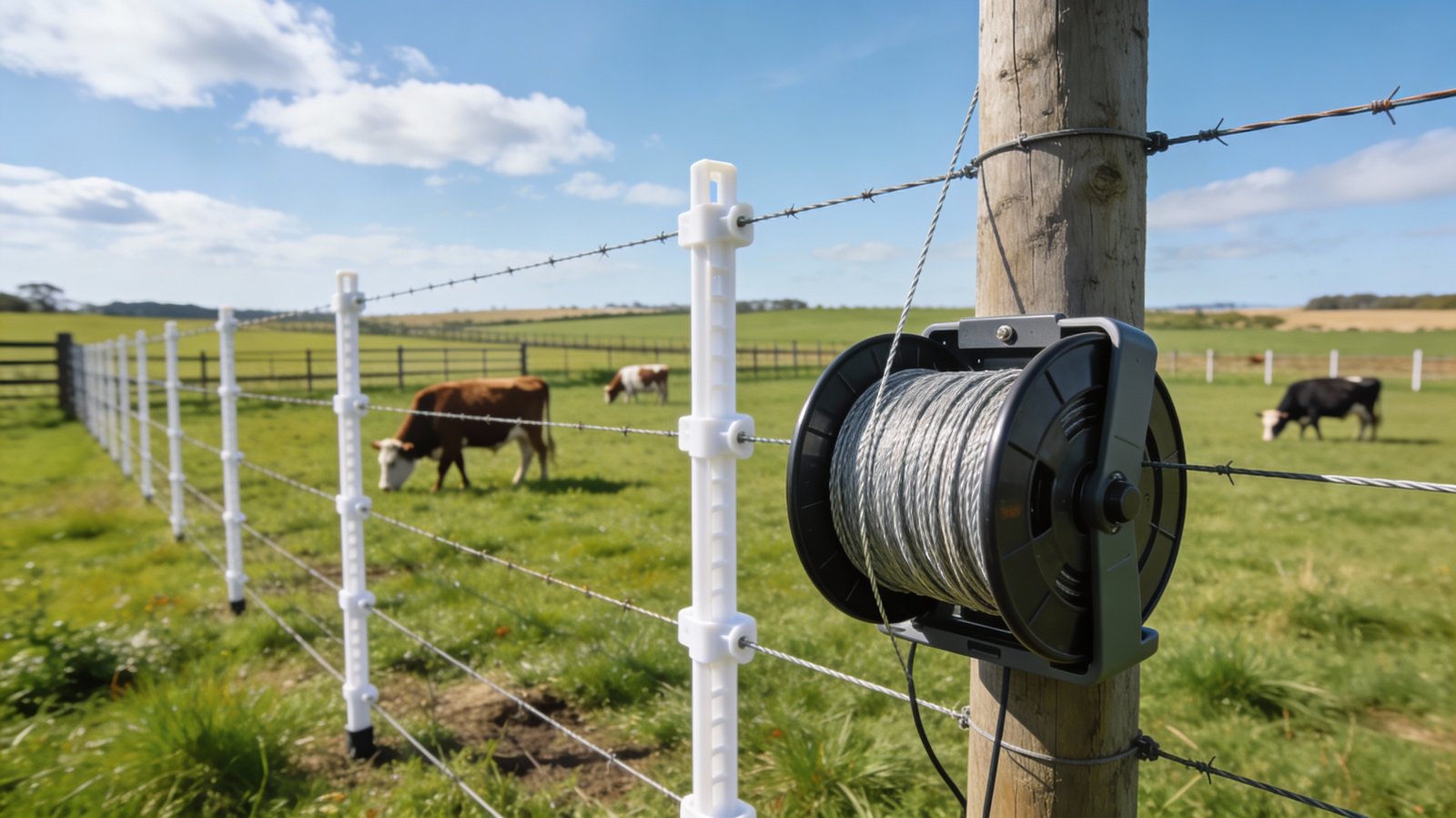
This video demonstrates how temporary portable electric fencing is used in real-world rotational grazing systems. It shows proper setup of polywire, step-in posts, and daily paddock movement to control grazing pressure and improve pasture recovery.
Quick System Selector Tool Pasture Size (acres) Number of Cattle Grazing System Recommended System Setup Paddocks Needed 8 Recommended Wire Polywire 9-strand Posts Needed ~100 Estimated Cost $850-1,400 📏 Flexible Zoning Quickly adjust paddock size and location to adapt to pasture growth stages and livestock needs. 💰 Low Cost 40-acre pasture requires only $200 for 4 paddock divisions, far less than permanent fencing. 🌱 Pasture Recovery Proper rest periods allow full pasture recovery, maintaining long-term productivity and diversity. ⚡ Electric Control Low-voltage electric systems provide gentle but effective animal control, easy to train and maintain.Materials: Wire, Posts & Chargers
Conductivity & Wire Specifications
| Material Type | Conductivity | Visibility | Lifespan | Cost Range | Best Application |
|---|---|---|---|---|---|
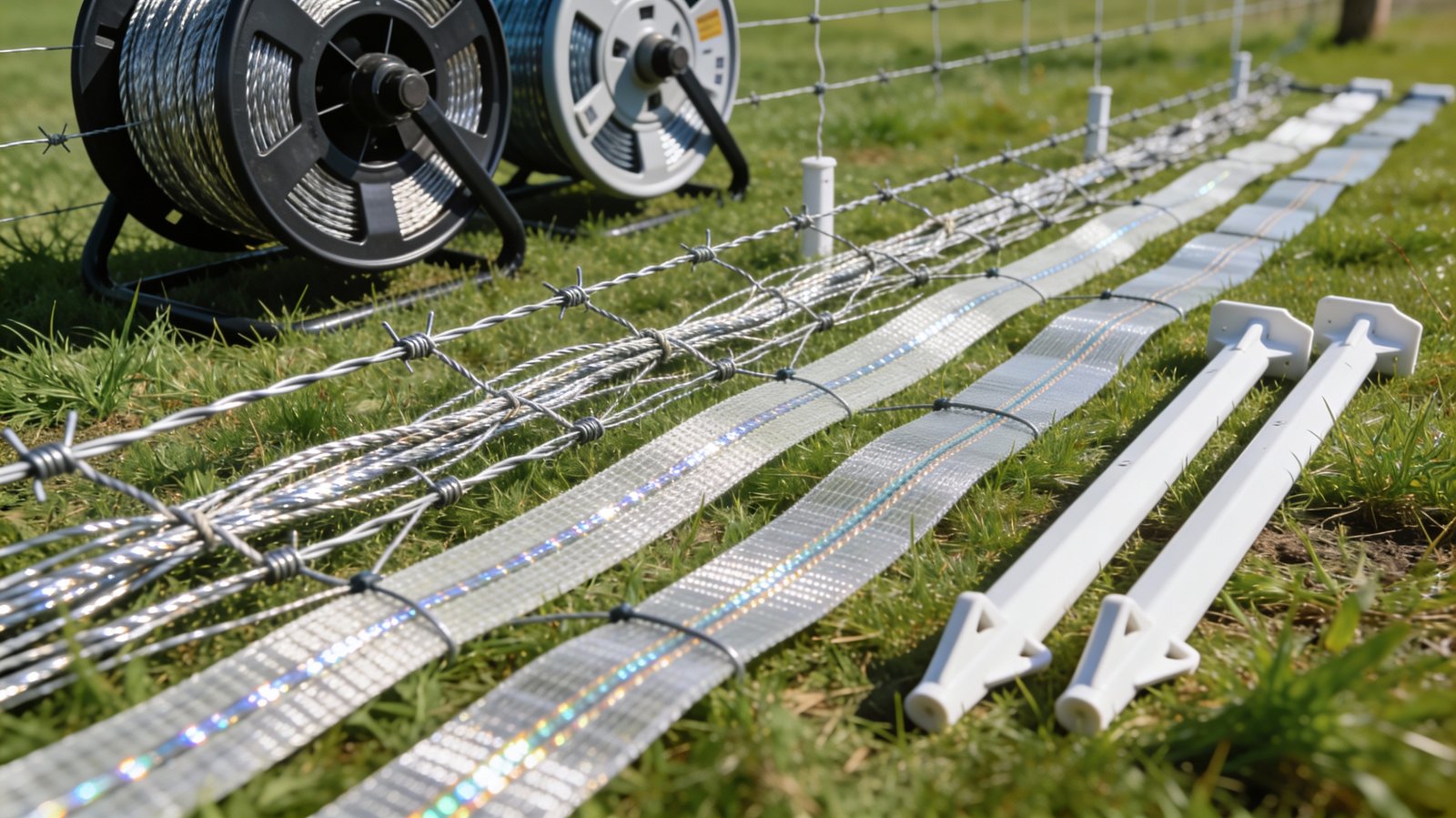
| Polywire 6-strand | Medium (100 Ω/km) | Poor | 5-6 years | $0.05-0.08/ft | Short runs <200m |
| Polywire 9-strand | Good (50% better) | Fair | 5-6 years | $0.08-0.12/ft | Medium runs 200-400m |
| Hi-Tensile Polywire | Excellent (100x) | Fair | 5-6 years | $0.12-0.18/ft | Long runs >400m |
| Standard Polytape | Medium (5-15 strands) | Excellent | 5-7 years | $0.12-0.20/ft | Horses, high visibility |
| IntelliRope 4.5mm | Excellent (50 Ω/1000ft) | Excellent | 8-10 years | $0.06/ft | Long-term heavy use |
| IntelliTwine 2.25mm | Good | Good | 7-9 years | $0.035/ft | Lightweight mobile systems |
Electric Fence Charger Selection Guide
⚡ Charger Power Requirements Single-wire vs Multi-wire Systems:• Single-wire: Ideal for strip grazing, low power requirements (0.25-0.5 joule)
• Multi-wire: For permanent/perimeter fences, requires 1-5+ joules
Power Matching Formula:
• Basic calculation: 1 joule per mile of fence + 0.5 joule for vegetation contact
• Example: 2 miles of polywire with moderate vegetation = 2 × 1 + 1 = 3 joule minimum
Charger Type Comparison:
• Plug-in chargers: $150-400, 5-50 joule output, best for fixed locations
• Battery/solar: $200-600, 0.5-10 joule output, portable, ideal for remote pastures
• Low-impedance: $300-800, works through vegetation, best for challenging conditions
Post Comparison & Selection
| Post Type | Height | Mobility | Lifespan | Unit Cost | Characteristics |
|---|---|---|---|---|---|
| Plastic Step-In | 35-43"/td> | Frequent | 3-5 years | $3.50-5.50 | Step-in, multi-notch, high visibility |
| Fiberglass | 36-48"/td> | Moderate | 15-20 years | $3.25-4.50 | Lightweight, durable, easy to drive |
| Steel T-Post | 48-72"/td> | Infrequent | 20+ years | $24.50+ | Permanent/semi-permanent, high strength |
| Wood Post | Custom | Rare | 10-15 years | $2-8 | Traditional, requires maintenance |
Grazing Systems: Strip Grazing & Mob Grazing
Strip Grazing for Daily Pasture Allocation
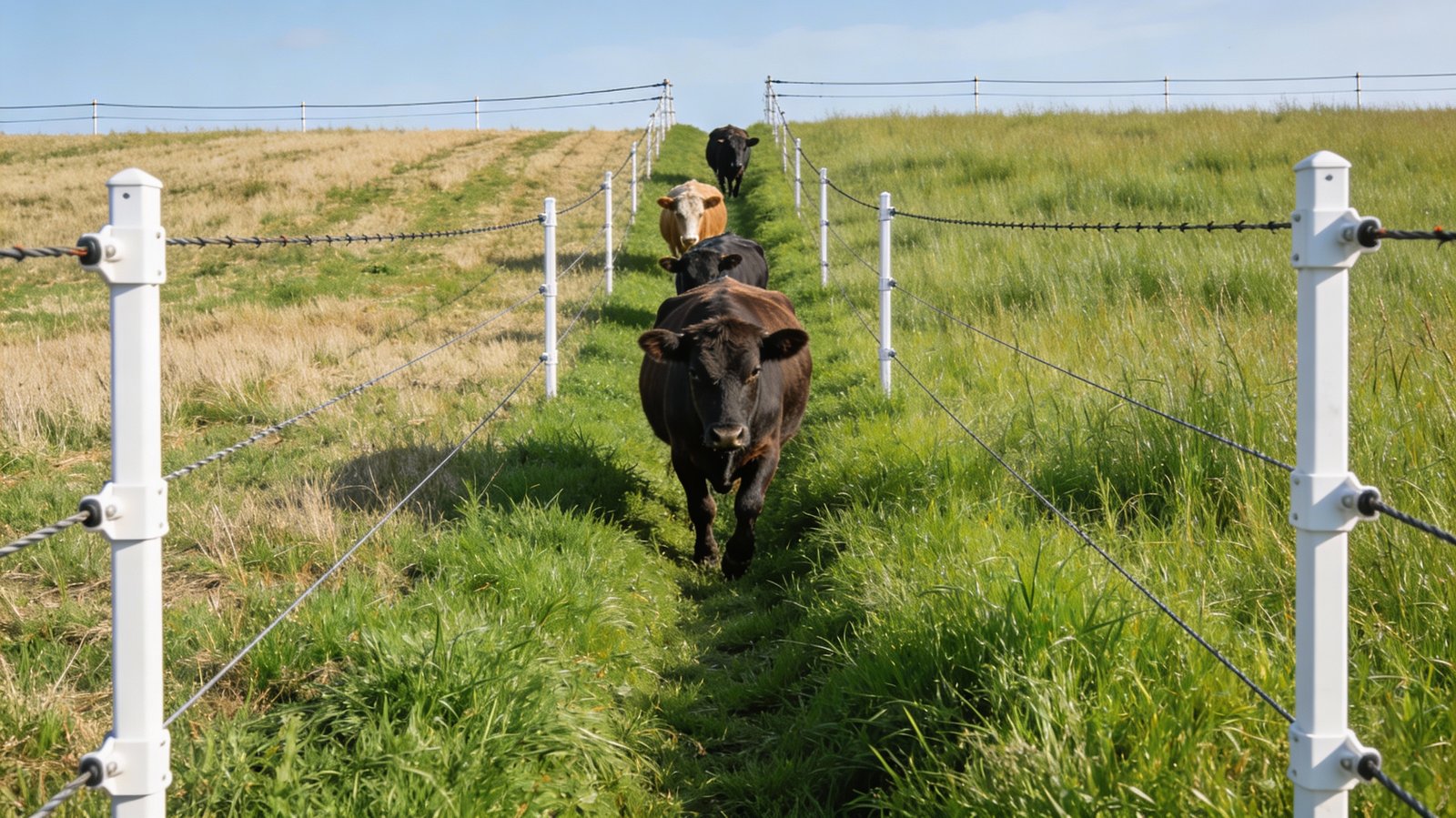
Strip grazing provides fresh forage through daily movement of the front fence, while maintaining a back fence to prevent livestock from grazing previously used areas.
📋 Daily Allocation Provide a new strip daily; livestock must consume allocated forage within one day. 🔄 Anti-Back Grazing Design Back fence prevents re-entry to grazed areas, forcing efficient use of fresh pasture. ⏱️ 3-Day Maximum Stay Limit to 3 days or less to ensure departure before regrowth, protecting root energy reserves.Mob Grazing for Intensive Management
Mob grazing is an advanced form of strip grazing where large herds graze small paddocks for 1-2 days, creating high trampling and rapid pasture renewal.
📊 Mob Grazing Core Metrics • Paddock size: 1-2 acres/group• Stay duration: 1 day or 24 hours
• Trampling effect: High trampling promotes organic matter return, improves soil structure
• Stock density: 50-100 head/acre, forces uniform grazing
• Best application: Removing mature forage, establishing new grass species, rapid pasture renovation
Seasonal Management Strategies
| Season | Grazing Days | Rest Period | Stock Density | Key Considerations |
|---|---|---|---|---|
| Spring | 1-3 days | 21-28 days | High (50-100/acre) | Fast growth, quick rotation, prevent overgrazing new growth |
| Summer | 2-4 days | 28-35 days | Medium (30-60/acre) | Heat stress management, water availability, shade access |
| Fall | 3-5 days | 35-45 days | Medium (25-50/acre) | Prepare for winter, stockpile forage, soil moisture monitoring |
| Winter | 5-7+ days | 45-60+ days | Low (10-30/acre) | Minimize soil compaction, manage frozen ground, supplemental feeding |
System Design & Installation
Calculating Paddock Numbers
The golden formula for determining required paddock count:
🔢 Paddock Count Formula Paddocks = (Rest Days / Grazing Days) + 1Example 1 (temperate pasture):
• Rest Days = 28 days
• Grazing Days = 4 days
• Required Paddocks = (28/4) + 1 = 8 paddocks
Example 2 (intensive strip grazing):
• Rest Days = 35 days
• Grazing Days = 1 day
• Required Paddocks = (35/1) + 1 = 36 paddocks
Example 3 (mob grazing):
• Rest Days = 42 days
• Grazing Days = 1 day
• Required Paddocks = (42/1) + 1 = 43 paddocks
Livestock Training for Electric Fencing
🐄 Training New Animals to Electric Fencing Step 1: Introduction Phase (2-3 days):• Set up small training paddock with highly visible polytape
• Ensure strong charge (minimum 5,000 volts at fence)
• Introduce animals with ample fresh forage inside paddock
Step 2: Controlled Exposure:
• Place attractant (salt/mineral) near fence line
• Most animals will investigate and receive mild shock
• Repeat 2-3 times until animals respect fence
Step 3: Expansion:
• Gradually increase paddock size over 7-10 days
• Monitor for any escape attempts (rare after proper training)
• Check fence voltage daily during training period
Budget, ROI & Cost Analysis
Initial Investment Costs
🔧 Basic Equipment (40 acres, 4 paddocks) $200-300 • Polywire (1000 ft × 3 strands) $50-80 • Step-in posts (≈100 units) $350-500 • Portable reel system $150-250 • Electric fence charger $200-400Total Initial Investment $950-1530 Free Resources & Tools
Download our complete guides and calculators for your rotational grazing planning:
📄 Complete Setup Guide PDF Step-by-step installation, maintenance checklist, troubleshooting guide 📊 ROI Calculator Excel Interactive calculator for cost analysis, ROI projection, and budgeting 📅 Seasonal Management Planner Year-round grazing schedule, seasonal adjustments, pasture monitoring formsSystem Integration & Maintenance
Classic Model: Permanent Perimeter + Temporary Interior
The optimal fencing strategy combines permanent high-tensile fencing with temporary electric fencing to minimize total investment while maximizing management flexibility.
Monthly Maintenance Checklist
🔧 Routine Maintenance Schedule Daily (during grazing season):• Check fence voltage (should be >5,000V for cattle)
• Inspect for vegetation contact and clear if needed
• Verify posts are upright and wire tension correct
Weekly:
• Test ground system resistance (should be <500 ohms)
• Check all connections and insulators
• Inspect charger operation and battery (if solar)
Monthly:
• Deep test entire fence line for faults
• Check for rodent damage or corrosion
• Clean solar panel (if applicable)
• Document voltage readings for trend analysis
FAQ & Troubleshooting
How do I train cattle to respect electric fencing? Start with a small training paddock using highly visible polytape. Ensure the fence has a strong charge (minimum 5,000 volts). Introduce cattle when they’re not hungry, and place attractants like salt or minerals near the fence line. Most cattle learn after 1-2 mild shocks. Training typically takes 2-3 days for the whole herd to respect the fence. What causes low voltage in my electric fence? Common causes include: vegetation contact (grass touching the wire), poor grounding (install 3+ ground rods 10 feet apart), insufficient charger power, broken wires or connections, and moisture issues. Start by clearing vegetation 12-18 inches below the fence line, then check your ground system resistance. How many paddocks do I need for rotational grazing? Use the formula: Paddocks = (Rest Days / Grazing Days) + 1. For example, with 28 days rest and 4 days grazing per paddock, you need (28/4) + 1 = 8 paddocks. Start with 4-6 paddocks if you’re new to rotational grazing, then expand as you gain experience. What’s the difference between polywire and polytape? Polywire consists of thin stainless steel wires woven into polyethylene strands (6-9 strands typical). Polytape is wider (½" to 2" with woven filaments, offering better visibility but slightly less conductivity per dollar. Polywire is better for long runs and frequent moves, while polytape excels with horses or where visibility is crucial. Can I use temporary fencing for bulls or aggressive animals? Yes, but with modifications: Use 2-3 strands of polytape for better visibility, ensure voltage exceeds 7,000V, increase post density to 15-20 feet spacing, and consider adding a second “hot” wire at nose level. Always monitor bull behavior and be prepared to reinforce if animals test the fence aggressively. How do I handle electric fencing in winter? Winter presents challenges: snow can short the fence, frozen ground reduces grounding efficiency, and ice buildup on wires can cause issues. Solutions include: raising the bottom wire 18-24 inches above snow line, using low-impedance chargers that work through vegetation, installing extra ground rods before freeze-up, and checking voltage more frequently.Case Studies & Real-World Results
📈 Dairy Farm Case Study 200-cow dairy implemented strip grazing: +22% milk production, $18,500 annual feed cost reduction, 3.1 year ROI on fencing investment. 🌾 Beef Ranch Results 150-head beef operation using mob grazing: Average daily gain improved from 1.6 to 2.1 lbs/day, pasture recovery time reduced by 40%. 💧 Environmental Impact Study Water quality monitoring showed 65% reduction in nutrient runoff, soil organic matter increased 1.2% annually with intensive rotational systems.Related Cattle Fencing Resources
Need cattle fence wire for your ranch?
Explore company profiles and prepare your specifications. Use each company’s official contact route to confirm pricing and lead times; contact CattleFenceWire for help using the platform.
Contact PlatformFrequently Asked Questions
What wire is best for temporary electric cattle fencing?
Polywire is the standard for portable cattle fencing: 6-strand suits short runs under 200 meters, 9-strand offers 50 percent better conductivity for medium runs, and hi-tensile polywire handles long runs over 400 meters. Polytape gives excellent visibility, ideal for training or high-traffic areas. Most polywire lasts 5 to 6 years and costs roughly $0.05 to $0.18 per foot.
What voltage does temporary electric fencing need for cattle?
Maintain at least 5,000 volts at the fence for cattle, and 7,000 volts or more for bulls. Size the charger using about 1 joule per mile of fence plus 0.5 joule for vegetation contact, so 2 miles with moderate growth needs roughly 3 joules. Battery or solar units output 0.5 to 10 joules and cost $200 to $600.
How many paddocks do I need for rotational grazing?
Use the formula: paddocks equal rest days divided by grazing days, plus one. For example, 28 days of rest with 4-day grazing periods needs 8 paddocks, while 35 days rest with 1-day grazing requires 36 paddocks. Shorter grazing windows and longer rest sharply increase paddock count, so match the system to your forage recovery and labor capacity.
How long does it take to train cattle to electric fence?
Training cattle to respect electric fence takes about 2 to 3 days. Use a small training paddock with highly visible polytape and place attractants near the fence line. Most animals learn to avoid the fence after just 1 to 2 mild shocks. Training before relying on portable fencing prevents escapes once you begin rotational grazing.
How much does temporary portable electric fencing cost?
For a 40-acre, 4-paddock setup, expect roughly $950 to $1,530 total: about $50 to $80 for polywire, $350 to $500 for around 100 step-in posts, $150 to $250 for a portable reel, and $200 to $400 for a charger. Basic paddock divisions alone can run as low as $200 to $300.