
What is Woven Wire Cattle Fence?
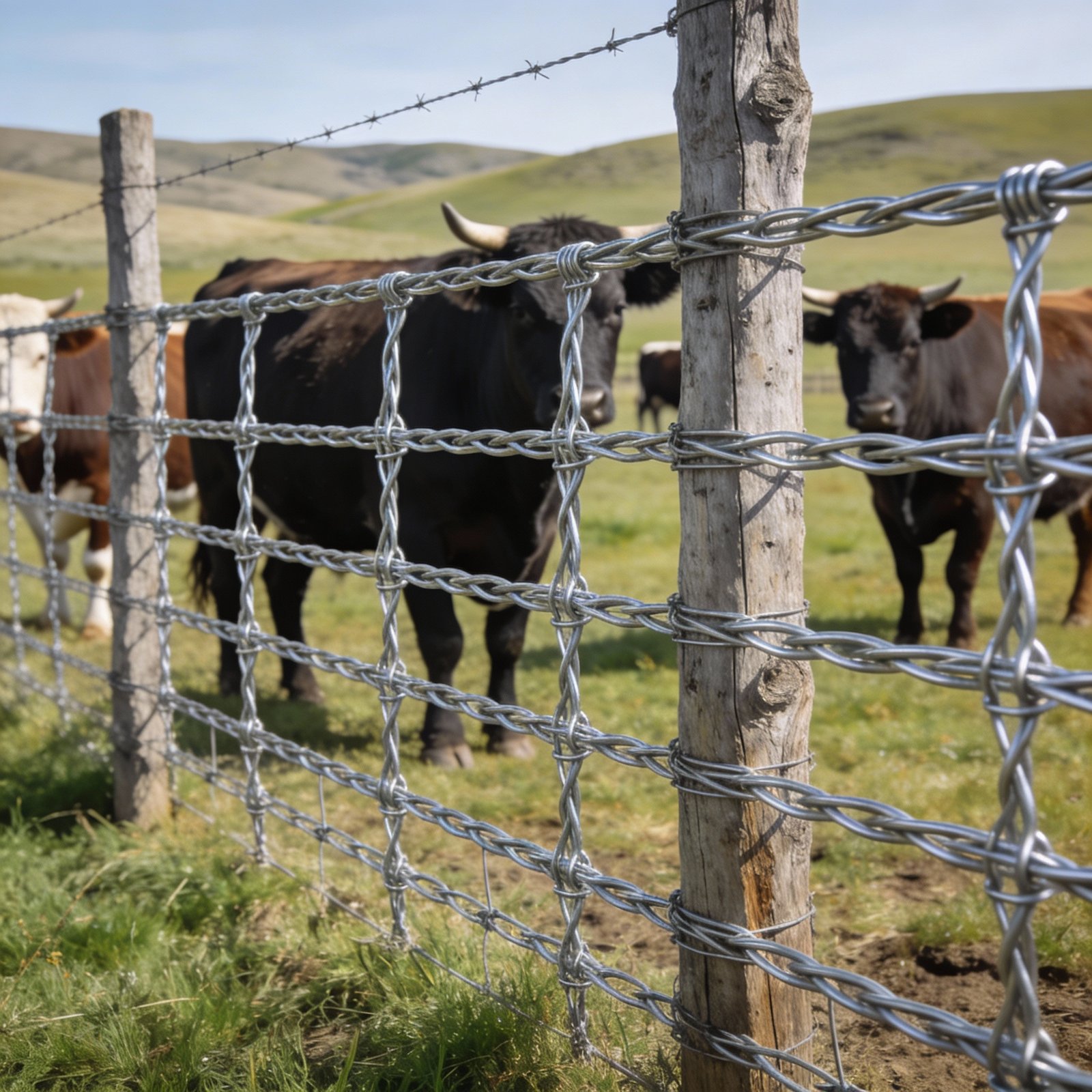
Woven wire fencing, also called field fence, is a livestock containment system consisting of horizontal line wires interlaced with vertical stay wires in a grid pattern. Unlike barbed wire fencing for cattle (which relies on pain deterrence) or high-tensile smooth wire fencing (which uses extreme tension), woven wire creates a physical barrier that prevents animals from passing through or over—making it ideal for cattle, mixed livestock, and predator exclusion.
Primary Applications
- Calf Pastures & Small Paddocks: Prevents young stock from escaping through gaps
- Mixed Livestock Areas: Works for cattle, sheep, goats, and pigs together
- Predator Exclusion Zones: Stops feral hogs, coyotes, and deer when mesh is tight at base
- Breeding Pens: Contains valuable genetics securely
- Pasture Subdivision: Durable rotational grazing subdivisions that outlast temporary electric
Why Choose Woven Wire?
Safety First: No sharp barbs to injure animals, riders, or handlers. Smooth or s-knot designs protect wool and hides.
Proven Longevity: Fixed knot woven wire lasts 10-15+ years with standard galvanized coating. Hinge joint (traditional) lasts 5-8 years.
Versatility: Fits terrain better than high-tensile due to flexible post spacing. Works in hilly or uneven land.
Industry Standard: University extension programs (UGA, USDA NRCS) recommend woven wire for mixed livestock systems.
Types of Woven Wire Fence
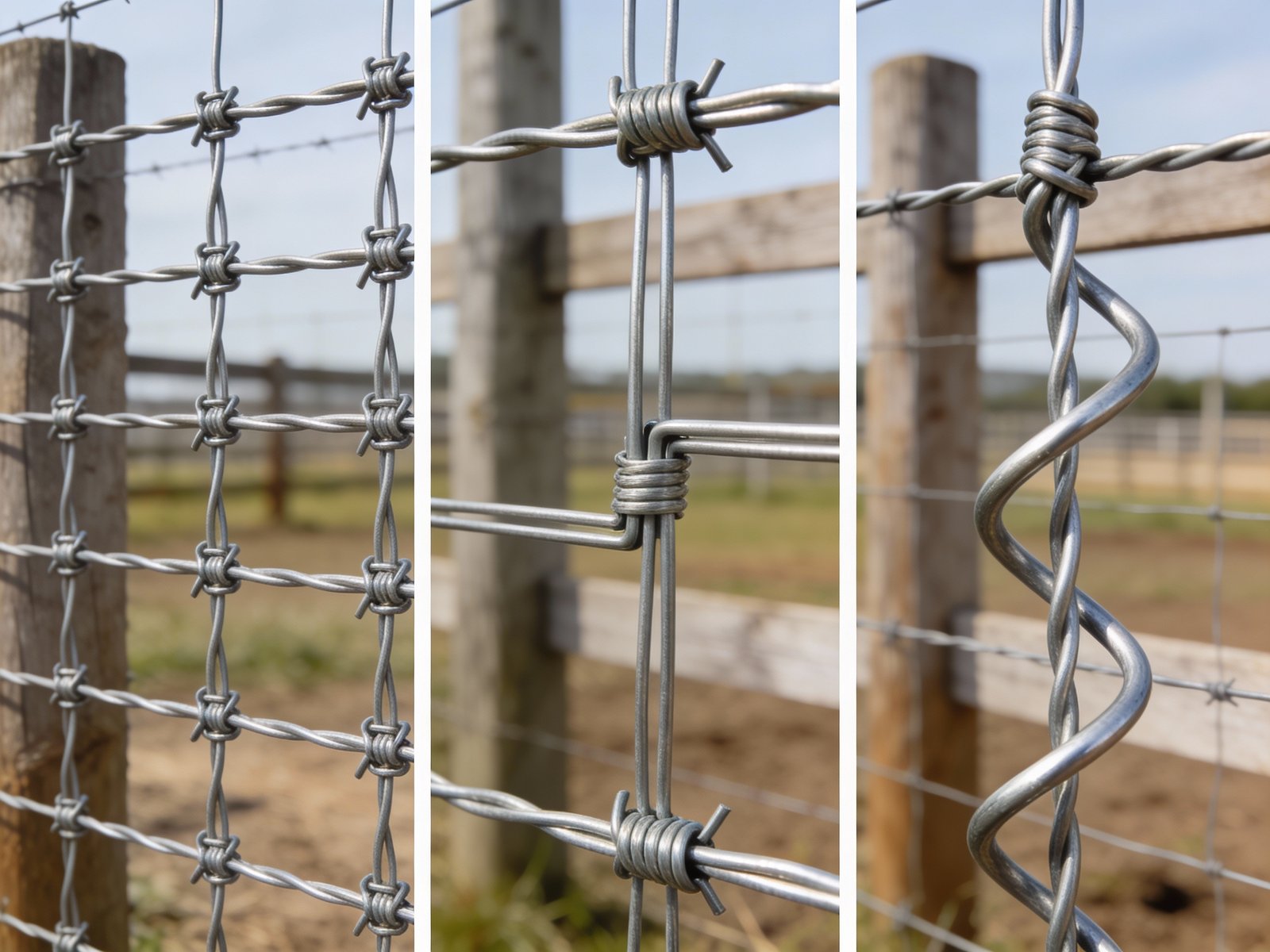
Woven wire fence is classified by its knot type—the way vertical stays are locked to horizontal wires. Each type balances strength, flexibility, durability, and cost.
Fixed Knot Fence
Knot Structure: Vertical stay is one continuous piece from top to bottom, locked at every horizontal wire intersection.
- Highest tensile strength: 1,500–2,200 lbs
- Minimal sagging (lasts 10–15+ years)
- Post spacing 16–20 ft (saves on materials)
- Wildlife-proof (feral hogs, deer, coyotes)
- High-tensile steel core (12.5 gauge)
- Higher material cost ($3–$5/ft)
- Less flexible on hilly terrain
- Trickier to repair (knot is tight)
Hinge Joint Fence (Traditional Field Fence)
Knot Structure: Vertical stays wrap around top and bottom wires only, allowing flexing at the hinge points.
- Lowest material cost ($1.50–$2.50/ft)
- Flexes with terrain (uneven ground)
- Absorbs impact (fallen branches, minor animal contact)
- Easier to repair (loose knots)
- Proven 50+ year track record on farms
- Lower tensile strength (400–800 lbs)
- Sags significantly (5–8 year lifespan)
- Requires post spacing 8–12 ft
- Needs re-tensioning every 2–3 years
- Not suitable for aggressive livestock
S-Knot Fence (Smooth Knot / Square Knot)
Knot Structure: Vertical stay wraps smoothly around each horizontal wire (no sharp protruding corners).
- Animal-safe (smooth on both sides)
- No hide/wool damage (critical for sheep, horses)
- Balanced strength (900–1,200 lbs)
- Moderate cost ($2–$3.50/ft)
- Class 3 galvanizing + corrosion resistant
- 8–10 year lifespan typical
- Mid-range tensile strength
- More expensive than hinge joint
- Post spacing 12–15 ft (mid-range)
Quick Knot Type Comparison Table
| Feature | Fixed Knot | Hinge Joint | S-Knot |
|---|---|---|---|
| Tensile Strength | 1,500–2,200 lbs | 400–800 lbs | 900–1,200 lbs |
| Wire Gauge | 9–12.5 gauge (high-tensile) | 11–14 gauge | 11–12 gauge |
| Post Spacing | 16–20 ft | 8–12 ft | 12–15 ft |
| Lifespan | 10–15+ years | 5–8 years | 8–10 years |
| Material Cost | $3.00–$5.00/ft | $1.50–$2.50/ft | $2.00–$3.50/ft |
| Terrain Flexibility | Moderate | High | Moderate |
| Wildlife Exclusion | Excellent (with tight mesh) | Good (with tight mesh) | Excellent (designed for it) |
| Animal Safety | Good (minimal sharp edges) | Fair (some abrasion) | Excellent (smooth knots) |
| Maintenance | Low (stays tight) | High (re-tension every 2–3 yrs) | Low–Medium |
Woven Wire Specifications & Mesh Patterns
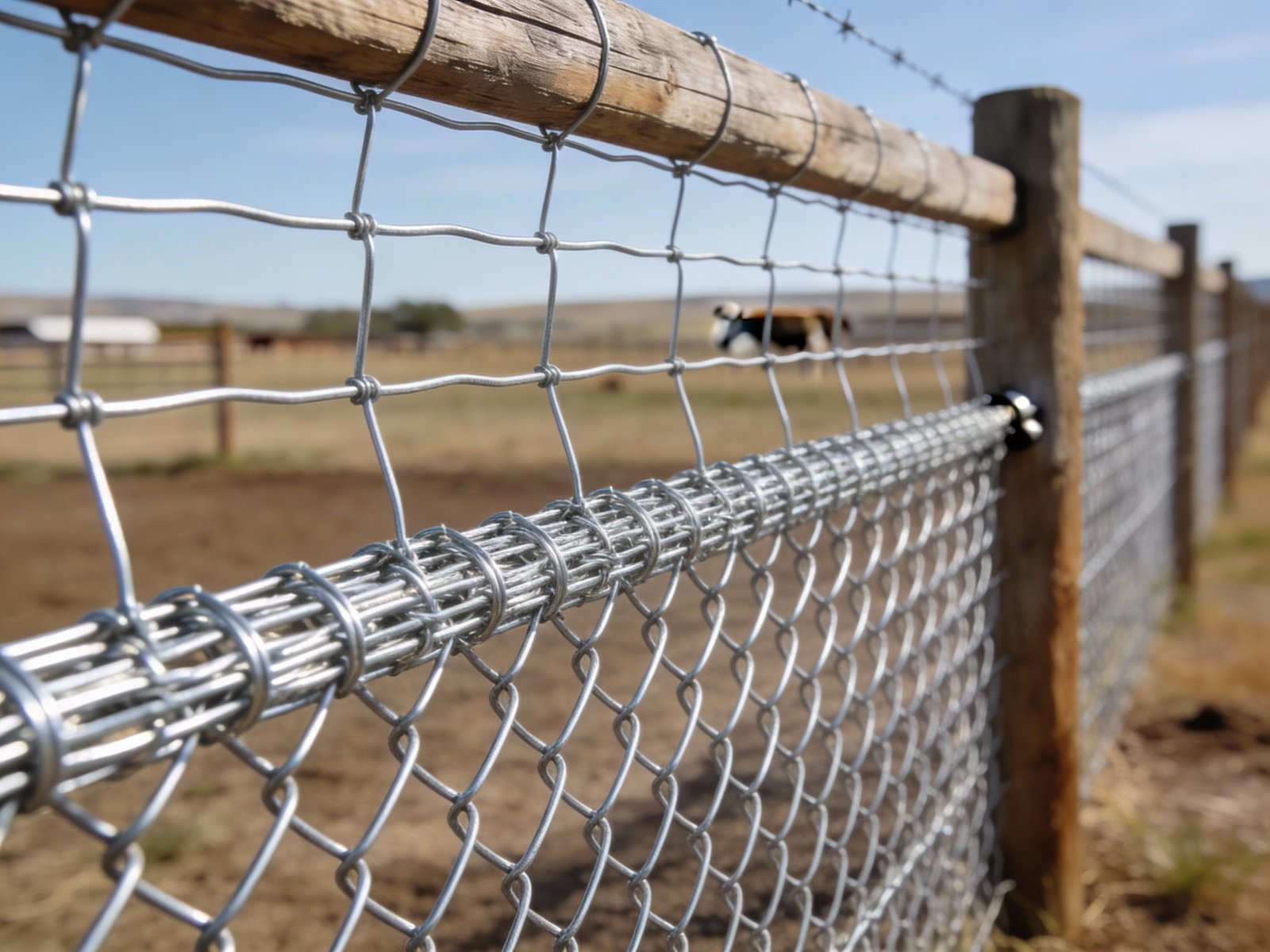
Woven wire fence is described using a standardized code system: HEIGHT–STAY SPACING–GAUGE. For example, 49–12–11 means:
- 49 = Total height in inches
- 12 = Spacing between vertical stay wires (inches)
- 11 = Wire gauge (smaller = thicker; 9 is thicker than 14)
Standard Heights for Cattle
Common Cattle Fence Heights
- 39–42 inches: Dairy calves, small breed cattle, secondary containment
- 47–49 inches: Adult cattle, breeding stock (STANDARD for most operations)
- 54–60 inches: Large breeds (Charolais, Hereford), aggressive bulls, bison, elk exclusion
Note: Most cattle can jump 4.5–5.5 feet, so woven wire alone won’t stop escape attempts—use fixed knot type and proper tension for containment.
Common Mesh Patterns (Bottom Spacing)
Horizontal wire spacing is tighter at the bottom to prevent small animals and predators from squeezing through.
Standard Mesh Designs
| Design Code | Height | Bottom Mesh | Middle Mesh | Top Mesh | Best Use |
|---|---|---|---|---|---|
| 47–12–11 | 47″ | 6×6″ | 6×12″ | 6×12″ | Cattle (standard) |
| 49–12–11 | 49″ | 6×6″ | 6×12″ | 6×12″ | Cattle + mixed livestock |
| 49–12–12–6 | 49″ | 2×4″ (bottom 12″) | 4×12″ | 6×12″ | Predator exclusion, small livestock |
| 54–12–11 | 54″ | 6×6″ | 6×12″ | 6×12″ | Large cattle, bison, game animals |
| 32–6–12 | 32″ | 2×4″ (tight mesh) | 2×4″ | 4×6″ | Goats, sheep, predator control |
Wire Gauge Explained
- 9–10 gauge: High-tensile steel (thickest, strongest—fixed knot only)
- 11 gauge: Standard for cattle (good balance of strength and cost)
- 12 gauge: Lighter duty, traditional field fence (hinge joint)
- 13–14 gauge: Lightweight (not recommended for cattle)
Coating & Corrosion Resistance
Galvanized coating extends fence lifespan significantly:
- Class 1 Coating: ~5 years protection (budget option)
- Class 2 Coating: ~8 years protection (standard)
- Class 3 Coating: ~15 years protection (premium, recommended)
- Polymer-Coated or Stainless Steel: 20+ years (high-salt environments)
Woven Wire Fence Cost Analysis
Cost Per Linear Foot (2025 Pricing)
20-Acre Installation Estimate
20 acres = ~3,730 linear feet of perimeter (square calculation). Actual perimeter varies with shape.
47″ Hinge Joint (Budget Option)
47–12–11 Fixed Knot (Premium)
Lifetime Cost Per Acre Analysis
For ranchers evaluating long-term investment value, analyzing total cost of ownership across fence lifespan reveals important trade-offs. While woven wire commands higher upfront costs compared to cattle fence cost comparison alternatives like traditional barbed wire cattle fence, the extended durability of fixed knot systems typically delivers superior value over 10-15 year planning horizons.
| Fence Type | Initial Cost/acre | Lifespan | Maintenance (10 yrs) | Total Cost | Cost/Year |
|---|---|---|---|---|---|
| Hinge Joint Woven Wire | $850–$1,050 | 5–8 yrs | $500–$800 (re-tensioning, wire replacement) |
$1,350–$1,850 | $135–$185 |
| Fixed Knot Woven Wire | $1,380–$1,680 | 10–15 yrs | $200–$300 (minor repairs) |
$1,580–$1,980 | $158–$198 |
| 5-Strand Barbed Wire | $735–$850 | 5–7 yrs | $800–$1,200 (rusted sections, wire replacement) |
$1,535–$2,050 | $154–$205 |
| High-Tensile Smooth Wire | $1,055–$1,300 | 7–10 yrs | $300–$600 (re-tensioning, rust prevention) |
$1,355–$1,900 | $136–$190 |
Woven Wire vs Barbed Wire vs High-Tensile Wire
Three main cattle fence types dominate modern ranching. Each excels in different scenarios:
| Feature | Woven Wire | Barbed Wire | High-Tensile Smooth |
|---|---|---|---|
| Containment Mechanism | Physical barrier (wires lock animals in) | Pain deterrence (barbs hurt on contact) | Extreme tension (very difficult to push through) |
| Safety for Animals | Excellent (no sharp edges if s-knot/smooth) | Poor (barbs cause cuts, infection risk) | Good (smooth wire, no injury) |
| Predator Exclusion | Excellent (2×4 mesh blocks hogs, coyotes, deer) | Poor (predators squeeze under) | Moderate (only deters jumping; coyotes dig under) |
| Calf/Young Stock Containment | Excellent (tight mesh prevents escapes) | Fair (some squeeze through gaps) | Poor (young stock slip under or between wires) |
| Installation Cost | $1.50–$7.50/ft | $1.25–$6.00/ft ⭐ Lowest upfront | $1.75–$5.50/ft |
| Material Cost/Acre (20 ac) | $850–$1,680/ac | $600–$800/ac ⭐ | $700–$1,050/ac |
| Lifespan | 5–15 yrs (type-dependent) | 5–7 yrs ⭐ Shorter | 7–10 yrs |
| Maintenance | Low (fixed knot); Moderate (hinge joint: re-tension every 2–3 yrs) | High (rust, wire replacement, animal injury) | Moderate (tension check yearly, rust prevention) |
| Terrain Adaptability | Excellent (fits hills, doesn’t require perfect spacing) | Good | Poor (needs level ground, high tension) |
| Post Spacing | 8–20 ft (type-dependent) | 10–12 ft | 20–30 ft (requires fewer posts) |
| Regulatory Compliance | Preferred for wildlife reserves, organic farms, animal welfare standards | Restricted in some states (dangerous to riders) | Acceptable |
| Best Applications | Calves, mixed livestock, predator zones, small paddocks, breeding pens | Long-distance perimeter, open ranch (500+ ft runs) | Large pastures, rotational grazing, cost-conscious ranches |
Decision Matrix: Which Type Should You Choose?
Choose Woven Wire If:
- You have calves, young stock, or small animals that need to be confined tightly
- You’re in a predator-heavy area (coyotes, hogs, deer, mountain lions)
- You run mixed livestock (cattle + sheep + goats)
- You prioritize animal safety (no barb cuts or high-tensile injuries)
- You have hilly or uneven terrain where high-tensile cattle fence systems don’t work
- You plan to keep fence for 10+ years (fixed knot payoff kicks in)
- You operate an organic or certified humane farm
Choose Barbed Wire If:
- You have only adult cattle with no young stock
- You need to fence 500+ linear feet on a budget
- You have no predators in your area
- Lowest upfront cost is your priority
- You’re okay with maintenance every 5–7 years
Choose High-Tensile Smooth Wire If:
- You have large, open pastures (100+ acres)
- You run adult cattle only (no young stock)
- You have flat terrain
- You want moderate cost with decent durability
- You prioritize fewer posts (wider spacing)
Installation Best Practices
Proper installation technique fundamentally determines fence lifespan and performance. This instructional video demonstrates professional fixed knot fence installation, including critical tensioning protocols and corner bracing methods. Correct initial tension prevents premature sagging, while robust H-brace construction ensures structural integrity under livestock pressure. Following manufacturer-specified tension limits (typically 50% of maximum crimp compression for fixed knot) protects wire from elongation damage that compromises long-term durability.
Key Installation Steps
- Site Preparation: Clear brush, mark perimeter, establish corner post locations every 100–150 ft
- Corner Posts: Use 8″+ diameter posts, 7–8 ft long, set 3 ft deep. Brace corners with diagonal 9-gauge wire for tension support
- Line Posts: Set at 8–20 ft spacing (depends on knot type). Posts should be 2.5″+ diameter, 6 ft long
- Wire Attachment: Pull fence up tight; secure to posts with U-nails or staples on wooden posts, or clips on metal posts
- Bottom Apron (Predator Control): For wildlife exclusion, add 6–12 inches of fencing bent outward at the base and cover with soil
- Tension Management: Fixed knot requires one-time tensioning. Hinge joint needs re-tensioning annually or after extreme weather
Common Mistakes to Avoid
- ❌ Under-tensioning (sag develops within months)
- ❌ Using posts too small (2 in. diameter) or spaced too far (20+ ft for hinge joint)
- ❌ Skipping corner bracing (fence twists and pulls apart)
- ❌ Not burying bottom mesh for predator control
- ❌ Installing on extremely uneven terrain without adjustments
- ❌ Using Class 1 galvanizing in humid/coastal climates (rusts in 5 yrs)
Frequently Asked Questions
Fixed Knot: Vertical stays are continuous from top to bottom, locked at every horizontal wire intersection. Tensile strength 1,500–2,200 lbs. Minimal sagging, lasts 10–15+ years. Higher cost but lower maintenance.
Hinge Joint: Vertical stays wrap only at top and bottom, creating a “hinge” that flexes. Tensile strength 400–800 lbs. Sags noticeably, lasts 5–8 years. Requires re-tensioning every 2–3 years. Lower upfront cost but higher long-term maintenance.
Best choice: Use fixed knot for cattle, aggressive livestock, or 10+ year timelines. Use hinge joint for budget operations, gentle livestock, or hilly terrain where flexibility helps.
Standard: 47–49 inches for adult dairy and beef cattle. This is the most common height in North America.
Calves/Young Stock: 39–42 inches (contained within paddocks, not long-distance)
Large Breeds (Charolais, Hereford) or Bulls: 49–54 inches recommended.
Important Note: Adult cattle can jump 4.5–5.5 feet. Woven wire height alone won’t stop determined escape—proper tension and fixed knot design are equally critical.
Material + Installation Cost:
- Hinge Joint (Budget): $1.50–$6.00 per linear foot installed
- Fixed Knot (Premium): $4.50–$7.50 per linear foot installed
For 20 acres (3,730 ft perimeter):
- Hinge joint: $18,650–$22,380 total (gates + corners included)
- Fixed knot: $27,600–$28,600 total
Per acre breakdown (20 ac): $850–$1,680/acre depending on type and terrain.
Yes, when designed correctly. Woven wire is the best fence type for excluding predators like feral hogs, coyotes, deer, and mountain lions when:
- Bottom mesh is 2×4 inches or tighter for the bottom 12–18 inches
- An apron (6–12 inches of fence bent outward) is buried to stop burrowing
- Fixed knot construction is used for maximum strength
- No gaps exist at bottom or gates
Best option: S-knot fence (smooth knot) is specifically engineered for mixed livestock + predator exclusion. It has 2×4 inch mesh at the bottom and Class 3 galvanizing for corrosion resistance.
- Fixed Knot: 10–15+ years (minimal sagging, low maintenance)
- Hinge Joint: 5–8 years (sags, requires re-tensioning every 2–3 years)
- S-Knot: 8–10 years (balanced performance)
Factors affecting lifespan:
- Galvanizing class (Class 1 = 5 yrs; Class 3 = 15 yrs)
- Climate (high humidity/coastal = faster rust)
- Animal pressure (aggressive livestock = faster wear)
- Maintenance (regular tension checks extend life)
Yes, woven wire is ideal for hilly terrain—better than high-tensile or barbed wire.
Why it works: The physical barrier design allows it to flex slightly on slopes without losing containment. Hinge joint fence is especially flexible for rolling land.
Installation tips for hills:
- Follow contours (don’t run straight up/down)
- Reduce post spacing on steep grades (8–12 ft instead of 16–20 ft)
- Use stronger posts on downhill corners
- Hinge joint flexes better than fixed knot on extreme slopes
This is the standardized fence specification code:
- 49 = Height in inches (49″)
- 12 = Spacing between vertical stay wires (12 inches apart)
- 11 = Wire gauge (11-gauge wire = moderate thickness)
Common codes: 47–12–11 (cattle standard), 49–12–11 (mixed livestock), 49–12–12–6 (predator exclusion with 2×4 bottom mesh)
Woven Wire: Physical barrier (animals can’t get through). Best for calves, mixed livestock, predator exclusion. Requires proper mesh design. Higher upfront cost ($850–$1,680/ac). Excellent for small paddocks and 10+ year timelines.
High-Tensile Smooth Wire: Extreme tension deters pushing (not a physical barrier). Works only for adult cattle on open pastures. Young stock can slip through or under. Lower predator protection. Slightly lower upfront cost. Better for 100+ acre ranches with minimal maintenance needs. Requires flat terrain.
Bottom line: Choose woven wire if you have calves, mixed livestock, predators, or hilly land. Choose high-tensile if you have adult cattle only, large flat pastures, and want maximum cost efficiency on 20+ acre areas.
Fixed Knot: NO (or rarely). One-time tensioning at installation. Stays tight for 10–15 years.
Hinge Joint: YES, required. Re-tension every 2–3 years, especially after winter freeze-thaw cycles. Missing this will result in sagging and animals pushing through within 5 years.
S-Knot: Minimal (every 3–5 years for most operations).
This is a major advantage of fixed knot—set it and forget it. Hinge joint demands ongoing attention.
Yes, strategic mixing is common:
- Woven wire at bottom + barbed wire on top: Gives predator exclusion (mesh) + long-distance perimeter economics (barbed). Common hybrid for mixed properties.
- Woven wire inner fence + high-tensile outer fence: Inner confines young stock; outer deters large animals escaping.
- Woven wire with electric top strand: Fixed knot base for safety + electric fencing for cattle hot wire to deter aggressive cattle or escape artists.
This “hybrid” approach is increasingly popular because it reduces total installed cost while maintaining safety and predator protection in critical areas.