
Corner Bracing Systems for Cattle Fence: Complete Guide 2026
Without reliable corner bracing, even the best woven wire and posts will sag, lean, and fail within just a few years. A properly designed corner bracing system can extend your entire fence’s lifespan from 5–8 years to 20–30 years while dramatically reducing long-term maintenance costs.
1. Why Corner Bracing Is Essential for Cattle Fences
1.1 The Critical Role of Corner Bracing
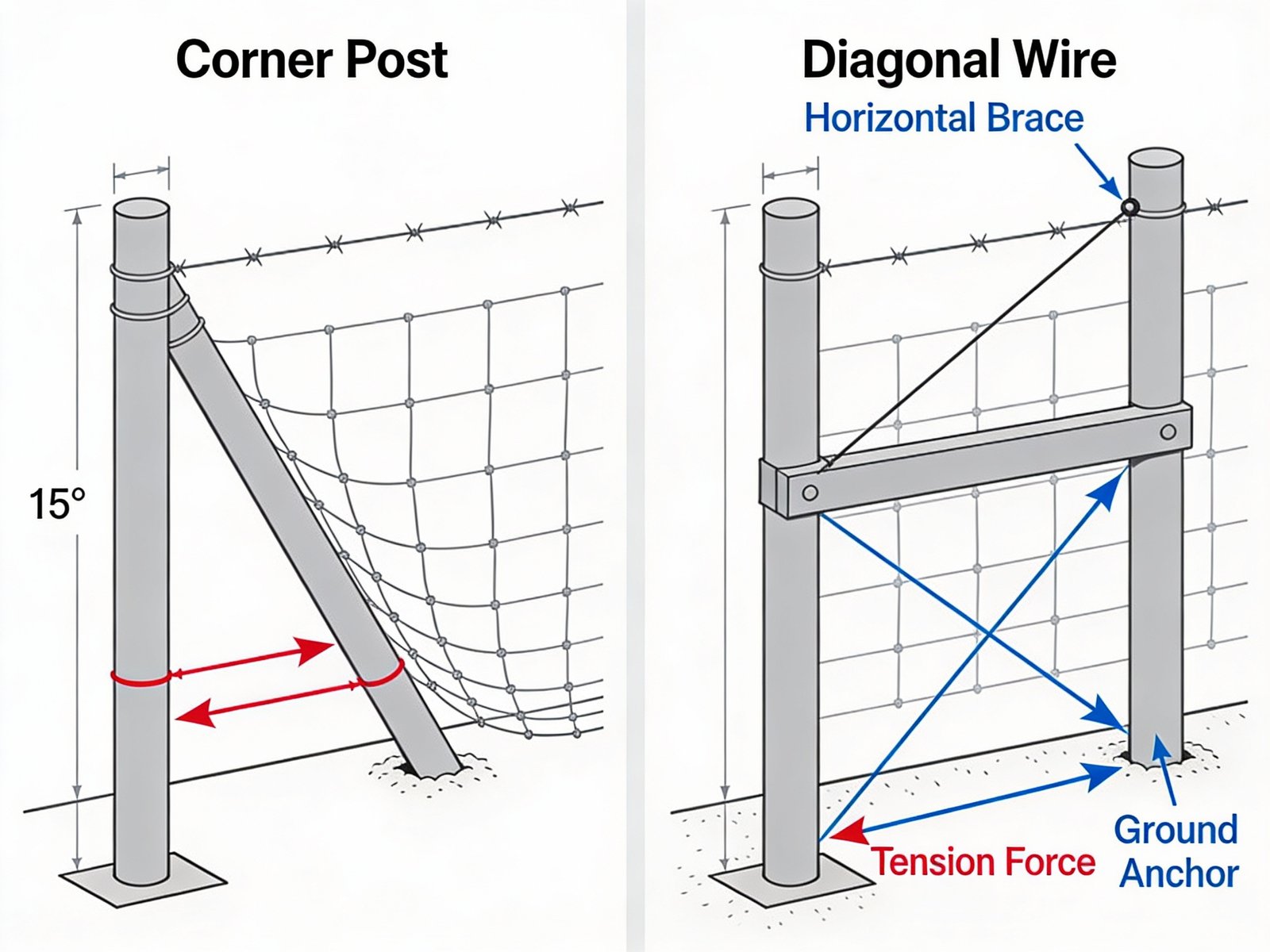
When you tension woven wire or high-tensile wire, all that pulling force concentrates at corner posts, end posts, and gate posts. Without corner bracing, these posts get pushed inward or pulled outward, causing leaning, bending, or uplift, which results in:
- Loose top wires that cattle can push through or jump over
- Sagging woven wire with increased ground clearance allowing animals to escape
- Unbalanced fence tension making spot repairs ineffective
- Complete structural failure requiring costly section replacement
The core purpose of corner bracing is to create a triangular force structure that redirects horizontal tension into the ground:
- The vertical corner post bears and transfers compression loads
- The horizontal or diagonal brace connects the corner post to a secondary post, forming a “frame” or “angle” structure
- Diagonal tension wire or floating struts pull the force pathway into the ground or floating foot, creating a stable load path
1.2 Where Corner Bracing Must Be Installed
Industry standards and university extension guidelines recommend installing corner bracing at:
- Every direction change greater than 10 degrees
- All fence starting and ending points (terminal posts)
- Both sides of every gate or access opening
- Long straight runs: woven wire every ~660 feet (200m); high-tensile every 330–660 feet
1.3 Basic Design Principles: Depth and Distance
Follow these empirical formulas for reliable corner bracing performance:
- Burial depth: Corner/end posts should be buried at least 1/3 to 1/2 of their total length. Common practice: 8-foot posts buried 3–3.5 feet deep, exposing 4.5–5 feet above ground
- Horizontal spacing (H-brace): Distance between two vertical posts should be 1.5–2× the fence height. For 4-foot fence → 8-foot spacing; for 5–6 foot fence → 8–10 foot spacing
- Diagonal brace angle: Whether using steel/wood diagonal or floating strut, optimal diagonal tension wire angle is 30–45 degrees. Too steep or too shallow reduces load capacity
Understanding proper woven wire fence installation steps is crucial for implementing effective corner bracing as part of your overall fence construction strategy.
2. Five Common Corner Bracing Systems Overview
Cattle fence corner bracing systems fall into five main categories, each suited to specific fence types, budgets, and site conditions. Choosing the right system depends on wire tension requirements, soil conditions, climate factors, and long-term maintenance preferences.
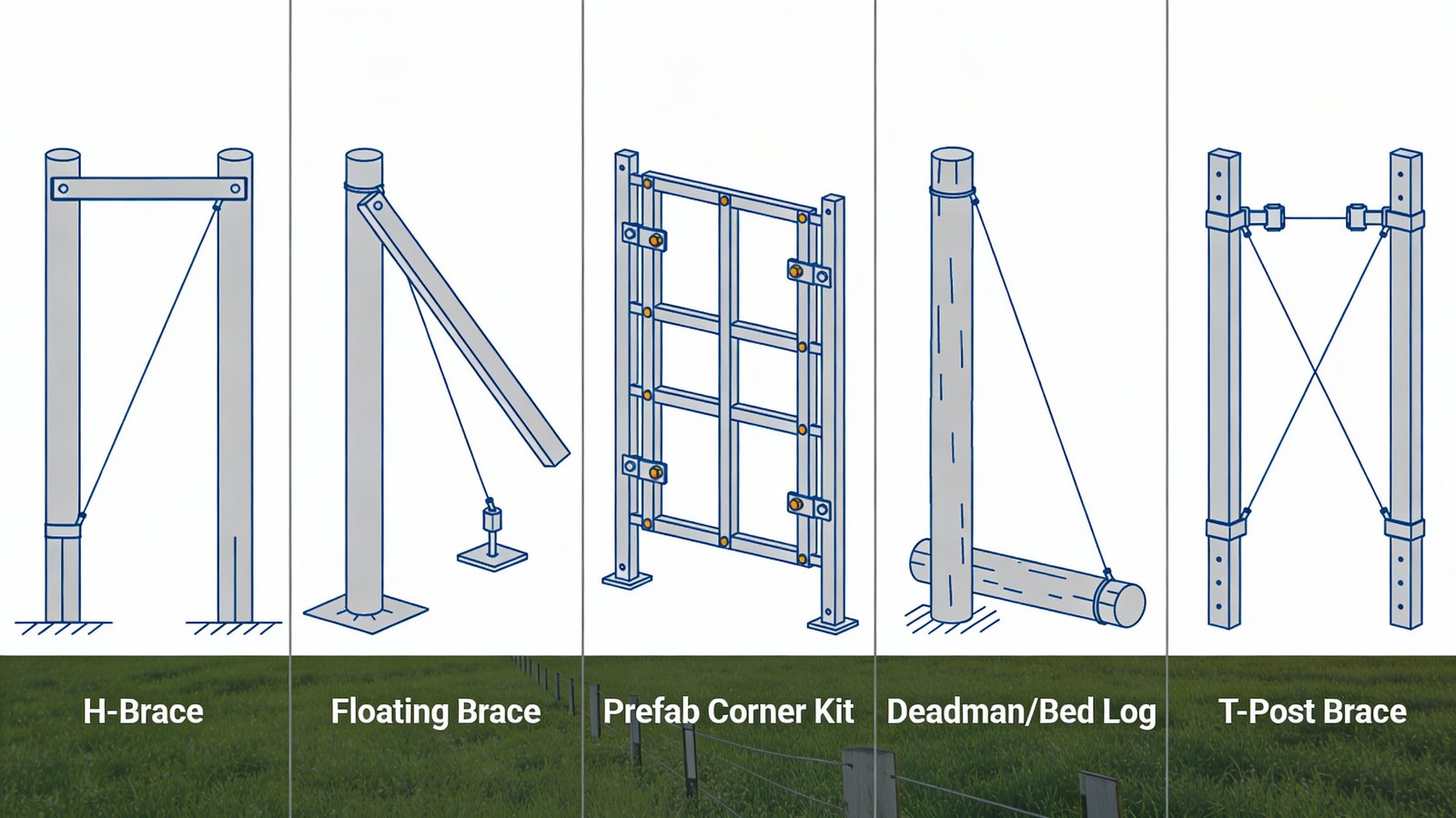
2.1 Classic H-Brace System
Best For:
High-tensile woven wire, 4–6 strand high-tensile smooth wire, long-distance ranch fencing, gates, and primary corners.
Basic Structure:
- Two vertical posts (corner post + helper post)
- One horizontal compression beam (brace rail)
- Diagonal high-tensile wire running from corner post bottom to helper post top
Typical Specifications (Single H-Brace Assembly):
- Corner post: 6–7 inch diameter, 8–9 feet total length, buried 3–3.5 feet
- Helper post: 5–6 inch diameter, same burial depth as corner post
- Post spacing: ~8 feet for 4-foot fence; 9–10 feet for taller fences
- Horizontal brace: 4–5 inch diameter, 8–10 feet long, installed 36–42 inches above ground
- Diagonal wire: 12.5-gauge high-tensile wire or cable, tensioned until corner post leans back 1–2 inches
Strength & Longevity:
Steel H-braces paired with high-tensile wire can withstand 1,000+ pounds total tension (200–250 lbs per wire on multi-strand systems). Properly installed with treated wood or steel posts, lifespan typically exceeds 20–30 years; steel tube systems can last 40+ years.
Cost Estimate (2026):
Wood H-Brace: $280–560 per assembly
- Posts + horizontal beam: $80–150
- Diagonal wire + hardware: $60–120
- Concrete (3–5 bags): $20–40
- Professional labor: $120–250
Steel H-Brace: $475–900 per assembly
- Steel posts + beam: $200–350
- Cable/wire + fittings: $50–100
- Concrete: $25–50
- Welding + installation: $200–400
2.2 Floating Brace / Dynamic Diagonal Brace
Key Features:
Requires only one deeply buried corner post. The brace strut and foot “float” on or just below the ground surface, creating a triangular structure that transfers corner post forces to a ground pad.
Core Components:
- Corner post: 5–6 feet above ground, 3–3.5 feet buried
- Brace strut: Typically 7–8 feet long, angled from corner post mid-height to ground foot
- Floating foot: Short post section or wood block resting on or slightly below ground surface (not concreted)
- Diagonal tension wire: Runs from corner post base to floating foot top, adjusted with in-line tensioner
Application Guidelines:
- 2–5 strand high-tensile electric fences
- Standard-tension woven wire on moderate terrain
- Hilly or freeze-thaw regions where concrete heaving is problematic
- Soil conditions unsuitable for extensive excavation
Advantages:
- Minimal excavation — only one deep post hole required
- Lower material costs compared to full H-brace
- Floating foot accommodates soil movement in freeze-thaw cycles
- Field experience shows good performance over 10+ years with proper tensioning
Important Considerations:
- Floating brace works best for single-direction force (end terminals or single-angle corners)
- For large-angle corners (>20°), consider using two floating braces or upgrading to H-brace
- Protect floating foot from livestock disturbance using rocks or small barrier
Cost Estimate (2026):
$170–390 per assembly
- Corner post + strut + foot: $80–180
- Diagonal wire + tensioner: $30–60
- No concrete required
- Labor: $60–150
2.3 Prefabricated Corner Brace Kits
Product Characteristics:
Pre-welded or bolt-together steel assemblies that form standardized H or N configurations when paired with standard posts. Components include pre-fitted clamps, brackets, and connection hardware.
Typical Features:
- Standard steel tube or T-post construction with factory connections
- Bolt assembly eliminates need for field welding
- Some kits include adjustable-angle assemblies for uneven terrain
- Designed for T-post integration in electric or lighter-duty applications
Best Use Cases:
- Time-sensitive projects requiring rapid deployment
- Large multi-section projects needing consistent appearance
- Installations without welding equipment access
- Standardized specifications for contractor bidding
Cost Estimate (2026):
$400–800 per assembly
- Prefab kit (without posts): $200–400
- Posts, concrete, diagonal wire: $100–200
- Installation labor: $100–200
2.4 Deadman / Bed Log Brace
Structure & Application:
A long horizontal timber (deadman or bed log) is laid on the ground in the direction of fence pull. Diagonal wire runs from the corner post top to the deadman, using the log’s weight and soil friction to resist horizontal forces.
Advantages:
- Fastest installation — minimal excavation
- Lowest material cost
- Suitable for temporary or seasonal fencing
Limitations:
- Significantly lower load capacity than H-brace or floating brace
- Timber degrades from ground contact; replacement typically needed every 3–7 years
- Not recommended for permanent cattle containment fencing
- Best suited for light electric fences or temporary livestock rotation
Cost Estimate (2026):
$100–250 per assembly
2.5 T-Post Corner Brace Systems
Concept:
Uses 2–3 steel T-posts with specialized brackets to create a triangular or H-frame corner structure. Diagonal tension wire and connecting hardware form the bracing geometry.
Typical Configuration:
- Two T-posts forming “gate frame” configuration
- Steel tube or bracket connectors with adjustable angles
- Diagonal wire with inline tensioners
- Suitable for level ground or slight slopes (≤6 inches vertical drop over 5 feet horizontal)
Best Applications:
- Budget-conscious projects with existing T-post inventory
- Electric fence supplementary bracing
- Light to moderate tension applications
- Quick repairs or temporary upgrades
Cost Estimate (2026):
$100–250 per assembly
3. Selecting the Right Bracing System
3.1 Selection by Fence Type and Tension
| Fence Type | Expected Tension | Recommended Bracing | Spacing Standard |
|---|---|---|---|
| Standard woven wire (cattle/sheep) | Medium-High | H-Brace (wood or steel) | Every 660 feet + all corners |
| High-tensile smooth wire (4–6 strand) | High (1000+ lbs total) | H-Brace or Floating Brace | Every 330–660 feet |
| Temporary electric (1–2 strand) | Low | Deadman or T-Post Brace | As needed for corners |
| Mixed (woven + electric top wire) | Medium-High | H-Brace at major corners, Floating mid-line | Per woven wire standards |
When planning your fence budget, use a comprehensive cattle fence installation cost calculator to estimate total material and labor expenses including proper corner bracing.
4. Cost Analysis: Corner Bracing Investment (2026)
The following cost ranges represent typical single-assembly pricing based on university extension budgets and commercial supplier data. Actual costs vary by region, material availability, and labor rates.
| Bracing System | Material Cost | Labor Cost | Total Per Assembly | Expected Lifespan |
|---|---|---|---|---|
| Wood H-Brace (field-built) | $160–310 | $120–250 | $280–560 | 20–30 years |
| Steel H-Brace (welded) | $365–525 | $200–400 | $475–900 | 30–50+ years |
| Prefab Corner Kit | $300–600 | $100–200 | $400–800 | 15–25 years |
| Floating Brace | $110–240 | $60–150 | $170–390 | 10–15 years |
| Deadman / T-Post | $50–120 | $50–130 | $100–250 | 5–10 years |
5. Common Installation Mistakes and Prevention
Proper corner bracing installation requires attention to critical details. The following mistakes cause the majority of premature bracing failures observed in the field.
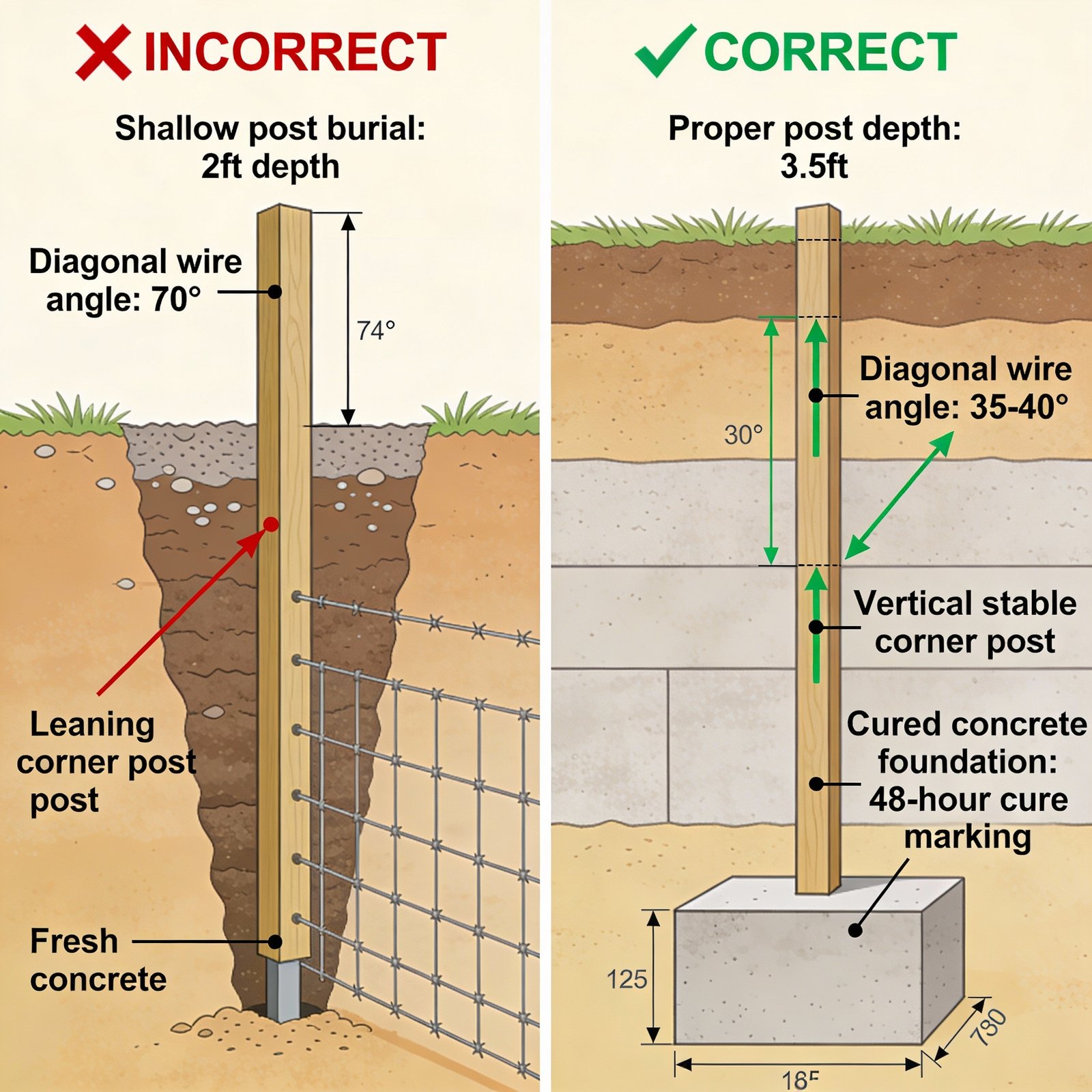
Critical Error #1: Insufficient Post Burial Depth
Problem: Burying posts only 2 feet deep instead of following the “depth equals height” principle.
Consequence: Posts lean noticeably within the first year, often requiring complete rebuild within 1–2 years.
Prevention: Bury corner/end posts at minimum 1/3 of total length, preferably closer to 1/2. For 8-foot posts, bury 3–3.5 feet. In sandy soil or high-tension applications, add 6–12 inches.
Critical Error #2: Incorrect H-Brace Spacing
Problem: Placing helper post too close (<1.5× fence height) or too far from corner post.
Consequence: Diagonal wire angle becomes too steep or too shallow, compromising load transfer efficiency.
Prevention: Maintain 1.5–2× fence height spacing. For 4-foot fence, use 8-foot spacing; for 5–6 foot fence, use 8–10 feet. Horizontal brace length should approximate 2× fence height.
Critical Error #3: Improper Diagonal Wire Tension
Problem: Over-tightening causes wood splitting or wire breakage; under-tightening fails to stabilize corner post.
Consequence: Structural failure or inadequate bracing performance.
Prevention: Tension diagonal wire until corner post top leans backward 1–2 inches. Use “tap test” — properly tensioned wire produces clear ringing sound when struck. Stop immediately if wood shows cracking or wire approaches breaking tension.
Critical Error #4: Tensioning Before Concrete Cures
Problem: Applying fence tension within 24 hours of concrete placement.
Consequence: Concrete cracking, post movement, foundation failure within weeks.
Prevention: Wait minimum 48 hours at normal temperatures (50–80°F) before any tensioning. In cold weather (<50°F), extend to 72 hours. In hot weather (>80°F), may reduce to 36 hours but monitor closely. Concrete should be fully cured and show no indentation under foot pressure before proceeding.
Critical Error #5: Single Brace for Large Angle Changes
Problem: Using only one H-brace at corners with >20-degree direction change.
Consequence: Corner post experiences twisting forces, leading to gradual rotation and fence geometry distortion.
Prevention: For direction changes >20 degrees, install two H-braces (one oriented to each fence direction) or use specialized angle brace hardware. Consult professional fence contractor for complex terrain or multiple-angle corners.
Implementing proper corner bracing is just one component of comprehensive fence longevity. For ongoing performance, follow recommended cattle fence maintenance and repair practices including annual re-tensioning and structural inspection.
6. Regional and Terrain Considerations
Freeze-Thaw Regions (Northern Climates)
Areas with significant frost penetration and spring thaw cycles require special bracing approaches:
- Preferred systems: Floating brace or minimal-concrete H-braces allow vertical movement accommodation
- Avoid: Fully concreted fixed-foot braces that resist frost heave forces
- Installation timing: Fall (September–October) preferred; avoid winter installation where possible
- Maintenance: Spring inspection critical after freeze-thaw cycles; re-tension diagonal wires annually
Steep Terrain & Hillside Applications
Slopes >15% require enhanced bracing specifications:
- Recommended: Double H-braces or engineered steel systems; shorter spacing intervals (330 feet instead of 660 feet)
- Post depth: Increase burial depth 30–50% on hillside corners
- Uphill side: Consider additional upstream brace or deadman anchor
- Professional consultation: Recommended for slopes >20% or complex multi-angle corners
Sandy or Soft Soil Conditions
Low-bearing-capacity soils require modified foundation approach:
- Post depth: Increase burial depth 20–30% beyond standard
- Concrete volume: Enlarge footings 30–50%; use 6–7 bags per hole instead of 3–5
- Floating brace option: Use wider floating feet (6×8 or steel pads) with gravel base
- Annual inspection: Monitor for settling; address subsidence promptly
7. Practical Installation Recommendations
For Most Woven Wire Cattle Fences:
- Install complete H-brace assemblies at every corner and terminal point
- For budget-constrained or challenging terrain projects, use floating braces on long straight sections while reserving H-braces for corners, gates, and high-stress points
- Avoid lightweight systems (deadman/T-post) for permanent perimeter fencing; reserve these for temporary or low-tension applications
Based on 2026 material costs, a wood H-brace assembly typically costs $160–310 in materials and $280–560 installed, while complete steel H-braces run $475–900 installed. Compared to per-mile fencing investments of $2,000–5,000, proper corner bracing represents one of the highest-value structural investments in the entire fence system.
Corner bracing effectiveness depends on complementary installation quality throughout the fence line. Review comprehensive guidelines in our woven wire fence installation guide and ensure you have the appropriate fence installation tools and equipment for proper bracing construction.
Conclusion: Corner Bracing as Critical Fence Infrastructure
Corner bracing represents the structural foundation of any tensioned cattle fence system. The relatively modest investment in proper corner bracing—whether $170 for floating braces or $900 for engineered steel H-braces—prevents the far greater expense of premature fence failure and reconstruction.
When selecting a bracing system, prioritize these factors in order:
- Fence wire type and total tensile load requirements
- Soil conditions and climate considerations (freeze-thaw, sandy soil, etc.)
- Terrain complexity and angle of direction changes
- Long-term maintenance capability and budget
- Initial installation budget constraints
Remember that corner bracing is not an area to compromise on quality. A fence system is only as strong as its weakest structural element—and in tensioned wire fences, that element is typically the corner or end brace. Proper bracing design, quality materials, correct installation depth and spacing, adequate concrete curing time, and appropriate diagonal wire tension collectively determine whether your fence performs reliably for decades or requires expensive repairs within just a few years.