
Bull Pen Fencing Systems: Heavy-Duty Designs for Safe Bull Containment
Bull pen fencing systems are purpose-built containment structures designed specifically to safely confine mature breeding bulls under continuous physical and behavioral stress.
Bull pen fencing represents one of the most demanding applications in agricultural infrastructure. Unlike standard cattle containment, bull pens must withstand sustained pressure from animals weighing 1,100 to 2,200 pounds, driven by powerful instincts and capable of charging with enough force to destroy conventional fencing. The consequences of inadequate containment extend beyond property damage to include serious human injury, liability exposure, and genetic asset loss. Mature bulls possess both the motivation and physical capacity to test boundaries continuously, particularly when detecting cows in heat up to six miles away. This section examines why specialized engineering and materials selection are non-negotiable for bull pen construction.
Effective bull containment requires understanding the intersection of animal behavior, structural engineering, and long-term material performance. Bulls use their heads to butt and their weight to push against anything within reach, creating constant stress on fence components. Dairy bulls, especially those hand-raised as bottle calves, present particularly high risk as they mature, often directing aggressive behaviors toward humans rather than other cattle. The fence system must account for these behavioral realities while providing worker safety features and maintaining structural integrity across seasonal temperature extremes and moisture exposure.
Why Bull Pens Require Specialized Fencing
Standard cattle fencing systems fail in bull pen applications because they are engineered for fundamentally different pressure scenarios. Commercial cattle operations use fencing designed to contain animals with moderate motivation to escape and limited physical capacity to damage infrastructure. Bulls, by contrast, represent the apex of livestock containment challenges. Their size, strength, aggressive tendencies, and breeding-driven motivation create a unique combination of stressors that expose weaknesses in conventional fence design. The decision to invest in specialized bull pen fencing is not about over-engineering but about matching infrastructure capacity to documented animal capabilities and behavioral patterns.
Behavioral Risks of Bulls in Confined Areas
Bulls confined in small quarters experience heightened stress that triggers engagement behaviors. When a bull feels cornered or unable to maintain adequate personal space, its natural instinct shifts from avoidance to confrontation. This behavioral response becomes particularly dangerous in confined pen environments where the animal has limited options for establishing distance. Research on bull behavior consistently demonstrates that aggressive tendencies intensify when bulls are housed in inadequate space, creating a cycle where poor containment design increases the likelihood of fence-testing behavior.
The motivational drivers behind bull escape attempts are profoundly strong. Bulls can detect pheromones from cows in estrus at distances exceeding six miles, triggering intense breeding drive that overrides normal fence respect. This olfactory sensitivity means a bull separated from breeding opportunities will persistently test fence lines, seeking the weakest point for breakthrough. Head-butting, pushing, mounting, and sustained pressure against fence components are instinctual behaviors that bulls employ without regard to structural limits. Fighting bulls, when housed near each other, will damage fences, posts, and buildings in attempts to establish dominance, often with no awareness of human presence or property in their path.
Dairy bulls present elevated risk compared to beef breeds, particularly those raised as bottle calves. Hand-reared bulls often develop improper socialization, viewing humans as herd members rather than separate entities. When these bulls reach breeding maturity at approximately two years of age, they redirect dominance behaviors toward people, resulting in unprovoked attacks. Unlike properly socialized bulls that challenge herd males, improperly socialized bulls lack appropriate behavioral outlets and perceive humans as rivals. This creates life-threatening situations where mature bulls weighing over a ton actively pursue human targets within pen environments.
Common Failure Points in Standard Cattle Fencing
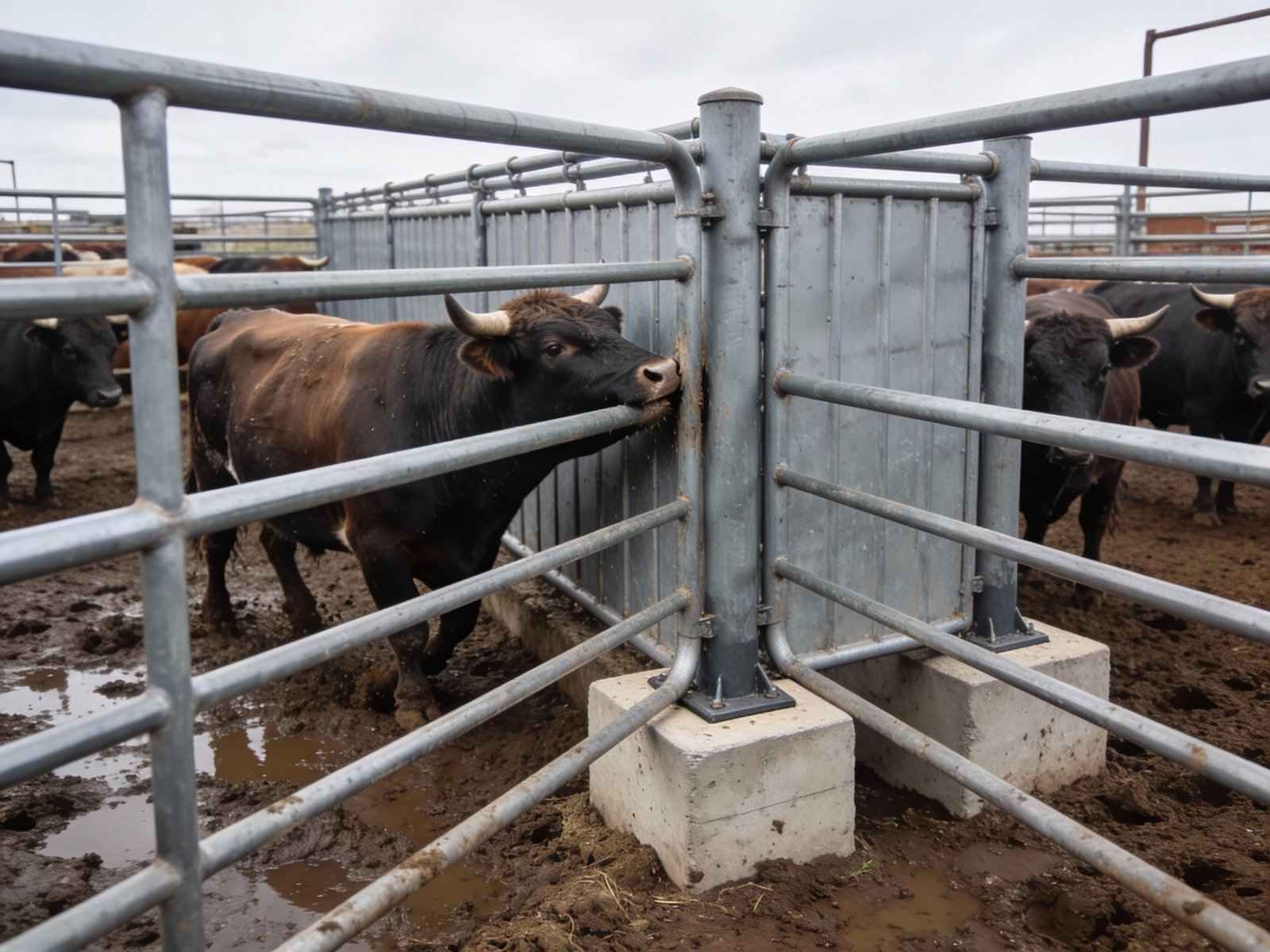
Conventional cattle fencing fails in bull pen applications at predictable stress points. Standard barbed wire systems, adequate for general cattle containment, buckle under sustained pushing pressure from bulls. The wire itself possesses insufficient tensile strength, typically rated at 950 pounds break strength for malleable steel, which a determined bull can exceed through body weight and leverage alone. Post spacing optimized for cattle (16 to 20 feet on flat terrain) creates excessive span lengths that allow fence deflection, signaling weakness to the animal and inviting further testing.
Woven wire fencing, while stronger than barbed wire, introduces different vulnerabilities in bull pen contexts. The flexible nature of woven wire, designed to conform to terrain variations, becomes a liability when bulls apply concentrated pressure. The fence yields and stretches, creating visual and physical cues that encourage escape attempts. Wire mesh openings, sized appropriately for cattle, allow bulls to insert their heads, creating entanglement risks and providing leverage points for fence destruction. Standard gate construction, adequate for cow-calf operations, sags under bull weight and develops gaps that compromise containment integrity.
Material degradation accelerates in bull pen environments due to concentrated animal activity. Moisture accumulation from manure, urine, and restricted drainage in confined areas attacks galvanized coatings at an accelerated rate. Bulls rubbing against posts and rails to establish scent marking wear through protective finishes, exposing base metal to corrosion. Wooden components subjected to continuous chewing, rubbing, and impact stress deteriorate faster than in pasture settings. The combination of chemical exposure, mechanical stress, and moisture creates a corrosive environment that reduces fence lifespan by 40 to 60 percent compared to standard applications.
Structural Requirements for Bull Pen Fencing
Bull pen fencing structural requirements exceed standard agricultural fencing specifications across every measurable parameter. Height, strength, load resistance, post spacing, and anchoring methods must account for the maximum force a mature bull can generate, not the average stress from typical cattle behavior. Engineering bull pen infrastructure requires conservative calculations that assume worst-case scenarios: the largest animal in the operation, under maximum motivation, applying peak force to the weakest structural point. This approach ensures the fence system can withstand not only normal use but also extreme events that inevitably occur in multi-year operational timeframes.
Fence Height, Strength, and Load Resistance
Minimum fence height for bull pens must reach 60 inches to prevent escape attempts through jumping or climbing. Standard cattle fencing, typically set at 48 to 54 inches, provides insufficient deterrent for bulls motivated by breeding drive or territorial aggression. The additional height serves both physical and psychological barrier functions, creating a visual obstacle that discourages escape attempts while providing actual clearance exceeding a bull’s shoulder height. Handling facilities and high-stress areas require the full 60-inch specification, while breeding bull pens may operate safely at 54 inches when combined with visual deterrent features such as board top rails.
Tensile strength requirements for bull pen fencing materials dramatically exceed standard specifications. High-tensile wire used in bull pen applications must demonstrate minimum tensile strength of 170,000 to 200,000 pounds per square inch, with breaking strength approximating 1,800 pounds per individual wire strand. This specification ensures that even if a bull applies its full weight and momentum to a single wire, structural failure will not occur. Pipe and panel systems use heavy-gauge steel construction with 1-gauge wire (0.283 inches diameter) for mesh components and 2-7/8 inch diameter pipe for structural posts, providing load resistance that exceeds bull capabilities by significant safety margins.
Load resistance calculations for bull pen fencing must account for dynamic impact forces, not just static weight bearing. A 2,000-pound bull charging at moderate speed generates exponentially greater force than its body weight alone. Corner posts and gate supports experience the highest loading, requiring embedment depths of three to four feet with concrete footings to prevent rotation under stress. The fence system operates as an integrated structure where each component shares load distribution. Weak points in any single element compromise the entire system, making consistent material quality and installation precision essential throughout the fence line.
Post Spacing and Anchoring Methods
Post spacing for bull pens must never exceed 10 feet between supports, representing an absolute maximum that should only be applied in ideal soil conditions. Optimal spacing ranges from eight to 10 feet, with tighter intervals required on sloped ground, in wet soil conditions, or where bulls congregate near feed or water points. This spacing requirement reflects both lateral load distribution and fence rigidity needs. Bulls pushing against fence rails generate lateral forces that accumulate across span distances. Closer post spacing distributes these forces across more support points, reducing stress on individual components and minimizing fence deflection that signals weakness.
Corner posts require substantially greater structural capacity than line posts, with minimum dimensions of eight inches diameter for wooden posts or 6×6 inch timbers. These posts anchor the entire fence line, absorbing cumulative tension from all wire or rail runs. Corner assemblies utilize H-brace configurations that convert lateral tension into compression forces distributed across brace posts and horizontal connecting members. Steel T-posts, while acceptable for line positions in some applications, prove inadequate for corners and gates, where concentrated forces exceed their capacity to resist bending and rotation.
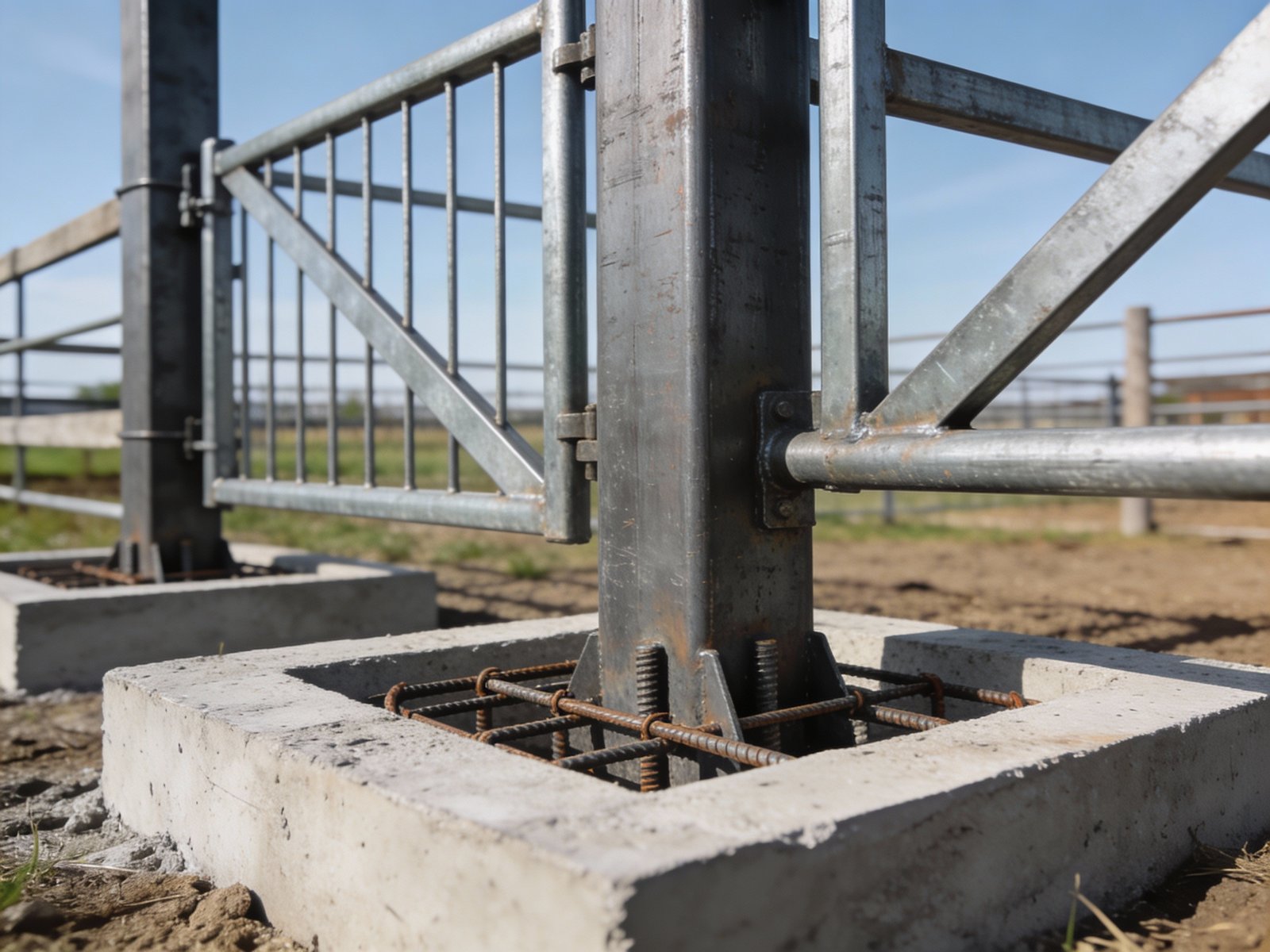
Anchoring methods determine whether posts resist sustained stress or gradually fail through rotation and heaving. Post depth must equal one-third of above-ground height at minimum, with deeper embedment required in sandy or disturbed soils. Clay soils require setting posts at depths equal to 10 times their diameter, while sandy conditions demand 15 times diameter depth to achieve equivalent holding capacity. Concrete footings provide the most reliable anchoring method for permanent installations, completely encasing the buried portion in a 12 to 16 inch diameter column that prevents rotation and distributes vertical loads across expanded bearing area. Posts must be positioned below frost lines in cold climates to prevent heaving during freeze-thaw cycles, which can elevate posts several inches and compromise fence tension.
Gate Design and Reinforcement Zones
Gates represent the most vulnerable component in bull pen perimeter systems, subjected to constant opening/closing cycles, impact from animal contact, and concentrated loading when bulls push against closed gates. Heavy-duty gate construction requires six to seven horizontal rails on frames built from 1.66-inch outer diameter pipe with 12 to 14 gauge wall thickness. Coped and fitted pipe connections, where rail ends are precisely cut to match post curvature before welding, create maximum weld surface area and eliminate stress concentrations that initiate failure. Square corner construction with diagonal bracing prevents racking, the gradual deformation that creates increasingly severe sag over operational life.
Gate hinge design must distribute weight and stress across maximum surface area while allowing smooth operation under load. Premium hinge systems completely encircle the gate leg with 12 inches of all-thread rod, secured with multiple nuts and washers that prevent vertical movement. This configuration transfers gate weight directly to the post rather than relying on weld strength or bracket integrity. Welded hinge tabs provide adequate performance in lighter applications but create stress concentrations in heavy-duty bull pen gates, particularly on spans exceeding 12 feet where gate weight and deflection generate substantial rotational forces.
Reinforcement zones surrounding gates extend the heavy-duty construction three to five posts beyond gate posts on both sides. Bulls habitually push against gates when attempting to access feed, water, or breeding females on the opposite side. This creates loading that radiates outward from the gate, affecting adjacent fence sections. Gate posts require 25 percent larger diameter than standard line posts, with corner-equivalent embedment depth and concrete footings. Cable and turnbuckle bracing, installed diagonally from top hinge corners to bottom latch corners, prevents gate sag in spans approaching or exceeding 16 feet, maintaining proper clearance and latch alignment throughout the gate’s service life.
Best Fence Types for Bull Pens
Bull pen fencing systems fall into four primary categories, each offering distinct advantages in specific applications. Pipe and panel systems provide maximum strength and durability but require highest initial investment. High-tensile reinforced systems offer excellent containment at moderate cost when properly installed with adequate bracing. Board fencing delivers superior visibility and psychological barrier effects in handling areas. Electric offsets augment physical barriers with behavioral conditioning but cannot serve as primary containment. Optimal bull pen design frequently combines multiple fence types, deploying each where its specific strengths align with functional requirements and risk profiles.
This video demonstrates the installation of continuous fence panels for bull pen construction, showing proper welding techniques, post spacing, and structural reinforcement methods. The footage illustrates how heavy-duty panel systems are assembled in field conditions, with particular attention to corner bracing and gate installation. Viewers can observe the substantial construction required for bison and bull containment, including the precision welding of panels to steel posts and the use of angle iron caps for panel termination. The demonstration emphasizes that proper bull pen construction requires both appropriate materials and correct installation procedures to achieve long-term containment reliability.
Pipe and Panel Bull Pen Systems
Pipe and panel systems represent the gold standard for permanent bull pen construction, offering unmatched strength, longevity, and livestock safety. These systems utilize heavy-gauge steel pipe for posts (typically 2-7/8 inch outer diameter) and horizontal rails, with welded or bolted connections that create rigid structures capable of withstanding extreme forces. Four-rail construction provides minimum adequate protection for exterior bull pen fencing, while five to six rail systems are specified for gates and high-stress zones where bulls concentrate activity. The pipe dimensions and wall thickness deliver load resistance far exceeding bull capabilities, with properly installed systems showing essentially unlimited service life when maintained against corrosion.
Bull panel construction differs from standard cattle panels through heavier gauge materials and tighter mesh spacing. Premium bull panels employ 1-gauge wire (0.283 inches diameter) welded at every intersection to create a rigid mesh grid, typically with six by six inch spacing. This mesh configuration prevents bulls from inserting their heads between wires while maintaining visibility for handlers and animals. Panel heights range from 60 to 72 inches, accommodating modern large-frame breeds that exceed historical size averages. Individual panel weights reach 82 to 210 pounds for 16-foot sections, reflecting the substantial material volume required for adequate strength.
Galvanized-before-welding represents the critical surface treatment specification for pipe and panel systems. This process applies zinc coating to individual components before welding, ensuring that weld joints receive complete corrosion protection. Standard hot-dip galvanizing, applied after fabrication, creates thin coating at weld points where heat has altered base metal properties, initiating premature rust failure. Galvanized-before-welding, though more expensive, provides uniform protection across the entire structure including the most vulnerable corrosion initiation sites. Panels treated with this process demonstrate service life exceeding 15 years in demanding agricultural environments with minimal maintenance beyond periodic inspection.
High-Tensile Reinforced Bull Pens
High-tensile fencing systems deliver excellent bull containment when engineered with appropriate wire gauge, strand count, and bracing infrastructure. These systems employ 12.5 to 14 gauge Class III galvanized wire with tensile strength of 170,000 to 200,000 pounds per square inch, substantially exceeding conventional fence wire specifications. The high-tensile designation refers to this increased strength, which allows wire to maintain tension under stress rather than stretching and deforming like standard fencing wire. Properly tensioned high-tensile systems create a rigid barrier that bulls cannot push through, over, or under, provided tension remains within design parameters throughout the fence line.
Strand count and spacing determine high-tensile fence effectiveness for bull containment. Minimum specification requires five strands for perimeter fencing, with six strands recommended for bull-specific applications. Strand spacing of approximately 10 inches provides adequate coverage across the 54 to 60 inch fence height range, with the bottom wire positioned at least 12 inches above ground level to prevent bulls from reaching under. At least two to three strands must be electrified to add behavioral deterrent to the physical barrier, though the physical wire tension provides primary containment. Bulls that test electrified strands receive aversive stimulus that conditions fence avoidance, reducing sustained pressure on the system.
H-brace construction at corners and end posts is non-negotiable for high-tensile systems, as these assemblies resist the cumulative tension from all wire strands. An H-brace consists of two vertical posts connected by a horizontal compression member, with diagonal wire wrapping that converts lateral wire tension into vertical and compression forces distributed across both posts. Corner braces must utilize posts with minimum eight inch diameter, set to depths of four feet or greater with concrete footings. The horizontal brace member, typically six to eight inches diameter, spaces the posts eight to 10 feet apart, creating a structural assembly capable of resisting 5,000 to 10,000 pounds of cumulative wire tension without deformation. Line post spacing in high-tensile systems can reach 16 to 90 feet, though bull pen applications should maintain tighter spacing of 15 to 20 feet maximum to minimize wire deflection under localized pressure.
Board Fencing in Bull Handling Areas
Board fencing serves specialized functions in bull handling facilities, particularly in areas where visual guidance and worker safety take precedence over pure containment strength. Wooden board fencing, constructed from two by eight or two by ten lumber attached to heavy posts, creates solid visual barriers that guide bull movement through chutes and alleyways. Bulls naturally avoid colliding with clearly visible obstacles, making board fencing highly effective for directional control in working facilities. The solid construction also prevents bulls from seeing distractions beyond the fence line, reducing balking and improving handler safety by containing the animal’s attention within the immediate handling area.
Height and spacing specifications for board fence bull applications exceed standard configurations. Board runs should extend 54 to 60 inches above grade, with individual board spacing not exceeding six inches between components. Closer spacing or solid construction is preferred in areas where bulls might attempt to insert heads or observe activity beyond the fence. Visible top rails, whether board or pipe, provide critical psychological deterrence by clearly defining fence height and creating the appearance of an insurmountable barrier. Bulls demonstrate reduced jumping attempts when top rails are highly visible, as the clear visual definition allows accurate assessment of barrier height and discourages escape attempts.
Structural limitations of board fencing require understanding when this fence type is appropriate versus when heavier construction is mandatory. Board fencing excels in controlled environments such as handling chutes, crowding pens, and short-run sorting areas where bulls are present temporarily under handler supervision. It proves inadequate for perimeter containment or overnight holding pens where sustained pressure and unsupervised contact will occur. Bulls can and will destroy wooden board fencing when sufficiently motivated, making it unsuitable as standalone containment in breeding pens or long-term bull housing. Strategic deployment combines board fencing in handling areas with pipe and panel or high-tensile systems for perimeter security, optimizing cost and performance across the complete facility.
Electric Offsets for Bull Behavior Control
Electric fencing serves as behavioral modification and fence life extension in bull pen applications but cannot function as primary containment. Bulls experiencing electric shock while contacting fence components develop conditioned avoidance that reduces sustained pressure on physical barriers. This behavioral conditioning extends fence life by minimizing rubbing, pushing, and impact stress that accelerates material degradation. However, electric fence systems fail completely as standalone bull containment because bulls can break through wire before deterrent shock registers, particularly when highly motivated by breeding drive or territorial aggression. The shock, while unpleasant, does not physically prevent a 2,000-pound animal from continuing forward motion once initiated.
Voltage requirements for bull applications substantially exceed general cattle specifications. Effective bull containment through electric deterrent requires maintaining 3,000 to 4,000 volts on fence lines, compared to 2,000 volts adequate for cows and calves. This increased voltage ensures bulls receive sufficient shock intensity to modify behavior even through thick hide and when distracted by breeding motivation. Low impedance fence chargers are essential for maintaining these voltage levels across long fence runs and when vegetation contact creates current drain. Five to six electrified wire strands, positioned at strategic heights including shoulder level, provide optimal shock delivery as bulls contact the fence at various points during different behaviors.
Offset wire configuration provides the most effective electric augmentation for physical barrier systems. Offset wires, mounted on insulators extending six to 12 inches inside the fence line at shoulder height, create an electrified buffer zone that bulls encounter before reaching the main fence structure. When bulls approach to rub or push against fence rails or panels, they contact the offset wire first, receiving aversive shock that terminates the behavior before physical stress transfers to fence components. This configuration dramatically reduces fence maintenance requirements and extends service life, particularly for pipe and panel systems where animal contact accelerates coating wear and corrosion initiation. Installation must ensure offset wires maintain proper voltage through low-resistance insulators and adequate ground rod systems, as poor grounding negates deterrent effectiveness.
Climate & Environment Considerations for Bull Pens
Environmental conditions directly impact bull pen fencing material selection, design specifications, and maintenance requirements. Climate factors including precipitation patterns, temperature extremes, freeze-thaw cycles, and humidity levels determine which fence types will achieve projected service life and which will fail prematurely. Bull pen fencing represents significant capital investment, making climate-appropriate design essential for achieving acceptable return on infrastructure costs. Geographic location drives material selection more than any other variable after animal size and behavior considerations, as identical fence systems demonstrate radically different longevity in different environmental contexts.
Wet, Muddy, and Freeze-Thaw Conditions
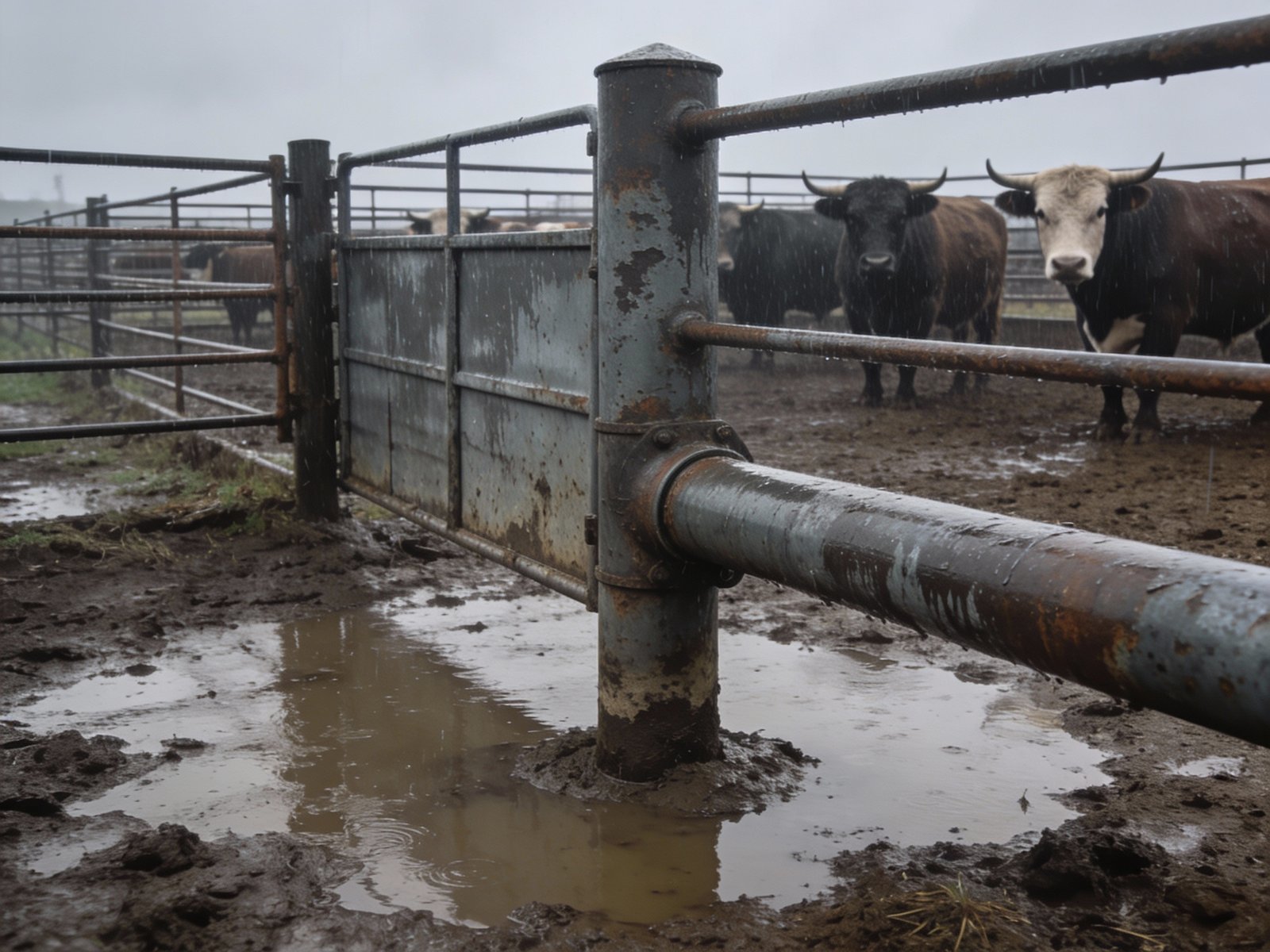
Wet and muddy conditions accelerate fence component degradation through multiple mechanisms simultaneously. Standing water at post bases creates continuous moisture contact that penetrates protective coatings and initiates corrosion at the most critical structural point. Mud accumulation retains moisture against fence surfaces even during dry periods, preventing protective coatings from drying and self-healing. The combination of manure, urine, and moisture creates chemically aggressive environments that attack galvanized coatings faster than clean water exposure alone. Wooden posts in wet conditions experience rot initiation within three to five years without pressure treatment, compared to 10 to 15 year life expectancy in well-drained locations.
Freeze-thaw cycles impose mechanical stress that supplements chemical degradation. Water penetrating coating defects or wood grain expands during freezing, widening cracks and creating pathways for deeper moisture intrusion. Repeated freeze-thaw events progressively enlarge these defects, accelerating the progression from minor coating damage to structural rust or wood failure. Posts set in saturated ground experience heaving as frozen soil expands, lifting posts incrementally each winter. This heaving loosens fence tension, creates gaps at ground level, and eventually compromises post stability. Climate zones experiencing more than 20 freeze-thaw cycles annually require posts set below frost line depth (typically 36 to 48 inches) and fence designs that accommodate seasonal ground movement without structural compromise.
Material selection for wet environments prioritizes maximum corrosion resistance through premium galvanizing and protective coatings. Hot-dip galvanizing after fabrication provides baseline protection, but galvanized-before-welding specifications prove essential for long-term durability in wet climates. This process creates uniform zinc coating thickness across entire fence components including weld joints where moisture initiates corrosion most rapidly. Powder coating applied over galvanizing provides additional moisture barrier and extends service life by five to seven years in wet conditions. Immediate touch-up of coating damage using zinc-rich paint prevents localized corrosion initiation that propagates across larger areas over time. Ranchers in consistently wet climates report fence life extension from 10 to 15 years through systematic coating maintenance programs versus unmaintained systems.
Hot Climate Stress and Material Fatigue
Elevated temperatures create thermal stress that affects fence material properties and dimensional stability. Metal components expand during heat exposure, creating stress at connection points and potentially loosening fasteners over repeated thermal cycles. Temperature differentials between day and night cause daily expansion and contraction that gradually works bolted connections loose, requiring periodic retightening to maintain structural integrity. Wire under tension experiences stress relaxation at elevated temperatures, gradually losing initial tension and reducing fence rigidity. High-tensile systems in hot climates require tension monitoring and periodic re-tensioning to maintain design performance, particularly during first two years after installation as wire stretches and stabilizes.
Ultraviolet radiation exposure degrades coating systems and accelerates material weathering in hot, sunny climates. Paint and powder coating systems chalk and fade under sustained UV exposure, losing protective properties and requiring reapplication at shorter intervals than in temperate zones. Galvanized coatings, while resistant to UV degradation, experience accelerated oxidation in hot conditions, particularly when combined with high humidity. The zinc coating develops white rust (zinc oxide) that, while less destructive than iron rust, indicates ongoing material consumption. Coastal hot climates present the most aggressive conditions, combining heat, humidity, salt spray, and UV exposure in ways that dramatically reduce fence service life without premium material specifications and intensive maintenance.
Heat stress affects bull behavior in ways that increase fence pressure and failure risk. Bulls experiencing heat stress become more irritable and aggressive, increasing the frequency and intensity of fence contact events. They seek shade, water, and areas with air movement, often congregating in specific pen locations that receive disproportionate impact and pressure. Fence sections near water sources in hot climates experience accelerated wear from sustained bull presence and increased moisture exposure. Design adaptations for hot climates include shade structure integration with fence lines, strategic water placement to distribute bull traffic, and fence reinforcement in identified congregation areas where both environmental and behavioral factors combine to create accelerated deterioration conditions.
Cost Considerations for Bull Pen Fencing
Bull pen fencing investment analysis requires evaluating initial construction costs against long-term operational expenses, risk mitigation value, and infrastructure service life. The cost differential between adequate and inadequate bull containment appears substantial when examining material invoices and contractor quotes. However, this analysis fundamentally misframes the financial decision. Inadequate fencing generates ongoing costs through repair requirements, escaped bull recovery, property damage liability, and genetic asset loss that cumulatively exceed initial savings within typical operational timeframes. Bull pen fencing represents infrastructure investment where value derives from what does not happen rather than from direct productivity gains.
Initial Build Cost vs Long-Term Repair Risk
Initial construction costs for bull pen fencing vary by system type, material specifications, and installation complexity. Cattle wire fencing with adequate specifications for bull containment ranges from $2.50 to $7.50 per linear foot installed, with heavy-duty specifications approaching the upper range. Professional installation labor contributes $1.10 to $2.50 per linear foot, with total labor costs of $40 to $60 per hour depending on regional wage rates and project accessibility. A typical bull pen enclosure of 150 to 200 square feet per bull, configured in 30 by 30 foot pens, requires approximately 120 linear feet of fencing per pen. Material and labor costs for pipe and panel systems approach $1,500 to $2,000 per bull pen, while high-tensile systems with adequate bracing may cost $800 to $1,200 per pen.
Long-term repair costs disproportionately burden operations that under-invest in initial construction. Standard cattle fencing adapted for bull use typically fails within two to four years through broken wires, bent posts, and damaged gates. Repair costs for these failures range from $200 to $500 per incident, occurring three to five times annually in active bull pens. Over a 10-year operational period, cumulative repair costs reach $6,000 to $15,000 per pen, double to triple the cost differential between adequate and heavy-duty initial construction. These figures exclude indirect costs including labor time for emergency repairs, stress on animals during fence failure events, and operational disruption when bulls must be relocated during repair work.
Risk-adjusted cost analysis incorporates low-probability, high-consequence events that adequate fencing prevents. Bull escape scenarios generate costs ranging from minimal (immediate recapture with no damage) to catastrophic (highway accident, crop damage, neighboring property breeding, human injury litigation). Even conservative risk modeling, assuming one significant escape event per five years with average damages of $5,000, adds $1,000 annually to total cost of ownership for inadequate fencing systems. Genetic asset protection provides additional risk mitigation value. Bulls representing $15,000 to $50,000 in genetic investment face injury and loss risks in inadequate containment that far exceed the $1,000 to $2,000 cost differential between standard and heavy-duty fence construction. Insurance actuarial analysis consistently supports heavy-duty fence investment for operations housing bulls valued above $10,000.
When Heavy-Duty Systems Save Money
Heavy-duty fence systems achieve positive return on investment through three primary mechanisms: extended service life, reduced maintenance requirements, and risk event prevention. Premium pipe and panel systems with galvanized-before-welding treatment demonstrate service life exceeding 20 years with minimal maintenance, compared to 10 to 12 years for standard hot-dip galvanized construction. The incremental cost of premium treatment (approximately 20 to 30 percent material premium) is recovered through doubled service life, reducing annualized infrastructure cost by 30 to 40 percent over project lifecycle. Operations planning for multi-generational infrastructure use find heavy-duty construction achieving lowest total cost of ownership despite highest initial investment.
Maintenance labor represents significant ongoing cost that heavy-duty systems minimize. Standard cattle fencing requires quarterly inspection and repair, consuming eight to 12 hours annually per pen. At $50 per hour labor valuation (opportunity cost for owner-operators or direct cost for hired labor), annual maintenance totals $400 to $600 per pen. Heavy-duty systems reduce maintenance requirements to semi-annual inspection and minor touch-up, consuming three to four hours annually and saving $250 to $400 per pen yearly. Over 15-year infrastructure life, maintenance savings reach $3,750 to $6,000 per pen, offsetting 75 to 100 percent of the initial cost premium for heavy-duty construction. Operations managing multiple bull pens multiply these savings across the entire facility, creating substantial economic advantage for heavy-duty investment.
Operational scale determines the threshold where heavy-duty systems become economically mandatory rather than optional. Small-scale operations housing one to two bulls may achieve acceptable risk profiles with reinforced standard fencing and intensive management. However, operations maintaining five or more bulls simultaneously, particularly high-value genetics in AI stud or seedstock production, cannot justify the risk exposure of inadequate containment. The probability of fence failure events increases proportionally with bull population and time exposure. An operation housing 10 bulls for 10 years creates 100 bull-years of exposure, with correspondingly higher probability of experiencing low-frequency, high-consequence failure events. At this scale, heavy-duty fence construction transitions from prudent investment to operational necessity that fundamentally determines whether the enterprise can operate sustainably.
Integrating Bull Pens with Larger Fencing Systems
Bull pen integration within comprehensive ranch fencing infrastructure requires careful consideration of animal flow patterns, breeding management protocols, and handling facility access. Isolated bull pens increase labor requirements and limit operational flexibility, while integrated systems enable efficient animal movement and adapt to changing management needs. The optimal configuration positions bull pens adjacent to handling facilities and cow-calf pastures, connected through gate networks and transition corridors that allow controlled bull movement without specialized equipment or excessive labor. Integration planning during initial facility design proves far more cost-effective than retrofitting connections into existing infrastructure.
Hybrid Bull Pen + Pasture Fence Layouts
Hybrid fencing layouts deploy heavy-duty construction exclusively where bulls exert sustained pressure while using standard specifications for perimeter and pasture divisions. This approach optimizes capital allocation by matching fence investment to actual stress requirements rather than applying uniform specifications across the entire property. The bull pen proper receives pipe and panel or heavy-duty high-tensile construction capable of withstanding concentrated bull activity. Immediately adjacent pasture fencing transitions to reinforced specifications (five to six strand high-tensile with tight post spacing) that contain bulls during breeding season turnout but cost 40 to 60 percent less than bull pen-grade construction. Perimeter fencing distant from bull concentration areas uses standard cattle specifications, completing the graduated approach that balances containment reliability with cost effectiveness.
Gate placement and corridor design determine hybrid system functionality. Bulls must move from pens to pastures without crossing areas containing inadequate fencing for their size and strength. This requires planning movement corridors that maintain heavy-duty specifications from bull pen gates through transition areas to final pasture destinations. Corridor width of 12 to 14 feet accommodates bull movement without excessive stress while preventing escape attempts during transit. Double-gate systems at corridor intersections provide sorting capability, allowing selective bull movement to specific pastures without disturbing other groups. The corridor network creates operational flexibility that adapts to changing breeding groups, seasonal pasture rotation, and bull retirement without requiring temporary fencing or high-risk animal handling.
Permanent-portable fence combinations provide additional flexibility for operations practicing intensive grazing management. Permanent heavy-duty fencing establishes base bull pen and primary corridor infrastructure that remains in fixed locations across years. Portable electric fencing subdivides adjacent pastures for rotational grazing, with temporary fence specifications adequate for cattle but insufficient for standalone bull containment. Bulls turned to pasture encounter the permanent perimeter fence as ultimate containment, with portable interior divisions providing grazing management without serving structural containment functions. This configuration allows frequent pasture subdivision changes without investing in heavy-duty construction throughout the grazing area, reducing infrastructure costs while maintaining operational flexibility.
Connecting Bull Pens to Handling Facilities
Bull pen location relative to handling facilities directly impacts operational efficiency and worker safety during processing events. Optimal configuration positions bull pens immediately adjacent to handling facility sorting pens, connected by short corridors with minimal directional changes. Bulls moved to handling facilities travel shortest possible distance through infrastructure designed specifically for their size and strength. This minimizes stress on animals, reduces fence contact during movement, and limits worker exposure to bulls in uncontrolled environments. Processing efficiency improves substantially when bulls can be sorted directly from pens into handling facility alleyways without crossing open areas or navigating complex fence networks.
Chute and alleyway specifications must accommodate bull dimensions that exceed cow measurements. Bulls demonstrate greater body length, width, and height than cows of equivalent age, requiring alleyway width of 28 to 30 inches versus 24 to 26 inches adequate for cows. Squeeze chute capacity must extend to the largest bull in the operation, as equipment sized for commercial cows will not contain mature herd sires. Many economy chute models prove inadequate for bull restraint, creating dangerous situations when undersized equipment cannot properly immobilize animals during treatment or examination. Palpation cages, breeding soundness examination areas, and treatment zones require heavy-duty construction and reinforced gates that contain bulls even under high-stress conditions where flight response overrides normal fence respect.
Emergency escape provisions become critical in bull handling areas where worker safety depends on rapid exit capability. Fourteen-inch wide pass-throughs in pen corners allow workers to escape aggressive bulls while preventing animal passage. Man-gates throughout handling facilities provide multiple exit routes so workers never find themselves trapped in confined spaces with agitated bulls. Solid fence construction in alleyways and chutes prevents bulls from seeing workers outside the immediate handling area, reducing distraction and balking while containing the animal’s attention on forward movement. These safety features integrate with overall facility design to create working environments where handlers maintain control and safety even during high-stress processing events with aggressive mature bulls.
Bull Pen Safety Best Practices
Bull pen safety protocols protect human life and animal welfare through infrastructure design, operational procedures, and maintenance systems that eliminate or mitigate identified hazards. Bulls cause approximately 54 percent of fatal livestock accidents, with dairy bulls presenting particularly high risk due to increased reactivity and unpredictable aggression. Effective safety programs acknowledge that all bulls possess lethal capabilities regardless of apparent temperament or handling history. Infrastructure cannot eliminate risk entirely but can reduce exposure through design features that create physical barriers between workers and animals, provide escape routes during emergency situations, and support low-stress handling procedures that minimize aggression triggers.
Human Safety and Escape Prevention
Physical separation between workers and bulls represents the primary safety strategy in bull pen operations. Pen design that allows feeding, bedding, and water provision from outside the enclosure eliminates the most common worker-bull interaction scenario. Feed bunks accessible from exterior walkways, automatic waterers serviceable without pen entry, and sliding gates operable from protected positions reduce worker exposure by 70 to 80 percent compared to pens requiring interior access for daily tasks. When pen entry becomes necessary, multiple escape routes must be available within 15 feet of any position where workers might be present. These escape routes include man-gates, pass-through openings, and fence toe slots that allow workers to exit the pen faster than bulls can close distance.
Escape route design must account for realistic worker capabilities under stress. Fourteen-inch wide pass-throughs allow adult humans to exit while preventing 1,500 to 2,200 pound bulls from following. These openings position at pen corners and along fence lines at intervals ensuring workers are never more than 20 feet from an exit. Toe slots, continuous gaps at ground level wide enough for boot placement, enable workers to climb fences quickly when bulls charge. Grab rails at fence top facilitate rapid climbing, while solid lower fence sections (three to four feet) prevent bulls from seeing workers on the opposite side and reduce fence testing behavior. Worker training emphasizes maintaining awareness of bull location, positioning near escape routes before entering pens, and retreating immediately when bulls display threat indicators including sideways positioning, lowered heads, and ground pawing.
Mobile sanctuary devices provide protection when work requirements mandate extended time in bull pens. Tractors, utility vehicles, or specifically designed bull pen carts offer enclosed operator positions that bulls cannot penetrate. Workers performing maintenance, health treatments, or infrastructure repairs use these mobile sanctuaries as base positions, exiting only when bulls are positioned at safe distances and retreat routes are clear. The vehicle presence also provides psychological security that reduces worker stress and improves decision-making during bull interactions. Operations lacking mobile sanctuary equipment should implement strict policies prohibiting solo work in bull pens, requiring minimum two-person teams where one worker monitors bull behavior and position while the second performs required tasks.
Maintenance and Inspection Schedules
Systematic fence inspection identifies developing problems before they escalate to structural failure or animal escape. Quarterly inspection protocols examine posts for rotation, checking vertical alignment and firmness. Posts showing movement, lean, or looseness require immediate repair through additional bracing, concrete reinforcement, or replacement. Wire and rail inspection identifies breaks, severe rust, or tension loss that compromises containment integrity. Gate inspection focuses on hinge wear, latch function, and frame alignment, with particular attention to sag that creates gaps at ground level where bulls can reach under. Documentation of inspection findings establishes maintenance records that identify recurring problems and inform infrastructure upgrade decisions.
Seasonal inspection timing aligns with conditions most likely to reveal defects. Spring inspections following freeze-thaw seasons identify posts heaved out of alignment and wire tension lost during ground movement. Fall inspections before winter assess fence condition ahead of wet season stress and reduced inspection frequency during adverse weather. Monthly visual inspections supplement quarterly detailed examinations, conducted during routine feeding or management activities. Workers performing daily tasks provide frontline detection of fence damage, abnormal animal behavior near fences, or emerging problems requiring attention. This multi-layered inspection approach catches problems at early stages when repair costs remain minimal and before animal escape risk becomes critical.
Maintenance scheduling prioritizes repairs based on risk assessment rather than convenience. Fence damage in areas where bulls congregate near feed or water requires immediate attention, as bulls will test damaged sections repeatedly and rapidly expand small defects into complete failures. Perimeter fence damage remote from normal bull activity may be scheduled for regular maintenance windows if temporary reinforcement prevents immediate escape risk. Coating damage receives immediate touch-up to prevent corrosion initiation, even when underlying structure remains sound. This prevents small coating defects from propagating into structural rust that necessitates component replacement. Documentation of maintenance activities creates service records that inform service life projections and replacement planning, allowing operations to budget for infrastructure renewal before emergency failures force reactive spending at premium costs.