
Predator-Resistant Cattle Fencing Systems: Protecting Herds from Predation
Predator-resistant cattle fencing systems are specialized containment designs engineered to prevent predators such as coyotes, wolves, bears, and large cats from accessing cattle herds while maintaining safe livestock movement. These systems combine structural reinforcements, behavioral deterrents, and strategic design elements to create multi-layered protection that addresses the diverse threat patterns exhibited by different predator species. Effective predator-resistant fencing requires careful consideration of height specifications, ground-level protection, material selection, and integration with existing ranch infrastructure to deliver measurable reductions in livestock predation losses.
Research conducted by Alberta Agriculture demonstrates that properly implemented electric fencing systems achieved a 90 percent reduction in sheep predation losses on farms with electrified pasture fences, with similar effectiveness documented for cattle operations facing coyote and wolf pressure. The economic imperative for predator-resistant fencing extends beyond direct livestock loss prevention—producers report significant reductions in veterinary costs from predator-induced injuries, decreased stress-related production losses, and improved operational efficiency through reduced night surveillance requirements. However, the effectiveness of any predator-resistant system depends fundamentally on understanding predator behavior patterns, selecting appropriate fence configurations for regional threat profiles, and maintaining system integrity through seasonal environmental challenges.
Common Predators and Threat Scenarios
Predator threats to cattle operations vary significantly by species, geographic region, and seasonal patterns, requiring ranchers to design fencing systems that address multiple attack vectors simultaneously. Understanding how different predators approach, test, and breach containment systems provides the foundation for engineering effective deterrence strategies. Predatory behavior research reveals that predators systematically probe fence lines for structural weaknesses, exploit environmental conditions that compromise fence integrity, and adapt their strategies based on previous encounters with containment barriers.
Coyotes, Wolves, and Pack Hunters
Coyotes represent the most pervasive predator threat to cattle operations across North America, accounting for approximately 53.1 percent of cattle and calf losses attributed to predation. These highly adaptable carnivores employ sophisticated hunting strategies that specifically target fence vulnerabilities during nighttime hours when surveillance is minimal. Coyotes can jump fences up to six feet high, dig 12 to 18 inches below ground when motivated by accessible prey, and squeeze through fence openings as small as 4.5 inches. Their pack hunting behavior intensifies during calving seasons, with multiple coyotes systematically testing fence perimeters to identify entry points.
Wolves pose substantially greater threats to cattle herds due to their larger size, greater strength, and coordinated pack hunting tactics. Research tracking GPS-collared wolves and cattle in Oregon documented 783 wolf-cattle interactions within 500 yards over a single grazing season, with nine of ten collared cows experiencing encounters at distances of 100 yards or less. Wolves rarely attempt to jump over fences but instead apply sustained pressure against structural weak points, particularly gate areas and corner posts. Their investigative behavior patterns demonstrate cautious initial exploration of fence lines, with pack members conducting systematic assessments before any individual crosses a barrier. Wolves detect and exploit fence sections where bottom wires provide insufficient ground clearance or where post spacing allows wire flexing.
Pack hunting dynamics fundamentally alter predation risk profiles compared to solitary predators. Multiple animals coordinate fence testing at different locations simultaneously, forcing cattle into defensive bunching against fence lines where escape options become limited. This behavioral response increases both predation success rates and fence damage from livestock pressure. Studies document that wolf presence alone causes cattle to shift from high-quality foraging areas to lower-quality hillside positions where visual detection of approaching predators improves, resulting in measurable production losses even when predation events do not occur.
Bears and Large Predators
Bear predation presents distinct engineering challenges due to the species’ exceptional physical strength and problem-solving capabilities. Black bears and grizzly bears approach fences with fundamentally different strategies than canine predators—rather than attempting to dig under or climb over barriers, bears apply direct force to push through or collapse fence structures. A properly motivated bear can exert sufficient pressure to bend metal posts, break wooden supports, or displace entire fence sections by pushing against horizontal wires.
Gate areas represent critical vulnerability points for bear intrusions. Bears quickly identify gates as structural discontinuities in fence lines and apply concentrated force at hinges, latches, and connection points. Research on electric fencing for bear deterrence emphasizes that if gates constitute the only non-electrified portion of a containment system, bears will discover and exploit this weakness within days of initial fence exploration. Ranchers report that bears demonstrate remarkable persistence in testing gates repeatedly until mechanical failure occurs or electric deterrent systems lose power.
Bear behavior toward electric fencing demonstrates the importance of initial conditioning experiences. When bears first encounter properly energized fence systems delivering 4,000 to 5,000 volts, the resulting shock creates strong avoidance conditioning that persists across subsequent encounters. However, bears that experience fence systems with inadequate voltage—particularly during their first contact—learn that fences represent obstacles that can be overcome through sustained physical effort. The species’ thick fur insulation requires substantially higher voltage levels than necessary for deterring cattle or canine predators, with low-impedance energizers specifically recommended to maintain shock effectiveness.
Predation Risks by Region and Terrain
Mountain and forested regions concentrate predator populations due to abundant cover, proximity to wild ungulate prey bases, and topographic features that complicate livestock surveillance. Cattle operations in these environments face elevated risks from mountain lions, wolves, and bears, with predation patterns intensifying during seasonal transitions when wild prey availability fluctuates. Forested terrain allows predators to approach fence lines under cover, reducing the effectiveness of visual deterrence strategies and enabling predators to conduct detailed fence reconnaissance without detection.
Open rangeland and prairie environments present different threat profiles dominated by coyotes and occasionally wolves in reintroduction zones. While open terrain provides improved visual surveillance opportunities, the extensive fence line requirements for large pasture operations create maintenance challenges and increase the probability of localized fence failures that predators exploit. Wind exposure on open range subjects fence components to continuous mechanical stress, gradually degrading wire tension and post stability. Seasonal vegetation growth in prairie environments creates grounding issues for electric fence systems during spring and summer months when plant material contacts energized wires.
High-density cattle grazing areas attract concentrated predator attention regardless of terrain type. Calving grounds, night pen areas, and confined feeding operations generate olfactory cues that draw predators from considerable distances. Research documents that predators systematically patrol high-value target areas, with GPS tracking revealing repeated visits to specific locations where vulnerable livestock concentrate. These areas require reinforced fencing specifications beyond standard perimeter fence designs, often incorporating multiple deterrent layers including electrified offsets, buried aprons to prevent digging, and enhanced lighting systems to reduce predator comfort levels during nighttime approaches.
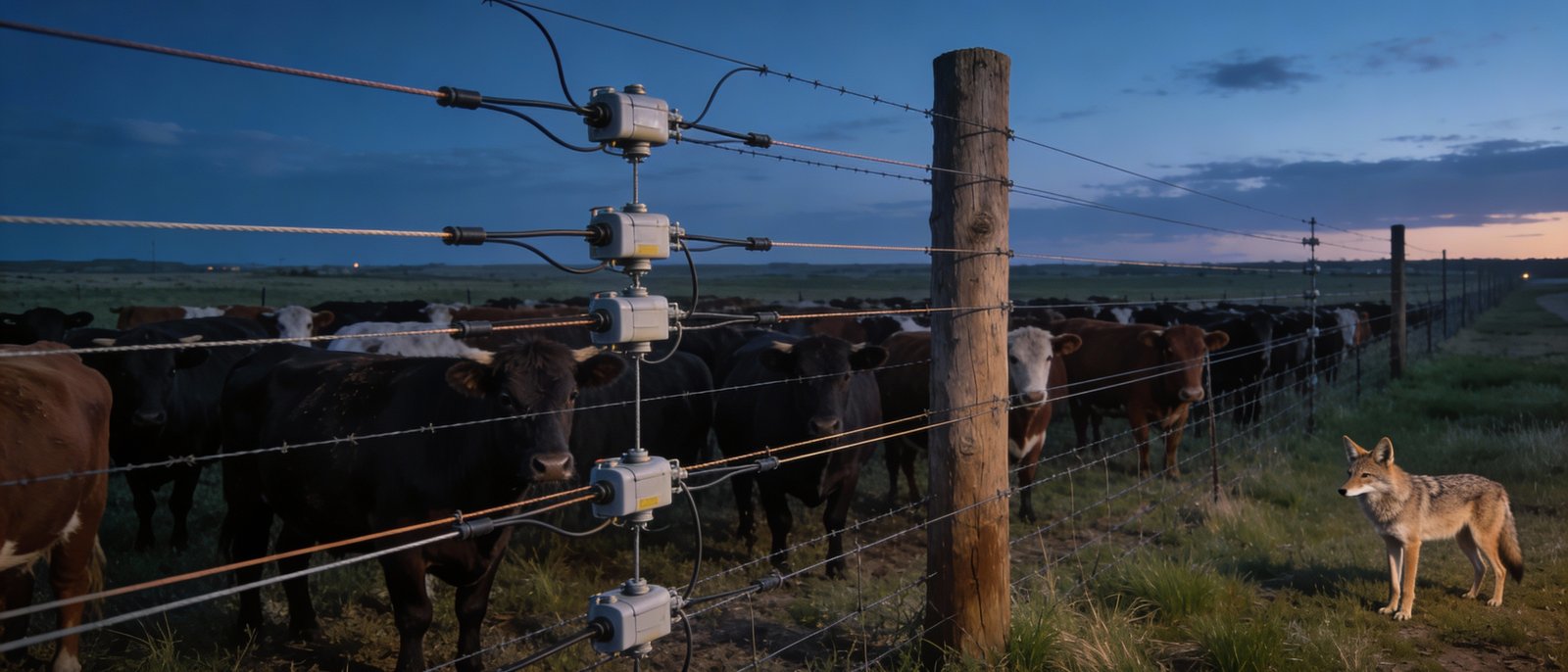
Structural Requirements for Predator-Resistant Fencing
Engineering effective predator-resistant fencing demands precise attention to three-dimensional threat vectors that predators exploit to breach containment barriers. Structural specifications must simultaneously address climbing attempts from above, digging intrusions from below, and direct force applications against fence planes. Research-validated design parameters provide quantifiable benchmarks for height, ground protection, and material selection that correlate with documented predation reduction outcomes.
Fence Height and Anti-Climb Design
Minimum fence height specifications for predator-resistant cattle systems require 60 inches of vertical barrier to deter climbing and jumping by coyotes, with 72-inch heights recommended for areas experiencing high wolf activity or confirmed mountain lion presence. Height requirements derive from predator behavioral research documenting that coyotes routinely clear 48-inch barriers but encounter significant difficulty with fences exceeding 60 inches. The 60 to 72-inch specification range provides safety margins accounting for terrain variations where predators gain elevation advantages approaching fence lines from upslope positions.
Anti-climb design elements focus on preventing predators from gaining sufficient purchase to scale vertical barriers. Woven wire mesh with aperture sizes limited to 4 inches by 6 inches prevents predators from inserting paws or claws to establish climbing grips. Fixed-knot construction in woven wire systems eliminates the hinge-joint flexibility that predators exploit by applying pressure at specific wire intersection points. Top wire configurations incorporating outward-facing angles or electric offset wires create psychological deterrents by preventing predators from establishing secure positioning for final fence clearance.
Electric wire placement at two-thirds shoulder height specifically targets predator nose contact zones where sensory nerve density maximizes shock perception. For coyote deterrence, this specification translates to 26 to 36-inch wire heights, while wolf-focused systems position wires at 36 to 46-inch elevations. Multiple wire strands at graduated heights ensure predators cannot pass between wires without contact, with seven-wire configurations providing baseline protection and nine to eleven-wire systems deployed in high-risk zones. Research emphasizes that alternating hot and ground wires in hot-ground fence systems delivers more consistent shock delivery across varying soil moisture conditions compared to all-hot designs that rely on ground rod effectiveness.
Ground-Level Protection and Dig Prevention
Ground-level protection represents the critical vulnerability point in predator-resistant fencing systems, as digging behavior allows predators to circumvent above-ground barrier height specifications entirely. Effective dig prevention requires the bottom electrified wire positioned no more than six inches from ground level to deliver shock contact as predators initiate excavation attempts. This tight ground clearance specification challenges installation in uneven terrain but proves essential for deterring coyotes and wolves that systematically test fence bottoms for digging opportunities.
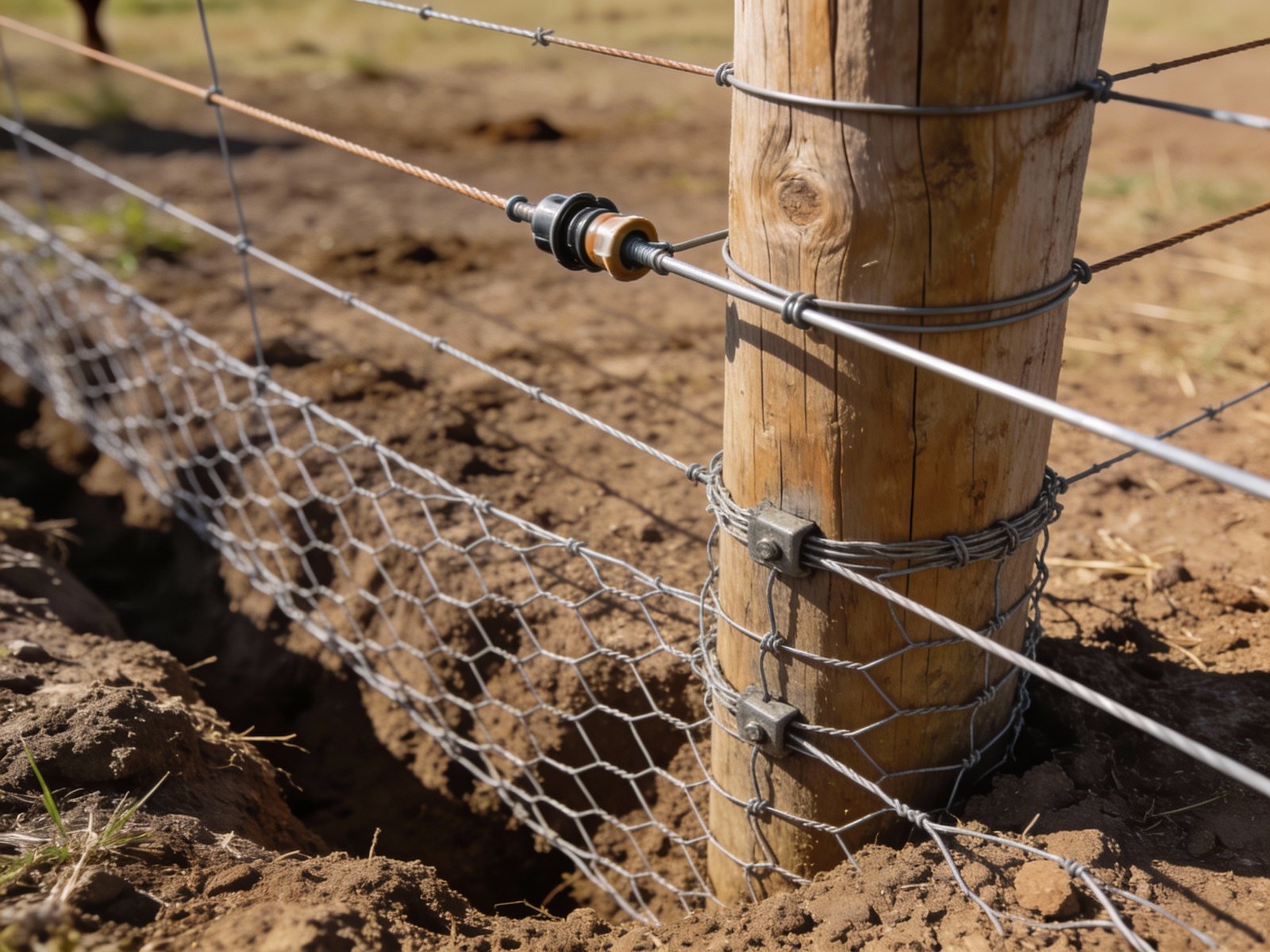
Buried apron systems extend wire mesh horizontally 12 to 18 inches outward from fence base positions at depths of 6 to 12 inches below surface grade. The L-shaped configuration intercepts predator digging trajectories as animals excavate downward and inward toward fence lines. When predators encounter buried mesh during digging, the unexpected resistance typically triggers abandonment of breach attempts. Wire mesh specifications for buried aprons require 2-inch by 3-inch or smaller apertures using 14-gauge galvanized wire with PVC coating to resist corrosion in soil environments. Installation labor for trenching and apron placement adds substantial cost to fence construction but delivers near-absolute protection against digging intrusions.
Alternative ground protection strategies deploy surface-laid aprons staked flat against soil immediately outside fence perimeters. This installation approach reduces labor requirements compared to buried systems while achieving similar functional outcomes—predators approaching fence lines walk onto mesh aprons and receive tactile warning signals that discourage continued advance. Surface aprons require 12 to 18-inch extension dimensions and benefit from partial soil coverage or vegetation growth through mesh to improve visual integration. Combination systems incorporate both buried barriers and electrified trip wires positioned 6 to 8 inches outside primary fence lines at 6-inch heights, creating layered deterrence that addresses multiple predator approach strategies simultaneously.
Visibility and Psychological Deterrence
Fence visibility functions as a psychological deterrent by eliminating the element of surprise that predators exploit during approach and fence testing behaviors. High-visibility materials including white or colored polytape, flagging attached to wire strands at regular intervals, and reflective markers mounted on top wires enable predators to assess fence presence from distances exceeding 50 yards. This visual detection range triggers natural caution responses that cause predators to reduce approach speeds, conduct extended fence reconnaissance, and ultimately divert to alternative travel routes rather than commit to breach attempts.
Electric shock delivery provides the most powerful psychological deterrent effect in predator-resistant fencing when properly implemented. Predators that receive initial shocks delivering 5,000 volts or higher develop strong avoidance conditioning that persists across subsequent encounters even when fence power temporarily fails. Low-impedance fence energizers maintaining 4,000 to 5,000-volt output throughout extended fence runs prove essential for overcoming predator fur insulation and delivering physiologically memorable shocks. Voltage testing at multiple points along fence perimeters confirms system effectiveness, with measurements below 3,000 volts indicating inadequate deterrence that predators may challenge through repeated testing.
Behavioral conditioning through baiting strategies enhances psychological deterrence by ensuring predators experience fence shocks during their initial encounters rather than discovering unpowered fence sections first. Placing attractive bait materials near fence lines attracts predators to contact electrified wires under controlled circumstances, establishing avoidance learning before predators develop fence-testing persistence. This proactive conditioning proves particularly valuable when introducing new fence installations or upgrading existing non-electric fences with electric components, as it prevents predators from retaining learned behaviors based on previous fence interactions where no deterrent consequences existed.
Best Fence Types for Predator Control
Selecting optimal fence configurations for predator control requires matching system characteristics to specific threat profiles, terrain conditions, and operational management approaches. No single fence type delivers universal effectiveness across all predator species and ranch environments. Instead, successful predator-resistant fencing strategies deploy targeted system selections in zones classified by vulnerability levels, with highest-specification barriers protecting critical areas and cost-efficient perimeter solutions establishing baseline containment.
High-Tensile Electric Fencing Systems
High-tensile electric fencing represents the most cost-effective predator control solution for large perimeter applications, delivering behavioral deterrence through psychological conditioning rather than absolute physical barriers. These systems employ 12.5-gauge high-tensile wire with minimum 170,000 PSI tensile strength and Class III galvanization or aluminum coating for extended corrosion resistance. Wire tension maintained at 200 to 250 pounds prevents sagging while allowing absorption of impact forces without permanent deformation. Seven-wire configurations with 6 to 8-inch vertical spacing provide baseline predator deterrence for moderate-risk areas, while nine to eleven-wire systems deployed at 60 to 72-inch total heights address high-risk zones with confirmed wolf or bear activity.
Electric fence effectiveness depends critically on energizer specifications and grounding system design. Low-impedance energizers delivering minimum 0.5 joules per acre of enclosed area maintain adequate voltage under vegetative load conditions that would drain conventional energizers. For predator control applications, energizer output must sustain 4,000 to 5,000 volts at fence terminals farthest from power sources, requiring joule ratings substantially exceeding livestock containment minimums. Hot-ground wire configurations alternating charged and grounded strands overcome poor soil conductivity by providing direct electron return paths rather than relying on ground rod effectiveness alone. This design proves essential for year-round predator protection in regions experiencing frozen ground conditions or drought periods when soil moisture drops below thresholds supporting adequate grounding.
Installation specifications for high-tensile predator fencing include corner post assemblies capable of withstanding 1,500 to 2,000 pounds of cumulative wire tension without displacement. Three-post H-brace systems or concrete-reinforced corner posts deliver required stability for perimeter fences exceeding one mile in length. Line posts spaced 40 to 60 feet apart support wire runs between corner bracing, with closer 30-foot spacing deployed in rolling terrain where topographic variations create wire suspension challenges. Bottom wire placement at 6-inch heights demands careful attention to ground contours, occasionally requiring localized grade modifications to maintain clearance specifications without creating crawl-under gaps.
Woven Wire with Electric Offsets
Woven wire fencing reinforced with electric offset wires provides dual-layer protection combining physical barriers with behavioral deterrence. The woven wire component establishes absolute containment preventing livestock passage while blocking predator access through fence planes. Electric offset wires mounted 6 to 10 inches outward from woven wire surfaces deliver shock contact before predators establish physical contact with primary barriers, protecting woven wire integrity from climbing attempts and aggressive testing. This hybrid approach proves particularly effective for operations managing mixed livestock including cattle, sheep, and goats where predation risks justify enhanced protection investments.
Fixed-knot woven wire specifications for predator-resistant applications require 12.5-gauge high-tensile horizontal wires with vertical stay spacing limited to 6 inches in bottom fence sections where small predators attempt penetration. Aperture dimensions transitioning from 6-inch bottom spacing to 12-inch spacing at heights exceeding 24 inches optimize material costs while maintaining predator exclusion effectiveness. Minimum fence height specifications of 48 inches for woven wire components allow addition of one or two electric wires above mesh tops, bringing total barrier heights to 60 to 72 inches in high-risk installations. The woven wire base provides structural integrity supporting electric wire positioning while preventing livestock from applying pressure against hot wires that could cause shorts or energizer drain.
Electric offset installation utilizes bracket systems attaching to existing fence posts or woven wire fabric, positioning charged wires at predator nose-height specifications of 8 to 15 inches above ground level. This placement zone intersects climbing attempt trajectories before predators gain sufficient elevation to clear mesh tops. Bottom offset wires positioned 6 to 8 inches above ground and 8 inches outward from fence bases function as trip wires deterring digging attempts. Dual offset configurations mounting wires on both exterior and interior fence faces provide bidirectional protection valuable in areas where predators may become trapped inside pastures after initial breaches, preventing fence damage during escape attempts. The structural investment in woven wire foundations justifies offset additions delivering 20-plus-year system longevity compared to all-electric alternatives requiring more frequent maintenance interventions.
Pipe and Panel in High-Risk Zones
Pipe and panel fencing systems deliver maximum structural strength for high-risk zones including calving grounds, night pen areas, and livestock handling facilities where predator attraction intensifies and vulnerability peaks. These heavy-duty barriers employ continuous rail designs using 1.5 to 2-inch schedule 40 steel pipe welded or bolted to posts spaced 8 to 10 feet apart. Rail configurations typically include 4 to 6 horizontal members spanning from 6-inch bottom clearances to 60-inch top heights, creating visual barriers with sufficient rail spacing preventing livestock head entrapment while blocking predator passage.
The structural advantage of pipe and panel systems manifests in their resistance to force applications that compromise wire-based barriers. Bears pushing against pipe rails encounter rigid resistance rather than flexible displacement, typically abandoning breach attempts after initial testing confirms barrier solidity. Pipe surfaces provide minimal climbing purchase compared to wire mesh, forcing predators attempting fence scaling to rely entirely on jumping capabilities rather than combined climb-jump techniques. However, the bottom clearance zone between ground level and first rails requires supplementary protection using either woven wire infill or electric trip wires positioned at 6-inch heights to prevent predators from crawling under rail systems.
Corral panel configurations using welded wire mesh within pipe frames combine the strength advantages of tubular steel construction with complete aperture closure preventing any predator penetration. These panels excel in portable applications where temporary predator protection accompanies seasonal calving operations or rotational night penning strategies. Standard 50-inch by 8-foot panel dimensions facilitate rapid deployment using slip-over panel brackets or chain connectors, enabling ranchers to establish reinforced protection zones responding to dynamic predation pressure patterns. Initial capital costs for pipe and panel systems substantially exceed wire fence alternatives, typically ranging from 8 to 15 dollars per linear foot compared to 3 to 5 dollars for high-tensile electric installations, but the infrastructure investment delivers value in critical-protection applications where livestock loss prevention justifies premium containment specifications.
Climate and Environmental Factors
Environmental conditions exert profound influence on predator-resistant fencing effectiveness, with climate patterns, seasonal transitions, and terrain characteristics determining which system configurations deliver reliable year-round protection. Fence designs optimized for temperate summer conditions may fail completely during winter freeze cycles or spring vegetation surges, requiring ranchers to anticipate seasonal challenges through strategic system selection and proactive maintenance scheduling.
Forested and Mountain Regions
Forested terrain and mountainous topography create installation challenges that elevate both construction costs and ongoing maintenance requirements for predator-resistant fencing. Steep slopes complicate post installation as standard mechanical augers struggle to penetrate rocky soils at angles required to maintain vertical post positioning. Hand digging or hydraulic rock drilling becomes necessary at intervals determined by subsurface geology, substantially increasing labor inputs and project timelines. Terrain undulation forces fence lines to follow natural contours, creating localized high and low points where wire clearances deviate from specification targets unless grade modifications smooth elevation transitions.
Tree fall represents the primary maintenance challenge in forested fence installations, with falling timber capable of destroying substantial fence sections during single storm events. Strategic corridor clearing extending minimum 30 feet on both sides of fence lines reduces but does not eliminate tree damage risk, as windthrow events during severe weather topple trees beyond corridor boundaries. Dead standing timber assessment and removal prior to fence installation prevents predictable failures, though ongoing forest succession continually generates new hazard trees requiring monitoring. Snow loading in mountain forests adds supplementary stress to fence structures, with accumulated snow weight on wire spans potentially exceeding design load capacities and causing post deflection or wire breakage.
Wildlife pressure beyond target predator species complicates fence management in mountain and forest environments. Elk, moose, and deer populations routinely contact or cross cattle fences during migration movements, with large ungulate collisions capable of damaging wire tension, breaking insulators, or displacing posts. Balancing predator exclusion requirements against wildlife passage needs generates design tensions, as specifications preventing predator penetration often impede wildlife movement. Some jurisdictions mandate wildlife-friendly fence modifications on public land grazing allotments, limiting design options available for predator control and potentially creating regulatory conflicts between livestock protection and wildlife conservation objectives.
Open Rangeland and Prairie Areas
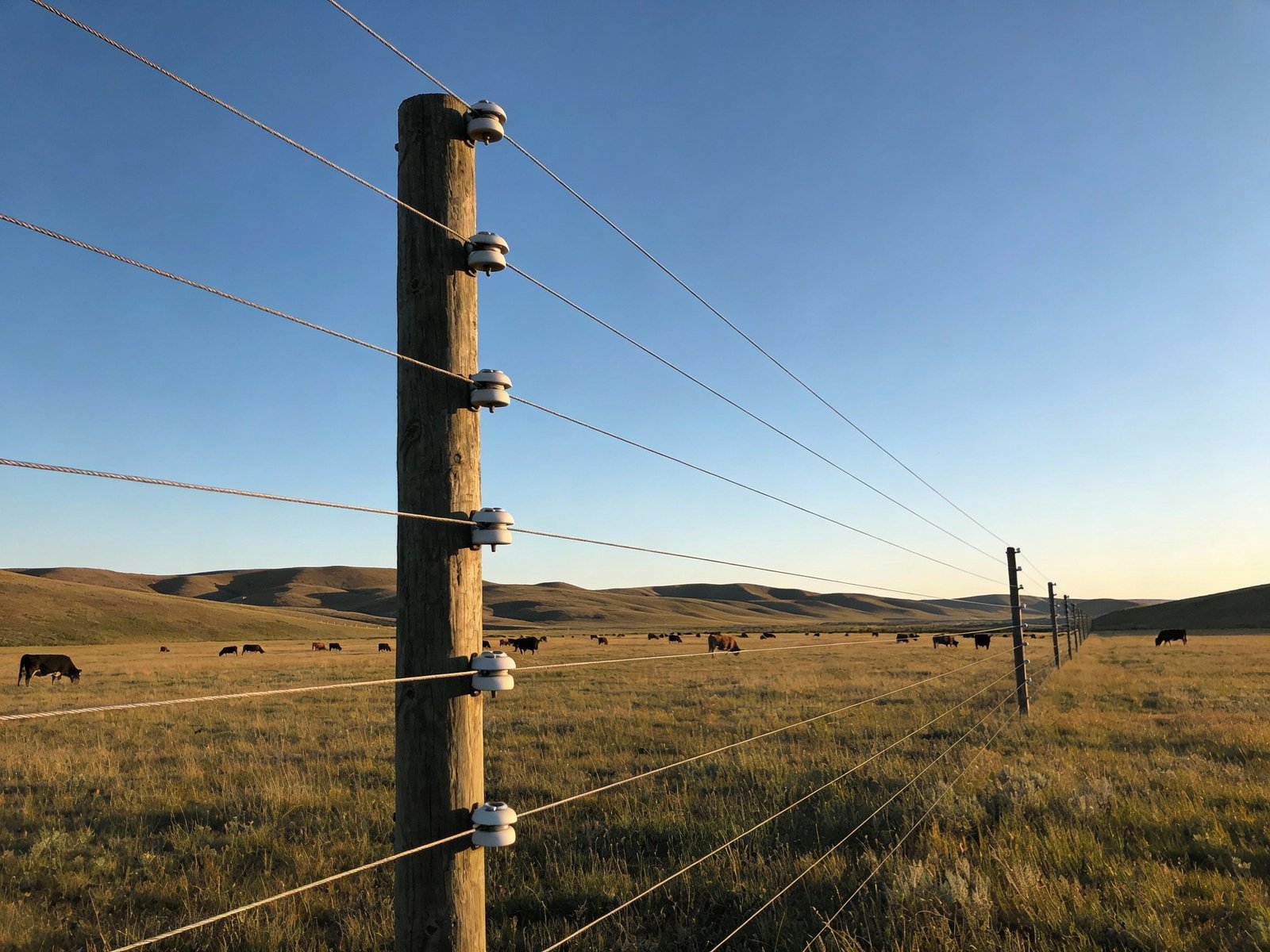
Open rangeland environments subject fencing systems to continuous wind exposure that accelerates structural degradation through vibration fatigue and mechanical wear. High-tensile wire systems prove particularly vulnerable to wind effects as sustained oscillation gradually loosens staple attachments, erodes insulator materials, and fatigues wire strands at connection points. Guy wire reinforcement on corner assemblies and intermediate anchor points becomes essential in high-wind zones, with additional bracing installed at intervals determined by prevailing wind intensity data. Post selection favors steel T-posts over wooden alternatives in prairie applications, as steel’s superior wind resistance and rot immunity deliver longer service life despite higher initial material costs.
Vegetation management constitutes the dominant ongoing maintenance requirement for electric predator fences in grassland and prairie environments. Spring vegetation growth rapidly creates grounding pathways as plant material contacts electrified wires, draining energizer output and reducing fence voltage below effective deterrence thresholds. Weekly vegetation monitoring during peak growth periods identifies problem sections requiring trimming before voltage losses compromise system effectiveness. Chemical vegetation control using selective herbicides applied in narrow bands beneath fence lines reduces manual trimming requirements but introduces environmental and regulatory considerations that vary by jurisdiction and proximity to water resources.
Lightning strike frequency in open rangeland areas exceeds forested environment rates due to isolated fence line prominence in otherwise flat terrain profiles. Direct lightning strikes to fence wires propagate voltage surges through electric fence systems, commonly destroying energizers, insulators, and ground rod connections unless lightning arrestor protection devices intercept energy before reaching control equipment. Installing grounded wire strands on fence tops provides alternative lightning paths directing energy to earth rather than through energizer circuits. Ranchers operating extensive prairie fence systems budget for annual lightning damage repairs including energizer replacement and systematic post-strike insulator inspection identifying failed components requiring replacement before fence functionality becomes compromised.
Snow, Frozen Ground, and Seasonal Migration
Winter conditions fundamentally alter electric fence performance through mechanisms that simultaneously degrade grounding effectiveness and create physical barriers reducing voltage delivery. Frozen ground increases soil electrical resistance by orders of magnitude compared to moist soil conditions, severely compromising ground rod function in all-hot fence systems where shock completion requires effective earth return paths. Snow accumulation burying bottom fence wires creates insulating barriers preventing predator contact with electrified strands, effectively eliminating deterrence at the critical ground-level zone where digging attempts occur. Research documentation confirms that snow and frozen ground conditions can reduce electric fence effectiveness to negligible levels, necessitating alternative protection strategies during winter months in northern climate zones.
Hot-ground fence configurations partially overcome frozen ground challenges by providing dedicated ground wires adjacent to hot strands, eliminating dependence on soil conductivity for shock completion. However, snow burial issues persist regardless of grounding system design, as accumulated snow depth exceeding 12 inches can insulate multiple wire strands from predator contact. Some operations deploy winter fence modifications including temporary wire height adjustments or supplementary electric netting positioned above anticipated snow depths. These adaptive management approaches require seasonal fence alterations that add labor costs but maintain predator deterrence during high-risk calving periods occurring in late winter and early spring when snow remains present but predator activity intensifies.
Seasonal cattle migration between summer range and winter feeding areas complicates predator protection planning when migration routes traverse public lands or require temporary containment at intermediate holding locations. Portable electric netting systems provide mobile predator deterrence accompanying cattle movements, with solar-powered energizers enabling fence functionality in remote areas lacking grid power access. These temporary installations protect vulnerable cattle during overnight stops while avoiding permanent fence infrastructure investments on non-owned lands. However, frozen ground conditions prevent proper insertion of temporary posts used with netting systems, limiting deployment windows to periods when soil frost depths remain less than 6 inches and posts can achieve adequate anchoring depth.
Cost vs Risk: Is Predator-Resistant Fencing Worth It?
Investment decisions surrounding predator-resistant fencing require quantitative analysis comparing fence installation and maintenance costs against expected livestock loss reductions and associated economic impacts. While upfront capital requirements for enhanced predator protection systems substantially exceed basic containment fencing costs, the return on investment calculation must incorporate direct predation losses, veterinary expenses for injured animals, stress-induced production reductions, and labor costs associated with increased surveillance and predator response activities.
Fence Cost vs Livestock Loss Risk
High-tensile electric fencing systems designed for predator deterrence cost approximately 3 to 5 dollars per linear foot installed, translating to 15,840 to 26,400 dollars per mile of perimeter fence. Enhanced specifications including increased wire counts, buried apron systems, and reinforced bracing elevate costs toward the upper range boundary. Woven wire installations with electric offsets range from 5 to 8 dollars per linear foot, or 26,400 to 42,240 dollars per mile, reflecting the increased material and labor requirements for mesh installation and tensioning. Pipe and panel systems deployed in critical protection zones exceed 8 to 15 dollars per linear foot, justifying their application only in confined high-risk areas where livestock concentration and vulnerability demand maximum protection.
Direct predation losses vary dramatically by region, predator population density, and cattle management practices. Ranches in confirmed wolf territory report calf predation rates ranging from 2 to 8 percent annually in unprotected herds, with individual calf values between 800 and 1,200 dollars generating losses of 16,000 to 96,000 dollars per 100-cow operation. Coyote predation on calf crops typically ranges from 1 to 5 percent depending on denning proximity and alternative prey availability, with losses concentrated during the 30 to 60-day post-calving window when calves remain most vulnerable. These direct loss calculations underestimate total economic impact, as injured cattle requiring veterinary intervention, animals exhibiting reduced weight gains due to predator-induced stress, and operational disruptions from predation events generate additional costs that studies estimate at 40 to 60 percent beyond direct mortality values.
Research evaluating electric fence cost-effectiveness for predator control documents that fencing investments achieve break-even points within 4 to 9 years for operations experiencing moderate predation pressure, with higher predation rates reducing payback periods proportionally. A 90 percent reduction in predation losses translates to annual savings of 14,400 to 86,400 dollars for the 100-cow operation examples cited above, easily justifying fence investments of 50,000 to 100,000 dollars when amortized across expected 20 to 30-year fence service lives. However, break-even analysis becomes less favorable for operations experiencing minimal baseline predation, as fence costs may exceed cumulative losses over system lifespans when annual predation rates remain below 1 percent.
When Reinforced Systems Pay for Themselves
Reinforced predator fencing systems demonstrate clearest economic justification in operations characterized by multiple reinforcing factors that elevate both predation risk and loss consequences. Ranches located within 5 miles of documented predator den sites or pack territories experience predation rates 3 to 5 times higher than regional averages, creating loss scenarios where fence investments achieve payback within 2 to 4 years. Specialty cattle operations producing registered breeding stock or finishing high-value animals face disproportionate economic impacts from predation events, as individual animal values ranging from 2,000 to 10,000 dollars transform single predation incidents into major financial setbacks that conventional per-head loss calculations underestimate.
Calving operations concentrating births in confined areas during defined seasonal windows represent optimal applications for reinforced predator fencing investments. The combination of predictable vulnerability timing, livestock concentration enabling focused protection deployment, and high calf values during the critical first 60 days post-birth creates conditions where comprehensive predator exclusion delivers maximum return on investment. Night penning strategies utilizing portable pipe and panel systems or permanent reinforced corrals protected by buried apron systems and electric offsets reduce predation risk to near-zero levels during overnight hours when 70 to 80 percent of predation attempts occur. Research from Tanzania examining chain-link corral effectiveness documented complete elimination of nighttime livestock losses in fortified enclosures while simultaneously reducing predation pressure on neighboring unfenced operations, demonstrating beneficial spillover effects extending protection value beyond direct users.
Operations managing sensitive livestock categories including first-calf heifers, recently purchased replacement females, or cattle recovering from health challenges justify enhanced predator protection investments due to elevated animal values and increased vulnerability compared to mature, healthy breeding stock. These high-risk subgroups benefit from segregated management in smaller paddocks where perimeter fence lengths remain manageable and reinforced system costs distribute across fewer animals but higher per-head values. Time-limited applications of temporary predator fencing protecting vulnerable livestock during critical risk windows offer intermediate solutions balancing protection needs against infrastructure costs, with portable electric netting or temporary high-tensile systems deployed for 60 to 90-day periods then relocated or stored for reuse in subsequent production cycles.
Integrating Predator Control into Ranch Fence Systems
Effective predator-resistant fencing integrates into comprehensive ranch fence systems through strategic deployment matching fence specifications to zone-specific risk levels and operational requirements. Rather than implementing uniform high-specification fencing across entire properties, successful approaches concentrate enhanced protection in critical areas while deploying cost-efficient baseline systems for lower-risk perimeter sections. This tiered strategy optimizes return on investment by allocating resources proportional to threat intensity and livestock vulnerability patterns.
Hybrid Predator + Cattle Fence Layouts
Hybrid fence layouts combine multiple fence types within unified ranch systems, with each fence category addressing distinct functional requirements. Permanent perimeter fencing establishes primary property boundaries and external containment using high-tensile electric systems optimized for cost-effectiveness across extensive linear distances. These perimeter installations typically employ seven-wire configurations at 54-inch heights providing adequate deterrence for moderate predation pressure while maintaining wildlife passage compatibility required on many public land grazing allotments. Interior subdivision fencing utilizes simpler three to five-wire designs focused on livestock rotation management rather than predator exclusion, as perimeter barriers intercept predator approaches before interior zones become threatened.
Critical protection zones within ranch properties receive reinforced fencing specifications incorporating woven wire with electric offsets or pipe and panel systems when predation risk justifies enhanced investment. Calving grounds, night pen areas, and livestock handling facilities concentrate vulnerable animals in confined spaces where predator attraction peaks and protection requirements exceed perimeter fence capabilities. These reinforced zones typically encompass 5 to 15 percent of total ranch acreage but account for 60 to 80 percent of predation risk, making focused infrastructure investment economically rational compared to property-wide premium fencing deployment.
Transition zones connecting permanent perimeter fences with temporary interior divisions require careful design attention to prevent predator exploitation of system discontinuities. Gates, water gaps, and fence terminus points represent structural vulnerabilities where fence effectiveness degrades unless specific reinforcement measures address these weak points. Electric fence controllers positioned centrally within ranch layouts enable single energizers to power both perimeter and interior fences through properly designed branch circuits, reducing equipment costs while maintaining voltage adequacy across extended fence networks. Voltage monitoring at multiple test points confirms energy distribution achieves deterrence thresholds throughout integrated systems.
Combining Permanent and Temporary Electric Systems
Temporary electric fence systems complement permanent installations by providing flexible predator protection adapting to seasonal risk variations and dynamic livestock management strategies. Rotational grazing programs dividing permanent pastures into smaller paddocks utilize temporary polywire or polytape fences for livestock control, with these subdivision barriers offering minimal predator deterrence in standalone applications. However, when deployed within permanent perimeter fences providing baseline predator exclusion, temporary interior divisions function effectively without requiring reinforced specifications or maintenance intensity necessary in exposed positions.
Seasonal predator pressure fluctuations align poorly with permanent fence capabilities remaining constant year-round. Calving seasons, wildlife prey scarcity periods, and predator denning activities create temporal risk concentration demanding enhanced protection during specific months while other periods experience minimal threat. Portable electric netting systems enable ranchers to supplement permanent fencing during high-risk windows, deploying additional barriers around calving grounds or night pen areas for 60 to 90-day intervals then removing infrastructure during lower-risk periods. This adaptive approach reduces annual fencing costs compared to maintaining year-round reinforced systems while delivering protection when vulnerability peaks.
Solar-powered fence energizers eliminate grid power dependence for temporary systems, enabling predator protection deployment in remote pastures lacking electrical infrastructure. Modern solar energizer technology delivers adequate joule output for temporary fence configurations spanning several acres, with integrated battery storage maintaining fence functionality during multi-day overcast periods. The mobility enabled by solar power allows ranchers to relocate temporary predator protection systems following livestock movements during seasonal range transitions or adaptive grazing rotations responding to forage availability patterns. These mobile protection strategies prove particularly valuable for operations grazing public lands where permanent fence installation faces regulatory restrictions but temporary systems receive approval for seasonal deployment addressing documented predator conflicts.
Related Cattle Fencing Resources
Producers seeking to implement predator-resistant fencing systems benefit from understanding how these specialized barriers relate to broader cattle fencing categories and design principles. Comprehensive ranch fencing strategies integrate predator control objectives with livestock containment, pasture management, and operational efficiency requirements through informed selection among available fencing technologies.