Cattle Fence Installation Cost & Labor Calculator 2026

Indicative ranges, not a quote. All cost figures on this page are typical 2026 industry ranges for budgeting only. Actual cost varies with region, terrain, wire gauge, post spacing and labour rates — always confirm your number with a supplier quote before you commit.
Key Takeaways
  • Professional woven wire cattle fence installation runs about $2–4 per linear foot for basic jobs and $7–20 per linear foot for complex terrain with gates.
  • Labor and materials each account for roughly 40–60% of total project cost, with equipment and permits adding 5–10%.
  • Terrain, gates, and regional rates can raise costs by 20–100%; off-season scheduling can cut labor by 15–25%.
  • A typical 1-acre project (about 836 linear feet) costs roughly $1,545–2,831 professionally installed.
  • DIY can save $300–1,200 upfront but requires 30–60 labor hours and a learning curve.
Cattle Fence Installation Cost & Labor Calculator 2026

Understanding the true cost of cattle fence installation requires breaking down materials, labor, equipment, and regional factors. Our 2026 cost calculator provides accurate pricing based on current market data for professional installations across different project sizes and complexities.

Quick Overview: Professional woven wire cattle fence installation ranges from $2–4 per linear foot for basic installations to $7–20 per linear foot for complex terrain with gates and premium materials. Labor typically comprises 40–60% of total project costs. Cattle fence installation cost and labor calculator infographic Use our interactive cost calculator to estimate your cattle fence installation project budget for 2026
Woven Wire Cattle Fence: 2026 Pricing Breakdown

Cost Per Linear Foot Overview

Installation Level Cost Range (Per Linear Foot) Annual Acres Cost per Mile (5,280 ft) Typical Terrain
Basic DIY Materials $0.75–1.50 Small (under 5) $3,960–7,920 Flat, clear pasture
Standard Professional Installation $2.00–4.00 Medium (5–10) $10,560–21,120 Flat to moderate slopes
Premium/Complex Installation $7.00–20.00 Large (20+) $36,960–105,600 Rocky soil, slopes, gates

Cost Breakdown by Project Size (2026)

Total Project Costs for Common Acreage

Acreage Linear Feet to Fence Budget Range (Basic) Budget Range (Standard) Budget Range (Premium)
¼ Acre ~200 feet $150–300 $400–800 $1,400–4,000
½ Acre ~400 feet $300–600 $800–1,600 $2,800–8,000
1 Acre ~836 feet $630–1,260 $1,672–3,344 $5,850–16,720
2 Acres ~1,672 feet $1,260–2,508 $3,344–6,688 $11,704–33,440
5 Acres ~4,180 feet $3,135–6,270 $8,360–16,720 $29,260–83,600
1 Mile (5,280 feet) 5,280 feet $3,960–7,920 $10,560–21,120 $36,960–105,600

Material Cost vs. Labor Cost Analysis

Where Your Money Goes: Cost Component Breakdown
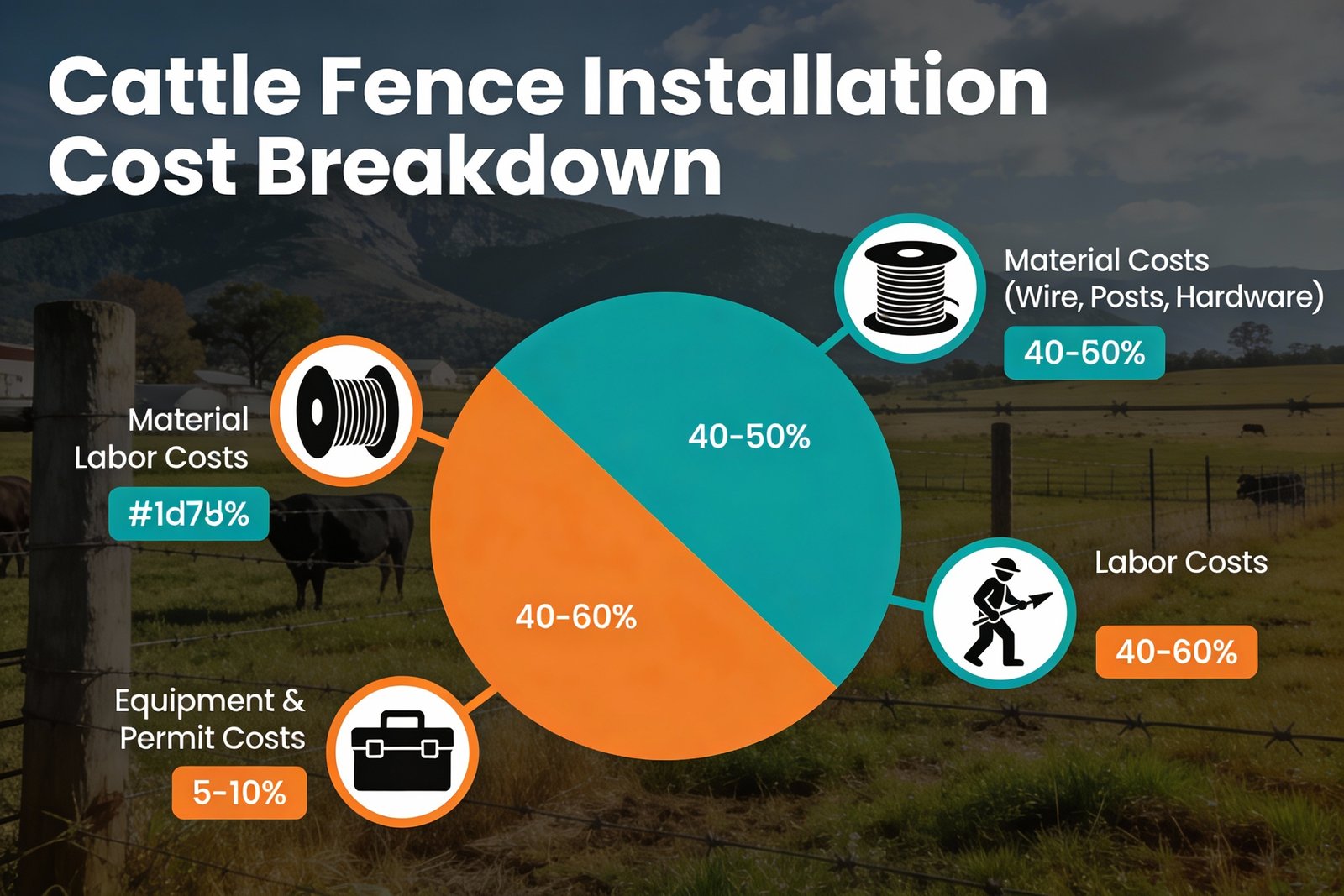
Cost breakdown for cattle fence installation Breakdown showing how materials, labor, and equipment contribute to total fence installation costs

💰 Material Costs

Percentage of Total: 40–60%

  • Woven wire fence: $0.50–1.00/ft
  • Wooden posts (4×4): $3–8 each
  • Hardware (staples, clips): $0.20–0.40/ft
  • Wire reel & tools: $200–500
  • Gates: $300–800 each

👷 Labor Costs

Percentage of Total: 40–60%

  • Site preparation: $300–500
  • Post installation: $0.75–1.50/ft
  • Wire stretching: $0.50–1.00/ft
  • Gate installation: $200–500/gate
  • Final inspection: Included in labor

⚙️ Equipment & Permits

Percentage of Total: 5–10%

  • Building permits: $100–300
  • Utility location: Usually free
  • Equipment rental: $50–150/day
  • Travel/mobilization: $100–300
  • Site restoration: Included in labor

Factors That Increase Installation Costs

Hidden Cost Multipliers (2026)
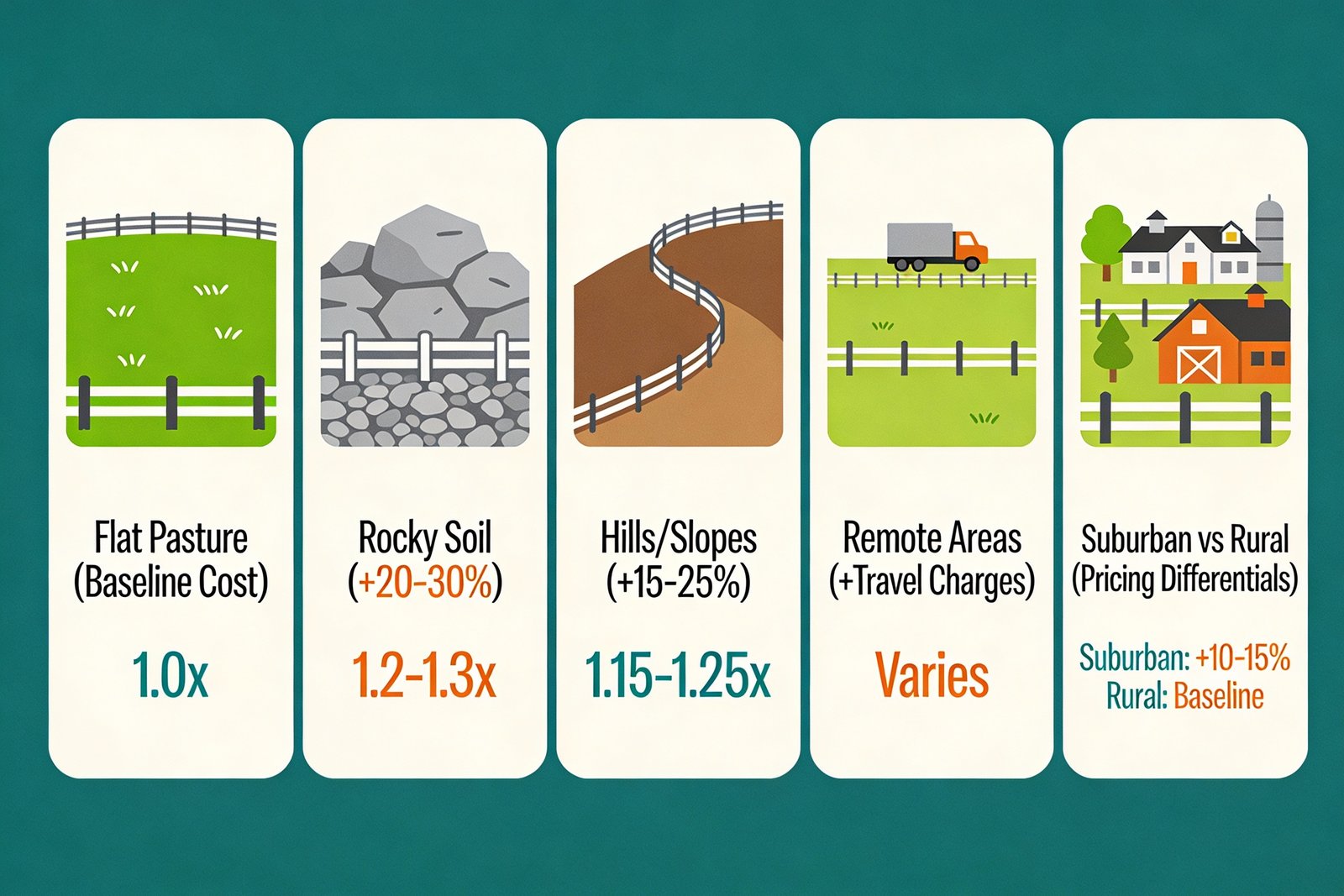
Terrain and regional cost impact on cattle fence installation Visual guide showing how terrain type, location, and regional factors multiply installation costs

⛰️ Terrain Complexity

Cost Impact: +20–50%

  • Steep slopes: +15–25%
  • Rocky soil: +20–50%
  • Heavy tree roots: +15–25%
  • Wet/boggy ground: +25–50%

🚪 Special Features

Cost Impact: +15–25% per feature

  • Single gate: +$200–500
  • Double gate: +$400–800
  • Water gaps: +$150–300 each
  • Corner bracing: +$100–200 per corner

🌍 Regional Labor Rates

Cost Impact: +10–30% by location

  • Rural areas: Baseline rates
  • Suburban areas: +15–25%
  • High-demand seasons: +20–30%
  • Remote properties: +Travel charges

⏱️ Project Timeline

Cost Impact: +0–25% variance

  • Off-season work: -10–20%
  • Peak season: +15–25%
  • Rush projects: +25–50%
  • Long-lead materials: Standard rates

🏗️ Site Preparation

Cost Impact: +10–30%

  • Vegetation clearing: +$500–1,500
  • Utility location service: Free
  • Grade/level work: +$300–800
  • Existing fence removal: +$0.50–1.50/ft

📦 Material Availability

Cost Impact: ±5–15%

  • Local supply: Standard pricing
  • Special orders: +5–10%
  • Premium materials: +10–15%
  • Bulk discounts: -10–20%

DIY vs. Professional Installation Cost Comparison

Complete Cost Analysis for 1-Acre Project (836 Linear Feet)

DIY Installation Costs

Woven wire fence (0.75/ft) $627 Wooden posts 4×4 (approx. 20 posts @ $6 ea) $120 Hardware, staples, clips (0.25/ft) $209 Basic hand tools (if needed) $200–500 Tool rental (auger/stretcher, 2 days) $100–200 Total Material & Equipment $1,256–1,656

Time Investment: 30–60 labor hours over 1–2 weeks (learning curve included) | Cost per linear foot: $1.50–1.98/ft

Professional Installation Costs

Woven wire fence (standard grade) $418–627 Posts & hardware $300–450 Labor (site prep, post holes, installation) $627–1,254 Equipment & permits $100–300 Project management & overhead $100–200 Total Project Cost $1,545–2,831

Time Investment: 2–4 working days (professional crew) | Cost per linear foot: $1.85–3.39/ft | Warranty: Typically 1–5 years

Financial Analysis: While DIY saves $300–1,200 upfront, professional installation offers: (1) 30–50% faster completion, (2) Warranty protection, (3) Proper permits & inspections, (4) Better long-term structural integrity, (5) Access to contractor material discounts. Break-even point for hiring professionals: Projects exceeding 1,500 linear feet where DIY time value exceeds $15–30/hour.

Regional Labor Rate Variations (2026)

Professional Installation Rates by Region

Region Labor Rate (Per Ft) Total Project Cost (1 Acre) Market Demand Seasonal Variation
Rural Agricultural Areas $1.00–2.00 $1,200–2,000 Moderate Low (year-round work)
Suburban/Small Towns $2.00–4.00 $1,800–3,500 High +15–25% spring/fall
Metropolitan Areas $3.50–8.00 $3,500–7,200 Very High +20–30% peak season
Mountain/Desert Regions $2.50–5.00 $2,500–4,800 Moderate +25–35% weather dependent

Money-Saving Strategies

Reduce Your Project Costs by 20–40%

🛒

Bulk Material Purchasing

Savings: 15–25%

  • Order full year supply if possible
  • Group purchases with neighbors
  • Direct mill purchases bypass retailers
  • Off-season ordering (fall/winter)
📅

Timing Your Project

Savings: 10–15%

  • Winter months (Nov–Feb): -15–25%
  • Avoid spring peak season: +20–30%
  • Multi-day projects get better rates
  • Off-week scheduling can save 10%
🤝

Hybrid DIY Approach

Savings: 30–45%

  • You: Basic hand-tool tasks
  • Pro: Complex work (stretching, gates)
  • Pros handle permits & inspection
  • Your time value must be ≥$15/hr
🔧

Material Selection

Savings: 10–20%

  • Standard grade vs. premium: -15%
  • Basic posts vs. treated: -5–10%
  • Stock sizes vs. custom: -5–15%
  • Recycled materials for corners: -20%

Complete Project Cost Examples (2026)

Real-World Scenario Breakdowns

📍 Small Farm Scenario

Project: 0.5 Acre (400 Linear Feet)

Terrain: Flat, clear pasture

Features: No gates, standard corners

  • Materials: $240–340
  • Labor (4 hours): $200–400
  • Permits/misc: $50–100
Total Cost: $490–840
Per Foot: $1.23–2.10

📍 Medium Farm Scenario

Project: 2 Acres (1,672 Linear Feet)

Terrain: Moderate slopes, mixed soil

Features: 1 gate, reinforced corners

  • Materials: $1,200–1,800
  • Labor (16 hours): $800–1,600
  • Equipment/permits: $200–400
Total Cost: $2,200–3,800
Per Foot: $1.31–2.27

📍 Large Farm Scenario

Project: 1 Mile (5,280 Linear Feet)

Terrain: Rocky, slopes, wet areas

Features: 2 gates, water gaps, multiple corners

  • Materials: $6,000–10,000
  • Labor (40+ hours): $3,000–6,000
  • Equipment/permits: $500–1,000
Total Cost: $9,500–17,000
Per Foot: $1.80–3.22

Conclusion: Planning Your Budget for 2026

Cattle fence installation represents a significant but essential investment in livestock containment and farm management. Using this 2026 cost calculator, you can accurately estimate expenses and make informed decisions about DIY vs. professional installation.

Key Takeaways:
  • Professional installation: $2–4/ft for basic, $7–20/ft for complex
  • Materials typically 40–60% of total cost; labor 40–60%
  • Terrain, gates, and region can increase costs by 20–100%
  • DIY saves $300–1,200 but requires 30–60 hours labor
  • Off-season installation saves 15–25% on labor
  • Get 2–3 written contractor quotes before deciding

To understand the tools and equipment needed for your project, review our cattle fence installation tools & equipment guide. For detailed installation techniques, consult our step-by-step installation instructions.

Calculator Last Updated: January 2026 | Data Sources: HomeAdvisor, Angi, BarrierBoss, Regional Contractor Surveys | Next Update: July 2026

Need cattle fence wire for your ranch?

Get factory-direct pricing, specifications and lead times.

Request a Quote

What drives fence installation cost — and why budget before you build

The total cost of a cattle fence is the sum of a few independent levers, and understanding each one separately is what turns a vague “it depends” into a number you can plan around. The biggest drivers are length (cost scales almost linearly with perimeter, so a square paddock is far cheaper to fence per acre than a long, narrow strip), fence and wire type (barbed, woven/field, high-tensile, and electric all sit at different price points for both material and labour), post type and spacing (heavy timber or steel posts every few metres cost more than high-tensile line wire run at wide post intervals), terrain (flat, clear pasture installs quickly; rock, slope, and wet ground slow the crew and drive labour up), and labour itself (a local hourly rate multiplied by crew time, plus corners, gates, and bracing that take disproportionate time per unit).

This calculator is built to separate those levers so you can see where the money actually goes. The single most useful split it surfaces is material versus labour: on a simple flat run, materials and labour are often roughly balanced, but on rough terrain or a heavily-cornered layout, labour can quietly become the dominant cost. Budgeting before you break ground is what avoids the two classic surprises — under-ordering wire and posts mid-project, and under-estimating the days of labour a difficult site demands. As a wire manufacturer and exporter, CattleFenceWire sees the material side of these projects every day; the figures here are indicative budgeting inputs, not a quote, and real costs vary by region, terrain, wire gauge and local labour rates. For the wire itself, our cattle fence wire buying guide and types of cattle fencing pages help you match product to budget.

Worked examples

1 km of high-tensile cattle fence on flat ground — material vs labour split

Indicative / typical only — figures vary by region, terrain, wire gauge and labour rate; they are budgeting drivers, not a fixed price.

Consider a single boundary run of roughly 1 km (about 3,280 ft) of high-tensile cattle fence on flat, cleared pasture, with line posts at wide intervals and only a couple of strained corners. High-tensile is the cost-efficient choice for long, straight perimeters because the wire holds tension over distance, letting you space posts further apart and cut both post count and labour.

  • Material (wire, posts, strainers, clips): the dominant variable; high-tensile line wire is relatively low cost per metre, so material often lands in the lower-to-middle band for a run like this.
  • Labour: on flat ground a crew moves fast, so labour per metre is at the low end of its range — the split here tends to sit close to balanced or slightly material-heavy.
  • Indicative range: for plain flat high-tensile, think in the order of roughly USD 2–6 per metre installed (~USD 2,000–6,000 per km / ~USD 3–10 per ft), clearly indicative and skewing lower as length and simplicity increase.

Cost lever: the flatter and straighter the run, the more material dominates and the cheaper the per-metre figure — this is the best-case baseline against which the next two examples rise.

The same 1 km on rough / sloped terrain — labour rises

Indicative / typical only — figures vary by region, terrain, wire gauge and labour rate.

Take the identical 1 km of high-tensile fence and move it onto rocky, sloped ground with some wet patches. The materials barely change — you may add a few extra brace assemblies where the line breaks over ridges and dips — but the labour profile changes dramatically. Post holes in rock are slow and may need a rock auger or hand work; slopes force more straining points and shorter post spacing to keep the wire following the ground; wet ground delays the crew and can require deeper or alternative posts.

  • Material: only a modest increase (extra braces, a few more posts).
  • Labour: this is where the cost climbs — difficult terrain can add anywhere from +20% to +50%+ to labour, so the material-vs-labour split tips clearly toward labour.
  • Indicative range: the same run might now sit in the order of roughly USD 5–12+ per metre installed instead of 2–6 — driven almost entirely by labour, not wire.

Cost lever: on hard sites, the way to control the budget is to reduce labour-intensive features (minimise corners, plan post spacing to the terrain) rather than to downgrade the wire — the wire is rarely what made the job expensive.

Barbed vs woven wire — the cost trade-off

Indicative / typical only — figures vary by region, terrain, wire gauge and labour rate.

For the same perimeter, the choice between barbed and woven / field fence changes both material and labour, and they pull in opposite directions:

  • Barbed wire: low material cost per metre, but you typically run several parallel strands, and stringing, spacing and stretching multiple lines adds labour. It is cheap to buy and acceptable for extensive cattle range, but offers less reliable containment.
  • Woven / field fence: higher material cost per metre (a full vertical mesh of wire), but it installs as a single roll — one stretch instead of five strands — which can keep per-metre labour competitive, and it delivers far stronger containment for calves and mixed stock.

Indicative trade-off: barbed often wins on raw material cost but can narrow that gap once you count strands and labour; woven costs more up front but buys containment quality and a faster single-pass install. As a budgeting rule of thumb — not a fixed price — barbed tends to sit at the lower per-metre band and woven a step above it, with the real decision driven by stock type, not just the cheapest number. See woven cattle fence wire and types of cattle fencing to weigh containment against cost.

What drives fence cost — reference table

A factor-by-factor view of what moves a cattle fence budget up or down. All effects are indicative and directional — there are no fixed prices here, because regional labour rates, wire gauge, terrain and project size all shift the actual numbers. Use this as a citable checklist when scoping a job or comparing quotes.
Cost factorEffect on total costNote
Length / perimeterLargest single driver; cost scales roughly linearly with metres runCompact, square paddocks fence cheaper per acre than long narrow strips; share boundary lines with neighbours where possible.
Fence / wire typeBarbed (low) → woven/field (mid) → high-tensile (efficient over distance) → electric (low material, needs energiser)Drives both material and labour; the cheapest wire is not always the cheapest installed fence once strands and stretches are counted.
Post type & spacingHeavy timber/steel at close spacing raises cost; wide spacing with high-tensile lowers itSpacing is a deliberate lever — wider intervals cut post count and labour on suitable wire and flat ground.
TerrainFlat/clear = baseline; rock, slope and wet ground add labour, often +20% to +50%+Affects labour far more than material; the wire rarely makes a hard site expensive.
Corners, gates & bracingHigh cost per unit — each corner/gate concentrates material and labourA layout with many corners or gates costs more per metre than a simple run of equal length.
Labour rate & crew timeLocal hourly rate × crew-days; can equal or exceed material on difficult jobsMaterial-vs-labour split flips toward labour on rough terrain, heavy cornering, or peak-season scheduling.

Indicative and directional only — not a quote and not fixed pricing. Always confirm current material prices and obtain written local labour quotes before committing a budget.

Who uses this calculator

Fence cost estimation cuts across every operation that contains livestock or develops rural land. Cattle and livestock ranchers use it to budget perimeter and cross-fencing for rotational grazing; dairy and beef farms scope paddock and laneway fencing where containment reliability matters as much as price. Agricultural contractors and fencing crews lean on factor-by-factor breakdowns to build defensible quotes and to explain to clients why rocky or sloped sites cost more. Land developers estimating subdivision or boundary fencing, and equestrian and hobby-farm owners pricing a single paddock, all need the same material-versus-labour clarity. On the desk side, estimators and procurement teams use indicative per-metre and per-km figures to sanity-check supplier quotes and plan wire and post orders before a project starts — which is exactly where a wire manufacturer like CattleFenceWire fits, supplying the material line of the budget.

Cattle & livestock ranchingDairy & beef farmsAgricultural contractorsFencing crewsLand developersEquestrian & hobby farmsRanchers & farmersEstimatorsProcurement teamsRural property owners

How to read these numbers (and what they are not)

This calculator is a budgeting estimate, not a quote. Its job is to make the cost logic transparent — length, fence type, post spacing, terrain and labour each shown as a separate lever — so you can see why a number moves, not just what it is. Every figure on this page is deliberately framed as indicative and typical rather than exact, because real cattle fence costs swing with region, terrain, wire gauge and local labour rates, sometimes by 50% or more for the same length of fence. We are a wire manufacturer and exporter, so we are candid about scope: we know the material side in detail and present labour as ranges drawn from typical project structure, not as guaranteed local pricing.

  • Indicative ranges, not fixed prices — numbers are budgeting inputs that vary by region, terrain, wire gauge and labour rate.
  • An estimate, not a quote — always obtain 2–3 written local contractor quotes before committing.
  • Transparent cost logic — each driver is broken out so you can adjust inputs to your own site.
  • Neutral on fence type — we present barbed, woven, high-tensile and electric trade-offs on cost and containment, not just the products we sell.
  • No invented proof — no fabricated reviews, client names, certifications or precise price guarantees; figures are honest ranges you should verify locally.

Glossary

High-tensile wire
Spring-steel fence wire made to hold high tension over long distances with little stretch. Because it stays taut, posts can be spaced more widely, which lowers post count and labour — making it the cost-efficient choice for long, straight cattle perimeters.
Post spacing
The distance between line posts along a fence run. Wider spacing reduces the number of posts and the labour to set them, lowering cost — but it depends on wire type and terrain; tensioned high-tensile on flat ground allows wide spacing, while slopes and heavier mesh demand closer posts.
Line post vs corner / brace post
Line posts carry the wire along straight stretches and are the cheap, repetitive units. Corner and brace (end) posts anchor and strain the fence at every turn or termination; they are heavier, often assembled as braced pairs, and cost far more per unit — so layouts with many corners cost more per metre.
Material-vs-labour split
The share of total cost coming from physical materials (wire, posts, hardware) versus the labour to install them. On flat, simple runs the split is often roughly balanced; on rough terrain or heavily-cornered layouts, labour can become the dominant share even though the materials barely changed.

More frequently asked questions

Why are the prices shown as ranges instead of exact figures?

Because cattle fence cost genuinely varies by region, terrain, wire gauge, post type and local labour rates — the same length of fence can differ by 50% or more between a flat rural site and a rocky, high-demand one. The ranges here are indicative budgeting inputs, not a quote. Use them to scope and compare, then get 2–3 written local contractor quotes for committed numbers.

Does the cheapest wire always give the cheapest fence?

No. The installed cost is material plus labour, not material alone. Barbed wire is cheap per metre but you run several strands, each needing stringing and stretching, which adds labour. Woven/field fence costs more per metre but installs in a single pass and contains stock better. The cheapest <em>wire</em> can end up a more expensive or less effective <em>fence</em> once labour and containment are counted.

How does terrain change the material-versus-labour split?

Terrain mostly hits labour, not material. On flat, cleared ground the split is often roughly balanced. On rock, slope or wet ground, post setting slows down, more straining points and braces are needed, and labour can rise 20–50% or more — so the budget tips clearly toward labour even though the wire and most posts are unchanged. The lever for controlling a hard-site budget is reducing labour-intensive features, not downgrading the wire.