
Climate-Based Fence Selection for Cattle
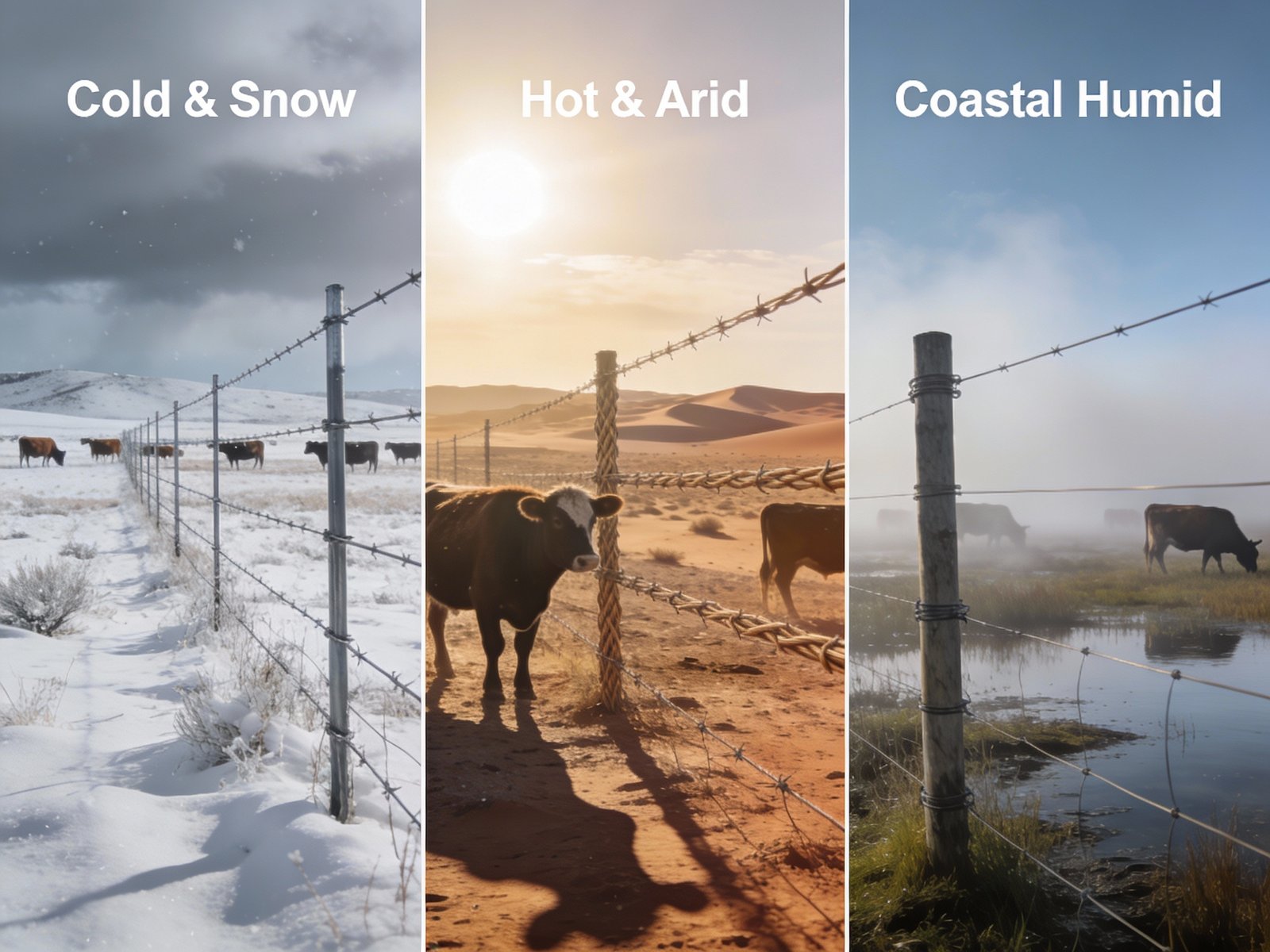
Fence performance varies dramatically across climate zones, with temperature extremes, precipitation patterns, ultraviolet exposure, and wind conditions exerting distinct pressures on materials and structural integrity. Selecting cattle fencing without accounting for regional weather patterns leads to accelerated deterioration, containment failures, and significantly higher lifecycle costs compared to climate-appropriate systems.
Why Climate Matters in Cattle Fence Selection
Climate vs Fence Performance
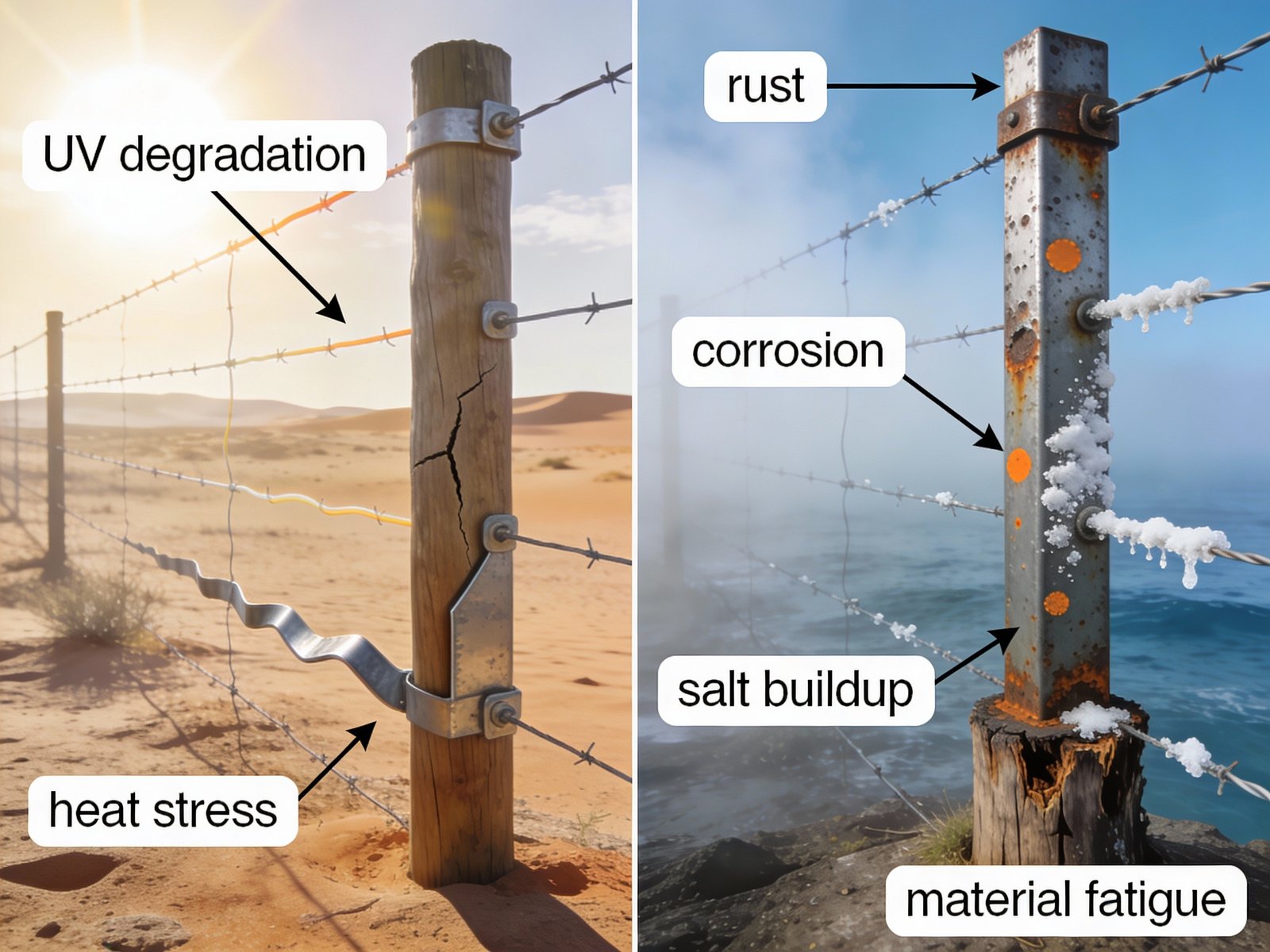
Temperature fluctuations create expansion and contraction cycles that stress fence materials at molecular and structural levels. Metal components expand in heat and contract in cold, generating stress points that lead to warping, joint separation, and fastener loosening over repeated cycles. UV radiation breaks down molecular structures in polymers and protective coatings, causing fading, brittleness, and compromised structural integrity. Prolonged exposure to ultraviolet light accelerates photodegradation—a process where UV rays break chemical bonds in materials, particularly affecting plastic components, wire coatings, and protective treatments.
Humidity and moisture content directly impact corrosion rates in metal fencing systems. Coastal environments with salt-laden air create aggressive electrolyte solutions on fence surfaces, accelerating corrosion compared to inland locations. High humidity prevents materials from drying completely, maintaining the moisture necessary for electrochemical corrosion processes. Properties close to ocean coastlines face the most severe salt exposure, though effects extend inland through morning dew and fog transport.
Wind pressure creates structural stress proportional to the surface area facing prevailing winds. Taller fences and solid designs experience greater force than low-profile or porous structures. Snow load adds considerable weight to horizontal fence elements, with accumulated snow potentially causing sagging, post displacement, or complete structural failure in systems not engineered for such loads. High-tensile fencing typically demonstrates superior snow load resistance compared to low-carbon alternatives, maintaining tension and structural integrity under heavy accumulation.
Common Fence Failures Caused by Climate
Rust and corrosion represent the most prevalent climate-induced failure mode in metal fencing systems. Standard galvanized wire may provide many years of service in inland moderate climates but shows visible rust much sooner near coastal areas, with complete failure occurring significantly earlier. As protective coatings break down, bare steel becomes exposed to moisture and oxygen, accelerating deterioration.
Wire sagging results from thermal expansion cycles, ground movement during freeze-thaw periods, and accumulated snow or ice weight. High-tensile systems tend to maintain proper tension better than low-tensile alternatives, with less permanent stretching over their service life. Persistent sagging reduces fence effectiveness and encourages livestock to test weak points.
Post shifting occurs when freeze-thaw cycles expand and contract soil moisture, displacing posts from their original positions. Winter ground expansion can push posts upward or sideways, and subsequent thaw periods may not settle posts evenly back into place, creating gaps that compromise fence line integrity. Saturated or sandy soils are especially vulnerable to such movement.
Material brittleness develops from cumulative UV exposure and temperature cycling. Some plastics and vinyl components become increasingly brittle after long periods of sun exposure, with cold temperatures further increasing cracking tendencies. Wood dries out and becomes prone to splitting and splintering under prolonged heat and UV exposure, while paint and protective coatings break down and require frequent reapplication.
Snow accumulation against fence lines can fill gaps and change how livestock perceive barriers. Ice formation within fence components expands as water freezes, widening cracks and straining connection points over time. In areas with recurring heavy snow or ice, inadequate design for these loads leads to progressive structural damage.
Fence Selection for Cold & Snowy Climates
Challenges in Cold Weather Regions
Frozen soil reduces electrical conductivity for grounded electric fence systems, diminishing shock effectiveness during winter months when ground moisture content drops. Electric fencing relies on moist soil to conduct current from the animal back to the energizer, completing the circuit. Dry or frozen ground interrupts this pathway and can require supplemental grounding strategies or alternative circuit designs.
Snow drifts accumulate against fence lines, particularly on downwind sides of barriers. When snow contacts lower conducting wires, it can continuously drain power from electric systems as the energizer delivers charge into the snow mass. Heavy snow loads stress horizontal fence elements, with accumulated weight potentially pulling wires downward, dislodging posts, or causing complete structural failure in under-engineered systems.
Thermal expansion and contraction cycles create fatigue in fence materials. Metal components contract in extreme cold, increasing brittleness and susceptibility to impact damage. Wire tension fluctuates with temperature changes, requiring periodic adjustments to maintain proper function. Ice buildup on wires adds weight and can cause snapping when loads exceed wire tensile strength.
Electric fence effectiveness diminishes in heavy snow conditions not because snow directly interferes with energizer function, but because accumulated snow can create grounding paths that drain system voltage before livestock contact. Deep snow may also physically block lower wires, reducing the effective fence height relative to animals.
Recommended Fence Types for Snow & Ice
High-tensile wire systems perform well in snow and ice conditions due to their strength characteristics and minimal stretching tendencies. Tensioned wires resist bending and sagging under snow weight better than many low-carbon alternatives. Properly crimped high-tensile wire can flex under load and temperature changes and then return to its original tension once conditions normalize.
Electric fencing remains viable in winter with appropriate system modifications. Installing cut-off switches on lower wire strands allows operators to disconnect bottom conductors during heavy snowfall, maintaining charge on higher wires that remain above snow level. Positive-negative circuit configurations use alternating hot and ground wires rather than relying solely on soil conductivity, enabling more consistent operation when ground freezing reduces traditional grounding effectiveness.
Woven wire fencing with tight, interwoven structure can handle snow buildup effectively without sagging or breaking when properly braced and supported. The distributed load across multiple horizontal and vertical wires prevents the concentrated stress points that cause failure in single-strand systems. When combined with appropriate post spacing and bracing, woven wire maintains barrier integrity through repeated snow accumulation cycles.
Hybrid systems combining physical barriers with electric components can provide redundancy in challenging winter conditions. A woven wire or high-tensile base structure maintains physical containment even if electric components lose effectiveness due to snow or ice accumulation, while electric offset wires help prevent animals from pushing against or rubbing on the structural fence.
Design Tips for Cold Climate Fencing
Fence height should account for potential snow accumulation at the base, with the lowest conductor wire positioned high enough to remain above typical snow depths. This helps prevent snow contact that drains electric fence power and maintains visual deterrent effectiveness for livestock. Taller fences in high-snow regions should be balanced against wind load and structural requirements.
Wire strand count and spacing require adjustment for snow load considerations. Multiple horizontal strands distribute weight more effectively than single-wire systems. Designs that maintain some openness allow wind to move snow through or over the fence rather than creating solid barriers that trap drifts directly against the structure.
Post reinforcement through deeper setting below frost line depth helps reduce heaving from freeze-thaw cycles. Cross-bracing on fence corners and high-stress points distributes weight and maintains structural alignment when snow loads create lateral pressure. Properly anchored and braced posts better resist displacement forces that compromise fence integrity during winter ground movement.
For detailed specifications on high-tensile installations suited to cold climates, reference comprehensive high-tensile wire systems. Electric fence adaptations for winter operation are covered in electric fencing implementation guides. Combining structural and electric elements for cold-weather resilience is addressed in hybrid fence configurations.
Fence Selection for Hot, Dry & High-UV Regions
Heat, UV Exposure, and Material Degradation
Ultraviolet radiation is a critical environmental factor driving material degradation in hot, arid climates. UV rays break molecular bonds in polymers, protective coatings, and certain wire treatments, leading to surface breakdown, color fading, and structural weakening over time. Plastic fence components without UV inhibitors often become brittle and crack far earlier than expected under intense sun exposure.
Extreme heat absorption by fence materials amplifies degradation processes. Dark-colored metal fencing can reach surface temperatures significantly higher than ambient air temperature, accelerating oxidation and coating breakdown. Heat causes materials to expand, while cooler nighttime temperatures trigger contraction—this constant cycling creates cumulative stress that manifests as warping, cracking, and connection point failure.
Dry conditions reduce wood moisture content, causing shrinkage, warping, splitting, and increased flammability. Wood fences in arid regions typically require more frequent sealing and treatment to prevent rapid deterioration. Metal wire may experience fatigue from repeated thermal expansion cycles, although properly galvanized high-tensile systems are designed to manage temperature variation with minimal permanent deformation.
Low humidity environments reduce corrosion rates compared to coastal or humid regions, which benefits metal fencing materials. However, abrasive wind-borne dust and sand can wear away protective coatings over time, eventually exposing base materials to oxidation. Fire risk in dry climates also makes the flammability of fence materials and vegetation management along fence lines important considerations.
Best Fence Types for Arid & Desert Conditions
Woven wire fencing with high-quality galvanization offers strong performance in hot, dry environments. A heavier zinc coating provides significantly more corrosion protection than standard galvanization, extending service life in areas where maintenance access can be difficult. The woven structure maintains integrity under heat expansion cycles while providing robust physical containment for cattle.
High-tensile wire systems with appropriate coating specifications deliver excellent longevity in arid conditions. The high tensile strength allows the fence to absorb thermal expansion without permanent stretching or sagging. Enhanced galvanization or specialized coatings protect against the gradual oxidation that occurs even in low-humidity environments, and properly tensioned systems can operate for decades with limited adjustment.
Electric fencing can be effective in dry climates when designed with robust grounding systems. Dry soil is a poor conductor, so additional ground rods, greater rod depth, and strategic placement in naturally moist areas help maintain adequate shock strength. Despite grounding challenges, electric systems offer low material requirements and can be maintained with relatively little physical hardware replacement once installed correctly.
Systems engineered for minimal maintenance provide particular value in hot, dry regions where fence line access may be time-consuming. High-tensile and properly coated woven wire both deliver long service life with limited intervention beyond periodic inspection, making them suitable options for large rangeland operations and remote pastures.
Long-Term Durability Considerations
Galvanization quality is a major determinant of lifespan in UV-intensive environments. Heavier zinc coatings deliver substantially extended protection periods compared to light coatings, especially where wind-blown sand and dust gradually abrade protective layers. When spread over a multi-decade service life, the initial cost premium for superior galvanization generally represents strong value.
UV-resistant coatings and treatments slow photodegradation in polymer components and certain composite posts. Products engineered with UV inhibitors tend to maintain structural integrity and flexibility longer than untreated alternatives, especially in regions with intense sunlight. Manufacturers that specify extended warranties for UV exposure provide additional assurance about long-term performance.
Reducing maintenance frequency through appropriate material selection lowers lifecycle costs significantly in remote or difficult-to-access locations. A fence requiring frequent repairs or recoating quickly becomes more expensive than a more robust system that operates with minimal intervention over the same period. High-tensile fixed-knot systems with enhanced galvanization often operate with very low annual maintenance requirements once properly installed.
Color selection influences heat absorption and UV damage rates. Lighter colors generally reflect more solar radiation, reducing surface temperatures and slowing thermal degradation, although structural performance and coating quality remain more important overall. Operators should prioritize proven material systems designed for arid conditions rather than relying solely on color changes.
Specifications for UV-resistant systems are described in woven wire fencing guides and in high-temperature performance resources for high-tensile installations.
Fence Selection for Wet, Coastal & High-Humidity Areas
Corrosion and Moisture-Related Risks
Coastal environments present some of the most aggressive corrosion conditions for metal fencing systems. Salt particles in ocean air settle on fence surfaces and absorb moisture from humid atmosphere, creating electrolyte films that accelerate electrochemical corrosion. This process can reduce practical service life dramatically compared to similar fences installed in dry, inland locations.
The combination of oxygen, salt, and moisture drives rust formation in ferrous metals. Salt weakens the protective qualities of galvanized coatings and paint, allowing moisture and air to initiate oxidation. Over time, even small breaches in coatings can expand and propagate along hardware, fasteners, and wire surfaces, especially if maintenance is infrequent.
High humidity prevents complete drying of fence surfaces, maintaining the moisture necessary for ongoing corrosion. Fencing materials that might last decades in dry inland locations can fail substantially sooner near coastlines without appropriate corrosion protection and regular inspection. Even materials marketed as rust-resistant require protective treatments and cleaning in such environments.
Soil conductivity changes in wet conditions influence electric fence performance. Wet ground generally conducts electricity more effectively than dry soil, improving electric fence effectiveness by providing consistent current return paths. However, dense or tall vegetation growth in wet climates increases the risk that plants will contact wires, creating leakage paths that reduce fence voltage.
Fence Types That Perform Well in Wet Conditions
Woven wire with heavy-duty galvanization resists corrosion in wet and humid environments while remaining flexible enough to handle ground movement during seasonal moisture cycles. The heavier zinc coating provides extended protection against rust formation, and the woven structure distributes stress across multiple connection points rather than concentrating forces at individual joints.
Electric fencing operates effectively in wet conditions when designed and maintained with vegetation growth in mind. Moist soil usually improves grounding, helping deliver consistent shock strength. However, regular clearing of grass and brush away from energized wires is essential to prevent voltage loss through plant contact. In coastal regions, insulated components and connectors should be chosen for higher corrosion resistance.
Pipe and panel systems constructed from galvanized steel or specialty-coated materials provide strong structural performance in corrosive environments when properly specified. Welded pipe panels handle substantial livestock pressure, but welds and cut edges must be protected against corrosion. Continuous rail systems that use well-coated steel components can offer long service life where regular inspection and maintenance are practical.
In particularly aggressive marine environments, selective use of stainless steel hardware or specialized coatings on critical connection points may be justified despite higher cost. Concentrating premium corrosion-resistant materials on components most exposed to salt spray and standing moisture helps extend system reliability where failures would be most disruptive.
Grounding and Drainage Considerations
Electric fence grounding systems require thoughtful design in wet coastal areas despite favorable soil conductivity. Multiple grounding rods, adequate depth, and proper spacing increase the reliability of the return path, especially where soil salinity and moisture vary seasonally. Grounding components should be chosen for corrosion resistance appropriate to local soil and moisture conditions.
Drainage around fence posts extends service life by reducing standing water contact time at the ground interface. Posts located in low-lying or poorly drained areas experience more rapid deterioration than elevated installations. Simple grading or shallow swales that redirect water away from post bases can significantly reduce long-term moisture exposure.
Vegetation management takes increased importance in wet climates where plant growth is vigorous. Regular clearing of grass, weeds, and brush from fence lines helps prevent moisture retention against fence materials and reduces the risk of electric fence grounding through plant contact. Access paths along fence lines can be planned to facilitate recurring maintenance.
Material selection principles for wet environments prioritize corrosion resistance over many other factors. The cost differential between standard and heavily protected materials often becomes justified when comparing replacement frequency and labor costs over decades. Long-lived systems that require less frequent major work usually provide better total value in high-humidity and coastal zones.
Additional specifications for corrosion-resistant systems appear in woven wire implementation guides, while electric fence optimization for wet conditions is covered in electric system design resources. Structural options for corrosive environments are detailed in pipe and panel fencing specifications.
Fence Selection for Windy & Storm-Prone Regions
Wind Load and Structural Stress on Fences
Wind pressure on fencing structures rises as fence height and exposed surface area increase. Solid fence designs present more resistance to airflow, creating higher pressure that can overwhelm inadequate post setting or bracing systems, especially during storms with sustained high winds or intense gusts. Taller solid panels in open landscapes are particularly vulnerable if not engineered for local wind conditions.
Fence posts bear the primary structural load from wind pressure, transferring forces into the soil through embedment depth and soil compaction. Shallow post setting or loose soil compositions allow posts to rock and gradually tilt under repeated wind stress, eventually compromising fence line alignment and tension. Deep post setting in well-compacted or concreted footings helps posts resist lateral movement.
Connection points between fence elements and posts represent potential failure locations under wind stress. Hardware that loosens over time from vibration and movement creates play that accumulates with repeated stress cycles. In corrosive or coastal wind-prone areas, deterioration of fasteners and connectors further weakens these critical points.
Sustained winds create different stress patterns than gusts. Steady wind pressure allows forces to accumulate and probe for weak points, while gusty conditions deliver impact loads that test peak strength. Fence systems intended for storm-prone regions must withstand both loading patterns to perform reliably.
Fence Types That Resist Wind Damage
High-tensile wire fencing offers strong wind resistance due to its open structure that allows air to pass through. Wind flows between wire strands rather than building pressure against a solid surface, greatly reducing total force on posts and bracing. Properly tensioned high-tensile wire can flex and then return to position after wind events without significant permanent deformation.
Low-profile fence designs reduce wind exposure by presenting less surface area. While height requirements for livestock containment limit how short fences can be, choosing more open patterns rather than solid panels helps decrease wind loading. In some contexts, using additional strands of wire rather than continuous solid surfaces balances containment with wind performance.
Flexible fence systems absorb wind energy through controlled movement rather than rigid resistance. High-tensile wire with correctly set tension flexes under wind load and then springs back, dissipating energy without concentrating stress at single locations. Rigid panel systems tend to focus loads at connections, where damage often starts.
Reinforced post and bracing systems distribute wind loads across multiple structural elements. Corner and end braces transfer tension and wind-induced forces to more than one post, reducing the likelihood that a single failure point will compromise long sections. In especially windy zones, closer post spacing and deeper or larger-diameter footings may be warranted.
Layout Strategies for High-Wind Areas
Fence alignment relative to prevailing wind direction influences total force magnitude. Fences perpendicular to dominant wind directions experience maximum pressure, while more oblique alignments reduce forces somewhat. However, property boundaries, terrain, and operational needs often dictate fence routes more than wind optimization.
Porosity in fence design—the percentage of open space versus solid surface—directly affects wind pressure accumulation. Fences with multiple horizontal strands spaced vertically provide sufficient containment while allowing substantial airflow, reducing wind load compared with solid barriers. In storm-prone regions, small increases in openness can produce large reductions in structural stress.
Terrain features and existing vegetation patterns influence local wind behavior. Natural windbreaks such as tree belts, ridgelines, or existing structures reduce effective wind speeds in their lee, creating zones where fence wind loading decreases. Positioning fence lines to leverage natural protection where practical can help minimize structural risks.
Flexibility in fence system design allows adaptation to local microclimates. Sections crossing exposed ridges or open plains may need heavier bracing or closer post spacing than sections protected by terrain or vegetation. Designing the system with zone-specific specifications avoids overbuilding in sheltered areas while ensuring adequate strength where winds are strongest.
Wind-resistant fence specifications and installation practices are detailed in high-tensile system guides. Combining wind resistance with other performance requirements appears in hybrid fence system resources.
Flood-Prone & Lowland Pasture Fence Selection
Flood Impact on Fence Stability
Water flow during flood events creates substantial lateral force on fence structures. Current velocity translates to pressure against any obstacle, with force magnitude rising sharply at higher flow rates. Fences set perpendicular to flow direction experience the greatest pressure, while those running more parallel to the flow are somewhat less exposed.
Debris carried by floodwaters impacts fence structures with considerable momentum. Logs, vegetation, and other floating materials can strike fences and become entangled, adding surface area that increases water pressure on the structure. This combination of impact and drag forces often causes more damage than water alone.
Sediment deposition during flooding buries lower fence sections and can shift post positions. As water velocity decreases, suspended sediment settles around fence structures, sometimes burying wires and lower rails. Accumulated material can hold moisture against fence components and may require significant cleanup to restore proper function.
Soil saturation and erosion during floods undermine post stability. Extended saturation softens soil and reduces its holding capacity, allowing posts to lean or loosen under water and debris loads. Erosion can scour soil away from around post bases, reducing effective embedment depth and weakening structural support even after floodwaters recede.
Fence Systems Suitable for Seasonal Flooding
High-tensile wire systems perform well in flood-prone areas because their open structure allows water and small debris to pass with reduced resistance. The spacing between strands limits the damming effect compared with solid or closely boarded fences. High-tensile wire can also flex under temporary loading and then return to tension if posts remain secure.
Electric fencing offers advantages in seasonally flooded areas because it uses minimal physical material and can be repaired or replaced quickly if damaged. Single or dual-strand systems present little obstruction to water flow while still providing effective psychological barriers under normal conditions. Grounding designs should account for both saturated conditions and drier periods to maintain reliability across seasons.
Removable or sacrificial fence sections in high-risk zones allow portions to be taken down before predicted flood events or accepted as low-cost losses. Quick-connect posts and portable electric systems fit well with this strategy, emphasizing ease of reinstallation after water recedes. For many operations, deliberately choosing a fence that fails cleanly and cheaply during extreme floods is preferable to overbuilding permanent structures.
Permanent fencing in floodplains should incorporate recognition that extreme events may exceed design capacity. Operators may choose to engineer for typical or moderate floods while accepting that rare, severe events will require partial rebuilding, balancing upfront construction cost with practical risk levels and insurance arrangements.
Temporary vs Permanent Solutions
Temporary fencing systems offer flexibility in flood-prone areas and in regions with seasonal grazing patterns. Portable electric netting or strand systems can be deployed when conditions permit pasture use and removed or de-energized when flooding threatens. Livestock trained to respect electric fences allow more reliance on these low-mass barriers without heavy physical structures in flood channels.
Permanent perimeter fencing positioned above typical flood elevations provides baseline containment, while temporary systems subdivide interior areas subject to inundation. This hybrid approach maintains secure property boundaries through weather events while accepting temporary fence loss in certain paddocks. Strategic planning of permanent fence routes along higher ground is central to this strategy.
Permanent installations within frequently flooded areas require careful economic evaluation. In many cases, designing for easy repair or replacement after floods offers better value than attempting to build fences that withstand extremely high water and debris loads. Where containment is critical, additional redundancy such as secondary lines or retreat zones may be more practical than hardening a single fence.
Decision factors include flood frequency, typical water depths and velocities, consequences of livestock escape during events, and labor availability for system deployment and removal. Properties experiencing regular flooding often benefit most from flexible, temporary electric options combined with resilient perimeter fencing.
Temporary electric fencing options and specifications are available in portable electric fence systems.
Using Hybrid Fence Systems Across Multiple Climate Conditions
Why Hybrid Systems Adapt Better to Climate Extremes
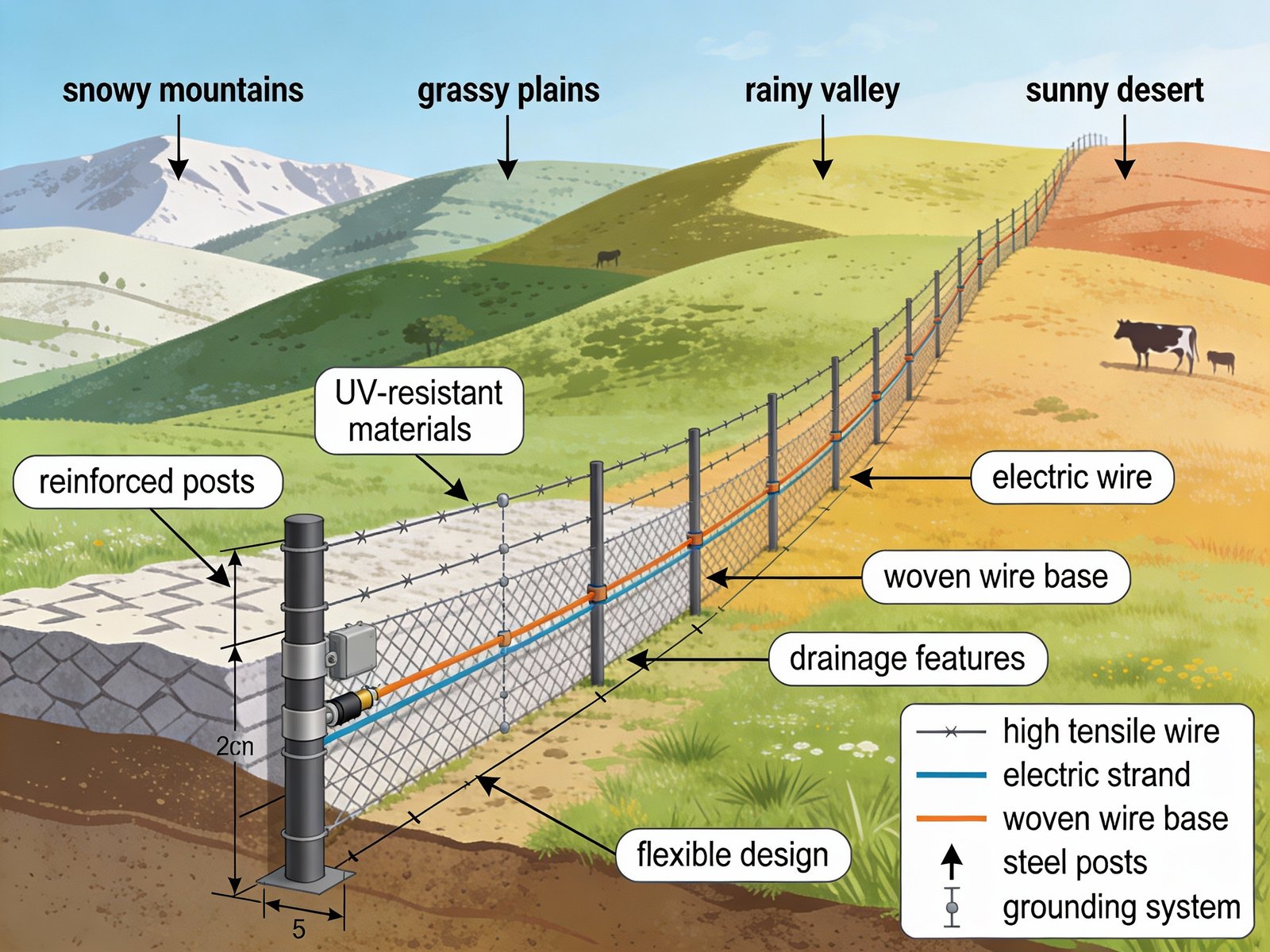
Hybrid fence configurations combine physical barrier components with electric deterrent elements, creating redundancy that maintains functionality when individual components experience climate-related performance drops. A woven wire or high-tensile physical structure provides containment even when electric elements lose effectiveness due to snow accumulation, wet vegetation contact, or temporary power interruption. Electric offset wires in turn protect physical fence components from constant animal pressure, rubbing, and leaning that would otherwise accelerate wear and deformation.
Climate variability within a single property often spans multiple challenge categories. Areas with seasonal snow can also experience intense summer heat and UV exposure, while coastal humidity may coincide with strong winds and storms. No single fence type optimally addresses all these stresses simultaneously, so combining strengths of different systems produces more robust overall performance.
Component redundancy in hybrid systems allows gradual degradation rather than sudden failure. If electric power fails during a storm, the physical fence still keeps cattle contained. If a physical component suffers localized damage, electric elements can discourage animals from testing weakened spots until repairs are completed. This resilience is particularly valuable in remote or large properties where immediate repairs are not always feasible.
Safety considerations favor hybrid approaches in climates where extreme weather temporarily limits access to fence lines. Severe winters, flooding periods, or extended heat waves can delay maintenance, so having both a physical and psychological barrier reduces livestock escape risk during these gaps. A hybrid system can maintain practical containment through short-term outages or minor damage without immediate intervention.
Hybrid designs also support incremental system upgrades. Operators can install a robust physical fence first and later add electric offsets as management needs evolve, or initially deploy electric components and later strengthen physical structures in high-pressure areas. This phased approach aligns investments with observed cattle behavior and climate realities over time.
Common Climate-Driven Hybrid Configurations
Cold and snowy regions often use woven wire or high-tensile physical fence with electric offsets placed above typical snow depth. The physical structure provides dependable containment when snow grounds lower electric strands or when frozen soil reduces grounding effectiveness. Electric wires discourage animals from leaning against or climbing the physical fence, helping preserve tension and alignment through winter seasons.
Hot and arid climates frequently pair high-tensile physical fences with strategically placed electric offsets to manage behavior at critical points. The physical fence delivers long-term durability under intense sun and low humidity, while electric components focus on gates, corners, or high-traffic lanes where cattle pressure concentrates. This combination reduces the need for heavily built barriers in every location.
Wet and coastal environments typically combine corrosion-resistant woven wire or pipe systems with electric offsets using well-insulated, corrosion-resistant hardware. The physical fence emphasizes longevity and structural strength under constant moisture and occasional storms, while electric strands control animal contact and reduce vegetation encroachment. Components exposed to salt spray or standing water are selected for extra corrosion protection.
Wind-prone areas often adopt high-tensile wire as the primary physical system, complemented by one or more electric offsets. The high-tensile fence provides strong yet open wind performance, and electric wires prevent livestock from creating extra stress by pushing on or deforming the structure. Bracing and post specifications can be adjusted for especially exposed ridgelines or open plains.
Flood-prone lowlands are well suited to hybrid strategies that combine permanent high-ground fencing with temporary electric subdivisions. A durable perimeter fence on higher elevation defines the boundary, while lighter electric fences divide pastures in flood-prone bottoms. This design ties temporary systems back to a strong, long-lived framework while recognizing that some internal fences will occasionally need replacement.
Comprehensive hybrid fence design principles and configuration options are detailed in hybrid system implementation guides.
This video explains how climate conditions such as snow, heat, rain, and wind affect cattle fence performance. It compares different fence types across environments and highlights why hybrid cattle fence systems often perform better in extreme or changing climates. The video also discusses common climate-related fence failures and provides practical guidance on selecting fence systems based on regional weather challenges rather than livestock type alone.
Climate-Based Fence Selection vs Cost Considerations
Short-Term Savings vs Long-Term Climate Costs
Initial fence installation cost represents only one component of total lifecycle expenditure, yet purchase decisions often emphasize upfront pricing over long-term economics. Climate-inappropriate fence selection creates hidden costs that accumulate through shortened service life, increased maintenance frequency, and premature replacement requirements. A lower-cost fence that needs replacement after a decade can end up more expensive than a higher-quality system that functions for several decades with minimal major work.
Maintenance labor in remote locations or challenging terrain amplifies lifecycle cost differences. Operations where fence line access requires substantial travel time, specialized equipment, or coordination with weather windows see maintenance costs multiply. A fence requiring frequent attention consumes far more resources over twenty years than a properly specified system needing only periodic inspection and occasional targeted repair.
Climate-accelerated deterioration creates cascading costs beyond fence replacement itself. Livestock escape during fence failure periods can result in animal loss, property damage, traffic hazards, and strained neighbor relationships. Grazing plans and pasture utilization efficiency also suffer when inadequate fencing prevents optimal rotation or forces unplanned changes to stocking patterns.
Repair timing challenges in extreme climates compound economic impacts. Fence damage occurring in deep winter or during flood periods may remain unrepaired for extended periods due to access limitations, increasing the risk of further damage and operational disruption. Climate-appropriate fence selection that minimizes weather-related failures reduces the frequency of these high-stress, high-cost situations.
Material longevity projections must account for actual climate conditions rather than generic ratings. Wire and coatings that last many years in mild inland climates may deteriorate much faster in salt air, intense UV, or persistently wet environments. Accurate lifecycle costing requires adjusting expected service life to reflect local weather patterns and environmental stressors.
Balancing Fence Type, Climate, and Budget
Optimization across fence type, climate demands, and budget constraints depends on evaluating total cost of ownership rather than initial purchase alone. High-tensile and premium woven wire systems with robust coatings often win on cost-per-year of service, even when they require larger initial outlays. This is especially true in climates that are hard on materials or where fence lines are long and remote.
Budget allocation should prioritize permanent perimeter fencing with climate-appropriate specifications while using more flexible or economical solutions for internal subdivisions. Property boundary fences guard against the highest-consequence escapes and should be designed for maximum reliability, whereas interior cross-fences can sometimes accept lower specifications or use temporary systems where failure consequences are limited.
Phased implementation strategies allow budgets to spread over several years while focusing first on the most critical or vulnerable segments. Systematic upgrades of weak sections, replacement of vulnerable materials, and strategic reinforcement of high-pressure areas can improve reliability without requiring full replacement in a single phase. This incremental approach helps align capital spending with cash flow and operational priorities.
Climate-specific material choices enable cost optimization by matching protection levels to exposure severity. Sections exposed to salt spray, extreme UV, or frequent flooding may justify premium materials, while sheltered or less severe segments can use standard options. This targeted investment approach raises overall system resilience without overspending on low-risk stretches.
Long-term maintenance budgeting should realistically reflect climate impacts on repair frequency and material replacement. Underestimating the effect of local weather often leads to deferred maintenance, which can escalate minor problems into larger structural failures. Planning and funding preventative maintenance appropriate to climate conditions almost always costs less than recurring emergency repairs.
Detailed cost analysis methodologies and lifecycle calculations appear in fence cost comparison resources.
Frequently Asked Climate-Based Fence Questions
What fence lasts longest in extreme climates?
High-tensile fixed-knot fence systems with robust galvanization typically deliver some of the longest service lives across a range of extreme climate conditions when properly installed and maintained. Heavier zinc coatings and high-strength wire design help these systems withstand corrosion, temperature cycling, snow loads, and ground movement better than many lighter-duty alternatives. In certain applications, premium board or pipe systems engineered for specific climates can exceed even these lifespans, although they usually come with higher initial costs.
Is electric fencing reliable in snow or heavy rain?
Electric fencing can be reliable in snow and heavy rain when it is designed and managed with those conditions in mind. Rain usually improves soil conductivity and can enhance shock effectiveness, but wet vegetation contacting wires needs to be controlled to prevent voltage loss. In snow, strategies such as raising lower wires, using switches to disconnect buried strands, and employing positive-negative wiring patterns help maintain performance. Correct energizer sizing, grounding, and regular monitoring are essential to keep electric systems dependable in adverse weather.
Should climate matter more than livestock type?
Climate and livestock type are both fundamental considerations, and neither should be ignored in fence selection. A fence that suits local climate but fails to contain the animals on the property is not acceptable, while a design that holds livestock well but deteriorates rapidly under local weather also fails the long-term test. In practice, several fence types can be configured to contain cattle effectively, so climate factors often differentiate which of those options provides the best lifecycle value. The most robust decisions treat climate and livestock needs as joint constraints and then select systems that satisfy both.