
Fixed Knot vs Hinge Joint vs S-Knot: Complete Woven Wire Fence Comparison Guide
Executive Summary
Fence knot design fundamentally determines woven wire fence performance characteristics, durability, and suitability for specific applications. Three primary knot types—fixed knot, hinge joint, and S-knot—each offer distinct structural properties that serve different livestock operations and environmental conditions. Understanding these differences allows ranchers to confidently select the most appropriate fence knot based on livestock pressure, terrain conditions, budget constraints, and long-term operational goals.
1. Foundational Concepts: Why Knots Matter
Woven wire fencing consists of two primary components: vertical stay wires and horizontal line wires (also called rail wires). The knot represents the critical junction where these wires intersect, determining how effectively the fence can resist animal pressure, weather forces, and thermal stress.
The knot performs four essential functions:
- Structural Integrity: Holds vertical and horizontal wires together under tension and compression
- Flexibility Management: Allows fence to absorb impact and thermal expansion/contraction
- Animal Safety: Minimizes sharp edges and pinch points that could injure livestock
- Maintenance Requirements: Determines whether fence needs regular adjustment or remains stable over years
2. The Three Main Knot Types: Construction and Characteristics
Fixed Knot (Cross Lock Knot)
Construction Method:
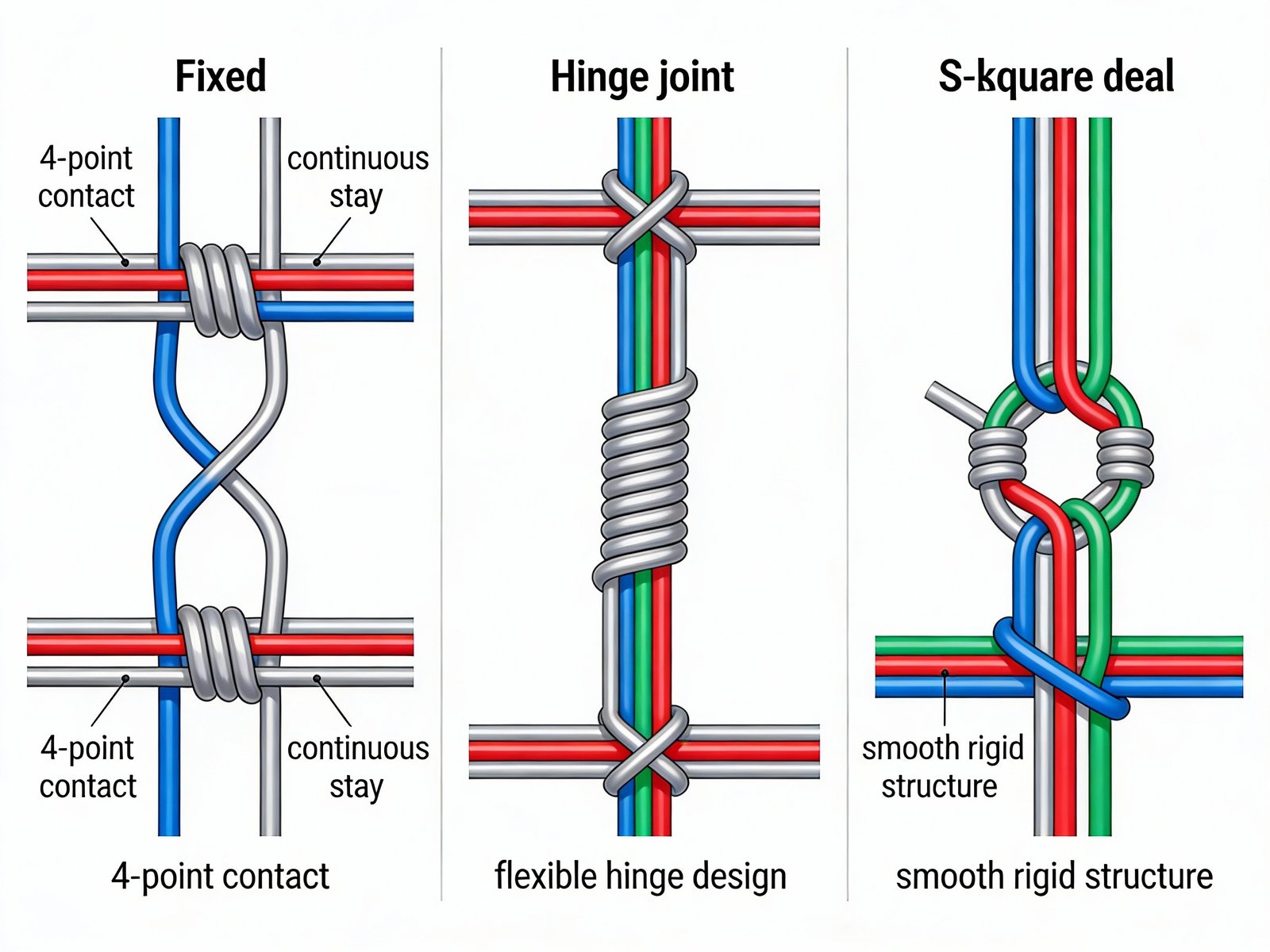
Fixed knot fencing uses a separate piece of wire twisted under pressure around both the vertical stay wire and the horizontal line wire, creating what manufacturers call a “four-point contact” design. The wrapping pattern follows this sequence: the wire wraps over the vertical stay line, loops around the horizontal line once on each side, then wraps around the vertical line again before the ends intertwine. This creates an exceptionally tight, permanent union that cannot slip or rotate under stress.
Key Structural Features:
- Continuous Solid Vertical Stays: Fixed knot uses unbroken vertical wires rather than individual wrapped segments, providing superior vertical strength
- Maximum Breaking Strength: Single horizontal wire rated at 1,380 lbs breaking strength when combined with high-tensile wire
- Deep Line Wire Crimps: Deeper crimping of horizontal wires than conventional fencing increases flexibility while maintaining rigidity
- No Slip Design: The knot locks permanently and cannot be pushed or pulled apart—it either holds or the wire itself breaks
- Wider Post Spacing: The rigidity allows posts to be spaced up to 20 feet apart without sagging, compared to 6-8 feet for hinge joint fences
Performance Under Pressure: Fixed knot fencing is rigid and maintains its form even under extreme animal pressure. It does not flex or absorb shock through movement; instead, it distributes forces throughout the entire wire structure. This makes it ideal for high-pressure applications but less suitable for terrain that demands flexibility.
Durability Profile: With proper high-tensile wire and Class 3 galvanization, fixed knot fencing can serve 20-30+ years with minimal to no maintenance. The tight knot construction prevents water intrusion and corrosion at the junction point, a common failure point in other knot types.
Hinge Joint (Monarch Knot)
Construction Method:
The hinge joint field fence design features a vertical stay wire that wraps or coils around the horizontal line wire at each intersection point. Rather than using a separate binding wire, the vertical wire itself creates the knot by wrapping around the horizontal wire. This creates a pivot-like joint that allows movement, functioning similarly to a door hinge—hence the name.
Key Structural Features:
- Flexible Design: The hinge joint is engineered to flex and move with livestock pressure, then snap back to original position
- Traditional Field Fence: Also called “field fence” or traditional farm fence, this is the most economical knot option and the industry standard for general-purpose fencing
- Tension Versatility: Works well on uneven or rolling terrain because it adjusts to ground contours without tearing
- Lower Breaking Strength: While durable, individual horizontal wires typically have lower breaking strength compared to fixed knot (varies by gauge)
- Standard Post Spacing: Typically requires posts every 6-8 feet to maintain fence form and prevent sagging
- Service Life: Standard hinge joint with Class 1 galvanization typically performs reliably for 10 years in average conditions
Performance Under Pressure: Hinge joint fencing is designed to bend but not break. When livestock press against it, the fence flexes and gives slightly, then springs back into place. This flexibility makes it ideal for corrals with multiple animals or situations requiring shock absorption.
Maintenance Considerations: Hinge joint fencing often requires clipping or fastening to top, middle, and bottom support wires to maintain shape during installation and over time. This adds installation labor compared to fixed knot designs.
S-Knot (Square Deal Knot)
Construction Method:
The S-knot woven wire fence, also called the “square deal knot,” uses a separate small piece of wire that “hugs” both the vertical stay wire and the horizontal line wire at their intersection point. Unlike the fixed knot’s complex wrapping pattern, the S-knot cinches firmly but compactly around both wires, creating a smooth, rigid connection with no protruding edges.
Key Structural Features:
- Smooth Design: The compact S-knot has no sharp edges or protrusions, making it safer for animals with sensitive skin and coats
- Rigidity Without Brittleness: More rigid than hinge joint but more flexible than fixed knot, offering middle-ground performance
- Continuous Vertical Stays: Uses solid vertical stays like fixed knot, providing superior vertical strength compared to hinge joint
- Buckling Resistance: Seldom buckles or sags because the knot cinches both wires firmly
- No-Climb Application: The smooth knot and 2×4 inch mesh make S-knot ideal for no-climb horse fences where animals cannot get feet or noses caught
- Installation Ease: Easier to install than fixed knot because the knot is more compact, though more labor-intensive than hinge joint
Performance Under Pressure: S-knot fencing provides firm resistance to pressure without complete rigidity. It will not flex like hinge joint, but it maintains some give to absorb shocks and thermal expansion.
Best Use Cases: S-knot excels in applications requiring high safety standards for livestock with sensitive skin (horses) or predator containment where smooth fencing is critical. It bridges the gap between hinge joint’s flexibility and fixed knot’s strength.
3. Comprehensive Performance Comparison
3.1 Strength and Durability Analysis
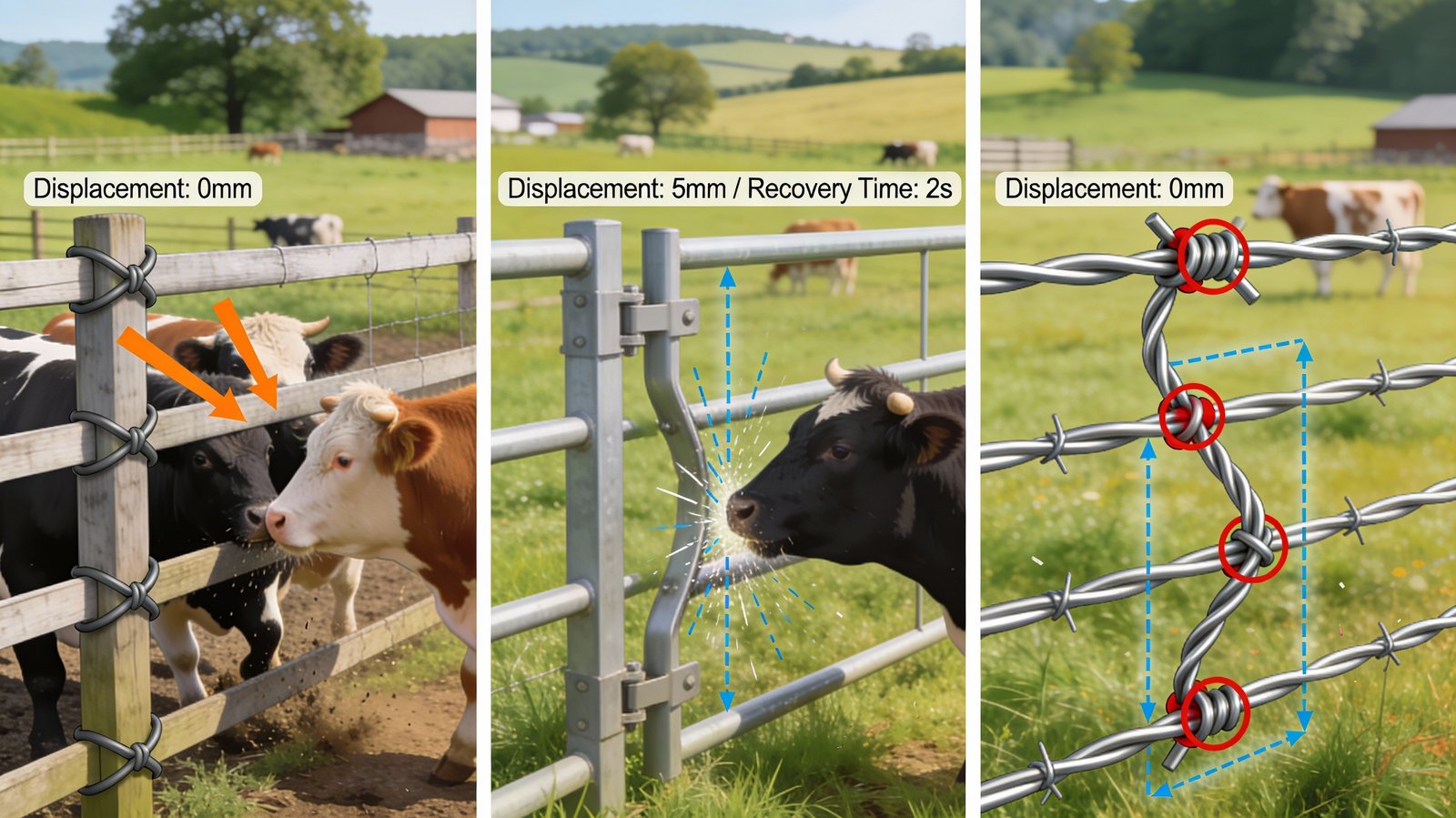
Fixed Knot Strength: The fixed knot represents the pinnacle of woven wire strength. When combined with high-tensile wire (12.5 gauge), individual horizontal wires achieve 1,380 lbs breaking strength. The four-point contact knot design ensures that forces cannot be concentrated at a single point; instead, stress distributes across all contact surfaces. Under pressure, the fence will not budge until the wire itself reaches breaking point—a virtually impossible scenario in practical livestock operations.
Hinge Joint Strength: Hinge joint fencing sacrifices absolute rigidity for flexibility. The wrapping design allows the knot to pivot slightly, which enables shock absorption but creates a potential weakness point. Under sustained pressure, hinge joint knots can experience minor creep (slight permanent deformation) over time. However, the flexibility actually provides safety—instead of a catastrophic failure, the fence gives way gradually, allowing animals to back away from dangerous situations.
S-Knot Strength: S-knot fencing bridges the gap between the two extremes. The cinching wire provides three-point contact (around both wires and cinched tight), delivering strength comparable to fixed knot while maintaining some flexibility through the continuous stay design. It resists sagging and buckling without being completely rigid.
3.2 Longevity and Service Life
Fixed Knot Service Life: With high-tensile wire and Class 3 galvanization (0.80-1.50 oz/sq ft thickness), fixed knot fencing routinely achieves 20-30+ years of service. The tight knot prevents water intrusion, protecting the wire junction from corrosion. Many installations with proper maintenance and climate conditions remain functional beyond 30 years.
Hinge Joint Service Life: Standard hinge joint field fence with Class 1 galvanization typically performs to expectations for 10 years in average conditions. The wrapping-style knot, combined with lower-quality Class 1 galvanizing, makes this design more vulnerable to corrosion at the junction point. Many ranch operations see reliable performance for 8-12 years before requiring replacement sections.
S-Knot Service Life: S-knot fencing with high-tensile wire and appropriate galvanization typically achieves 15-20 years of service. The smooth knot design provides better corrosion protection than hinge joint, and the solid stays offer structural longevity superior to field fence but slightly less than fixed knot designs.
4. Cost and Economic Analysis
4.1 Initial Installation Costs
While hinge joint fencing presents the lowest initial cost, the fixed knot investment translates to superior long-term economics. The wider post spacing (20 feet vs. 6-8 feet) reduces material and labor requirements despite higher per-linear-foot wire costs. Ranchers can use a fence installation cost calculator to compare these expenses for their specific operation.
4.2 Total Cost of Ownership (30-Year Cycle)
- Fixed Knot: $1,800-2,200/mile initial + minimal maintenance (3-4 inspections over 30 years) = approximately $2,200-2,800/mile total
- Hinge Joint: $1,300-1,800/mile initial + replacement every 10 years (3 complete cycles) + ongoing maintenance = approximately $4,500-5,500/mile total
- S-Knot: $1,550-2,150/mile initial + replacement every 15-20 years (1.5-2 cycles) + moderate maintenance = approximately $3,200-4,000/mile total
Economic Conclusion: Over a 30-year cycle, fixed knot fencing proves significantly less expensive to own than hinge joint field fence when accounting for replacement and repair costs. While initial per-unit costs are higher, the extended service life and minimal maintenance requirements create a compelling economic case for ranchers planning operations longer than 10-15 years.
5. Installation and Maintenance Requirements
5.1 Fixed Knot Installation
Installing fixed knot fencing requires proper fence installation tools and equipment to achieve optimal results:
- Ease of Installation: Moderate—requires proper tension adjustment and careful measuring, but fewer posts means less overall labor
- Special Tools Required: Tension calculator, come-along or power puller, post-hole digger for 20-foot spacing
- Typical Installation Time: 3-4 hours per 1/4 mile with 2-person crew
- Skill Level Required: Intermediate—proper tension is critical for performance
- Post Material Flexibility: Works with wood posts (properly braced), metal T-posts, or pipe depending on application
5.2 Hinge Joint Installation
- Ease of Installation: Easiest—can be stapled or clipped to posts with minimal tension requirements
- Special Tools Required: Stapler or hog rings, wire clips, minimal specialized equipment
- Typical Installation Time: 3-5 hours per 1/4 mile (more posts to secure)
- Skill Level Required: Low—basic fence knowledge sufficient
- Ongoing Adjustments: Requires periodic clipping to support wires to maintain form, especially in high-traffic areas
5.3 S-Knot Installation
- Ease of Installation: Moderate—easier than fixed knot but requires more care than hinge joint
- Special Tools Required: Tension tools, post digger, stiffening wire tool for some applications
- Typical Installation Time: 3-4 hours per 1/4 mile
- Skill Level Required: Intermediate
- Maintenance Frequency: Periodic inspection but minimal adjustment required due to tight knot design
5.4 Ongoing Maintenance Profiles
Understanding proper fence maintenance requirements is critical for maximizing fence lifespan:
Fixed Knot Maintenance (Annual):
- Quarterly visual inspection (30 minutes)
- Emergency wire replacement only (rare)
- Post integrity check at entry gates
- Estimated annual labor: 2-3 hours total
Hinge Joint Maintenance (Annual):
- Monthly visual inspection (30 minutes)
- Seasonal re-clipping to support wires (1-2 hours per section)
- Regular wire tightening and sagging correction (quarterly)
- Vegetation management around fence line
- Estimated annual labor: 12-16 hours per mile
S-Knot Maintenance (Annual):
- Quarterly visual inspection (30 minutes)
- Light tightening if needed (seasonal)
- Emergency wire replacement (rare, less than fixed knot)
- Estimated annual labor: 4-6 hours per mile
6. Application Scenarios and Selection Framework
6.1 When to Use Fixed Knot
Fixed knot fencing is the optimal choice for:
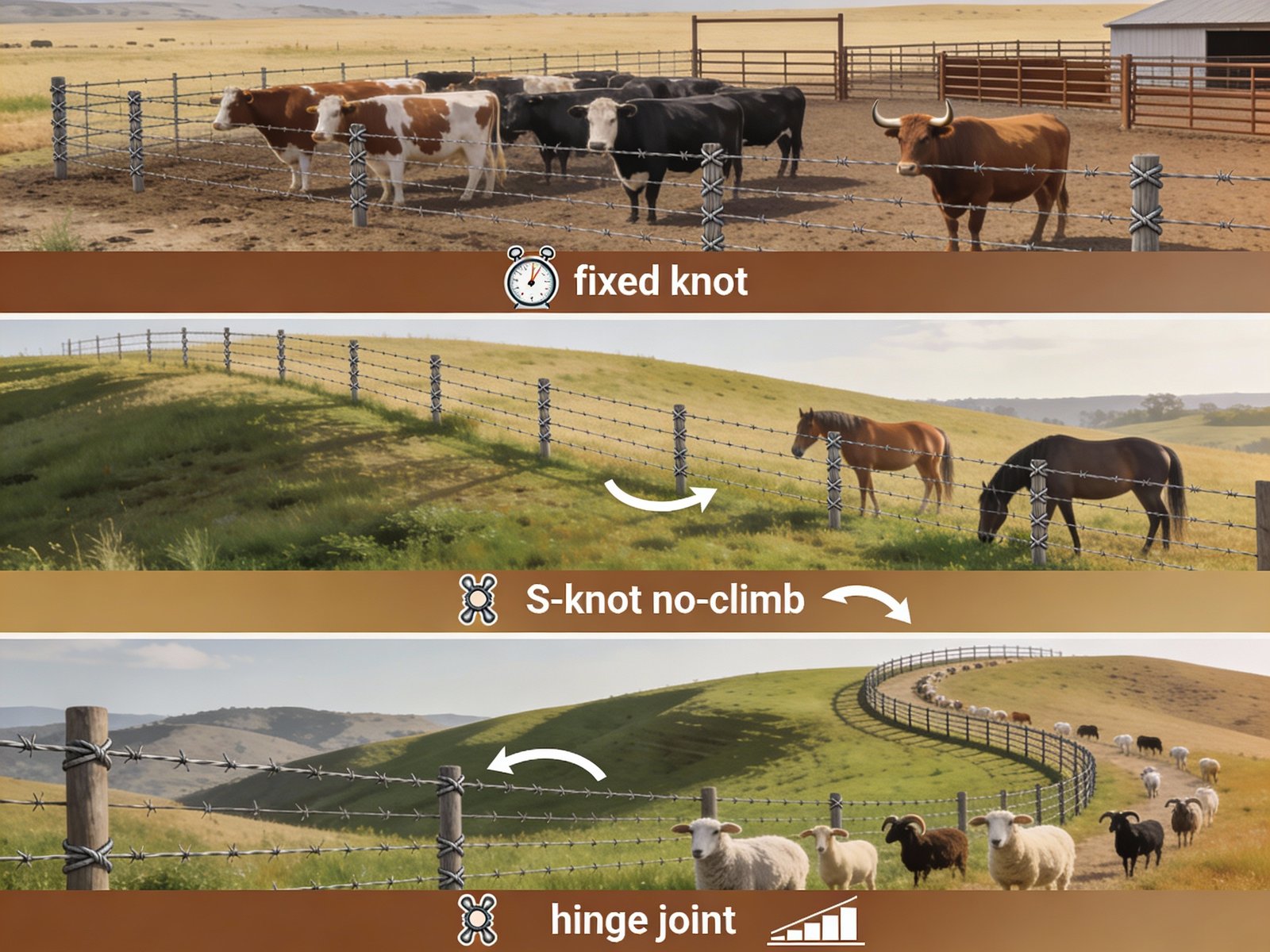
- Cattle Operations: Especially bulls and breeding stock requiring maximum containment strength
- Feral Hog Control: The tight mesh and high rigidity prevent rooting and breakthrough attempts
- Wildlife Exclusion/Containment: Deer, bison, and exotic livestock requiring absolute barrier
- Perimeter Fencing: Farm boundaries and property line protection requiring 20+ year durability
- High-Traffic Areas: Gates, loading chutes, and handling facilities experiencing frequent animal pressure
- Predator-Vulnerable Flocks: Sheep or goats in high-predator areas where fence integrity is life-or-death
- Smooth Terrain Operations: Farms without significant elevation changes where post spacing advantages matter most
- Long-term Planning: Operations planning 20-30+ year management cycles
6.2 When to Use Hinge Joint
Hinge joint fencing is the optimal choice for:
- Rolling Terrain: Hilly or uneven ground where flexibility accommodates contours without tearing
- Multiple-Animal Corrals: High-stocking-density enclosures where shock absorption is critical
- Budget-Conscious Operations: Initial capital constraints where lowest upfront cost is priority
- Temporary or Short-term Use: Fencing removed within 5-10 years
- General-Purpose Farm Fencing: Routine cattle or mixed livestock where maximum strength isn’t critical
- Suspension Fencing: Applications requiring structural flexibility for support
- Maintenance-Capable Operations: Acceptable if regular adjustments and maintenance can be performed
6.3 When to Use S-Knot
S-knot fencing is the optimal choice for:
- Horse Fencing: No-climb 2×4 inch mesh with smooth knot prevents injury to sensitive animals
- High-Value Livestock: Animals where hide damage or injury carries economic penalty
- Mixed Species Operations: Versatile strength/flexibility balance suitable for multiple animal types
- Predator Control: Smooth edges and firm construction for chicken, sheep, or goat protection
- Moderate-Terrain Farms: Some rolling ground but not extremely challenging topography
- Medium-term Operations: 15-20 year planning horizon needing balance between cost and durability
- Safety-First Requirements: Applications where animal injury prevention is paramount
6.4 Livestock Type Recommendations
7. Safety Considerations for Livestock
7.1 Injury Risk Assessment
Fixed Knot Fence Safety: While the fixed knot is tight and strong, the protruding knot edges can potentially catch or scratch sensitive animal skin, particularly on horses’ eyes or sensitive facial areas. For animals that frequently push heads through fence, fixed knot is less ideal than S-knot. However, the overall fence rigidity actually prevents catastrophic failures that could result in animal entanglement or breakthrough leading to injury from predators.
Hinge Joint Fence Safety: The wrapping-style knot with its potential rough edges presents moderate injury risk for sensitive animals. The flexibility provides some safety in that animals backing away from pressure suffer less whiplash, but the tendency to sag creates gaps where hooves can catch. The primary safety concern is that sagging creates escape opportunities for agile animals.
S-Knot Fence Safety: The smooth, compact S-knot design represents the safest option for animal contact. No sharp edges means no risk of hide or eye damage, and the firm structure prevents hooves or legs from becoming trapped. This makes S-knot the optimal choice for horses and other high-value animals where injury prevention carries economic importance.
7.2 Injury Prevention Best Practices
- Edge Treatment: For fixed knot fencing, ensure knots are filed smooth or use fence wraps at head-level heights for sensitive animals
- Regular Inspection: Broken or protruding wires present acute injury hazards and must be repaired immediately
- Sagging Prevention: Hinge joint fencing must be clipped to support wires to prevent gap creation where hooves can catch
- Post Spacing: Tighter spacing for animals prone to pushing (cattle) versus wider spacing for animals that press rather than strike (horses)
- Mesh Size Matching: Ensure mesh openings are sized so animals cannot get heads through (prevents crushing injury from struggling)
8. Climate and Environmental Performance Factors
8.1 Temperature and Thermal Expansion
Fixed Knot Performance: The fixed knot’s tight construction provides minimal accommodation for wire expansion/contraction with temperature changes. However, deep line wire crimps (deeper than hinge joint) provide flexibility memory that allows thermal adjustment without knot slip. In extreme cold/hot climates, fixed knot fencing may experience minor tension changes but maintains form.
Hinge Joint Performance: The flexible design accommodates thermal expansion naturally. However, this flexibility can compound sagging issues in hot climates where wire expansion plus creep creates significant shape changes.
S-Knot Performance: The moderate flexibility provides good thermal accommodation without excessive movement. The cinched design prevents creep while allowing necessary thermal adjustment.
8.2 Corrosion and Galvanization Impact
The tight fixed knot provides superior corrosion resistance because it minimizes water intrusion at the junction point—the primary corrosion source. Hinge joint fencing’s wrapping design creates crevices where water accumulates, accelerating corrosion. S-knot’s cinched design offers middle-ground protection.
8.3 Heavy Weather Performance
Snow Load Resistance: Fixed knot’s rigidity makes it superior for areas experiencing heavy snow. The knot won’t compress or deform under weight accumulation. Hinge joint can collapse under extreme snow load because the flexible knot pivots, causing the entire fence to fold.
Wind Resistance: All three knot types perform well in wind, but fixed knot’s rigidity provides the most stable appearance. Hinge joint may flutter or oscillate in strong wind, creating visual instability (though structurally sound).
Flood/Water Exposure: Fixed knot’s tight knot minimizes water accumulation. Hinge joint fencing in flood-prone areas experiences accelerated corrosion due to extended water exposure at junction points.
9. Comprehensive Scoring Matrix
10. Decision Framework: Selecting Your Optimal Knot Type
The ideal fence knot depends on a convergence of factors specific to each operation. Use this framework to evaluate your situation:
Questions to Guide Your Decision:
- ☑ Operation Timeframe: Will you operate this fence for 10+ years? If YES → Fixed Knot becomes increasingly attractive
- ☑ Animal Types: Do you raise cattle or hogs requiring maximum containment? If YES → Fixed Knot. Horses or sensitive animals? → S-Knot
- ☑ Terrain: Is your property significantly rolling or uneven? If YES → Hinge Joint or S-Knot. Relatively flat? → Fixed Knot
- ☑ Budget: Is initial capital cost the primary constraint? If YES → Hinge Joint. Can you invest more initially? → Fixed Knot
- ☑ Labor Availability: Can you perform quarterly maintenance and adjustments? If NO → Fixed Knot (minimal maintenance). If YES → Hinge Joint acceptable
- ☑ Safety Priority: Is animal injury prevention critical? If YES → S-Knot. Standard containment sufficient? → Fixed Knot
- ☑ Climate Stress: Does your region experience heavy snow, extreme heat, or flood risk? If YES → Fixed Knot (superior weather performance)
- ☑ Predator Pressure: Do you need absolute exclusion (wildlife/predators)? If YES → Fixed Knot. Standard containment? → S-Knot
10.1 Quick Selection Guide
Choose Fixed Knot If:
- Cattle or hog operation
- Planning 15-30+ year timeframe
- Minimal maintenance labor available
- Extreme weather or predator pressure
- Long-term cost savings matter
Choose Hinge Joint If:
- Rolling terrain with elevation changes
- Initial cost minimization is priority
- Short-term use (5-10 years)
- Regular maintenance capability exists
- Multiple animals in high-density corrals
Choose S-Knot If:
- Horse or high-value livestock operation
- Animal injury prevention paramount
- Medium-term planning (15-20 years)
- Mixed livestock types
- Balance between strength and safety needed
11. Installation Best Practices for Each Knot Type
11.1 Fixed Knot Installation Checklist
- Establish proper corner bracing systems before tensioning (prevents permanent stretching)
- Space posts exactly 20 feet apart—deviations reduce structural performance
- Use tension meter or come-along to achieve proper wire tension (consult manufacturer specs)
- Tension wires gradually rather than all at once (prevents post-hole stress)
- Verify knot integrity at every post—no twisted or kinked knots
- Test final fence by applying moderate pressure (should not move noticeably)
11.2 Hinge Joint Installation Checklist
- Space posts 6-8 feet apart—closer spacing improves sagging resistance
- Secure fence to top, middle, and bottom support wires at installation
- Use hog rings or staples rather than clips (more secure)
- Tension fence moderately (aim for slight tension, not extreme)
- Plan for seasonal re-clipping and adjustments in maintenance schedule
- Monitor for sagging at 6 and 12-month marks, adjust as needed
11.3 S-Knot Installation Checklist
- Space posts 12-15 feet apart (intermediate to fixed knot)
- Apply moderate tension (between hinge joint and fixed knot levels)
- Verify knot cinching is complete at every intersection
- No support wire clipping typically needed (unlike hinge joint)
- Test for sagging—should be minimal even without clipping
- Inspect knot smoothness, file any rough spots before animal introduction
Conclusion: Matching Knot Type to Operation
The choice between fixed knot, hinge joint, and S-knot fencing represents one of the most consequential decisions in agricultural infrastructure investment. Each design reflects fundamentally different engineering philosophies: fixed knot prioritizes absolute strength and durability for demanding applications; hinge joint maximizes initial economy and flexibility for challenging terrain; S-knot balances strength with animal safety for specialized livestock.
Fixed knot fencing emerges as the clear winner for ranchers operating cattle and hog operations with long-term planning horizons (15+ years). The superior durability, minimal maintenance, and dramatic cost-of-ownership advantage make it the benchmark choice for serious agricultural operations. However, this advantage only materializes when operations maintain fences for the long term.
Hinge joint fencing retains legitimate value for operations with rolling terrain, budget constraints, or short-term needs (under 10 years). The economic accessibility and flexibility advantages justify selection despite higher lifetime costs. For equestrian operations and applications prioritizing animal safety, S-knot offers the optimal balance of strength, safety, and durability.
Strategic Recommendation: Most sophisticated agricultural operations employ a hybrid approach—using fixed knot for permanent perimeter and high-pressure areas while leveraging hinge joint or portable electric fencing for temporary or flexible interior divisions. This strategy optimizes structural investment while maintaining operational flexibility.
Ranchers seeking comprehensive guidance on woven cattle fence wire systems should systematically evaluate animal types, terrain characteristics, climate factors, maintenance capacity, and timeline horizons using the decision framework provided. The long-term financial and operational success of fencing investment depends upon this deliberate matching of technology to application.
Research Sources: This comprehensive analysis synthesizes findings from Tejas Ranch Fence cattle industry standards, San Antonio Steel Company engineering specifications, Bekaert Fencing technology documentation, Stay-Tuff fence knot analysis, Meriwether Wire construction details, Red Brand understanding fence knots guide, Kencove woven wire fence options, agricultural extension publications, and multiple rancher forum discussions to provide evidence-based recommendations for knot type selection in livestock fencing applications.