
Cattle Fence Wire Standards & Regulations
Introduction: Why Standards & Regulations Matter
In cattle fencing, standards and regulations define the technical baseline that separates ad‑hoc construction from systems designed to perform reliably over decades under livestock pressure and environmental exposure. Rather than focusing on price or marketing claims, standards translate performance requirements into measurable parameters such as coating class, tensile strength, knot type, and post spacing that can be specified, procured, and inspected in a consistent way.
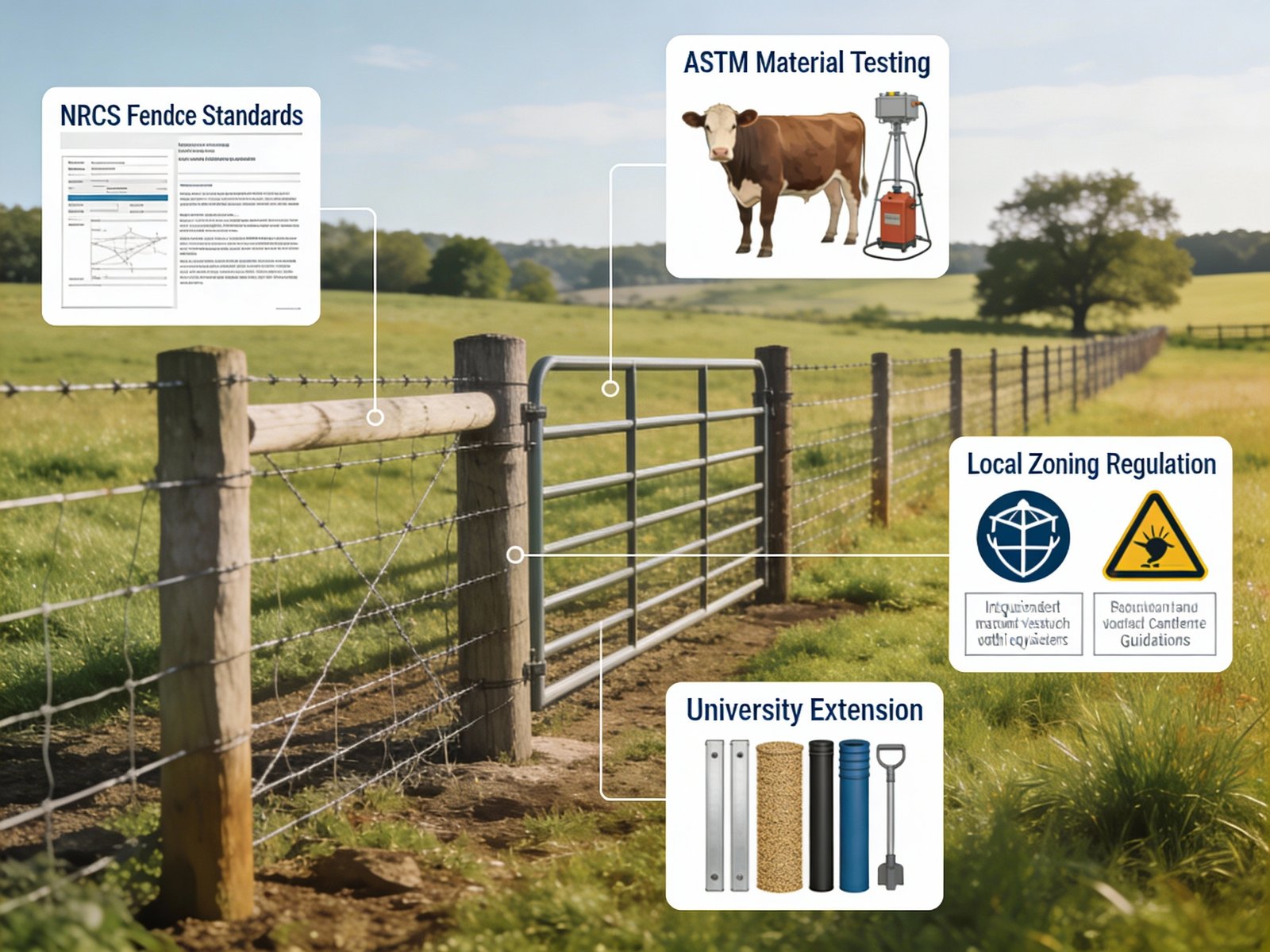
Across the United States, the core framework for cattle fence wire consists of NRCS conservation practice standards for fence layout and materials, ASTM material and coating specifications for steel wire, local agricultural building and zoning codes, and university extension publications that adapt these standards to local soils and climates. Together, these sources turn “good practice” into a documented minimum technical baseline, reducing the risk of premature corrosion, structural failure, and compliance issues.
In practical terms, standards in cattle fence wire selection serve three roles: they provide a common technical language between owners, designers, and contractors; they anchor procurement and inspection in verifiable criteria rather than subjective judgments; and they support long‑term management decisions by linking design choices (such as coating class or knot type) to expected service life and maintenance needs. For detailed product comparisons and budget planning, readers should refer to the site’s comprehensive cattle fence wire buying guide, which translates these technical baselines into actionable procurement scenarios.
National, Regional & Agricultural Building Codes
Overview of Agricultural Building Codes
While there is no single national “cattle fence code,” many states and counties regulate fence height, location, and occasionally materials through zoning ordinances and agricultural or rural building codes. These local rules sit alongside but do not replace technical standards such as NRCS fence practice standards and ASTM wire specifications, which remain the primary sources for engineering performance requirements.
Agricultural land frequently enjoys partial zoning exemptions, especially where parcels exceed certain acreage thresholds or meet defined agricultural income criteria, but these exemptions typically relate to land use and siting rather than structural safety. As a result, a fence may be exempt from height limits yet still be expected to meet safety and good‑engineering practice, particularly where adjacent to public roads, historic districts, or floodplains that impose their own protective conditions.
Permitting, Zoning, and Land-Use Considerations
In many jurisdictions, agricultural perimeter fences on larger parcels can be erected without a building permit, while taller residential or roadside fences may require formal approvals, especially if they exceed typical thresholds such as 6 feet above grade. Even where a permit is not required, local ordinances often restrict sight‑line obstructions near intersections, define minimum setbacks from property lines or rights‑of‑way, or specify special rules for fences in floodplains and environmentally sensitive areas.
Fence design requirements may vary significantly depending on regional fencing standards and regulations, particularly in areas governed by zoning ordinances, floodplain restrictions, or agricultural land-use exemptions. For cattle operations participating in NRCS cost‑share programs, compliance with NRCS fence conservation practice standard 382 is a formal condition of funding, effectively making the NRCS standard the controlling technical reference even where local building codes are silent on specific material or layout criteria.
NRCS Fence Specifications for Cattle Systems
Scope and Role of NRCS Practice Standard 382
The USDA Natural Resources Conservation Service (NRCS) Conservation Practice Standard Fence (Code 382) defines how fences should be designed and constructed when they are installed as part of federal conservation programs, and it has become a de facto technical benchmark for many cattle operations even outside cost‑share projects. The standard addresses fence function, layout, materials, installation, and operation, with specific guidance for various livestock types, including cattle, along with minimum criteria for posts, bracing, and wire properties.
For cattle fences, NRCS 382 focuses on ensuring that height, wire type, post spacing, and anchorage are sufficient to safely contain livestock without causing avoidable injuries, while also accommodating wildlife passage or exclusion where required by conservation objectives. Documentation in the NRCS Field Office Technical Guide and related job sheets translates these general criteria into tables and diagrams that planners and contractors can use during design and inspection.
Coating Classes and Corrosion Performance
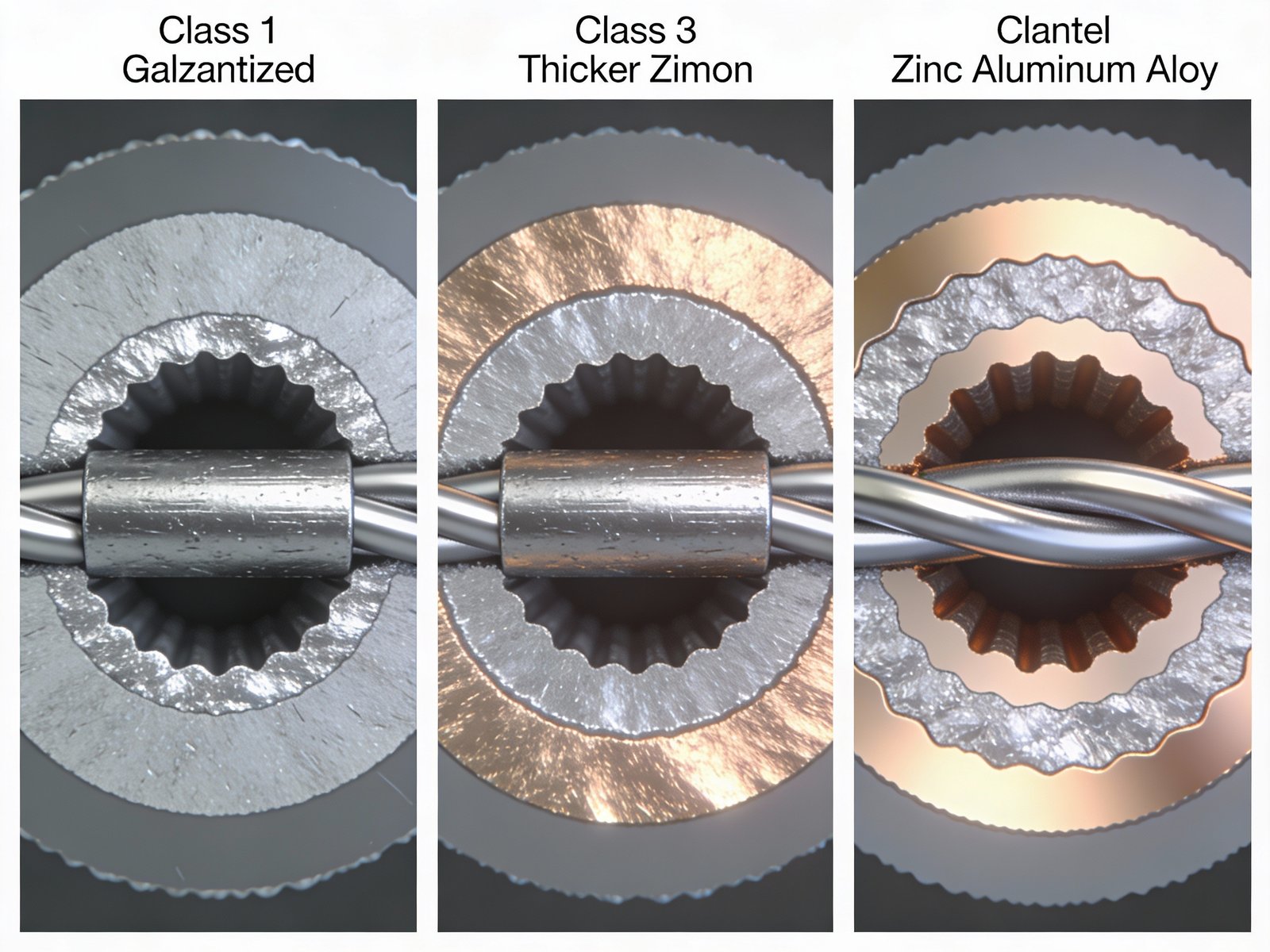
NRCS materials guidance for fence wire consistently points to heavy zinc coatings—commonly referred to as “Class 3” galvanizing—as the baseline for permanent livestock fences in most agricultural environments. These coatings, typically around 0.80 ounces of zinc per square foot of wire surface as defined in ASTM wire coating standards, provide roughly three times the zinc mass of lighter “Class 1” coatings and correspondingly longer service life under typical rural exposure.
In more corrosive settings, such as coastal zones, high humidity regions, or areas with industrial pollution, NRCS encourages the use of coatings with higher durability, which may include zinc‑aluminum alloys that meet or exceed the mass and performance requirements of Class 3 galvanizing. Engineering literature and DoD corrosion‑control guidance, often used as a reference framework in agricultural engineering, commonly cite zinc–5% aluminum alloys as providing two to three times the corrosion resistance of conventional galvanizing at similar coating thickness, making them a logical upgrade where fence replacement would be particularly disruptive or costly.
From an engineering perspective, the key point is that “galvanized” is not a single, uniform condition: coating class, coating mass, and base metallurgy are all essential descriptors that must be specified if the desired service life is to be achieved. NRCS specifications therefore pair descriptive requirements such as “Class 3 galvanized” with references to ASTM test methods for coating weight, so that inspectors can verify that delivered materials meet the intended corrosion performance baseline rather than relying solely on catalog labels. These recommendations are further supported by real-world fencing performance cases, where long-term field data highlights how coating class, post depth, and knot design directly affect service life under different environmental conditions.
| Coating type | Typical coating mass | Relative service life (inland) | Typical use in NRCS-aligned designs |
|---|---|---|---|
| Class 1 galvanized | ≈ 0.28 oz/ft² zinc | Baseline; often less than half of Class 3 | Shorter-term or low-risk fences; not preferred for permanent cattle perimeter systems |
| Class 3 galvanized | ≈ 0.80 oz/ft² zinc | ≈ 2–3× Class 1 in many rural environments | Standard choice for permanent cattle fence wire in inland agricultural settings |
| Zinc–aluminum alloy (e.g., Zn–5%Al) | Similar or higher metal mass than Class 3 | Often cited as ≈ 2–3× Class 3 in accelerated tests | Upgraded option for coastal, high humidity, or industrially influenced environments |
Tensile Strength, Yield Strength, and Working Load
High tensile cattle fence wire typically uses carbon steel with minimum tensile strengths in the range commonly quoted at 140,000 psi or higher, with many modern products achieving 170,000–200,000 psi for 12.5 gauge wire. University extension publications and technical bulletins emphasize that tensile strength, while important for defining the breaking load of a wire, is not the same as the allowable working load that can be applied without causing permanent deformation.
For steel wire, yield strength—the stress level at which the material transitions from elastic behavior to permanent elongation—is typically around three‑quarters of the ultimate tensile strength, meaning that a wire with a 1,500 lb breaking load might have a yield point near 1,100–1,200 lb. To preserve the ability of a fence to recover from seasonal temperature changes and occasional livestock impacts without “taking a set,” extension guidance and livestock fencing manuals encourage designers to maintain everyday working tensions below yield, often at levels that correspond to roughly two‑thirds of the breaking strength of the wire.
This distinction between tensile strength and working load is central to reading NRCS tables correctly, because practice standards may specify minimum tensile strengths and recommended tension ranges in pounds per wire, but the intent is to avoid plastic deformation rather than to “use all the strength” of the material. Extension publications on high tensile fence construction therefore pair NRCS tension recommendations with practical guidance on using tension gauges, in‑line strainers, and seasonal inspections to keep each strand within a safe working range over the life of the fence.
Typical 12.5 ga cattle fence wire tensile strength, enabling wider post spacing and reduced stretch over time.
Yield strength is often about three‑quarters of ultimate tensile strength; working loads should stay below this to avoid permanent elongation.
Extension guidance encourages setting everyday wire tension at a conservative level below yield to maintain resilience and service life.
Knot Types and Structural Behavior
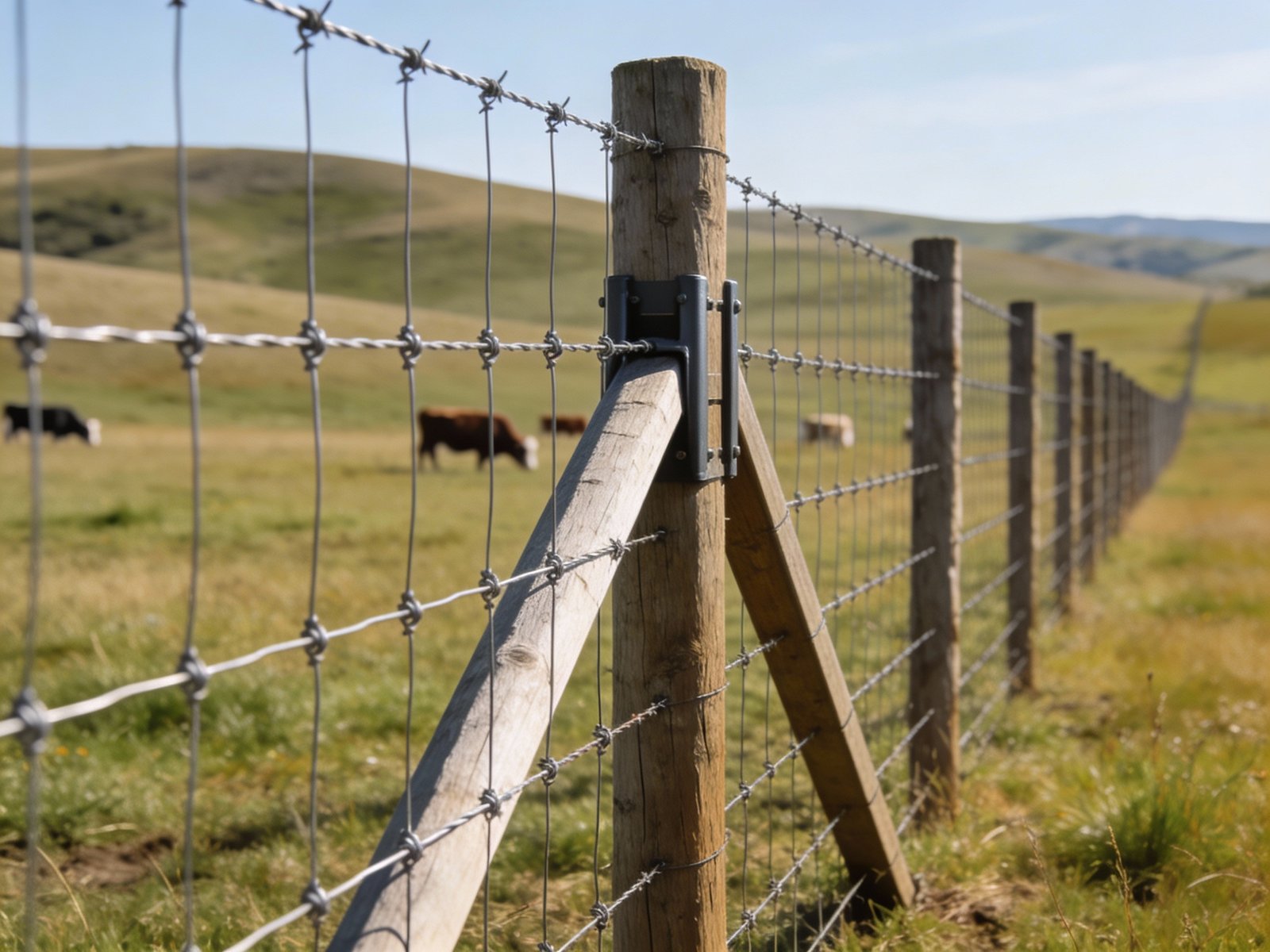
For woven cattle fence, knot design is a major determinant of how a fence behaves under impact and over uneven ground, and is often as important as wire strength and coating class when evaluating long‑term performance. Fixed knot woven wire uses a separate piece of high tensile wire to lock each horizontal line wire to the vertical stay wire, producing a stiff joint that resists sliding and allows larger post spacing without the mesh deforming under livestock pressure.
Hinge joint designs wrap the vertical stay wire around the horizontal line wires, creating a more flexible connection that can absorb some impacts but tends to open or distort if heavily loaded, which may require closer post spacing to maintain fence geometry. S‑knot or stiff‑stay designs sit between these extremes, offering improved aesthetics and animal safety in some applications but generally not matching the vertical stiffness of fixed knot configurations in high‑pressure cattle systems.
Because of this behavior, extension bulletins and manufacturer‑independent technical guides often recommend fixed knot woven wire for permanent perimeter cattle fences, particularly where larger animals, higher stocking densities, or terrain irregularities will subject the mesh to repeated high loads. More detailed mechanical comparisons of fixed knot versus hinge joint fence designs, including deformation patterns and recommended post spacing ranges, are available in resources dedicated to structural nuances without turning this standards page into a full design manual.
NRCS Parameters and Practical Reading of Tables
NRCS 382 materials tables specify minimum wire gauges, coating classes, post sizes, and spacing values for different fence functions, including exterior cattle fences, cross fences, and special use configurations such as riparian exclusion. For example, guidance for permanent high tensile livestock fences commonly calls for 12.5 gauge wire, heavy zinc coatings consistent with Class 3 galvanizing, and minimum post diameters and depths that reflect the expected combined load of wire tension, wind, and animal contact.
When practitioners read these tables, the intent is not to treat the numerical values as an upper bound on performance but as a minimum threshold that should be met or exceeded depending on local conditions. A system designed for bulls or high‑density rotational grazing might adopt the same basic NRCS geometry but increase the knot stiffness, wire tensile strength, or bracing frequency relative to the minimums in order to reduce the likelihood of deflection or partial failure over time.
To avoid misapplication, NRCS planners and extension specialists encourage users to cross‑check table entries against local soil conditions, climatic stressors, and livestock behavior, rather than copying values in isolation. Detailed step‑by‑step examples of how these tables translate into specific wire heights, strand counts, and hardware choices for different cattle operations are intentionally developed within the broader buying and design guides so that this page can stay focused on what the standards are and how to interpret them, rather than reproducing full construction drawings or pricing schedules.
ASTM Wire & Coating Standards in Context
ASTM A641: Zinc-Coated (Galvanized) Carbon Steel Wire
ASTM A641/A641M is a foundational material standard for zinc‑coated carbon steel wire, defining coating classes, testing methods, and mechanical properties for wire used in a wide range of applications, including agricultural fencing. It establishes coating mass requirements for multiple classes of galvanizing, with lighter coatings such as Class 1 and heavier coatings such as Class 3, and ties these to test protocols for verifying zinc weight and adhesion, making it the primary reference behind shorthand terms like “Class 1” and “Class 3” fence wire.
For cattle fencing, the relevance of ASTM A641 lies less in prescribing a specific fence design and more in providing the measurement framework that ensures “Class 3 galvanized high tensile wire” in a specification actually corresponds to a quantifiable coating level and mechanical behavior. When NRCS or extension documents refer to Class 3 coatings for permanent fences, those coating classes are typically interpreted through the lens of A641’s definitions and test methods, allowing inspectors to verify compliance by sampling wire and comparing measured zinc mass to published thresholds.
ASTM A121: Metallic-Coated Barbed Wire
ASTM A121/A121M defines requirements for metallic‑coated barbed wire, including zinc, aluminum, and zinc–aluminum alloy coatings, and prescribes minimum coating masses and mechanical performance criteria for both the line wire and the barbs. For cattle fencing, barbed wire is often used in combination with woven or smooth high tensile wires—for example, as a single or double line above a woven mesh—to discourage animals from leaning or attempting to climb the fence.
The role of A121 in the standards ecosystem is to ensure that barbed wire used in such systems is compatible with the corrosion and mechanical performance of the primary fence wire, particularly where Class 3 or zinc–aluminum coatings are specified for the main fence. Without this alignment, it is common to see barbed strands rust significantly earlier than the rest of the system, effectively reducing the functional life of the fence despite otherwise robust design and materials.
ASTM A817 and A116 in the Standards Framework
ASTM A817 covers metallic‑coated steel wire and fabric used in chain‑link fences, while ASTM A116 addresses zinc‑coated woven wire fence fabric, both of which are relevant to cattle fencing primarily through their treatment of coating quality and wire mechanics rather than as prescriptive livestock fence patterns. In practice, agricultural woven wire products may align with the strength and coating concepts in A116 while also incorporating modern fixed knot designs and high tensile wires that go beyond the original grades and design numbers envisioned in the standard.
Rather than memorizing every numeric detail in A817 or A116, practitioners typically use these standards—along with related coating and test standards—as a framework to ask the right questions of wire products marketed for cattle use: what is the specified coating mass, how is it verified, what is the tensile range of the line and stay wires, and how does the fabric behave under load. This approach keeps ASTM standards in their intended role—defining verifiable material properties—while leaving livestock‑specific layout decisions to NRCS, extension guidance, and project‑level engineering judgment.
University Extension & Regional Best Practice Guidance
Role of Extension Publications in the Standards Stack
University extension publications translate the language of federal practice standards and ASTM material specifications into region‑specific, practice‑oriented guidance that can be used directly by producers and local contractors. They typically explain how climate, soil type, topography, and livestock behavior interact with standard wire and post specifications, and they often include simplified decision charts or layout sketches that complement, rather than replace, the underlying standards.
For example, extension bulletins frequently show how recommended post spacing and depth should be adjusted for clays, loams, and sands, or how coastal versus inland environments should influence the choice between lighter and heavier galvanized coatings. These recommendations are further supported by real-world fencing performance cases, where long-term field data highlights how coating class, post depth, and knot design directly affect service life under different environmental conditions.
Climate, Soil, and Environmental Exposure
Extension and corrosion‑control guidance often organize environments by severity levels ranging from low‑corrosion inland conditions to severe coastal or industrial exposures, and these categorizations are commonly cited in engineering literature as a reference framework for selecting coatings and detailing. In milder inland climates, heavily galvanized (Class 3) high tensile wire is generally sufficient to achieve multi‑decade performance when paired with adequate post depth and bracing, while in coastal or high humidity settings zinc–aluminum alloy coatings or plastic‑coated wires may be recommended to maintain comparable lifetimes.
Soil type influences performance both through mechanical support and through its moisture‑holding and chemical properties, which affect corrosion and electric fence grounding. Clay and loam soils provide relatively strong support but can retain moisture around posts and lower wire, potentially accelerating corrosion at the ground line, whereas sands may require deeper posts and more robust anchoring but often drain well and, when dry, may require additional ground rods to maintain electric fence performance.
Readers seeking more detailed climate and exposure‑based recommendations for coating selection, including inland versus coastal and semi‑arid versus humid regions, can consult the dedicated environment-specific fence selection resources in the cattle fence wire by environment cluster. Those materials extend the standards framework here into regionally tuned design scenarios without duplicating the same level of environmental detail on every page.
Using Standards in Design & Procurement
Applying standards effectively in design and procurement means using NRCS practice standards to define system‑level performance, ASTM standards to define material properties and test methods, and extension guidance to adjust those baselines for local soils, climate, and livestock behavior. Understanding these standards is particularly important when evaluating DIY versus professional fence installation decisions, as improper interpretation of specifications often leads to hidden long-term costs and premature system failure.
Pre-Purchase Standards Checklist
Before requesting quotes or purchasing materials, many operations find it useful to pass through a short standards‑oriented checklist that frames subsequent design and pricing decisions. The goal is not to lock in a complete construction specification at this stage, but to ensure that all subsequent design, procurement, and installation steps remain anchored to a documented minimum standard rather than drifting toward ad‑hoc compromises.
- Confirm which NRCS fence practice standard (typically Code 382) and local zoning or building rules apply to the project area.
- Identify the primary environmental exposure category (inland versus coastal, high versus low humidity, industrial influences) that will drive coating class selections.
- Characterize soils along the fence line (clay, loam, sand, rock) to inform minimum post diameters, depths, and anchorage methods.
- Define livestock types and management systems (e.g., cow‑calf, bulls, high‑density rotational grazing) that will influence fence height, knot type, and bracing requirements.
- Establish minimum acceptable wire tensile strength and coating class (e.g., high tensile, Class 3 galvanized, or zinc–aluminum alloy) before considering vendor‑specific offerings.
- Plan for inspection by specifying that wire and coatings should comply with relevant ASTM standards and that suppliers can provide test data where appropriate.
Typical Specification Elements (Standards-Focused)
Rather than reproducing a complete contract‑ready specification, it is useful to understand the types of elements that a standards‑aligned cattle fence specification typically includes. These elements provide the bridge between the conceptual roles of NRCS, ASTM, and extension guidance and the practical language needed to describe expected performance in a design brief or internal company standard.
- Wire material description that references high tensile carbon steel in a defined gauge range, with a minimum tensile strength aligned to the intended fence function.
- Coating requirements expressed in terms of coating class and test methods, such as Class 3 galvanizing per an ASTM zinc‑coated wire standard or an equivalent zinc–aluminum alloy system, with coating mass verified by standard tests.
- References to NRCS practice standard 382 for fence function, wire arrangement, post spacing, and bracing concepts, ensuring that system‑level layout and performance reflect recognized conservation practice criteria.
- Post material and geometry expectations, including minimum diameters, lengths, and burial depths, with adjustments for soil type and environmental conditions based on extension or NRCS guidance.
- General statements that wire and accessories should meet applicable ASTM mechanical and coating standards and be suitable for the anticipated environment and livestock loads, rather than listing every possible test procedure.
For full procurement-ready specifications that combine these elements with project‑specific dimensions, hardware lists, and quality assurance procedures, readers should refer to the Buying Guide and related design resources, which are intentionally structured to go beyond the scope of this standards‑focused cluster page.
Video Reference: NRCS-Oriented Fence Installation
This video is provided for educational reference only. Fence design, materials, and installation requirements may vary based on regional standards, soil conditions, and environmental exposure. Always consult local NRCS guidance and applicable regulations before construction.
Linking Standards to Design Workflows
In many operations, the standards‑driven checklist above is followed by more detailed design tools that align wire selection, post details, and layout patterns with specific grazing systems, pasture rotations, and infrastructure constraints. The environment-specific fence selection resources in the cattle fence wire by environment cluster demonstrate how coating classes and layout choices shift across climates, while the cattle fence wire by livestock type cluster applies the same standards to herds with different behavior and pressure profiles.
Many of the issues discussed below are closely related to typical cattle fence failure mechanisms, including premature corrosion, post uplift due to frost heave, and permanent wire deformation caused by over-tensioning. Separate guidance on typical cattle fence failure mechanisms and on DIY versus professional fence installation decisions provides deeper case‑study examples and cost‑risk trade‑offs without turning this standards summary into a construction manual.
Common Misinterpretations & Pitfalls
Many of the most frequent problems observed in cattle fences originate not from a lack of standards, but from partial or incorrect interpretations of what those standards actually imply in practice. The patterns below are not exhaustive failure analyses, but they highlight where a more precise reading of NRCS, ASTM, and extension guidance can prevent avoidable issues in long‑term fence performance.
“Galvanized” Without a Coating Class
A recurring misinterpretation is equating the single word “galvanized” with adequate corrosion protection, without specifying a coating class, coating mass, or relevant test standard. As ASTM wire standards make clear, two wires may both be galvanized but differ by a factor of roughly three in zinc mass per unit area, leading to markedly different service lives under similar conditions.
NRCS and extension guidance therefore emphasize the need to state the coating class explicitly—such as Class 3 zinc coating—to avoid unintentional downgrades when purchasing from different suppliers or when switching product lines. For more detailed discussion of how this and related misunderstandings show up in actual purchasing decisions, the common cattle fence wire buying mistakes cluster examines case studies where specification gaps translate directly into shortened fence life.
Confusing Tensile Strength with Allowable Working Tension
Another frequent source of trouble is treating the quoted tensile strength of a wire as the intended operating stress, rather than as the maximum capacity beyond which failure is likely. Engineering and extension sources consistently distinguish between ultimate tensile strength, yield strength, and working load limits, with safe working tensions set below the yield level to maintain elasticity, accommodate thermal expansion and contraction, and absorb occasional overloads.
In high tensile cattle fences, over‑tensioning can lead to permanent stretching of wires, damage to posts and braces, and an increased risk of snapping under winter temperature swings or dynamic livestock impacts. This is why NRCS job sheets and extension guides stress the use of tension gauges and in‑line strainers, as well as periodic inspection and adjustment, rather than relying on visual judgment alone when tensioning fence wires.
Underestimating the Influence of Environment and Soil
Installing a fence that performs well in dry, inland conditions in a coastal or high‑humidity region without upgrading coatings is a common way to shorten service life, even when wire strength and fence geometry match NRCS minimums. Corrosion‑control guidance for infrastructure, technically similar to agricultural fences in terms of materials and exposures, shows that coating systems that perform well in mild environments can deteriorate much more rapidly under salt spray, acid deposition, or frequent wetting and drying cycles.
Similarly, setting posts at depths appropriate for firm loams in loose sands or saturated clays is likely to result in tilting, uplift under frost heave, or gradual loss of alignment as soils cycle between wet and dry states. Extension publications on fence and water systems consistently frame soil and climate as core design variables, not afterthoughts, and encourage practitioners to treat coating selection and post design as environment-dependent decisions.
Over-Specifying Details Without Reference Back to Standards
It is also possible to go too far in the opposite direction by writing highly detailed internal specifications that are not clearly traceable back to NRCS or ASTM criteria, which can make it harder to adopt updated guidance or to compare alternative products on a standardized basis. For example, specifying exact numeric tolerances for every minor detail without linking them to recognized test methods or practice standards may lock a farm or contractor into vendor‑specific assumptions rather than maintaining the flexibility to adapt materials as standards evolve.
A standards‑first approach typically defines performance baselines in terms of NRCS practice standards, ASTM material and coating specifications, and extension‑informed environmental adjustments, and then uses those baselines to evaluate vendor offerings and refine internal templates. Where more detailed investigation of failure modes is needed, the why cattle fences fail cluster explores typical cattle fence failure mechanisms in more depth, including how seemingly minor deviations from standards can propagate into major performance issues over time.
Standards, Interpretation, and Next Steps
At a high level, cattle fence wire standards and regulations are about defining a shared technical language and minimum performance threshold, not about dictating a single fence design for every farm or ranch. NRCS practice standard 382 establishes how fences should function and be constructed in conservation contexts, ASTM standards define what wire and coatings must be from a materials standpoint, and university extension publications explain why those requirements matter in specific climates, soils, and management systems.
By keeping this page focused on what the standards are, how they interrelate, and why they matter, it can serve as a stable reference point and internal linking hub for more design‑, pricing‑, or installation‑oriented cluster pages. For readers evaluating regionally tuned designs, environment-specific fence selection resources in the cattle fence wire by environment cluster offer more detail on climate and exposure effects, while the comprehensive cattle fence wire buying guide, common cattle fence wire buying mistakes, and cattle fence maintenance and repair guide provide operational and economic context built on the same standards foundation.
Fence design requirements may vary significantly depending on regional fencing standards and regulations, and the most resilient systems are those that use NRCS, ASTM, and extension guidance as a consistent baseline while accommodating local codes, site conditions, and management goals. By approaching cattle fence projects as applications of a standards ecosystem rather than isolated construction tasks, producers and professionals can reduce uncertainty, improve long‑term performance, and create a coherent framework that supports future upgrades and related infrastructure decisions.
References to NRCS, ASTM, university extension publications, and corrosion-control guidance in this page are conceptual and for educational purposes only; readers should consult the latest official documents and local regulations for project-specific requirements.