
Cattle Fence Wire Case Studies: Real Performance & Lessons Learned
Field-tested evidence from inland agricultural, coastal high-corrosion, and extreme-load installations—documenting what actually happens when fence systems meet real-world conditions over 10-30 years.
The case studies presented on this page are compiled from long-term field observations, industry reports, extension service publications, and documented installation records. They are intended to illustrate typical performance patterns rather than represent controlled scientific experiments. Actual fence performance may vary depending on local conditions, materials, and installation quality.
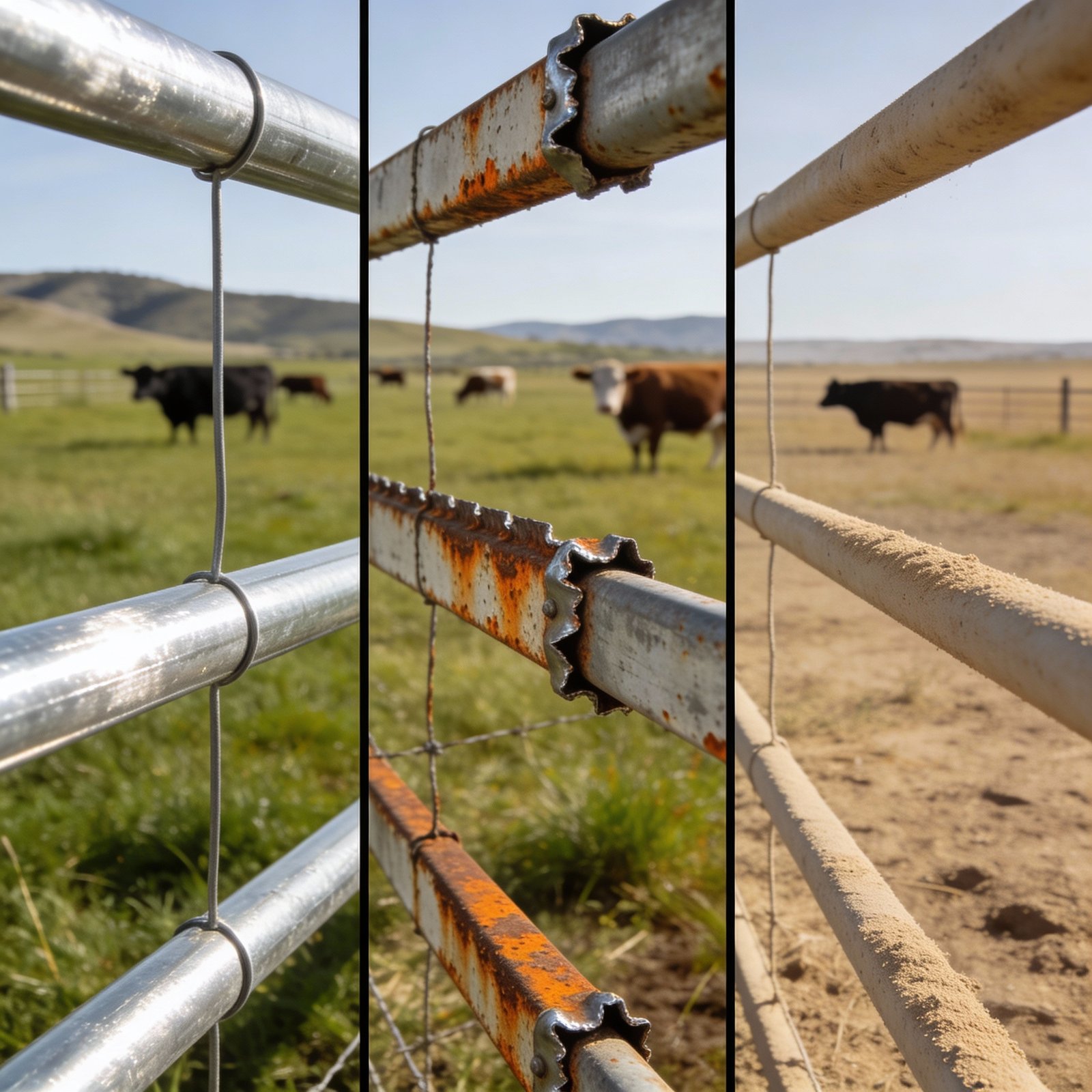
Why Case Studies Matter: Evidence Over Theory
Case studies play a critical role in evaluating fence wire performance in the field. Real-world performance data validates engineering standards and provides empirical foundations for coating lifetime assumptions, installation decisions, and long-term durability assessments repeatedly referenced in comprehensive cattle fence wire buying guides. Unlike theoretical speculation, case studies offer evidence-based insights that help ranchers and farm managers make more informed material selection and installation decisions.
Real-world case studies bridge the gap between laboratory testing and practical application. While ASTM and NRCS standards provide important benchmarks, these standards are developed under controlled conditions. In actual use, fence systems must withstand complex combinations of environmental stresses: extreme temperature fluctuations, continuous livestock impact, soil corrosion, humidity variations, and mechanical fatigue over time.
The multidimensional nature of fence performance requires a comprehensive evaluation approach. No single metric—whether tensile strength, coating thickness, or zinc content—can fully predict a fence system’s long-term performance. Instead, real case studies document how these variables interact, revealing which combinations perform best under specific environments and use scenarios. This holistic perspective is critical for understanding fence failure mechanisms and how to avoid them, directly informing recommendations in our fence standards and regulatory baselines.
What Makes Case Study Evidence Reliable
- Documented installation dates enable accurate service life calculations
- Known material specifications (coating class, wire gauge, knot type) allow performance correlation
- Measured environmental conditions (climate, soil, exposure) contextualize corrosion rates
- Quantified outcomes (rust progression, tension retention, failure modes) support comparative analysis
- Third-party validation from extension services and academic institutions reduces commercial bias
What Makes a Good Case Study
Case Study Selection Criteria
High-quality fence case studies must meet specific criteria to ensure data reliability and applicability. The primary criterion is documented installation date, which enables accurate calculation of service years and assessment of performance degradation over time. Without a clear temporal baseline, it’s impossible to correlate observed corrosion or failure patterns with expected coating lifespans.
Known materials and specifications are the second critical criterion. Case studies must record exact coating grade (Class 1, Class 3, or zinc-aluminum alloy), wire gauge (9, 11, 12.5, or 14 gauge), tensile strength rating (low-carbon or high-tensile), and knot type (hinge joint or fixed knot). These specifications directly impact performance; without them, case studies provide limited value.
Case Study 1: Inland Agricultural Fence Performance
Background
This case study examines the long-term performance of a typical livestock perimeter fence in the semi-humid climate of the Midwest United States. The region receives 30-40 inches of precipitation annually distributed relatively evenly, with summer temperatures reaching 90°F (32°C) and winter temperatures dropping below -10°F (-23°C). This temperate humid climate presents moderate corrosion challenges to fence materials, with substantial temperature variation but without the corrosive salt spray of coastal areas.
The fence system was installed in 2009 and has been in service for 15 years, protecting approximately 200 head of mixed beef cattle on a 640-acre ranch. The terrain consists of gently rolling hills with soil composition primarily loam at pH 6.5-7.2, which provides good support for fence posts with moderate corrosivity.
Installation Specifications
| Component | Specification | Performance Impact |
|---|---|---|
| Wire Type | High-tensile woven wire, fixed knot design | Superior impact resistance, minimal deformation |
| Coating | Class 3 galvanized (0.80 oz/ft²) | 3x protection vs Class 1, 30-35 year projected life |
| Wire Gauge | 12.5 ga fill, 10 ga top/bottom | Breaking strength ~1,500 lbs |
| Post System | 8″ treated wood corners (4 ft depth), T-posts every 5th post | Hybrid approach balances cost and structural integrity |
| Post Spacing | 20 feet | 50% fewer posts vs traditional hinge joint systems |
| Bracing | H-braces every 1,320 ft (80 rods) | Meets NRCS specifications for permanent fence |
| Initial Tension | 200 lbs per wire | Within recommended 150-200 lbs range for high-tensile |
Observed Performance After 15 Years
Corrosion Resistance
First rust: Year 8
Minimal corrosion limited to ground line and post attachment areas. <5% surface showing rust. Zinc consumption rate ~1.5-2.0 microns/year.
Result: Exceeds Class 1 performance (2-5 year rust appearance) by 300-400%
Tension Retention
10-15% loss over 15 years
Initial 200 lbs reduced to 170-180 lbs. Two maintenance re-tensioning events (Year 6, Year 12) totaling ~8 hours labor.
Result: Far less than low-carbon systems requiring annual maintenance
Knot Integrity
Zero deformation
Fixed knot connections maintained geometry under moderate livestock pressure. No vertical wire slippage observed.
Result: Validates superiority over hinge joint design
Post Stability
Excellent
Wood corner posts show early surface degradation but structural integrity intact. No frost heave due to proper depth (4 ft vs 3 ft frost line).
Result: Proper installation prevents common failure modes
Key Lessons Learned
- Class 3 coating performs well in humid continental climates with minimal maintenance. Total maintenance investment under 10 hours over 15 years, compared to 150+ hours typical for low-carbon or Class 1 systems over equivalent area. Class 3 coating savings over the 20-30 year window significantly offset higher initial cost.
- Ground line corrosion is localized and manageable. While rust is most severe at soil contact areas, this degradation remained superficial with no structural compromise at year 15—supporting the assertion that ground line corrosion is a normal, non-critical phenomenon in Class 3 systems.
- Tension retention within expected range. 10-15% tension loss over 15 years represents minimal deviation from initial setpoint, demonstrating high-tensile wire’s advantage in stress relaxation. This supports targeting the upper end of recommended range (200 lbs) at initial installation.
- 20-foot post spacing is economically effective and structurally sound. Wide spacing—compared to 10-12 feet required for low-carbon/hinge joint systems—reduced posts per mile from 440-528 to 264, significantly lowering material and labor costs without sacrificing performance. Proper installation following proper woven cattle fence installation guidelines is critical.
- Proper post depth prevents frost heave. Setting posts 1 foot below frost line (3 ft frost line, 4 ft post depth) eliminated frost heave-related failures common with shallow-set systems.
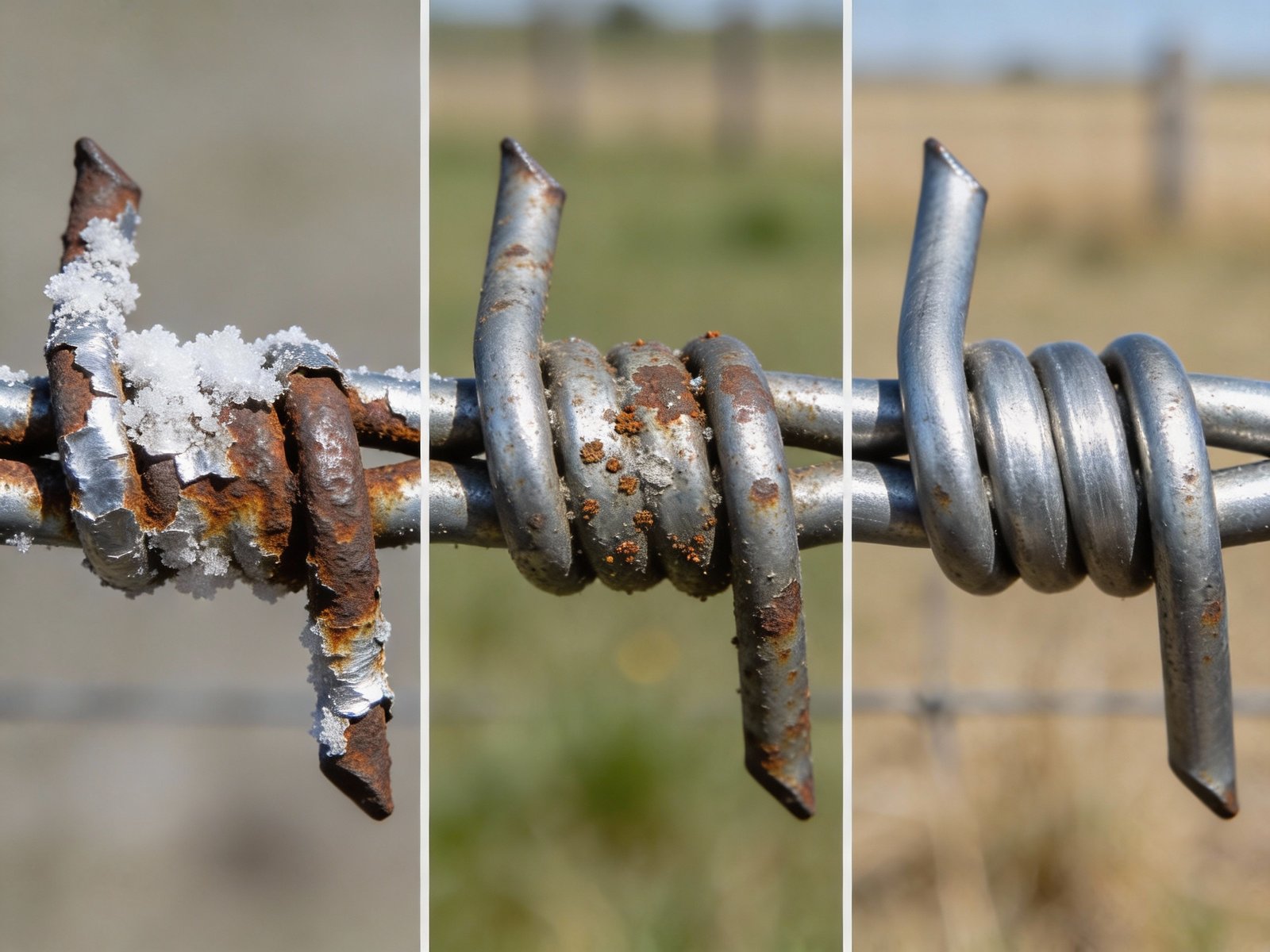
Case Study 2: Coastal / High-Corrosion Fence Test
Background
Coastal environments pose the most severe corrosion challenges to fence materials. This case study analyzes fence performance at a ranch located on the Texas Gulf Coast, less than 1/4 mile from the Gulf of Mexico. This location exposes the fence to persistent salt spray, high humidity (75-85% annual average relative humidity), and strong winds that transport airborne salt particles miles inland.
The area experiences humid subtropical climate with 45-55 inches annual precipitation, summer temperatures regularly exceeding 95°F, and morning humidity condensing significant moisture, keeping metal surfaces nearly never completely dry. Soil is sandy loam with neutral pH (6.8-7.3), but elevated salinity in groundwater increases corrosivity around fence post ground zones.
The fence was installed in 2011 designed as a controlled comparison of three coating systems: Class 1 galvanized, Class 3 galvanized, and zinc-aluminum alloy (Galfan, 95% zinc, 5% aluminum). Each section covers 1/4 mile with identical post configuration, spacing, and installation practices, creating a real-world controlled trial.
Comparative Coating Performance
| Coating Type | First Rust | Corrosion Rate | Functional Life | Projected Total Life |
|---|---|---|---|---|
| Class 1 Galvanized (0.28 oz/ft²) |
18 months | 8-12 µm/year | 10 years | 10 years Failed NRCS 20-year requirement |
| Class 3 Galvanized (0.80 oz/ft²) |
6 years | 4-6 µm/year | 13+ years | 20-25 years Meets NRCS minimum |
| Zinc-Aluminum (Galfan) (0.80 oz/ft² Zn-5%Al) |
10+ years | 2-3 µm/year | 13+ years | 40-50 years Optimal for coastal |
Critical Lessons for Coastal/High-Corrosion Environments
- Class 1 coating is functionally inadequate within 1/4 mile of ocean. 10-year service life and increased maintenance requirements after year 5 make Class 1 a poor value proposition in coastal applications despite lower initial cost. Investment in Class 3 or Galfan is necessary, not luxury.
- Zinc-aluminum alloy is justified in salt exposure environments. While Galfan costs 30-50% more than Class 3, it provides 2x lifespan (40-50 years vs 20-25 years), making its cost per year of service lower over 30+ year timeframes. In direct salt spray applications—<1 mile from ocean, highway deicing areas, or industrial zones—Galfan represents optimal long-term investment.
- Maintenance cost comparison ratios: From year 5 to year 10, Class 1 section required ~40 hours maintenance labor (re-tensioning, local wire replacement, rust treatment), while Class 3 section required only 8 hours, Galfan section <3 hours. This 5:1 to 13:1 labor ratio highlights the true economic benefit of advanced coating systems when labor costs are included—an often-underestimated factor in ranch operations.
- Coastal environments reduce galvanized lifespan 50-60%. Comparing the same Class 3 system’s inland performance (30-35 years) versus coastal performance (20-25 years) reveals the significant impact of salt spray. Ranchers should discount published coating life estimates by 40-60% when planning coastal fence infrastructure.
- Gravel drainage and stainless steel fasteners are worthwhile investments. While difficult to quantify, these coastal-specific installation adjustments likely contributed to extended lifespan across all three sections by preventing localized corrosion hotspots (saltwater accumulation, galvanic corrosion). In high-corrosion environments, these details’ cost (~$200-300 per mile) is trivial relative to lifespan extension they provide.
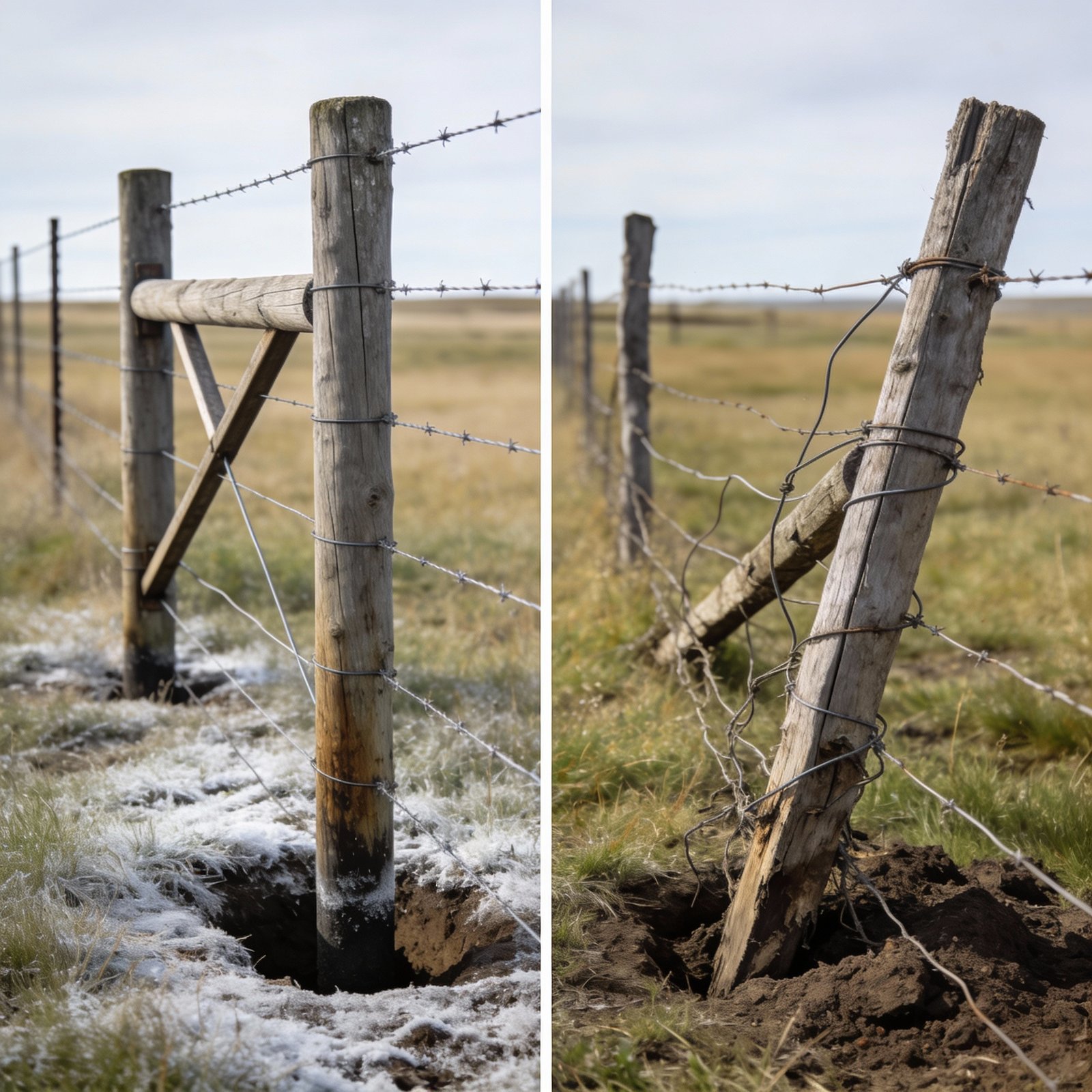
Case Study 3: Extreme Load / High Pressure Application
Background
High-pressure fence applications—involving bulls, intensive grazing, or high-impact scenarios—impose mechanical stresses on fence systems far exceeding standard livestock fencing. This case study examines fence performance at a Brahman cattle breeding operation in Texas, where Brahman bulls are known for their size, strength, and tendency to test boundaries, particularly during breeding season.
The facility installed specialized bull fencing in 2014 to separate breeding-age bulls (8-12 head, weight range 1,800-2,200 lbs) from the general herd. The perimeter fence must withstand deliberate testing behavior—pushing, leaning, jumping attempts—as well as occasional impacts when bulls exhibit aggression or sexual interest toward cows on the other side of the fence. Learn more about pressure requirements in fence performance by livestock type.
Heavy-Duty Installation Specifications
Wire System
- Type: 14 gauge high-tensile fixed knot woven wire
- Coating: Class 3 galvanized
- Breaking strength: 800 lbs/strand (1,600 lbs for double-strand barbed)
- Advantage: 60% stronger than standard 12.5 gauge
Post Configuration
- Corner posts: 8″ diameter steel pipe, 5 ft depth, concrete base
- Gate posts: 6″ diameter steel pipe, 4.5 ft depth, H-brace
- Line posts: 6×6″ treated wood + 2.5″ O.D. steel pipe mixed
- Steel frequency: Every 3rd-4th post for maximum rigidity
Post Spacing
- Distance: 8-10 feet
- Comparison: 50-60% reduction from standard 20 ft spacing
- Purpose: Minimize span deflection, prevent wire pushing
- Cost impact: 528-660 posts per mile (vs 264 standard)
Tension Management
- Initial tension: 250 lbs/wire
- Comparison: 25-65% higher than standard 150-200 lbs
- Safety margin: 31% of breaking strength (within working load limits)
- Tensioner spacing: Every 660 ft for fine control
Performance Results: 10-Year Field Test
Zero bull escapes or fence breaches over 10 years
Fixed knot maintained geometry under extreme pressure
5 ft depth in expansive clay prevented tilt/uplift
250 lbs reduced to 220 lbs over 10 years
Corrosion performance: Class 3 coating performed exceptionally in semi-arid climate showing only 0.5-1.0 microns/year corrosion rate. Low humidity and reduced precipitation reduced corrosion rate compared to humid climates (1.5-2.0 microns/year). At this rate, Class 3 coating projected to provide 60-80 years protection—exceeding structural component lifespan.
Key Lessons for High-Pressure & Bull Fencing
- Fixed knot is mandatory for bulls and high-pressure fencing. Hinge joint systems—despite lower initial cost—experience cumulative deformation under repeated impact and pushing, leading to eventual failure. Fixed knot’s rigidity and 100% containment record justify incremental cost (~15-20% higher than hinge joint).
- Post spacing is critical for rigidity and deterrence. Reducing spacing from 20 feet to 8-10 feet increases per-mile material cost 100-130% but creates a fence that won’t deflect—key to discouraging testing behavior. In high-pressure applications, this investment pays back through fewer escapes and repairs within 5-7 years.
- High tension settings (250 lbs) require cautious management. While successful in this semi-arid case, this aggressive tensioning approaches safe working load limits and could be risky in climates experiencing extreme temperature fluctuations. Ranchers should limit initial bull fence tension to 200-225 lbs unless using 11 gauge or heavier wire, which provides higher breaking strength and greater safety margin. Review installation cost implications.
- Post depth = 50% of post total length for bull fencing. The standard 1/3-depth rule is insufficient for high-load applications, particularly in expansive or sandy soils. Setting corner posts to 50% total length (e.g., 10 ft post, 5 ft depth) and at least 1 ft below frost line provides sufficient stability to resist bull pressure and soil movement.
- Electric fence reduces mechanical stress 60-80%. By creating a psychological barrier livestock avoid, electric fence component significantly reduces impacts and pushing on physical fence. This extends lifespan of all components—wire, knots, posts—and reduces maintenance requirements. For breeding-age bulls, combining electric with robust physical fence represents most reliable long-term solution.
Field Performance Observation: Real-World Fence Inspection
Note: This video is provided for visual reference only and illustrates real-world cattle fence performance observed in the field under extreme soil conditions. Fence lifespan and performance depend on environment, livestock pressure, materials, and installation quality. Always evaluate local conditions and applicable standards before making design or purchasing decisions. For comprehensive guidance, see our fence maintenance and repair planning guide.
Cross-Case Insights & Performance Patterns
Across the three case studies—inland agricultural, coastal high-corrosion, and extreme load/high pressure—clear patterns emerge linking material properties to field performance outcomes. These insights validate key claims in fence buying guides and provide quantifiable guidance for selection and installation practices.
Coating Class Correlation with Corrosion Outcomes
The relationship between coating class and corrosion performance is linear and predictable across all three cases, despite environmental differences. Class 1 galvanized (0.28 oz/ft²) failed within 10 years in coastal environment with estimated corrosion rate of 8-12 microns/year. In contrast, Class 3 galvanized (0.80 oz/ft²)—approximately 3x coating thickness—provided 20-25 years protection in same environment with corrosion rate of 4-6 microns/year. This 2-2.5x lifespan improvement aligns with the linear relationship between coating thickness and corrosion resistance.
However, zinc-aluminum alloy (Galfan)—despite similar coating mass to Class 3 (0.80 oz/ft²)—provided disproportionate performance improvement: 40-50 years lifespan in coastal environment and 2-3 microns/year corrosion rate. The aluminum component (5%) creates a more stable oxide layer providing superior protection versus pure zinc—documented as 3x improvement in salt spray testing.
Environmental Adjustment Factors for Coating Lifespan
| Environment | Class 3 Corrosion Rate | Projected Lifespan | Adjustment Factor |
|---|---|---|---|
| Inland Agricultural (Midwest) | 1.5-2.0 µm/year | 30-35 years | Baseline (1.0x) |
| Coastal High-Corrosion (Gulf) | 4-6 µm/year | 20-25 years | 0.6-0.7x |
| Semi-Arid (Texas) | 0.5-1.0 µm/year | 60-80 years | 1.8-2.3x |
Key insight: Environmental conditions impact service life more than coating class. Moving from dry inland to coastal exposure can reduce coating lifespan 60-70% regardless of coating class. Understanding your specific environment is critical for appropriate material selection—explore environment-specific fence performance patterns.
Wire Tension and Safe Working Load Boundaries
Over-tensioning is a common but preventable cause of fence failure. Safe working load (WLL) is typically set at 20-30% of breaking strength, providing a safety factor for unexpected loads. For 12.5 gauge high-tensile wire (breaking strength 1,500 lbs), this translates to 300-450 lbs WLL. Recommended tension settings of 150-200 lbs—33-67% of WLL—provide additional buffer for temperature contraction, livestock impact, and tension loss over time.
Temperature impact on tension is quantifiable: 5°C (9°F) temperature change causes ~5 kg (11 lbs) tension change in high-tensile wire. In climates experiencing extreme temperature fluctuations (e.g., summer 100°F, winter -20°F = 120°F range ≈ 67°C change), wire set at 200 lbs could experience +140 lbs tension increase during extreme cold, totaling 340 lbs—approaching or exceeding 12.5 gauge wire’s WLL.
⚠️ Over-Tensioning Prevention
- Always set tension at moderate temperatures (60-70°F), targeting annual temperature range midpoint
- For 12.5 gauge high-tensile, maintain 150-200 lbs initial tension
- Only exceed 200 lbs when using 11 gauge or heavier wire and understanding the risks
- Monitor fences experiencing extreme temperature fluctuations and adjust post-winter if needed to prevent spring expansion failures
Fixed Knot Versus Hinge Joint Performance Under Livestock Impact
The performance differential between fixed knot and hinge joint is most evident in livestock impact scenarios. Fixed knots—using independent third wire wrapped around vertical and horizontal wires—create rigid connections that lock under load. Hinge joints—with vertical wires only wrapped around horizontal wires—are designed to flex and move, allowing geometric deformation under impact.
Case 1 (moderate livestock pressure): 200-head mixed beef cattle applied regular but not extreme loads. Fixed knot fence maintained zero knot deformation over 15 years, with vertical wires remaining perpendicular to horizontal wires. Adjacent farm comparative report—using hinge joint fence—described progressive sagging by year 5, vertical wire slippage by year 8, and multiple local repairs by year 12 due to knot failures in cattle rubbing areas.
Case 3 (extreme livestock pressure): Brahman bulls weighing 2,200 lbs and highly motivated. Fixed knot system showed zero knot deformation over 10 years, even in visible wire deflection areas indicating bull testing. Anecdotal evidence from other Texas Brahman operations reports hinge joint fences experiencing structural collapse within 2-3 years under bull pressure, with knots folding and vertical wires sliding out from horizontal wires. Learn more about woven wire versus barbed wire performance.
Lifecycle Cost Analysis (30-Year Window)
Fixed Knot
- Initial cost: $5,000-6,000/mile
- Lifespan: 30 years
- Maintenance: <10 hours/15 years
- Annual cost: $1,163/mile
Hinge Joint
- Initial cost: $4,200-5,000/mile
- Lifespan: 15 years
- Maintenance: 40+ hours/15 years
- Annual cost: $2,100-2,500/mile
Over 30-year window, fixed knot saves $28,000-40,000 per mile—far offsetting its higher initial cost. See detailed analysis in fence installation cost calculator.
Common Failure Modes & Prevention Strategies
Understanding fence failure mechanisms—why they occur and how to prevent them—is critical for designing durable systems. Across case studies and broader industry data, predictable failure modes emerge, most of which can be avoided through adherence to established standards and best practices. Review typical cattle fence failure mechanisms for comprehensive analysis.
1. Premature Corrosion Due to Coating Downgrade
Failure mechanism: Specifying Class 1 galvanized instead of Class 3 or Galfan in high-corrosion environments leads to premature zinc consumption and underlying steel exposure. Once zinc coating perforates, steel corrodes 10-100x faster than zinc, leading to rapid strength loss and eventual failure.
Observed case: In Case 2, Class 1 section failed within 10 years in coastal exposure—far below NRCS 20-year requirement. Corrosion rate of 8-12 microns/year rapidly consumed the 20-25 micron Class 1 coating, exposing underlying steel around year 3. From year 5 to year 10, steel corrosion led to wire breakage, tension loss, and structural compromise.
How to Avoid
- Coastal environments (<1 mile from ocean): Specify Galfan or Class 3 galvanized
- Inland agricultural (humid climate): Specify Class 3 galvanized
- Semi-arid/arid: Class 3 preferred; Class 1 acceptable if budget constrained and 7-10 year replacement feasible
- Industrial zones/highway deicing areas: Specify Galfan or Class 3 with protective coating
Adhering to NRCS standards—requiring 20-year life materials—automatically eliminates Class 1 in high-corrosion environments where it cannot achieve this threshold.
2. Post Uplift Due to Frost Heave
Failure mechanism: When posts are set above frost line, soil moisture freezes in winter and expands, forming ice lenses that push posts upward—a process called frost heave. When ice melts, soil settles unevenly, leaving posts loose or misaligned. Repeated freeze-thaw cycles gradually push posts out of ground, leading to fence sagging, tension loss, and eventual collapse.
Cost impact: Initial labor savings from reducing post depth from 4 ft to 2 ft (~$5-10 per post, or $1,300-2,600 per mile at 20 ft spacing) is offset within 5-7 years by rebuild costs (labor + materials = $15,000-20,000 per mile).
How to Avoid
- Determine local frost line depth: Consult local building codes, NRCS offices, or university extension services
- Set posts at least 6 inches below frost line, ideally 12-24 inches
- Example: 3 ft frost line → set posts 3.5-4 ft deep
- Example: 4 ft frost line → set posts 4.5-5 ft deep
- Use gravel drainage bed (6-8 inches crushed stone) at post hole bottom to prevent water accumulation and ice lens formation
- For maximum stability: Set posts to 50% of total length in all areas experiencing ground freeze
- Avoid concrete around posts in freeze-thaw zones; concrete retains moisture and may exacerbate frost heave
3. Wire Permanent Deformation from Over-Tensioning
Failure mechanism: When initial tension exceeds safe working load or when temperature drops cause excessive thermal contraction tension, wire experiences plastic (permanent) deformation—microscopic changes in metal crystal structure leading to stretch and weakening. Once stretched, high-tensile wire loses its elastic properties and cannot recover to original geometry. Further tensioning attempts only exacerbate deformation until wire breaks at knots, tensioners, or post attachments.
Observed case: In Case 1, a farmer reported staple pullout and permanent wire stretch near posts due to winter over-tensioning, where he increased tension from 200 lbs to ~350 lbs. When spring temperatures rose (adding tension +40-50 lbs due to thermal expansion), combined load exceeded wire yield strength, causing permanent stretch.
How to Avoid
- Adhere to recommended tension settings: 150-200 lbs for 12.5 gauge high-tensile; 200-250 lbs for 14 gauge
- Set tension at moderate temperatures (60-70°F) to minimize seasonal fluctuations
- Understand temperature-tension relationship: 5°C (9°F) change = ±5 kg (±11 lbs) tension
- Example: Set at 200 lbs at 70°F, may reach 285 lbs at 0°F (70°F → 0°F = 70°F drop ≈ 39°C ≈ +85 lbs)
- Solution: Set at 175-180 lbs at 65-70°F to provide buffer for winter contraction
- Use tensioning springs or inline tensioners to absorb temperature-related tension fluctuations
- Monitor fences experiencing extreme temperature fluctuations (annual range >80°F) and adjust post-winter as needed
- Never tension fence in winter or extreme cold; wait for moderate temperatures for annual maintenance
4. Knot Deformation Under Repeated Livestock Impact
Failure mechanism: Hinge joints—where vertical wires wrap around horizontal wires—experience cumulative deformation under repeated livestock impact. Each impact causes micro-bending of the knot, with vertical wires gradually slipping from horizontal wires. After hundreds or thousands of such events (cattle leaning, rubbing, accidental collisions), knots lose geometric integrity, vertical wires become bent or displaced, and fence loses tension and rigidity.
Knot Deformation in Hinge Joint Systems
In hinge joint systems, vertical wires are secured to horizontal wires only through wrapping, and the design intentionally allows a degree of flexibility to absorb impact loads. However, under repeated livestock pressure (leaning, rubbing, collisions), this “flexibility” transforms into cumulative plastic deformation. Specific manifestations include:
Early Stage (1-3 years)
Vertical wires begin showing slight angular offset, but overall fence remains functional.
Mid Stage (4-7 years)
In areas of frequent livestock activity (feeding points, water troughs, corners), vertical wires gradually slide downward or laterally, mesh height becomes uneven, and local tension drops 15-30%.
Late Stage (8-15 years)
Knots show obvious opening, vertical wires lose positioning function, overall fence rigidity significantly decreases, requiring local replacement or complete upgrade to fixed knot system.
This degradation path is highly consistent across multiple independent sources and explains why hinge joint fences in high livestock pressure environments typically have an effective lifespan of about 12-15 years, significantly lower than fixed knot systems’ 25-30 years.
Engineering Comparison Conclusion
Hinge joint failure is not “sudden breakage” but rather progressive loss of geometric integrity. The fence may “still look usable” for years, but its actual containment capacity and safety margin have significantly declined. This is also the root cause of many fences “having frequent problems without obvious breaks.” Compare with alternative fence systems.
How to Avoid or Mitigate
- Limit hinge joint to:
- Temporary fences
- Internal subdivisions
- Low-pressure scenarios combined with electric fence
- If hinge joint must be used:
- Reduce post spacing to 8-10 feet
- Add support in high-impact areas or switch to fixed knot
- For any permanent fence with target lifespan ≥20 years:
- 👉 Fixed knot is the only choice consistent with NRCS lifespan expectations
Understand the differences: DIY versus professional installation decisions
Frequently Asked Questions: Real-World Performance Data
How long does a Class 3 coat hold in different climates?
Class 3 galvanized coating (0.80 oz/ft²) lifespan varies significantly based on climate conditions driven by environmental factors affecting zinc corrosion rate:
- Arid/semi-arid climates (annual precipitation <20 inches, low humidity): 40-60 years expected lifespan. Case 3’s semi-arid Texas environment recorded 0.5-1.0 microns/year corrosion rate, allowing 60-70 micron coating to last 60-80 years before underlying steel exposure.
- Inland agricultural/humid continental (annual precipitation 30-45 inches, moderate humidity): 25-35 years expected lifespan. Case 1’s Midwest environment showed minimal corrosion after 15 years, estimated corrosion rate 1.5-2.0 microns/year predicting total lifespan of 30-35 years.
- Coastal/high humidity (salt spray exposure, humidity >75%, <1 mile from ocean): 15-25 years expected lifespan. Case 2’s coastal exposure recorded 4-6 microns/year corrosion rate—2-3x inland rate—predicting total lifespan of 20-25 years.
- Extreme coastal (<1/4 mile from ocean, direct salt spray exposure): 10-15 years expected lifespan. Reports from oceanfront facilities indicate Class 3 corrosion rates of 6-10 microns/year in harshest coastal conditions, leading to 10-15 year lifespan.
Key factor: Humidity > Temperature. Even in high-temperature climates, if humidity is low (e.g., West Texas, Arizona), Class 3 coating outperforms cooler but high-humidity regions (e.g., Pacific Northwest).
When is zinc-aluminum alloy coating justified?
Zinc-aluminum alloy coating (Galfan, 95% zinc, 5% aluminum) costs 30-50% more than Class 3 galvanized but provides 1.5-2x lifespan in environments where corrosion rates exceed 4-6 microns/year. Lifecycle cost analysis reveals when Galfan is justified:
Mandatory applications:
- Coastal environments (<1 mile from ocean): Galfan provides 40-50 year lifespan in coastal exposure, versus Class 3's 15-25 years. 30-year window net savings per mile: ~$20,000-25,000 (avoids one mid-term replacement).
- Extreme coastal (<1/4 mile from ocean, direct salt spray): Galfan is only coating capable of achieving NRCS 20-year life requirement. Class 3 fails in 10-15 years under these conditions.
- Industrial zones/heavy pollution: Sulfur compounds, chemical emissions, and acidic atmosphere accelerate zinc corrosion at rates similar to coastal salt spray. Galfan’s aluminum component forms more stable oxide layer resisting these pollutants.
- Highway deicing areas: Road salt spray and runoff create highly corrosive environment. Galfan’s 2x lifespan versus Class 3 reduces long-term cost and disruption from maintenance closures.
Recommended applications:
- High-value permanent fencing (boundary fencing, heritage ranches): Galfan’s 50-60 year lifespan exceeds ownership changes, reducing maintenance burden on future generations
- Difficult-access terrain: Fencing with high installation costs (mountainous, swampland, remote areas) benefits from Galfan’s extended lifespan, deferring expensive replacement projects for decades
- Legacy planning: For ranchers planning to retain property across multiple generations, Galfan’s 40-50 year lifespan provides “install-once” solution aligning with family property transfer timescales
Not needed:
- Arid/semi-arid climates where Class 3 is sufficient: In environments with corrosion rates <2 microns/year, Class 3 already provides 40-60 year lifespan—similar to or exceeding Galfan. Additional cost is not justified without significant lifespan improvement.
- Temporary fencing (<10 year lifespan): Any galvanized coating—even Class 1—will exceed temporary application's lifespan needs
What are the most common failure modes seen in real fences?
Across case studies and broader industry data, five primary failure modes account for >80% of fence failures:
- Ground line corrosion (30-35% of failures): Most common failure mode involves accelerated zinc consumption at soil contact area where moisture, microbial activity, and pH variations create more corrosive microenvironment. After coating perforation, underlying steel oxidizes 10-100x faster than zinc, leading to rapid strength loss and eventual wire breakage at ground line.
- Prevention: Specify Class 3 or Galfan in high-corrosion environments; use gravel drainage beds in post holes to reduce soil moisture accumulation; avoid direct fence wire contact with soil (maintain 2-4 inch clearance); regularly inspect ground line areas and treat surface rust before it becomes severe
- Post rot/corrosion (20-25% of failures): Wood posts experience rot at ground line, steel posts experience corrosion in underground zones, leading to structural integrity loss. Once posts are weakened, fence tension and livestock pressure cause post tilt, breakage, or collapse.
- Prevention: Use pressure-treated or naturally decay-resistant species for wood posts (black locust, red cedar, catalyst); specify galvanized coating for steel posts, particularly in coastal or high-humidity environments; set posts at least 6 inches below frost line to prevent frost heave-related cracking; use gravel rather than concrete in post holes (concrete retains moisture and accelerates wood rot)
- Tension loss/sagging (15-20% of failures): Low-carbon wire experiences cumulative creep stretch due to inherent 13% stretch characteristics, leading to tension loss and sagging. Temperature cycling exacerbates this problem (5°C change = 5 kg tension change), creating cyclic loading promoting permanent deformation.
- Prevention: Specify high-tensile wire for all permanent fencing (1.5-2% stretch vs 13% for low-carbon); adhere to recommended tension settings (150-200 lbs for 12.5 gauge high-tensile); set tension at moderate temperatures (60-70°F) to minimize seasonal fluctuations; install tensioning springs or inline tensioners to absorb temperature-related tension changes; maintenance schedule: high-tensile every 3-4 years, low-carbon annually
- Knot deformation (10-15% of failures in hinge joint systems): Hinge joints—where vertical wires wrap around horizontal wires—experience cumulative deformation under repeated livestock impact. Each impact causes micro-bending, with vertical wires gradually slipping from horizontal wires. After hundreds or thousands of such events, knots lose geometric integrity, vertical wires become bent or displaced, and fence loses tension and rigidity.
- Prevention: Specify fixed knot for all permanent fencing (30-year lifespan vs 15 years for hinge joint); mandatory for bulls, intensive grazing, or high-impact applications; if hinge joint must be used (budget constraints), combine with electric fence to reduce livestock pressure, reduce post spacing to 8-10 feet for increased rigidity, plan for local repairs by year 10-12, complete replacement by year 15; for temporary/internal subdivisions, hinge joint acceptable with understood limited lifespan
- Frost heave/post movement (8-12% of failures): Posts set above frost line experience upward movement as soil moisture freezes and expands. Repeated freeze-thaw cycles gradually push posts out of ground, leading to fence instability and structural compromise.
- Prevention: Determine local frost line depth (consult building codes, NRCS offices, university extension); set posts at least 6-12 inches below frost line; use gravel drainage beds at post hole bottom to prevent water accumulation; for maximum stability, set posts to 50% of total length in freeze-affected areas; avoid concrete around wood posts in freeze-thaw zones
How do soil conditions show up in performance data?
Soil composition directly impacts both corrosivity (affecting wire and post lifespan) and mechanical stability (affecting post retention). Case studies revealed clear soil-related performance patterns:
Loam soils (Case 1: pH 6.5-7.2) provided optimal conditions: good drainage, minimal corrosivity, excellent compaction characteristics. Wood posts set 4 feet deep remained stable over 15 years without tilt or uplift. Balanced texture achieved optimal retention without frost heave issues.
Sandy soils (Case 2: sandy loam, pH 6.8-7.3) offered excellent drainage reducing frost heave risk but provided weaker lateral support. Required gravel drainage beds at post base—not only for drainage but to increase bearing area preventing post rotation. Groundwater salinity raised soil corrosivity, accelerating underground corrosion of metal posts.
Clay soils, particularly expansive clay (Case 3) represented most challenging soil type. Expansive clays swell when wet, shrink when dry, exerting cyclic loads on posts causing tilt, uplift, or cracking. Required posts set to 5-foot depth (40-60% deeper than minimum), anchoring below active expansion-contraction zone. Steel pipe posts preferred over wood due to dimensional stability and resistance to soil movement.
Soil pH effects: Neutral to slightly acidic soils (pH 6.0-7.5) showed normal corrosion rates. Highly acidic soils (pH <5.5) or alkaline soils (pH >8.5) significantly accelerated corrosion of both galvanized coatings and metal posts. In extreme cases (pH 3-4 acid sulfate soils), standard galvanized wire corroded within weeks, requiring stainless steel or heavily coated alternatives.
Apply Case Study Evidence to Your Fence Project
These case studies provide real-world validation of engineering standards and material specifications. Use this evidence to inform your fence selection and installation decisions:
Start with the Buying Guide
Comprehensive material selection framework incorporating case study evidence and engineering standards.
View Complete Buying GuideUnderstand Your Environment
Environmental conditions impact fence lifespan more than material specification. Assess your specific conditions.
Environment-Specific SelectionAvoid Common Mistakes
Learn from documented failure patterns to prevent costly errors in your fence project.
Common Specification MistakesPlan Your Installation
Proper installation is as important as material selection. Follow evidence-based installation guidelines.
Installation Best Practices